
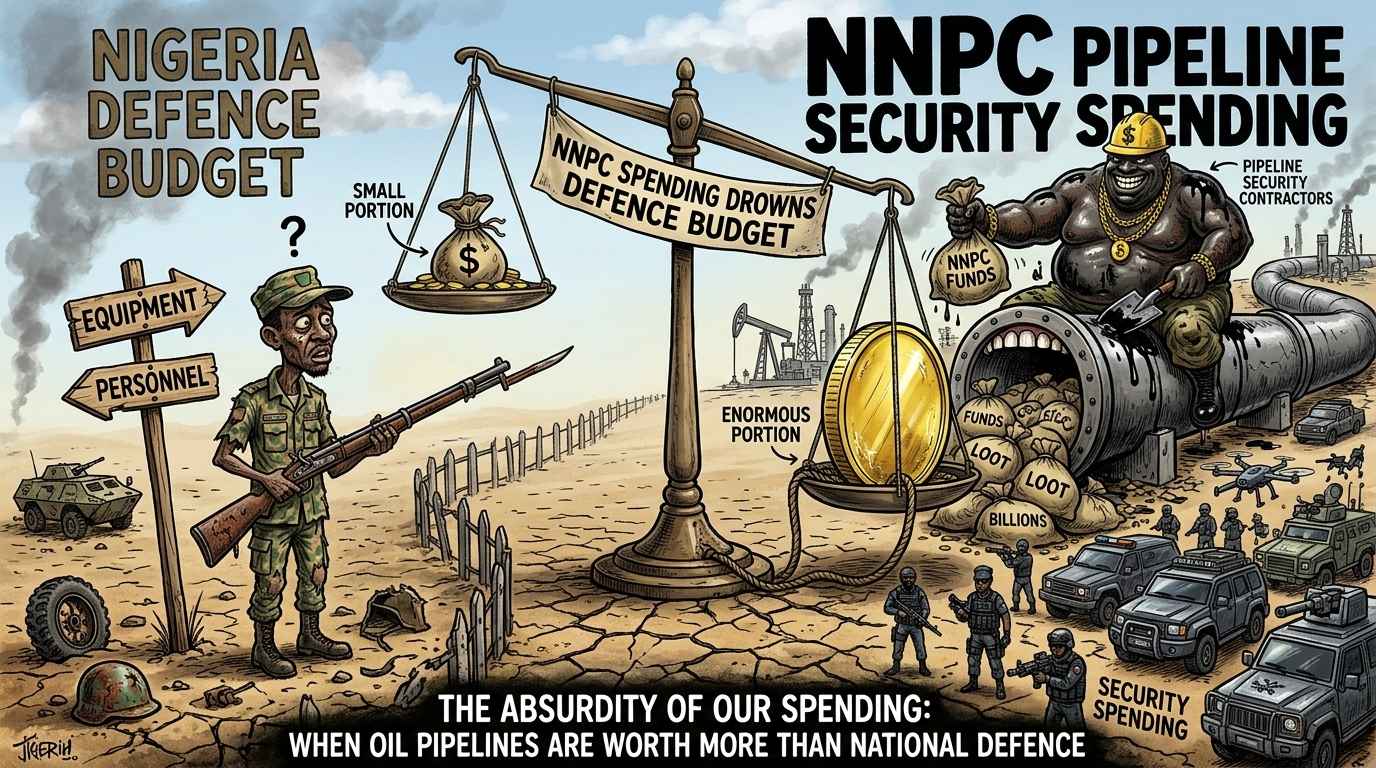
NNPC Pipeline Security vs Nigeria’s Defence Budget: Where Is the Money?
One number is N3.1 trillion and the other is N11.2 trillion. They sit in different books, but when a country’s pipelines appear to cost nearly four times what its army, navy and air force are given, a citizen is allowed to ask a simple question: where is the money?
Imagine a family whose generator guard earns more than the entire food budget. Nobody would need a calculator to start asking questions. That is roughly the mood that greeted a post by Ayodele Babatola, an ADC House of Assembly candidate, who set the Nigeria defence budget beside the NNPC pipeline security figure and let the arithmetic do the shouting. In his words: “Nigeria’s entire 2025 defense budget was 3.1 trillion naira. But the NNPC pipeline security contract stands at 11.2 trillion. 1 pipeline security contract is almost 4 times the entire defense budget of Nigeria.” The comparison needs careful handling, and we will give it that. Even so, the central point survives the careful handling: enormous figures demand scrutiny, questions and accountability, and Nigerians cannot afford to be numb to them.
The Nigeria Defence Budget Against NNPC Pipeline Security: What Was Claimed
Babatola went on to list how the defence money is split. We reproduce his list as he gave it, and we note that we could not find independent coverage of his post or verify each line against the 2025 Appropriation Act. Treat the breakdown as his claim.
Nigerian Army: N1.48 trillion
Nigerian Navy: N442.52 billion
Nigerian Air Force: N376.78 billion
Defence Headquarters: N257 billion
Nigerian Defence Academy: N37.15 billion
National Defence College: N26.58 billion
First R&D Bureau: N10.6 billion
NNPC pipeline security: N11.2 trillion
A quick sum shows his seven defence lines add up to about N2.63 trillion, which leaves roughly N470 billion of the N3.1 trillion in lines he did not list. That is a normal gap in a budget with many small items. A bigger caution is that “defence budget” means different things in different reports. Atiku Abubakar’s camp, as Tribune reported, also uses about N3.1 trillion for the Ministry of Defence in 2025. A Vanguard commentary put the Army, Navy and Air Force figure at under N4.9 trillion, and a Modern Ghana column cited a record N6.57 trillion for defence and security broadly. Even at that widest definition, N11.2 trillion is still about 1.7 times larger. On the N3.1 trillion basis, it is about 3.6 times larger, which makes “almost 4 times” a fair rounding.

What the N11.2 Trillion NNPC Pipeline Security Figure Actually Is
Here is where fairness matters, because the word “contract” carries more certainty than the documents do. According to Punch, as republished by Voice of Nigeria, NNPC’s 2025 audited accounts record N11.2 trillion as “other receivables” from the Federation. The notes describe it as an “advance payment to Federation” and “the security costs incurred in protecting the oil and gas assets.” The same notes say no energy security expense was recognised in 2025, compared with N7.13 trillion in 2024, and that earlier balances were netted against royalties, taxes and dividends due to the Federation by September 2025. In plain language, NNPC is saying the Federation owes it money for costs it carried, and security is part of that.
Oil and gas consultant Chuks Emeka, quoted by Naija News, warned that the figure “should therefore not simply be presented as N11.2 trillion in fresh cash” spent on pipeline security in one year. Atiku’s own statement conceded that the two numbers sit in different accounting categories. So the honest reading is this: N11.2 trillion is a large claim on public funds recorded in NNPCL’s books, partly tied to security costs, and it cannot yet be broken into who was paid and for what. That gap in detail is the story. Vanguard’s commentary noted that NNPC’s 2025 revenue was N34.5 trillion and profit after tax N7.2 trillion, so the security-related balance is about 1.5 times the profit. A company that announces a profit and a security bill larger than the profit, with no line-by-line explanation, is asking the public for trust. Trust in Nigeria has to be earned with documents.
“So the basic question then is, what did you derive from that N11.2 trillion?”
Professor Wumi Iledare, energy economist, on Arise TV, as reported by Naija News
“Security is necessary, but security spending should not become a blank cheque.”
Chuks Emeka, oil and gas consultant, as reported by Naija News
Accountability in Nigeria Starts With Four Plain Questions
Babatola’s questions are the right ones, and they are cheap to answer if the answers exist: who got the contract, what exactly are they being paid to do, where are the results, and why does spending to secure pipelines look like a national emergency while securing Nigerian lives does not? Add the questions raised by Vanguard’s commentary: how much went to private security firms, how much to the military and the NSCDC, how much is overhead, and who audited the security costs? Oil theft and pipeline vandalism are still in the news, so the results are fair game too.
The ADC’s statement went further than budget arithmetic. It named Tantita Security Services as holder of a pipeline security contract and alleged that its founder supports the President’s re-election effort, while asking for disclosure of any contributions by federal contractors. These are allegations raised in a political statement. We found no response from NNPC, the Presidency or the company in the coverage we reviewed, and nothing here establishes wrongdoing by anyone. A lawyer, Ameh Madaki, told Daily Post that the spending could be linked to 2027 election preparations, and Naija News noted that this claim was not independently established. Allegations of that kind should be investigated and answered with documents, and silence only feeds suspicion. Our earlier piece on who is really demarketing Nigeria made a similar point: image problems come from unanswered questions, not from the people asking them.

Alhaji Atiku Abubakar
A former customs officer turned businessman and politician, Atiku has contested the presidency several times. His statement, issued through spokesman Phrank Shaibu, asked, “Where are the results?” and said a government that asks families to make sacrifices “must be willing to account for every naira it claims on public purse.”
Nigeria’s Defence Budget Meets the Battlefield
Meanwhile, soldiers fight insurgents and communities bury their dead. A Daily Trust editorial, drawing on the Open Treasury Portal, reported that of N20.56 billion budgeted for Army security equipment in 2025, only N1.46 billion, or 7.11 percent, had been released by December 31. It also cited former Army chief Abdulrahman Dambazau as saying that only about 40 percent of budgeted funds for recurrent and capital projects are typically released. It added that a BSIL report counted over 10,000 deaths in 2025. Senate defence committee chairman Ahmed Lawan put it plainly, according to Modern Ghana: “You cannot postpone the implementation of the defence budget because that gives an edge to the enemy.”
Read those facts together. The defence allocation is smaller than the NNPC balance, and the defence money that is allocated is not always released. We have traced this pattern in our pieces on worsening insecurity in Nigeria, whether the government is part of the problem and the kidnapping economy. Citizens who pay ransoms, hire private guards and build their own boreholes are running a second security budget out of their own pockets. When a state protects pipelines with the vigour other countries reserve for people, the priorities are on display. If you want another lesson in how big numbers shrink when examined, see the SERAP case on the $460 million CCTV project.
Why a Strong Opposition Party in Nigeria Matters: The ADC Example
This episode is also a lesson on why a healthy opposition matters. A ruling party seldom volunteers a spreadsheet. It is the job of an opposition party, the ADC in this case, to read the audited accounts, ask the awkward questions and put them in front of the public. A Babatola post and an Atiku statement did what a quiet legislature often fails to do: they turned a footnote in a financial statement into a national conversation. Where opposition is weak, accounts get filed and forgotten. Where it is strong, numbers get compared and officials get asked to explain.
Fairness cuts both ways. An opposition has electoral motives, and citizens should read its statements with the same sharp eye they turn on the government. The test of a good opposition is whether it asks for documents, keeps asking after the headline fades, and holds itself to the same standard on the day it wins power. We asked similar questions about weak checks and balances in whether Nigeria is a democracy or a kakistocracy in robes and in the legal basis for electoral malpractice. A democracy needs referees, and an opposition is one of them.
A government that asks you to sacrifice owes you receipts. An opposition that asks for those receipts is doing its job, and a citizen who repeats the question is doing theirs.
Anuoluwa Soneye, NarrivonAccountability in Nigeria Is Every Citizen’s Business
It is tempting to treat trillions as numbers too large to feel. Do not. These are public funds, and public funds are our petrol, our hospitals, our schools, our roads and our safety. Every naira spent without explanation is a naira that could have turned into better and more sustainable living for ordinary Nigerians, and every naira that vanishes into a few pockets is paid for by the rest of us, directly through taxes and indirectly through the cost of everything. Our pieces on the mismanagement of public funds, understanding corruption in Nigeria and how corruption compromises Nigerians show the same pattern from different angles.
Accountability is a habit, and habits are built by repetition. Read the headline, ask for the document, share the figure with your family group chat, raise it at the town hall and at your next community meeting, and vote with the answer in mind. We have also argued before that the docility of Nigerians is costing us everything and that impunity in Nigeria feeds on silence. Numbness is how big numbers get away.
Accountability in Nigeria Is Heavy Work, So Rest Well
Chasing answers about trillions is tiring work, and many Nigerians are already stressed, short on sleep and carrying more worry than one head should hold. So take a pause. Put on headphones, press play, close your eyes and let these calming sounds slow your breathing. A rested citizen asks sharper questions. If your stress feels heavy or lasts for weeks, please speak with a doctor or a trusted person as well.
Nigeria Defence Budget and NNPC Pipeline Security: Demand the Answers
Let us gather the threads. The defence allocation and the NNPC balance sit in different books, and the labels need to be accurate. The N11.2 trillion is a receivable in NNPCL’s 2025 accounts, with security costs as part of its description, and the public still has no line-by-line account of who was paid and what was delivered. Babatola’s instinct is right even where his shorthand is rough. Enormous figures require scrutiny, and the burden of proof sits with those who hold the money.
Becoming better citizens, people who do right, think right, act right, speak up and actively participate, and who have the guts to demand for more, is a step toward the Nigeria of our dreams. Start with one question this week: where is the money? Ask it of your representative, your party, your local government and yourself. A Nigeria where the answer arrives with documents is a Nigeria worth building, and we will not build it by staying numb.
Frequently Asked Questions About the Nigeria Defence Budget and NNPC Pipeline Security
Is the N11.2 trillion a pipeline security contract?
It appears in NNPCL’s 2025 audited accounts as “other receivables” from the Federation, described as advance payment and security costs incurred in protecting oil and gas assets. Critics call it pipeline security spending, but the accounts do not show a single contract or a breakdown of who was paid.
How big was Nigeria’s defence budget in 2025?
Atiku’s camp and Babatola use about N3.1 trillion for the Ministry of Defence. Other reports use wider figures, including under N4.9 trillion for the three services and N6.57 trillion for defence and security broadly. The definition matters when comparing.
Has NNPC responded to the criticism?
The coverage we reviewed carried only NNPCL’s description in its accounts, which says the balances relate to advances to the Federation and security costs, and that no energy security expense was recognised in 2025. We found no direct reply to the questions about who was paid and the allegations about contractors.
Why does a strong opposition matter for accountability?
Opposition parties read the accounts, ask questions and give citizens a second source of information. Without them, large figures in financial statements often pass unnoticed. Citizens should still read opposition claims critically.
Sources and Further Reading:
Atiku questions NNPC pipeline security spending (Tribune, October 2026) •
ADC statement on the N11.2 trillion (Peoples Gazette, October 2026) •
Atiku demands details of N11.2tn NNPC receivables (Arise) •
NNPC’s oil security claims rise to N11.2tn (Punch via Voice of Nigeria) •
Who can explain NNPC’s N11.2trn security bill? (Vanguard, October 2026) •
Experts question NNPCL’s N11.2 trillion pipeline security spending (Naija News, October 2026) •
A war budget that fails troops (Daily Trust, April 2026) •
Nigeria’s defence budget: trillions spent, security still broken (Modern Ghana) •
Defence, Special Operations get N3.15trn in 2026 budget (Vanguard)