
The $460 Million CCTV Project: Nigeria Borrowed the Money, Lost the Cameras, and Cannot Find the Paper Trail
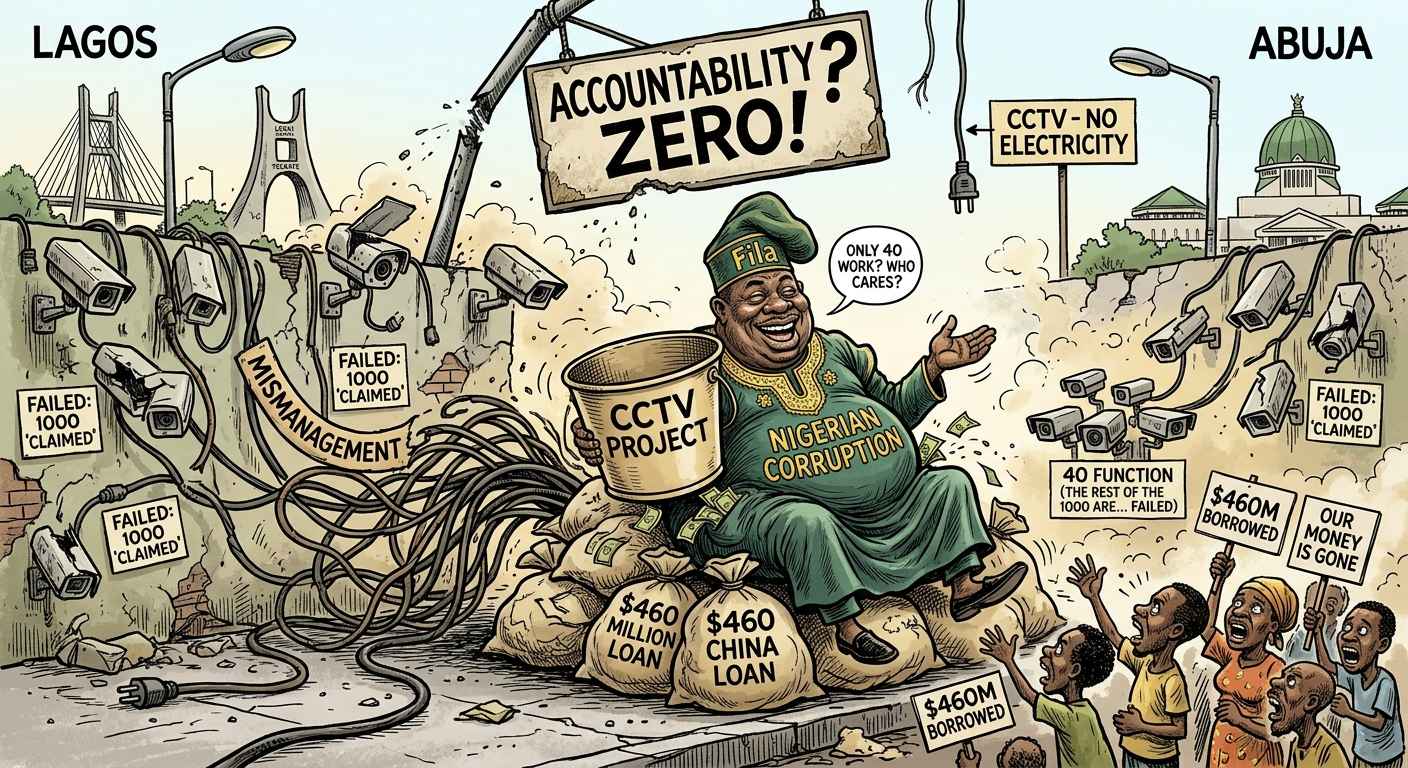
In 2010, Nigeria signed a contract to install 1,000 CCTV cameras across Abuja, financed by a loan of roughly $460 million from China. Today, only 40 of those cameras work. The other 960 sit dead in plastic boxes across the city, killed by a government that never funded their electricity or maintenance. In May 2026, after a court order and years of stalling, the Ministry of Finance finally responded to a transparency lawsuit with a single, almost unbelievable sentence: it does not know who the contractors were. Nigerians are still repaying the loan.
There is a particular kind of Nigerian public project that manages to fail in every direction simultaneously, technically, financially, and administratively, and still somehow keeps generating a monthly bill. The Abuja CCTV scandal is the platonic ideal of this category. It is not simply a story about broken cameras. It is a story about a sovereign government borrowing $460 million in the country’s name, watching the resulting infrastructure die within a couple of years of installation, and then, sixteen years later, telling a federal court it genuinely cannot locate the records showing who the money went to. This is not corruption in the abstract. This is corruption you can watch decompose in real time, standing in a plastic box on an Abuja street corner, still costing Nigerians money every single month it continues not to work.
The National Public Security Communication System and the $460 Million Question
The project has a formal name almost nobody uses: the National Public Security Communication System. It was conceived under President Umaru Yar’Adua following a 2008 visit to China, and the contract was formally signed in August 2010 under President Goodluck Jonathan’s administration, after then-Finance Minister Olusegun Aganga led a delegation to Beijing. The contract was awarded to Chinese telecommunications firm ZTE Corporation at a total cost reported across various official and legislative sources as between $460 million and $470 million, financed through an 85 percent loan facility from the Export-Import Bank of China, worth $399.5 million, with Nigeria providing the remaining 15 percent, roughly $70.5 million, as counterpart funding. The loan carried a 3 percent interest rate over a 10-year repayment window. The stated purpose was to give security agencies real-time video and data communication across Abuja and Lagos to fight terrorism, armed robbery, and kidnapping.
The project’s preliminary acceptance test was conducted in December 2012, meaning the government formally signed off on it as functionally complete. What that acceptance actually delivered became clear when the House of Representatives Committee on Internal Security and Intelligence physically visited the intended monitoring centre at the Nigeria Police Headquarters in Abuja. Committee members were reportedly shocked to discover that out of the 1,000 cameras imported for the project, only 40 were actually online, while the remaining 960, according to the police officers manning the centre, were simply “down” or had been vandalised. Committee member Tony Nwulu described the outcome bluntly, saying the project appeared “planned to fail from the beginning because from all indications, all the components didn’t do the right thing.”

The $460 Million CCTV Project Failed Because Nobody Budgeted for Electricity
The specific mechanism of failure here deserves attention because it is so mundane it becomes almost comic. According to Ahmed Rufai, former Director General of the Nigerian Communications Satellite Limited (NigComSat), the agency that served as consultant on the project, the system was not undermined by a single dramatic act of theft. It was undermined by the government’s failure to fund its ongoing electricity and maintenance costs after installation. The required monthly operational budget for the system, as of 2012, was estimated at approximately N11 billion, later revised downward to around N5 billion, a figure the government still failed to consistently provide. A $460 million security infrastructure project, built with borrowed money at interest, was allowed to die because nobody kept paying the electricity bill. The Bureau of Public Procurement’s own former Director-General, Emeka Eze, additionally confirmed that the contract was awarded without the mandatory Certificate of No Objection that due process requires, meaning the entire arrangement bypassed standard procurement safeguards from the outset.
What remains today, according to reporting by the International Centre for Investigative Reporting, are literal carcasses: cameras, cables, batteries, and solar panels stripped by vandals across multiple sites in and around Abuja, with almost none of the original installations surviving intact. As we documented in our examination of budget mismanagement in Nigeria, this pattern, a project completed on paper, celebrated at commissioning, and then quietly starved of the maintenance funding needed to keep functioning, is not unique to CCTV cameras. It is a structural feature of how Nigerian public infrastructure spending routinely operates, front-loaded on capital expenditure and abandoned the moment recurrent funding becomes politically less exciting.
We can conclude that Nigeria is a crime scene where the perpetrators have a track record of walking out unscathed
Anuoluwa Soneye, NarrivonSERAP’s CCTV Court Case Forces the Question Nigeria Kept Avoiding
The Socio-Economic Rights and Accountability Project, a Lagos-based advocacy organisation, did what Nigeria’s own legislature had failed to accomplish across at least three separate House of Representatives probes dating back to 2016: it took the matter to a court with actual enforcement power. On May 15, 2023, Justice Emeka Nwite of the Federal High Court ordered the Ministry of Finance to disclose the total amount paid under the $460 million Abuja CCTV loan, the identities of both the local and Chinese contractors who received the funds, the implementation status of the project, and related details concerning a separately reported N1.5 billion payment linked to the Code of Conduct Bureau headquarters project.
2010: Contract signed with ZTE Corporation, financed by a $399.5 million China Exim Bank loan plus $70.5 million Nigerian counterpart funding
December 2012: Preliminary acceptance test conducted, system declared complete
2016 to 2019: At least three separate House of Representatives investigations, none producing a public report
May 15, 2023: Federal High Court orders the Ministry of Finance to disclose full contractor details and payment records
January 2026: SERAP forced to initiate formal contempt proceedings and serve a Notice to Show Cause after nearly three years of non-compliance
May 15, 2026: Ministry of Finance finally responds, stating it has no detailed subcontracting records identifying which local companies received funds
The Ministry’s actual response, dated May 15, 2026, and signed by Permanent Secretary R.O. Omachi, is worth quoting directly because paraphrasing risks softening how remarkable it is: “Records from the Ministry of Police Affairs indicate that while local subcontractors may have been engaged, there is an absence of detailed subcontracting records identifying specific local companies that received funds directly from the Chinese loan.” Sixteen years after the contract was signed, and three years after a federal judge ordered full disclosure, the sovereign government of Nigeria’s official position is that it cannot say, with any specificity, who received the Nigerian people’s borrowed money.
“We are concerned that although the judgment was delivered in May 2023, the Ministry only released some information after we commenced contempt proceedings and served a Notice to Show Cause in January 2026. Nigerians still do not know exactly the names of local contractors for the project. The absence of this information raises serious concerns about record keeping, transparency and accountability, and whether the project was implemented in a manner consistent with the public interest.”
SERAP, statement by Deputy Director Kolawole Oluwadare, May 2026
The $460 Million CCTV Loan Is Still Being Repaid by Citizens Who Never Saw a Working Camera
Here is the part of this story that turns it from an embarrassing footnote into an active, ongoing cost. The China Exim Bank loan was structured for repayment over 10 years at 3 percent interest, calculated against the prevailing exchange rate at the time of each instalment. That repayment obligation did not pause because the cameras stopped working. It did not pause because the House of Representatives investigated the matter three separate times without producing a report. It did not pause because a federal court found the Ministry of Finance in breach of a disclosure order. Nigeria’s external debt servicing obligations are paid out of the federal budget, funded ultimately by the same citizens who cannot point to a single functioning camera on their street that this specific loan was supposed to install. As we detailed in our broader analysis of the true cost of corruption in Nigeria, this is the precise mechanism by which mismanagement converts into hardship: a specific, named debt obligation, serviced monthly, in exchange for a specific, named piece of public infrastructure that was allowed to die within roughly two years of being switched on.
The absurdity compounds further when you consider what a functioning version of this system might actually have delivered. A real-time CCTV and communications network across Abuja, properly maintained, could have provided law enforcement with exactly the kind of surveillance infrastructure that cities battling insecurity, kidnapping, and terrorism genuinely need. As we have documented extensively in our coverage of Nigeria’s insecurity crisis, the country has spent years searching for tools to address exactly the categories of crime this system was explicitly designed to help combat. Instead of that tool, Nigeria got a $460 million line item on its external debt schedule and 960 dead cameras standing as monuments to a maintenance budget that was never approved.
The Abuja CCTV Scandal Demands More Than Another Committee Probe
This is not a complicated case requiring forensic reconstruction of ancient events. It is a loan, from a specific bank, for a specific contract, with a specific contractor, ZTE Corporation, whose identity was never actually in dispute. What SERAP’s court case has exposed is something narrower and more damning: that the Nigerian government cannot, or will not, produce the subcontractor-level records showing exactly which local companies and individuals received the money that flowed through this arrangement. A government that can track a citizen’s tax remittance to the naira cannot locate the paper trail for $460 million of its own borrowed funds. That is not an accident of poor record-keeping. It is, at minimum, a symptom of a system where the absence of documentation has become a convenient and consequence-free outcome.
At Narrivon, we believe the Nigeria of our dreams requires citizens who do right, think right, act right, and refuse to let a court-ordered disclosure be quietly satisfied with the answer “we don’t know.” SERAP has done the hard, unglamorous work of forcing this admission into public record. What happens next, whether the contempt proceedings actually produce named contractors, recovered funds, or any consequence whatsoever, depends on whether Nigerians treat this the way they have treated so many similar revelations before it: with a week of outrage and then silence. The cameras are still dead. The loan is still being repaid. And somewhere in a filing cabinet that apparently does not exist, the names of the people who were paid $460 million for cameras that do not work are still waiting to be found.
Frequently Asked Questions About the Abuja CCTV Scandal
What is the Abuja CCTV scandal about?
In 2010, Nigeria’s government under President Goodluck Jonathan signed a contract with Chinese firm ZTE Corporation for the National Public Security Communication System, a CCTV and communications network for Abuja and Lagos, at a total cost reported between $460 million and $470 million. The project was financed primarily through a loan from the Export-Import Bank of China. After a preliminary acceptance test in December 2012, investigations by the House of Representatives found that out of 1,000 installed cameras, only 40 were functional, with the remaining 960 either non-operational or vandalised.
Why did the CCTV cameras stop working?
According to former NigComSat Director General Ahmed Rufai, who served on the project’s management team, the system failed primarily because the federal government did not provide the required ongoing operational funding, estimated at approximately N11 billion monthly in 2012, needed to power and maintain the cameras after installation. The Bureau of Public Procurement also confirmed the original contract was awarded without the mandatory Certificate of No Objection, meaning it bypassed standard procurement safeguards.
What did SERAP’s court case against the Ministry of Finance achieve?
On May 15, 2023, Justice Emeka Nwite of the Federal High Court ordered the Ministry of Finance to disclose the total amount paid under the CCTV loan, the identities of local and Chinese contractors, the project’s implementation status, and related payment details. The Ministry did not comply until SERAP initiated contempt proceedings and served a Notice to Show Cause in January 2026. In a letter dated May 15, 2026, the Ministry finally responded that it had no detailed subcontracting records identifying which specific local companies received funds directly from the Chinese loan, though it acknowledged local subcontractors “may have been engaged.”
Is Nigeria still repaying the CCTV loan?
Yes. The loan from the Export-Import Bank of China, reported at $399.5 million out of the total $470 million project cost, was structured for repayment over 10 years at a 3 percent interest rate. This repayment obligation, serviced through Nigeria’s external debt servicing budget, continues regardless of the project’s operational failure, meaning Nigerian taxpayers continue funding a loan for infrastructure that has been largely non-functional for over a decade.
Sources and Further Reading:
$460 million Abuja CCTV scandal: Tinubu govt says it has no records of local contractors (SaharaReporters, May 2026) •
SERAP insists on full disclosure on $460m Abuja CCTV project (Ripples Nigeria, May 2026) •
$460m Abuja CCTV project: FG can’t identify Nigerian contractors (The Whistler) •
Finance Ministry lacks records of local contractors, SERAP threatens contempt action (Freedom Online, May 2026) •
The $470 Million Abuja CCTV Scandal (AllAfrica, October 2025) •
The $470 Million Abuja CCTV Scandal (ThisDay) •
Relics of a N76bn project: Seven spots in Abuja where CCTV cameras are not working (The ICIR) •
Abuja $470m CCTV camera project lies in ruins (Guardian Nigeria)