
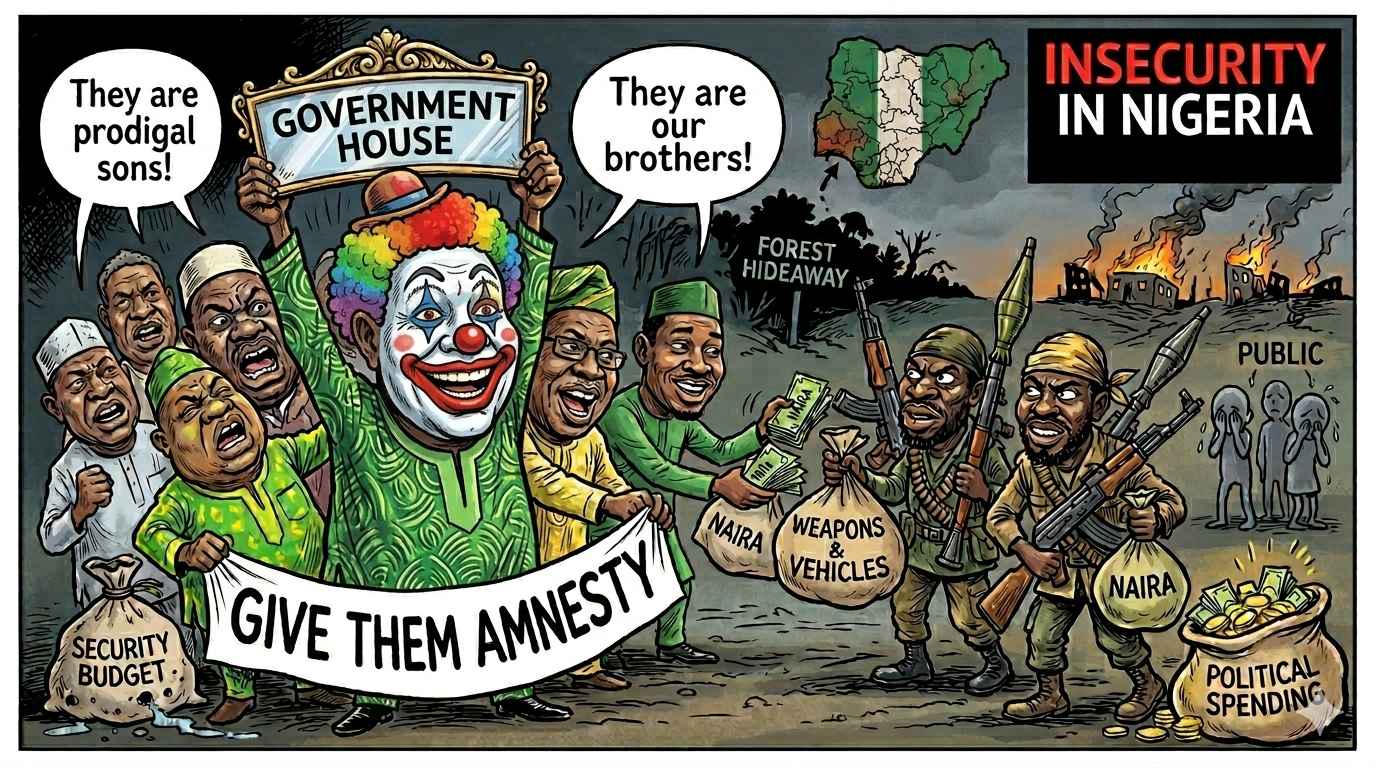
Kidnapping in Nigeria: How Bad Is Nigeria’s Insecurity Situation and Who Is the Government Actually Protecting?
A mathematics teacher named Michael Oyedokun went to work in Oyo State and was beheaded on camera. His colleagues are still in captivity. Children who came to school that morning are still missing. And the National Security Adviser of the Federal Republic of Nigeria has called the people who did this “our brothers.” This is the state of kidnapping in Nigeria in 2026. And the most alarming part is not the violence. It is the official language used to describe the people committing it.
Nigeria’s insecurity crisis has a body count, a timeline, and a pattern. But it also has something more troubling: a cast of government officials who speak about the perpetrators of this violence with the warmth of men describing distant relatives who have gone astray rather than armed criminals running multi-state kidnapping networks and killing teachers in front of their pupils. This article is about both things. It is about what is happening on the ground to ordinary Nigerians. And it is about what is being said, from the highest offices in the land, about the people doing it. Because insecurity in Nigeria cannot be understood only through the body count. You have to understand it through the body language of the people who are paid to end it and who keep finding other things to say.
The Kidnapping of Oyo Schoolteachers and Children: What Happened and Who Is Still Missing
On May 16, 2026, armed bandits raided three schools in the Ahoro-Esinele and Yawota communities in Oriire Local Government Area, Oyo State. Three Community Grammar School, Baptist Nursery and Primary School, and L.A. Primary School were all hit in the same coordinated attack. A total of 32 people were abducted, including 18 primary school pupils, 7 secondary school students, and 7 teachers. One of those teachers, a mathematics teacher named Mr Michael Oyedokun, was beheaded in a video that circulated online the following day. Governor Seyi Makinde of Oyo State confirmed the killing. Six suspects were subsequently arrested. But arrests are not the same as rescue.
As this article is written, the school principal, Mrs Alamu, is still in captivity. She appeared in a video begging Nigerians, the government, the Christian Association of Nigeria, and anyone listening to please help get them out. A teacher named Dahunsi Temitope Mary appeared in the same video, adding her own voice to the same desperate appeal. One of the kidnapped schoolteachers in Oyo was reportedly backing an infant child when she was taken. Another teacher had just returned from a meeting before the attack struck. These are not statistics. They are parents, educators, and citizens who went to work and have not come home. The Oyo teachers protest in Ibadan that followed, as families and colleagues took to the streets demanding urgent action, was the sound of people who had realized that waiting quietly was not producing results. They were right to march. The results have still not arrived.
Kidnapping in Nigeria has become so normalized that a teacher can be beheaded on camera, children can disappear from a school compound, and the story trends for 48 hours before the timeline moves on. The families do not have a timeline to move on to.
Anuoluwa Soneye, NarrivonA Timeline of Mass Kidnapping in Nigeria: From Chibok to the Present
Kidnapping in Nigeria entered global consciousness in April 2014 when Boko Haram abducted 276 schoolgirls from Government Secondary School, Chibok, Borno State. That event produced a global campaign, a hashtag, and a moment of worldwide solidarity. More than 100 of those girls remain unaccounted for as of 2026. That is not a figure from a news ticker. That is over a hundred human beings, women now, who have been in terrorist captivity for over twelve years. And during those twelve years, Nigeria’s kidnapping crisis did not stay in Chibok. It spread.
In February 2018, Boko Haram descended on Government Girls Secondary School, Dapchi, Yobe State, and took approximately 110 girls. Amnesty International confirmed that Nigerian security forces had received at least five advance warnings of the attack and failed to respond in time. One girl, Leah Sharibu, remains in captivity today, over eight years later, because she refused to convert to Islam. In December 2020, bandits abducted 344 students from Government Science Secondary School, Kankara, Katsina State, returning them after a ransom process. In March 2021, 279 students were abducted from Government Girls Secondary School, Jangebe, Zamfara State. In November 2025, over 300 students were abducted across multiple schools in Niger State in one of the largest mass school kidnapping in Nigeria events in the country’s history. AFP later reported that approximately $7 million was paid for the release of the Niger State pupils, a figure the Nigerian government denied but did not conclusively disprove.
Abductions in Nigeria Are Part of a Wider Pattern of Mass Killings Nobody Is Accounting For
Abductions in Nigeria do not happen in isolation. They are part of a broader security collapse that includes mass killings of civilians across multiple states with a frequency that has become, for many Nigerians, simply the background noise of daily life. In June 2022, gunmen stormed St. Francis Catholic Church in Owo, Ondo State, during a packed Pentecost Sunday service and killed at least 40 worshippers, many of them children. In July 2022, ISWAP and Boko Haram affiliated fighters attacked Kuje Medium Security Custodial Centre in Abuja, Nigeria’s capital, freeing approximately 879 inmates including 64 confirmed Boko Haram members. In June 2025, over 300 people were killed in a single night in Yelewata, Benue State. In March 2026, at least 51 people were killed in the Palm Sunday massacre at Angwan Rukuba, Jos, Plateau State. In February 2026, more than 160 people were killed in Muslim-majority villages in Kwara State. The NBS documented over 614,000 Nigerians killed in a single year between May 2023 and April 2024. Six hundred and fourteen thousand. In one year. That number is not a figure. It is a catastrophe wearing a number’s clothing.
The response to each of these events has followed what Nigerians have learned to call the cycle: attack, condemnation, promise, silence. Repeat. The president met the victims of the Jos massacre at the airport rather than at the site of the killings. Condolence visits are conducted from the safe distance of motorcades. Press statements are issued. Investigations are promised. And then the next attack comes, and the cycle begins again, while the perpetrators of the previous attack enjoy the space that the absence of consequence creates.
“Every time you see a terrorist or a bandit, remember that behind every gun is a child who was once a victim of neglect, inequality, and broken systems. That does not excuse what they do. But it explains what we failed to prevent.”
Human rights advocate framing widely circulated in Nigeria, 2025. Note: This framing has been used to justify dialogue. Critics argue it has also been used to delay accountability.
Nigeria’s Insecurity Problem Has Champions in Government: The Men Who Defend the Bandits
Mallam Nuhu Ribadu
Nuhu Ribadu was once the most feared anti-corruption official in Nigeria. As EFCC chairman, he prosecuted governors, senators, and businessmen with a ferocity that made him famous. He was supposed to be one of the good ones. Then he became National Security Adviser and, in March 2026, a video went viral. In it, Ribadu is heard saying: “Whether we like it or not, there are terrorists in Nigeria who want peace. They are our brothers. We must…” Those five words, “they are our brothers,” landed in the national conversation like a match thrown into a petrol station. This was the same period during which Nigerian families were burying children killed in attacks, communities in the north were counting their dead from bandit raids, and the government was still unable to account for what had happened to the remaining Chibok girls. For Ribadu to describe these bandits and terrorists as “our brothers” was not just a bad word choice. It was a window into an official worldview. The ADC (African Democratic Congress) condemned the statement, noting that such remarks “reflect a dangerous mindset that accommodates and tolerates criminality instead of confronting it.” Ribadu had also been identified by Vanguard as the major negotiator in the government’s response to the Niger State kidnapping, in which AFP alleged $7 million changed hands. He has denied wrongdoing.
General Olufemi Olatunbosun Oluyede
General Oluyede did not wait for a microphone to be thrust at him. He chose a formal occasion, the inaugural lecture of the Joint Doctrine and Warfare Centre in Abuja in March 2026, to deliver what may be the most memorable contribution to the official language of Nigerian insecurity response. He compared terrorists to the biblical prodigal son, arguing: “People are asking why we are not killing terrorists even if they have killed others. Well, even in the Bible, the prodigal son was given a chance, so we should give terrorists a chance to repent.” He also referred to terrorism as an “adventure,” a word choice that the families of the 300+ people killed in Yelewata in June 2025 might find instructive. One month after his prodigal son sermon, 744 former terrorists graduated from the Operation Safe Corridor programme in Gombe with certificates, speeches, and state resources. The Borno communities whose families were killed by these same graduates received no equivalent ceremony.

And then there is the Chief of Army Staff, Lieutenant General Waidi Shaibu, who, when asked about the reintegration of repentant Boko Haram members, said: “The terrorists are our sons.” Our sons. Not victims. Not threats. Sons. The same sons who burned churches, kidnapped children, raped women, and killed soldiers. Three of Nigeria’s most senior security figures, the National Security Adviser, the Chief of Defence Staff, and the Chief of Army Staff, have used familial language to describe the people responsible for the bloodiest period of civilian casualties in modern Nigerian history. As Narrivon has previously explored, the question this raises is not rhetorical. It is structural: if those in charge of ending the violence describe its architects as family, whose interests are they serving?
Nigeria’s Rising Insecurity Gets Civil Society Cover: When NGOs Sound Like the Government
The official enthusiasm for rehabilitation extended beyond the military and security establishment. A civil society organization, the National Initiative for Peace and Security (NIPS), stepped into the conversation around Operation Safe Corridor with a statement that many Nigerians found striking. In a video circulated on social media, a NIPS representative was recorded saying: “The truth is that the terrorists are one of us before they were confused because of situations and circumstances.” NIPS positioned itself as an organization involved in monitoring rehabilitated terrorists and defending the Safe Corridor programme.
Civil society organizations exist, in democratic theory, to hold governments accountable and protect the interests of ordinary citizens. When a CSO’s most prominent contribution to the national insecurity debate is a defence of the people who have been kidnapping, killing, and burning down communities, the question of who such organizations are serving becomes urgent. The families of the Oyo kidnapping victims were not invited to participate in the NIPS statement. The survivors of the Yelewata massacre were not consulted. The “confusion” framing for terrorism, the idea that terrorists are simply misguided community members who can be educated back to civility, may have theoretical merit in an academic context. Deployed in the middle of an active kidnapping crisis, with children still in captivity and a beheaded teacher’s family still in mourning, it communicates something specific and alarming: that the ecosystem of official and semi-official voices around this government is pointing in a direction away from the victims and toward the perpetrators.
Sheikh Gumi, as we have documented in detail, has been the loudest civilian voice in this direction for years. In May 2026, he called on the government to grant blanket amnesty to bandits. In March 2026, he disclosed on camera that the government knows the names and locations of terrorists. He has been repeatedly invited into rooms of power and continues to operate freely despite calls from human rights organizations for scrutiny of his advocacy. Taken together, these voices, the NSA, the CDS, the Army Chief, the CSOs, and Sheikh Gumi, form a chorus that has a consistent melody: the bandits are people too. We should talk to them. We should rehabilitate them. We should understand them. And what the families of Michael Oyedokun, Leah Sharibu, and the Oyo school children hear when that chorus plays is something very different: we matter less to this government than the people who are killing us.
Nigeria’s Insecurity Is Real. So Is What the Soldiers Fighting It Are Being Paid.
Here is the final piece of this picture. While Nigeria’s insecurity in Nigeria consumes government attention and produces lavish rehabilitation programmes for insurgents, the men and women actually deployed to fight these insurgents, the frontline soldiers in Borno, Zamfara, Plateau, and elsewhere, are operating in conditions that Justice Crack was allegedly arrested for describing. As we covered in detail in our piece on Justice Mark Chidiebere’s military arrest, a social media activist posted a video about soldiers’ poor feeding conditions and was allegedly chained to a tree for 72 hours, before being arraigned in court on charges of distributing false information. The soldiers were still eating the same food.
Nigerian Army privates earn basic salaries ranging from approximately N30,000 to N50,000 per month at lower grades. They are deployed into some of the most dangerous security environments in Africa. Their barracks in several states have been reported in deplorable condition. Welfare allowances for families of killed soldiers have in documented cases been delayed for months or years. And the rations that soldiers complained about, the same rations that triggered Justice Crack’s arrest, remain a documented concern. As we have previously noted, Nigeria’s most sophisticated police equipment and best-resourced security details are not assigned to fight insecurity. They guard politicians. The hungry soldier is fighting the war. The well-fed convoy is attending the commissioning ceremony.
Nigeria’s government pays millions to rehabilitate ex-terrorists and allegedly millions more to ransom their victims. The soldiers fighting them earn N30,000 a month and eat food that cannot be discussed publicly without someone getting arrested. This is not a security policy. It is an accounting scandal.
Anuoluwa Soneye, NarrivonKidnapping in Nigeria Will Not End Until Nigerians Demand That It Does
Nigeria’s insecurity has survived more declarations of war than most countries have fought. It has survived emergency proclamations, security summits, military offensives, reintegration programmes, ransom payments, and ceasefire negotiations. What it has not survived is sustained, organized, loud, informed civic pressure from the people it is directly harming. Because the people it is directly harming have, in too many cases, accepted the official framing: that this is complex, that the bandits are “confused,” that the brothers must be given a chance, that the prodigal sons deserve a graduation ceremony.
Michael Oyedokun deserved more than a viral video and 48 hours of outrage. Mrs Alamu, still in captivity as this article is written, deserves more than a begging video. The children taken from those three Oyo schools deserve more than condolences and a promise. The docility that allows this government’s response to the insecurity crisis to go effectively unchallenged is not a neutral posture. It is a choice that costs lives.
At Narrivon, we believe that the most powerful tool available to ordinary Nigerians right now is the refusal to accept the official framing. The bandits are not our brothers. They are criminals who have killed, kidnapped, and terrorized citizens who were simply trying to live their lives. Their rehabilitation might have merit as a long-term strategy if it were paired with adequate security, genuine justice for victims, and treatment of the soldiers fighting them as the heroes they are rather than the inconveniences they appear to be. Right now, none of those conditions exist. What exists is a government that moves faster to arrest the person who films soldiers’ food than to find the children who went to school in Oyo and never came home.
That cannot be the end of the conversation. Share this article. Name the names. Ask the questions. Demand the answers. And do not stop until the people who call terrorists our brothers understand that the people voting for them call them their government. And governments are accountable to the governed.
Frequently Asked Questions About Kidnapping in Nigeria and Nigeria’s Insecurity
What happened with the Oyo State teacher kidnapping in May 2026?
On May 16, 2026, armed bandits attacked three schools in Oriire LGA, Oyo State, abducting approximately 32 people including 18 primary pupils, 7 secondary students, and 7 teachers. Mathematics teacher Michael Oyedokun was beheaded in a video circulated online on May 17. Governor Seyi Makinde confirmed the killing and police arrested six suspects. School principal Mrs Alamu and teacher Dahunsi Temitope Mary appeared in videos begging for help from captivity. Multiple victims remain unaccounted for as of this writing.
What did NSA Nuhu Ribadu say about terrorists?
In a video that went viral in early March 2026, National Security Adviser Nuhu Ribadu was heard saying: “Whether we like it or not, there are terrorists in Nigeria who want peace. They are our brothers.” The statement was confirmed by multiple Nigerian news outlets and a YouTube video posted on March 3, 2026. The African Democratic Congress condemned the remark, saying it “reflects a dangerous mindset that accommodates and tolerates criminality.” Ribadu has argued his position advocates for a non-kinetic approach to ending insurgency.
What is Operation Safe Corridor and how much did it cost?
Operation Safe Corridor is Nigeria’s federal de-radicalisation, rehabilitation and reintegration programme for repentant terrorists, established in 2016. In April 2026, 744 former Boko Haram members and other insurgents graduated from the programme in Gombe State, bringing the total rehabilitated to approximately 2,190. The programme involves months of psychosocial support, vocational training, and religious reorientation at state expense. Critics argue the resources directed at rehabilitating insurgents dwarf those directed at compensating or supporting their victims.
How bad is kidnapping in Nigeria in 2025 and 2026?
Between July 2024 and June 2025, approximately 4,722 people were kidnapped in Nigeria according to SBM Intelligence. The NBS documented over 614,000 Nigerians killed in the single year between May 2023 and April 2024. In November 2025, over 300 students were abducted across Niger State schools. In May 2026, teachers and children were abducted from three Oyo State schools, with one teacher beheaded. The crisis spans the North-West, North-East, North-Central, and increasingly southern states.
Sources and Further Reading:
Bandits behead abducted Oyo teacher Michael Oyedokun (The Punch, May 2026) •
Oyo school kidnap horror sparks outrage (Guardian Nigeria, May 2026) •
Nigeria Security Chief Nuhu Ribadu Calls Some Terrorists ‘Our Brothers’ (YouTube, March 3, 2026) •
Ribadu tags killings in North ‘family affair’, calls terrorists ‘our brothers’ (Parallel Facts, March 2026) •
ADC slams NSA, Army chief over treating terrorists as brothers, sons (Politics Nigeria, March 27, 2026) •
Ribadu confronts rising criticism over terror talks (Truth Nigeria, March 2026) •
Nigerian forces failed to act on Dapchi abduction warnings (Al Jazeera, March 2018) •
FG rehabilitates 744 repentant terrorists (PR Nigeria, April 2026) •
Chibok schoolgirls kidnapping (Wikipedia)