The Electoral Act 2026: Nigeria Did Not Accidentally Write a Rigging Manual
The Electoral Act 2026 was passed by both chambers of the National Assembly on February 17, 2026. President Tinubu signed it into law the very next day. A law that took two years to debate was signed in under 24 hours. The question is not why the rush. The question is what, exactly, was being rushed into law. Three specific sections have the answer. And the answer is not comfortable reading.
Here is a useful way to read any new electoral law in Nigeria. Do not start with the good provisions. Start with the ones that are hard to explain. Start with the sections that, when you read them carefully, produce not clarity but a nagging sense that someone in the drafting room knew exactly what they were doing. The Electoral Act 2026 has three such sections. They were identified by a former Resident Electoral Commissioner of INEC, a man who has spent decades working inside the electoral system and who, by his own account, had disengaged from electoral debates out of pure disappointment, until he read the new law. When he emerged from that reading, he called what he found “the three most dangerous provisions” in Nigerian electoral history. His name is Mike Igini. His credentials are impeccable. And what he found in Sections 63, 137, and 138 of the Electoral Act 2026 is what this article is about.
Tinubu Signs the Electoral Act 2026: What the Ceremony Looked Like and What It Left Out
On February 18, 2026, at about 5:00 p.m., President Tinubu sat in his first-floor office at the State House in Abuja and signed the Electoral Act 2026 into law. The ceremony was described by the State House as a “landmark legislation” marking “a significant milestone in the administration’s commitment to delivering more transparent, credible, and technologically advanced elections.” Senate President Godswill Akpabio was there. Speaker of the House Tajudeen Abbas was there. Deputy Speaker Benjamin Kalu was there. Chief of Staff Femi Gbajabiamila was there. Everyone who needed to be present to make this moment look like progress was present.
The president said, during the ceremony: “By assenting to this Bill, we are reinforcing the foundations of our democracy. We are ensuring that the voice of every Nigerian is not only heard but accurately recorded and protected by the law.” He also said, on the matter of how results would be transmitted: “For final results, you are not going to be talking to the computer.” Which is, in itself, a phrase worth keeping.
What the ceremony did not include: a reading of Sections 63, 137, and 138. What it did not include: a mention of the opposition lawmakers who staged a walkout during deliberations. What it did not include: any acknowledgement that the most significant debate about the new law, the one involving electronic transmission of results and the hybrid manual backup provision, had been resolved in a way that civil society organizations described as a step backward. The law was signed less than 24 hours after it was passed, which the Senate Leader explained by saying all relevant stakeholders had been involved during the drafting process. This may be true. The question is which stakeholders, and what their interests were.

The “Satisfied” Presiding Officer and the Ballot That Might Not Be Real
Mike Igini
Mike Igini is not a politician. He is a lawyer who worked inside INEC as a Resident Electoral Commissioner in two of Nigeria’s most electorally contested states. When he speaks about electoral law, he speaks from the inside of the machine he is criticizing. Speaking on Arise TV’s The Morning Show on April 22, 2026, Igini described his findings after reviewing the new Electoral Act: “You know I said I have not been interested in so many things because I’m so disappointed, but I decided and said let me go through the Electoral Act. Now, Section 63, which I just discovered, they have now reintroduced something very terrible. You can see it there that the ballot paper that will be used for the 2027 election that does not bear the official marks and features, and security features of INEC should be accepted by presiding officer. The Presiding Officer has now been given a discretion to now accept ballot paper, notwithstanding the absence of the official mark, and to count that ballot paper.”
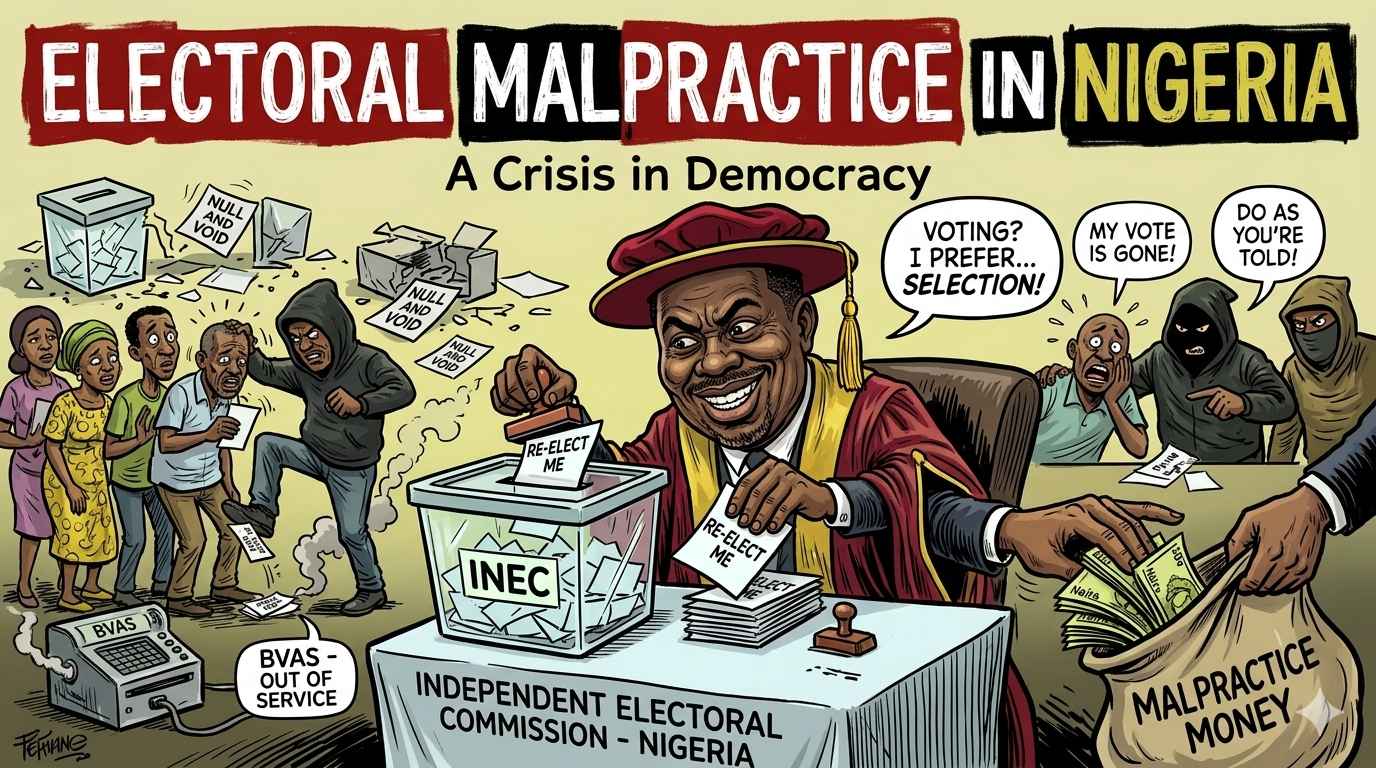
Section 63 of the Electoral Act 2026 deals with what happens when a ballot paper does not carry the official mark prescribed by INEC. The provision has two subsections. The first says that such a ballot paper shall not be counted. The second says: where the returning officer is “satisfied” that the unmarked ballot paper came from a book of ballot papers that was properly furnished to the polling unit, it shall be counted anyway. That word, “satisfied,” is doing enormous work in this sentence. It is, in law, a subjective standard. It does not require objective evidence. It does not require documentation. It requires the personal satisfaction of one individual official. And that satisfaction, according to former REC Igini, is enough to put an unofficial ballot paper into the count.
“Where the returning officer is satisfied that a ballot paper which does not bear the official mark was from a book of ballot papers which was furnished to the presiding officer of the polling unit in which the vote was cast for use at the election in question, he or she shall, notwithstanding the absence of the official mark, count that ballot paper.”
What is the objective condition for evaluating “satisfaction”? There is none specified in the Act. No documentation requirement. No independent verification process. No second opinion mechanism. The returning officer is satisfied or not satisfied, and the law does not tell you how to measure or challenge that satisfaction. Igini’s warning is direct: “What that means is that before this election, politicians who now have access to the security features of the INEC ballot are going to produce their ballot papers. They are going to print their own ballot paper to be accepted. This is dangerous.”
It is worth noting, in fairness, that TheCable’s fact-checking unit found that a similar provision existed in the Electoral Act 2022, which Igini did not publicly challenge when it was in force. The 2026 Act did not invent this clause from scratch. But the fact that a dangerous provision is not new does not make it less dangerous. If anything, it raises a more uncomfortable question: why, across two successive electoral laws, has this clause survived? Who in the system has consistently found it worth preserving?
Nigeria’s Electoral Act gives an official the power to count a ballot paper with no security mark if they are personally satisfied it is genuine. There is no objective test for that satisfaction. In a country with the history of electoral malpractice that Nigeria has, this is not a drafting oversight. It is an invitation.
Anuoluwa Soneye, Narrivon
How the Electoral Act 2026 Shielded Officials Who Break INEC’s Own Rules
Section 138 of the Electoral Act 2026 deals with the grounds on which an election can be legally challenged. The provision limits petition grounds to two: that the election was invalid because of corrupt practices or non-compliance with the Act’s provisions, or that the respondent was not duly elected by a majority of lawful votes. This represents a significant change from the 2022 Act, which included a third ground: that the person elected was not qualified to contest at the time. The 2026 Act removes qualification as a petition ground entirely, converting it into a pre-election matter only.
“An act or omission which may be contrary to an instruction or directive of the commission, or of an officer appointed for the purpose of the election but which is not contrary to the provisions of this Act shall not of itself be a ground for questioning the election.”
Read that again, slowly. An act or omission that is contrary to an INEC instruction or directive, but not expressly prohibited by the Electoral Act itself, cannot be used to challenge an election result. In plain language: an electoral officer who ignores INEC’s own guidelines and regulations, the very rules INEC created to govern the conduct of elections, cannot be held legally responsible for that violation through a petition, as long as the Act itself does not expressly forbid what they did.
Igini describes this provision as “one of the rigging provisions that we have cried out to be removed.” He explains that INEC’s regulations and guidelines are the operational rulebook of elections. They govern everything from how ballot boxes are sealed to how results are collated, how voters are accredited, and how disputes at polling units are managed. Section 138 tells every presiding officer, collation officer, and returning officer in Nigeria: you can ignore those guidelines. If someone tries to challenge your election result because you broke INEC rules rather than the Electoral Act itself, the court will not entertain it. As election law analysts at Mondaq noted: “Section 138 effectively creates an accountability gap: electoral officers who deviate from INEC directives are insulated from petition consequences as long as their actions do not expressly violate the Act.”
Is this a rigging provision? It depends on your definition. If “rigging provision” means a clause that a dishonest actor could exploit to conduct an election in violation of INEC’s own standards without legal consequence, then yes. It is precisely that. Whether it was designed for that purpose or arrived there by unfortunate drafting is a question only the people who wrote it can answer. And they have not been asked that question publicly.
When the Officials Who Ran Your Election Cannot Be Brought to Court
Section 137 of the Electoral Act 2026 deals with who must be made a party in an election petition. Where the petitioner alleges misconduct by an electoral officer, a presiding officer, or a returning officer, the provision says it is not necessary to join that officer as a respondent. Instead, INEC itself is made the respondent and is deemed to be defending the petition on behalf of its officers.
“Where the petitioner complains of the conduct of an electoral officer, a presiding or returning officer, it shall not be necessary to join such officers or persons notwithstanding the nature of the complaint and the commission shall, in this instance, be (a) made a respondent; and (b) deemed to be defending the petition for itself on behalf of its officers or such other persons.”
The immediate consequence of this provision is that the people who actually ran the election, who sat inside the polling units, who accredited voters, who counted the ballots, who sealed the boxes, cannot be personally summoned and cross-examined in court. INEC answers for them. INEC’s lawyers speak on their behalf. The person who was physically present when the irregularity allegedly occurred is not in the witness box. The system answers for the person.
This connects directly to a specific and documented problem that Nigeria’s election petition courts have wrestled with for years: the practice of “document dumping.” Petitioners would file thousands of pages of electoral materials, forms, and declarations as evidence without calling the people who produced those documents to testify. Courts have consistently complained that this approach defeats the purpose of evidence: the relevant officials who handled those documents should be there, subject to cross-examination, explaining what they did and why. The push toward oral evidence was meant to fix exactly that. But Section 137 undermines it. If the presiding officer is not a respondent, they cannot be compelled by the petitioner to appear and testify. INEC sends its lawyer instead. The actual witness stays home. And the document-dumping problem, addressed in one place, finds a new home in the next provision.
“Discretion without objective safeguards is a license. Unauthorized ballot papers may find their way into the electoral process, clothed with a veneer of legitimacy by the unilateral ‘satisfaction’ of an official. This is a recipe for systemic manipulation.”
Mike Igini, former INEC Resident Electoral Commissioner, May 2026, speaking on the Electoral Act 2026
Incidents of Electoral Malpractice in Nigeria: Why These Loopholes Are Not Theoretical
Electoral malpractice in Nigeria is not a theoretical risk. It is a documented, decades-long practice with specific elections, specific methods, and specific consequences that are still being lived by the people whose votes were stolen. Nigeria’s electoral history is a museum of ingenuity in this regard. As we have documented in our examination of how Nigerian politicians weaponize poverty for electoral gain, the vote-buying, ballot-stuffing, and result manipulation that characterize Nigerian elections are not accidents. They are strategies, refined over time, and executed with institutional knowledge.
The annulment of the June 12, 1993 presidential election, widely acknowledged as the freest and fairest in Nigeria’s history, established a precedent that has never fully been overcome: that the state can decide, regardless of the expressed will of the people, what the electoral outcome will be. The 2007 elections, which produced a verdict so polluted that the incoming president’s own party acknowledged the results were problematic, showed that INEC’s own officials could be complicit at scale. The 2011 post-election violence killed over 800 people, demonstrating that electoral violence in Nigeria is a real and lethal consequence of perceived rigging. The 2019 Kogi State governorship election produced a video catalogue of malpractice that went viral globally. The 2023 elections saw BVAS results transmission delayed, disputed, and in some cases unavailable, with petitions that wound through the courts for years. Each election cycle, the incidents of electoral malpractice in Nigeria are documented, condemned, and then used as justification for another round of reforms. The reforms arrive. The malpractice adapts. The provisions that enable it, quietly, survive the reform process.

What Happens When the Institutions That Should Guard Elections Guard Something Else
The Electoral Act 2026 did not appear from nowhere. It was drafted by members of the National Assembly, many of whom will be contestants in the 2027 elections for which this law creates the legal framework. It was signed by a president who was himself elected under disputed conditions in 2023, whose electoral victory was challenged in court, and whose party has a documented interest in the outcome of future elections. The conflict of interest embedded in the legislative process that produced this law is not hidden. It is structural. The people who wrote the election rules are the people who will compete under those rules. The incentive to include loopholes is built into the architecture of the process.
The judiciary, which should be the corrective for legislative manipulation, operates inside its own pressures. As we have examined in our broader analysis of corruption in Nigerian governance, the Nigerian judiciary has produced both extraordinary moments of principled independence and deeply troubling instances of politically convenient outcomes. Election petitions routinely stretch years beyond the term they are contesting, producing rulings that arrive after the mandate has effectively expired. Supreme Court decisions have, in documented cases, produced outcomes that legal scholars have described as legally strained. The faith Nigerians are asked to place in the judiciary as the backstop of electoral integrity is faith that has been tested and, in many instances, found wanting.
Curbing electoral malpractice in Nigeria is not simply a matter of better technology or tougher penalties. BVAS is now law. Biometric accreditation is now law. Electronic transmission has a place in the legal framework. These are genuine improvements. But they coexist with Section 63, which allows unofficial ballots to be counted. They coexist with Section 138, which gives immunity to officials who ignore INEC’s own rules. They coexist with Section 137, which removes the direct witnesses from election petition proceedings. The system gives with one hand and takes with the other. And the hand that takes is writing the law.
The Electoral Act 2026 was signed in under 24 hours. The loopholes in it have been building for years. No law that enables electoral malpractice in Nigeria arrives by accident. Someone in the room always knew what they were doing.
Anuoluwa Soneye, NarrivonWhat Citizens Must Do Before the 2027 Elections
The electoral act amendment process that produced this law was not conducted in secret. It was debated publicly. Public hearings were held. Civil society organizations participated. And despite all of that, Sections 63, 137, and 138 survived the process intact. What this tells you is that participation alone is not enough. Attending the public hearing is not enough. The drafters can hear you, record your objection, and proceed to include the provision anyway. What changes the outcome is the kind of sustained, informed, vocal, organized pressure that makes it politically costly to include dangerous provisions in electoral law, regardless of what stakeholders were “consulted.”
Mike Igini, the former REC who raised the alarm, has called for these sections to be immediately amended before the 2027 elections. He has presented the analysis. He has done the legal reading. The task for citizens is to amplify that demand until it cannot be ignored. The 2027 elections are scheduled for February 20, 2027 for the presidential and National Assembly elections, and March 6, 2027 for governorship and state assembly contests. There is time to demand amendments. There is time to organize around this. There is time for the national conversation about these sections to be so loud and so well-documented that the legislators who included them cannot pretend it is not happening.
At Narrivon, we believe that every Nigerian who reads this article now knows three things that are worth knowing before 2027. They know what Section 63 says and what the word “satisfied” means in the hands of a motivated official. They know what Section 138 means for an electoral officer who decides to ignore INEC’s regulations on election day. And they know what Section 137 means for the petitioner who tries to challenge what happened at a polling unit and discovers that the person who was there will not be in court to answer for it. Knowledge of these provisions is itself a form of accountability. It makes it harder to deploy them quietly. It makes the official who “satisfies” himself about an unmarked ballot aware that someone is watching. It makes the lawmaker who might quietly let these sections stand aware that people know what they contain.
The ballot in Nigeria belongs to the voter. But the legal framework around that ballot is being shaped by people with a very specific interest in the outcome. As we have written before, the Nigeria of our dreams is a project, not a prayer. The 2027 election is the most important civic moment in Nigeria’s recent history. The docility that allows dangerous provisions to survive a reform process is the same docility that makes electoral malpractice in Nigeria a perpetual story rather than a resolved one. The cure for docility is information, organization, and the refusal to accept that this is simply how things are. It is not. These provisions can be amended. They must be. And the people who must demand it are the people reading this article.
“The ballot is stronger than the bullet.”
Abraham Lincoln, widely attributed
In Nigeria, the ballot is only stronger than the bullet if the law around it is stronger than the loopholes. The Electoral Act 2026, as it stands, has not yet guaranteed that. The work of guaranteeing it belongs to citizens. It always has.
Frequently Asked Questions
What is the Electoral Act 2026 and when was it signed?
The Electoral Act 2026 (officially the Electoral Act 2022 Repeal and Re-Enactment Bill 2026) was passed by the National Assembly on February 17, 2026, and signed into law by President Tinubu on February 18, 2026, less than 24 hours after passage. It replaces the Electoral Act 2022 and introduces several changes to Nigeria’s electoral framework ahead of the 2027 general elections.
What is wrong with Section 63 of the Electoral Act 2026?
Section 63 allows a returning officer to count a ballot paper that does not carry INEC’s official mark or security features, provided the officer is “satisfied” it came from a properly furnished book of ballot papers. Critics, including former INEC REC Mike Igini, argue that the subjective word “satisfied” creates a discretion with no objective safeguards, potentially allowing unofficial or counterfeit ballot papers to be counted. The provision was similarly present in the Electoral Act 2022 but has been retained despite documented concerns.
What does Section 138 of the Electoral Act 2026 mean for elections?
Section 138(2) provides that an act or omission by an electoral officer that is contrary to INEC’s instructions or directives, but not expressly contrary to the Electoral Act itself, cannot be used as a ground for questioning an election. Critics argue this effectively grants immunity to electoral officers who ignore INEC’s own regulations and guidelines, removing a key accountability mechanism for election petitions.
What is the problem with Section 137 of the Electoral Act 2026?
Section 137 removes the requirement to join presiding officers or returning officers as respondents in election petitions. Instead, INEC is made the respondent and defends the case on its officers’ behalf. Critics argue this means the electoral officials who were physically present at polling units and can give firsthand evidence about what happened cannot be compelled to testify in court, undermining the push toward oral evidence and direct witness accountability in election disputes.
Sources and Further Reading:
Tinubu signs Electoral Act Amendment Bill 2026 into law (AllAfrica, February 19, 2026) •
Tinubu signs Electoral Act 2026 ahead of 2027 polls (PR Nigeria, February 18, 2026) •
Why Tinubu quickly signed Electoral Act Amendment Bill (Premium Times, February 23, 2026) •
Ex-INEC REC Igini reveals 2026 Electoral Act dangerous provisions (Daily Post, April 22, 2026) •
Ex-INEC REC reveals dangerous sections of Electoral Act 2026 (This Day Live, April 23, 2026) •
Fresh alarm over 2027 polls: Ex-REC lists dangerous sections of Electoral Act 2026 (Vanguard, May 2026) •
Why politicians may print fake ballot papers for 2027 elections (Premium Times, April 23, 2026) •
Key provisions in the new Electoral Act that you may not know (TheCable, March 5, 2026) •
Fact check: Ballot paper provision in Electoral Act 2026 also existed in 2022 law (TheCable, April 2026) •
Electoral Act 2026: Progress, gaps and the legal landscape for 2027 (Mondaq, March 2026) •
Nigeria makes e-results optional, critics facepalm (SBM Intelligence, February 2026) •
Electoral Act 2026 full text (PLACNG)
Leave a Reply