
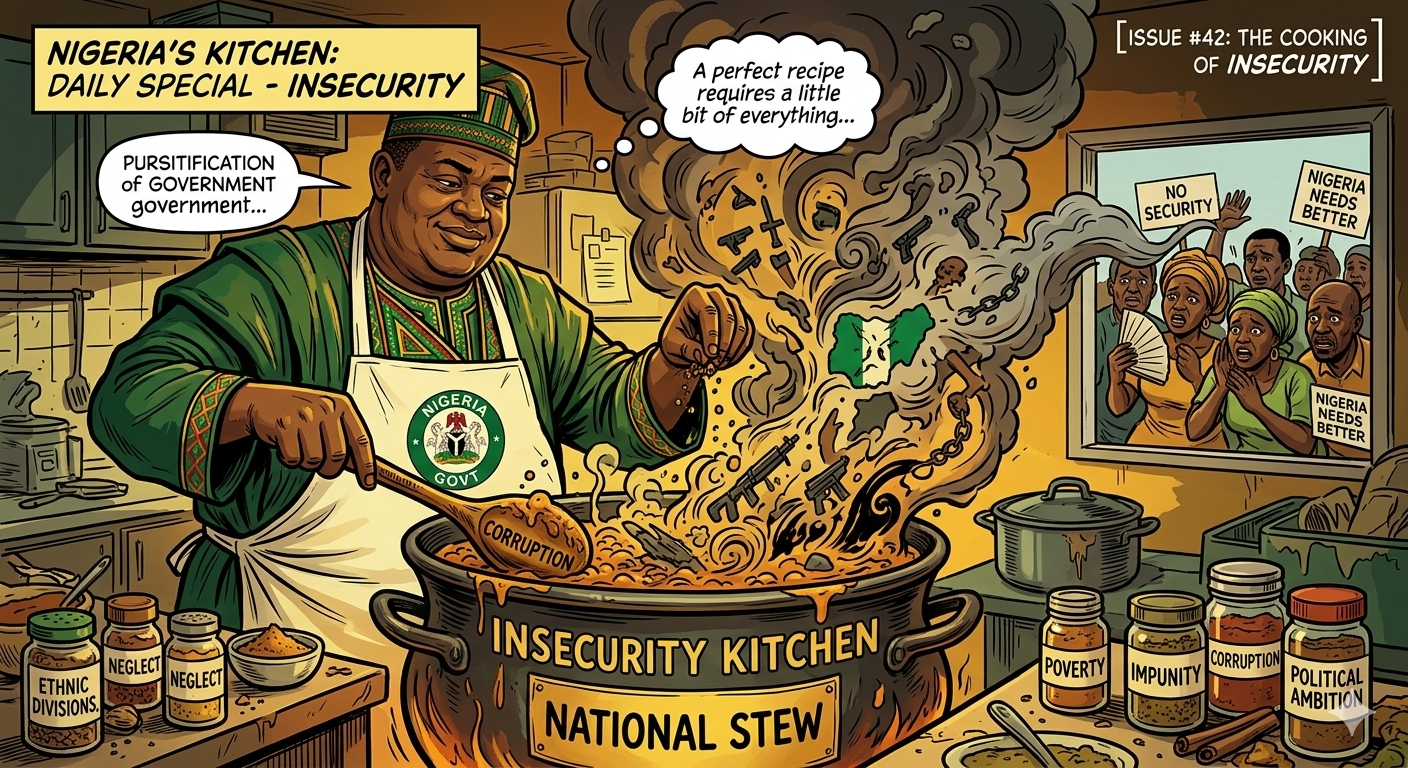
Is the Nigerian Government Complicit in Insecurity? The Questions Nobody Wants to Answer
This article does not make accusations. It asks questions. Questions that arise when you notice that bandits can post death threats on TikTok for years without arrest, while a blogger who posts an army welfare video is picked up within 48 hours. Questions that arise when insecurity in Nigeria has survived Goodluck Jonathan, Muhammadu Buhari, Bola Tinubu, and enough security summits to fill a stadium. Questions that a dead general answered in one sentence decades ago.
Let us begin with the man who said the quiet part out loud. General Sani Abacha, Nigeria’s former military Head of State from 1993 to 1998, is not a figure widely celebrated for his democratic credentials. But he is credited with one statement that has aged with a precision that should make every Nigerian deeply uncomfortable: “Any insurgency that lasts more than 24 hours, a government official has a hand in it.” This quote, attributed to Abacha and first widely circulated publicly by his daughter Gumsu Abacha in a 2014 tweet during the height of the Boko Haram crisis, has since been cited by former President Olusegun Obasanjo, former presidential candidate Peter Obi, former military head of state Ibrahim Babangida, and numerous analysts. None of them have disputed the attribution. None of them have disputed the logic. And insecurity in Nigeria has now lasted not 24 hours but twenty-four years, through multiple administrations, multiple security chiefs, multiple declared states of emergency, and a security budget that has consumed trillions of naira and billions of dollars without producing safety for the ordinary Nigerian.
This article is not a verdict. It is a series of questions. Questions that the available, confirmed, publicly documented facts make it impossible not to ask.

From Chibok to Yelewata: How Insecurity in Nigeria Outlasted Every Promise
The story of insecurity in Nigeria as a national emergency is usually dated to April 14, 2014. That night, Boko Haram terrorists raided the Government Secondary School in Chibok, Borno State, and abducted 276 schoolgirls. Fifty-seven escaped in the immediate aftermath. The remaining 219 became a global cause. World leaders wore hashtags. Michelle Obama held a sign. President Goodluck Jonathan took several days to respond publicly. Boko Haram was still a declared emergency. The girls were still gone.
Jonathan lost the 2015 election to Muhammadu Buhari, who ran partly on the promise of ending the terrorism in Nigeria that had defined the previous administration’s failures. Buhari’s first declaration as president was that Boko Haram had been “technically defeated.” He would make variations of this declaration multiple times. Boko Haram, apparently not having read the press releases, continued operating. By December 2015, the group had carried out more bombings following Buhari’s victory declaration than in the months before it.
In February 2018, Boko Haram descended on the Government Girls Secondary School in Dapchi, Yobe State, and abducted approximately 110 girls. Amnesty International documented that Nigerian security forces received at least five warning calls in the hours before the attack. The military was informed. The military confirmed it was “aware and monitoring.” The convoy arrived in Dapchi. The girls were taken. Only one remains in captivity today: Leah Sharibu, who refused to convert to Islam and was kept as a permanent hostage. The government has not secured her release. She has been in captivity for over eight years.
In June 2022, gunmen entered St. Francis Xavier Catholic Church in Owo, Ondo State, during a packed Pentecost Sunday mass and opened fire. At least 40 people were killed, many of them children. Also in July 2022, ISWAP and Boko Haram affiliated insurgents attacked the Kuje Medium Security Custodial Centre in Abuja, the nation’s capital, and freed approximately 879 inmates, including 64 confirmed Boko Haram members. This attack happened in Abuja. Not in the North-East. Not in the bush. In the city where the president lives. In June 2025, over 300 people were killed in a single night attack in Yelewata, Benue State. In March 2026, at least 51 people were killed in the Palm Sunday massacre in Angwan Rukuba, Jos. In November 2025, over 400 schoolchildren across four northern states were abducted in a mass kidnapping spree that surpassed the 2014 Chibok numbers. The pattern is not a wave. It is a current. And it has been flowing in one direction for twenty years.
Why Bandits Post on TikTok for Years While Bloggers Get Arrested in 48 Hours
Here is something that deserves to be held very still and looked at carefully. Kidnapping in Nigeria is no longer conducted by faceless men in the dark. It is documented, broadcast, and in some cases announced in advance. Bandit leader Bello Turji, one of the most feared figures in the Zamfara security crisis, posted a video on social media in late December 2024 threatening to attack communities in Shinkafi, Zurmi, and Sokoto if his captured relatives were not released by December 31. Community leaders begged him. Fulani elders held meetings. Turji’s deadline passed. His men attacked anyway, abducting travelers and burning vehicles. The warning video remained publicly accessible. Turji remained free.
This is not an isolated example. ISWAP, Nigeria’s most active terror group, releases regular propaganda videos showing attacks on military positions, burning of villages, and the faces of fighters who have killed Nigerian soldiers. Their content is not hidden. It is on the internet, with production quality that would not shame a small Nigerian media company. They have photographers. They have editors. As documented in Narrivon’s coverage of insecurity in Nigeria, bandits control hundreds of villages and impose taxes, run supply chains, and receive regular deliveries of food and ammunition. A criminal enterprise of this scale does not operate on goodwill and grass. It operates on funding, logistics, and either the absence of serious state pressure or something worse.
Now compare the response to bandits broadcasting on TikTok with the response to critics posting on the same platform. Justice Crack (Justice Mark Chidiebere) posted a video about soldiers eating poorly and was picked up by the military within days. VeryDarkMan (Martins Vincent Otse) has been arrested multiple times for social media commentary. A TikToker was reportedly held on a N2 billion bail simply for making commentary deemed critical of the administration. Nigeria’s insecurity crisis has bandits broadcasting freely for years. Nigeria’s accountability culture has critics arrested within 48 hours. The comparison is not a coincidence. It is a data point.
“Before I left office, Nigeria could identify and locate anyone who committed any crime anywhere in the country. Today, with technology such as drones and improved tracking tools, we can easily locate and remove them. But we are not doing that. Why are we negotiating with terrorists?”
Former President Olusegun Obasanjo, cited by Peter Obi in response to Kwara State terror suspects’ claims of government supply, December 2025

The Allegations That Were Made, the Denials That Followed, and the Investigations That Never Happened
This section deals with confirmed public statements and documented allegations. It does not make accusations. Every person mentioned has denied wrongdoing. What it does do is ask why, across more than a decade of confirmed allegations, no formal, transparent, independent investigation has ever concluded with accountability.
Senator Shehu Umar Buba
In 2024, Bauchi State Governor Bala Mohammed submitted a petition to the presidency directly accusing Senator Umar Buba of sponsoring bandits. The allegation attracted significant public attention for a specific reason: at the time the accusation was made, Senator Umar Buba was serving as the Chairman of the Senate Committee on National Security and Intelligence. He was, in other words, the senator most directly responsible for legislative oversight of Nigeria’s response to banditry and terrorism. In October 2025, a video circulated again linking him to banditry activities. Senator Buba has denied all allegations. The Nigerian Senate, which resolved in December 2025 to expose terrorism sponsors, has not, as of this writing, concluded any formal investigation of the matter. Various groups described the accusations as politically motivated ahead of potential 2027 gubernatorial ambitions. The matter has not been resolved either way.
Muhammad Bello Matawalle
Bello Matawalle served as governor of Zamfara State during one of the most violent periods of banditry the state has experienced. During his tenure, he pursued a controversial peace negotiation strategy with known bandit leaders, including meetings with figures like Bello Turji. Critics argue these negotiations provided bandits with legitimacy and operational breathing room rather than a path to disarmament. He has also been linked by multiple security-focused publications to terror groups, allegations he has consistently denied. He was later appointed Minister of State for Defence by President Tinubu in 2023, giving him direct oversight of Nigeria’s military operations against the same groups he is alleged to have links with. He denies all allegations of wrongdoing. No formal investigation has produced a contrary conclusion.
Beyond these specific individuals, the documented record includes a Kwara State incident in late 2025 where suspected terrorists arrested by security forces claimed in a widely shared video that government officials had supplied them ammunition and logistics. Peter Obi, in a December 2025 statement, cited this video and demanded an immediate, transparent, independent investigation. He said the persistence of insecurity in Nigeria despite trillions spent “points either to complicity or failure of leadership.” He called both options unacceptable. The investigation he demanded has not been publicly announced.
Former Adamawa State Governor Murtala Nyako made perhaps the most explosive allegation of all when, in 2014, he directly accused the Goodluck Jonathan federal government of being behind the Boko Haram insurgency and described events in the North as a “genocide against Northern Nigeria.” His allegations were widely circulated, generated enormous debate, and were disputed by the Jonathan administration. No independent inquiry was established. The Boko Haram insurgency continued.
Nigeria has a list of 48 alleged terrorism financiers. It has a senator who chaired the National Security Committee while being accused of funding bandits. It has security forces claiming they cannot trace people who are broadcasting on TikTok. At some point, these are not coincidences. They are a pattern. And patterns deserve investigation, not just press releases.
Anuoluwa Soneye, NarrivonWho Gets the Government’s Attention: The People Who Kill or the People Who Are Killed?
The clearest possible picture of this government’s actual priorities is painted not by its statements but by its resource allocation. In April 2026, the Nigerian government held a graduation ceremony in Gombe State for 744 former Boko Haram members and other insurgents who had completed the De-Radicalisation, Rehabilitation, and Reintegration programme under Operation Safe Corridor. Certificates were distributed. Speeches were made. Resources drawn from the national budget had funded months of vocational training, psychosocial counselling, and religious reorientation for people who had, in many documented cases, killed Nigerian soldiers, civilians, and children. As we reported, the Chief of Defence Staff had recently compared these insurgents to the biblical prodigal son.

Now consider the parallel track. When President Tinubu visited to express condolences after the Palm Sunday massacre in Angwan Rukuba, Jos, he met with community members at the airport. Not in the village. Not where the bodies were buried. At the airport. The community that lost 51 people in a single night did not receive a graduation ceremony. They received a layover. The families of Yelewata, Benue State, who lost over 300 people in June 2025, received expressions of condolence and a Makurdi-based visit from government officials. The families of the Chibok girls, many of whom have waited twelve years for daughters who are still unaccounted for, have received presidential statements, hashtags, and a report from a government committee. The girls remain missing.
The arithmetic is not subtle. Terrorism in Nigeria, as prosecuted by the state, appears to work as follows: kill Nigerians for years, then surrender, receive vocational training and a certificate. Be a Nigerian civilian killed by those same terrorists and receive a press release and a condolence visit at your nearest airport. The prodigal son gets a fatted calf. The father’s household, the ones who were robbed, burned, and buried during the prodigal’s absence, get the government’s thoughts and prayers.
Trillions Spent. Insecurity Is Increasing Across Nigeria. Someone Should Ask Where the Money Went.
Insecurity is increasing across Nigeria despite what is perhaps the most extraordinary sustained investment in “security” any Nigerian government has ever made. Defence and security budgets have grown year on year. Contracts have been awarded for equipment, training, and logistics. International partnerships with the US, UK, France, and the African Union have provided intelligence support, drone technology, and tactical assistance. In December 2025, the United States military launched airstrikes against alleged ISIS-linked targets in Sokoto, directly intervening militarily in a crisis the Nigerian military has been unable to resolve for years. This intervention, while demonstrating that the technology and willingness to strike exist, also raised an uncomfortable question: if a foreign power can identify and strike terrorist targets in Nigerian territory, why has Nigeria’s own military, with years of intelligence and Obasanjo’s explicitly confirmed technological capacity, been unable or unwilling to do the same?
The corruption in Nigerian governance that siphons billions from every sector does not stop at the security budget. It is arguably most dangerous there. Security contracts are notoriously opaque. Procurement processes for military equipment are routinely classified. Equipment allocations cannot be independently verified. In a system where ministers run construction companies that receive government contracts, where N3.6 billion can move from a state treasury to a governor’s private firm without prosecution, the possibility that security funding is being embezzled at scale is not a conspiracy theory. It is a structural inevitability. Corruption does not discriminate by sector. And terrorism in Nigeria is, among other things, expensive. Sophisticated weapons, drones, logistics chains for remote forest camps, regular food and supply runs, the ability to launch coordinated attacks across multiple states simultaneously: none of this happens on volunteer enthusiasm. Someone is paying for it. The question of who is one that Nigeria’s government has consistently been reluctant to fully investigate or answer publicly.
“In Nigeria, trillions of naira and billions of dollars have been continuously collected by the government in the name of security. Yet insecurity has continued to worsen across the country. The spread of violence has become more frequent and more daring.”
Peter Obi, former Presidential candidate and Labour Party leader, December 2025, following reports of arrested terrorists claiming government officials supplied them arms
If You Are Not Asking These Questions, Someone Else Is Benefiting From Your Silence
This article does not conclude that the Nigerian government is complicit in insecurity in Nigeria. That is a conclusion that requires investigation, evidence, and accountability processes that this country has consistently failed to complete. What this article concludes is simpler, and perhaps more alarming: nobody in power is doing anything meaningful to find out. A senator chairs the National Security Committee while being publicly accused of funding bandits and is neither investigated nor removed. Suspects arrested by security forces claim on video that officials supplied them weapons and the investigation Peter Obi publicly demanded is not announced. Trillions are spent on security and Nigeria’s insecurity gets worse each year. Bandits broadcast threats on social media for years. Bloggers post welfare complaints and are arrested within 48 hours. And Nigerians, as we have examined in our piece on the docility of Nigerians, largely absorb all of this and move on to the next trend.
The questions raised in this article are not rhetorical. They are the foundational questions of a functioning democracy: Where did the money go? Who is being protected by the absence of investigation? Why can a foreign military strike terrorist targets in Nigerian soil while Nigeria’s military cannot? Why does the state move faster to arrest a welfare critic than to arrest a bandit leader who posted his face and his threats on TikTok? Why does a man accused of sponsoring terror get to chair the committee that oversees Nigeria’s response to terror?
General Abacha, whatever his many failings, gave us the framework for thinking about this. An insurgency that lasts more than 24 hours has government involvement. Nigeria’s insecurity crisis has lasted over 17 years. The math is not complicated. What is complicated is building the political will, and the civic pressure, to make those in power answer for it.
At Narrivon, this is the work we are committed to: asking the questions, documenting the facts, and refusing to accept press releases as substitutes for answers. But this work only produces change when ordinary citizens decide that these questions are also their questions. Not just when the bandits arrive in their village. Not just when their own child is among the missing. Now. Before the next school is raided. Before the next community is burned. Before the next set of families discovers that the government’s fastest response to their tragedy is a condolence visit at the airport and a graduation ceremony for the people who caused it.
Insecurity is increasing across Nigeria. The only question that matters now is whether enough Nigerians will decide to stay awake long enough to demand real answers.
Any insurgency that lasts more than 24 hours, a government official has a hand in it. Nigeria’s insecurity has lasted more than 17 years. We will leave the arithmetic to you.
Anuoluwa Soneye, Narrivon, citing Gen. Sani Abacha
Sources and Further Reading:
Peter Obi reacts after terrorists claim government supplied them arms (Politics Nigeria, December 2025) •
Terrorism financing: Can Nigerian Senate unmask suspects? (Premium Times, December 2025) •
Nigerian govt releases updated list of terrorism financiers (Premium Times, April 2026) •
Nigerian forces failed to act on Dapchi abduction warnings (Al Jazeera / Amnesty International, March 2018) •
Bandit leader Bello Turji attacks after threatening communities on video (AllAfrica / Leadership, January 2025) •
US bombs target ISIL in Nigeria (Al Jazeera, December 2025) •
Country Reports on Terrorism 2023: Nigeria (US State Department) •
2022 Owo church attack (Wikipedia) •
Boko Haram insurgency (Wikipedia) •
Nigeria insecurity overview (Global Centre for Responsibility to Protect, March 2026)
Leave a Reply