
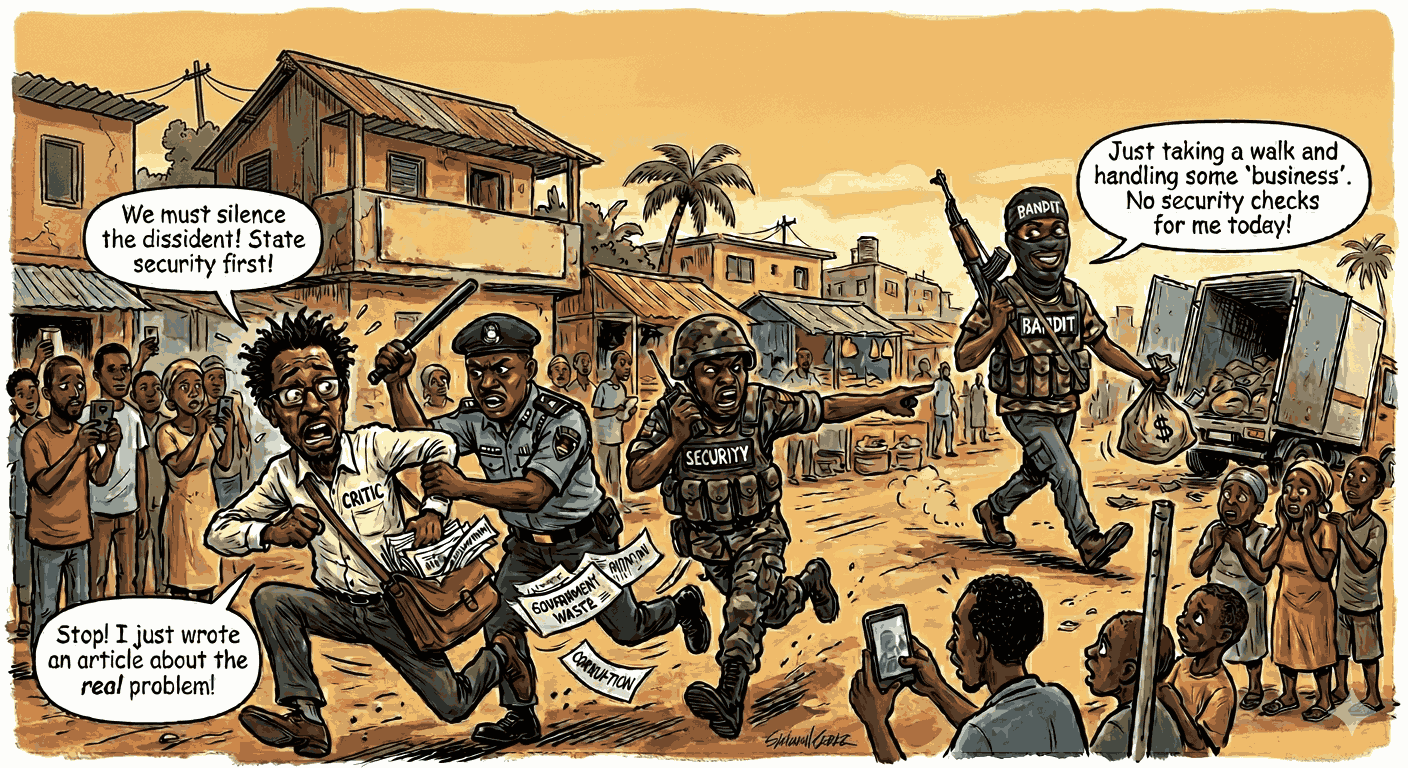
Insecurity in Nigeria: When Killing Becomes Just Another News Headline
Over 614,000 Nigerians were killed by bandits and insurgents in just one year. Terrorists get Bible studies. Critics get arrested in 48 hours. Soldiers abandon schools before attacks. And yet, somehow, the greatest threat facing this government appears to be a blogger with a phone. Welcome to the insecurity business in Nigeria.
There was a time when news of a massacre in Nigeria would stop the country cold. People would gather around radios and televisions. They would weep. They would demand answers. Today, the average Nigerian scrolls past the headline. Not because they do not care, but because there have simply been too many. Too many villages burned. Too many children taken from school. Too many families burying people in mass graves while the government issues a press statement and moves on to the next political event. Insecurity in Nigeria has not just become a crisis. It has become a climate, and like any climate, people have stopped noticing it because it is always there.
This essay is for the people who still notice. The people who still want to ask the hard questions. Like: why, after sixteen years of fighting Boko Haram, are things getting worse? Why are bandits who post videos of themselves on TikTok still free, while a content creator who posts a video criticizing the government is arrested in days? And most importantly, a question that every Nigerian deserves an honest answer to: does the Nigerian government actually want to solve the insecurity crisis, or has the crisis become too useful to end?
What Insecurity in Nigeria Actually Looks Like in Numbers
Let us start with the facts, because the facts alone are staggering enough without any commentary. In May 2024, Nigeria’s National Bureau of Statistics (NBS) published a report showing that 614,937 people were killed by bandits and insurgents between May 2023 and April 2024. In that same twelve-month period, 2,235,954 Nigerians were kidnapped, and families paid a combined N2.23 trillion — that is over one trillion naira — in ransom to get their loved ones back.
The 2025 figures were no better. According to Nextier’s 2026 Nigeria Security and Conflict Outlook, banditry alone accounted for 2,724 deaths in 2025 — a near-doubling from 1,585 in 2024. In November 2025, at least 402 people, mostly schoolchildren, were kidnapped across four states in the north-central region in a single month. In Kwara State — a place that was not previously considered a frontline — gunmen killed over 160 people in a single attack in February 2026. Amnesty International documented daily attacks in Zamfara State alone, and confirmed that bandits now control 725 villages across 13 local governments of that state.
Think about that last line. Not areas of influence. Not zones of concern. Controlled. 725 villages, inside a Nigerian state, effectively governed by armed criminals rather than the Nigerian state. And what is the federal government’s response? Press releases. Condolence visits at airports. And, most recently, Bible lessons.
“The first duty of the government is to keep citizens safe and the country secure.”
Gordon Brown, former Prime Minister of the United Kingdom
When Nigeria’s Top Military Officer Compared Terrorists to a Bible Story
General Olufemi Oluyede
General Olufemi Oluyede is the highest-ranking military officer in Nigeria, overseeing all three arms of the Nigerian Armed Forces. He is responsible for the overall strategic direction of Nigeria’s counterterrorism operations. In March 2026, he made a statement at the inaugural lecture of the Joint Doctrine and Warfare Centre in Abuja that sparked nationwide outrage — and raised serious questions about the philosophy guiding Nigeria’s approach to the insecurity crisis.
On March 27, 2026, General Oluyede stood before an audience of military and government officials and delivered what may be the most talked-about defence policy statement of the decade. He was defending Operation Safe Corridor — the government’s programme for rehabilitating and reintegrating former terrorists. Many Nigerians had been asking a simple question: why are we rehabilitating people who have burnt villages and killed thousands? His answer:
“People are asking why we are not killing terrorists even if they have killed others. Well, even in the Bible, the prodigal son was given a chance, so we should give terrorists a chance to repent.”
General Olufemi Oluyede, Chief of Defence Staff, Nigeria — March 27, 2026He continued: “These are Nigerians, mostly. And it’s important for us to give them that window to repent, if they want, rather than pushing them to the extreme. To say, okay, ‘It’s either we kill you, or you continue with the adventure.'”
The internet, to put it politely, did not receive this well. And honestly, who could blame it? The statement came just days after a fresh attack in Borno left over 20 people dead. The same week that communities in the north were counting their dead, Nigeria’s most senior military officer was drawing on the New Testament to explain why the people who killed them deserve a second chance. The families of the dead were not offered any such theological comfort. They were just offered a mass grave and a press release.
Now, to be clear and fair: there is a serious academic and strategic debate about whether rehabilitation can form part of a counterterrorism strategy. Countries like Colombia and Indonesia have used deradicalisation with some success. The position itself is not inherently unreasonable. What is unreasonable — what is tone-deaf beyond description — is saying it in a country where bandits control entire villages, where over 600,000 people were killed in a single year, where schoolchildren are being kidnapped in bulk while soldiers are reportedly abandoning their posts before attacks happen, as confirmed in the November 2025 Kebbi State school kidnapping when a state governor admitted that soldiers left just before bandits arrived. The timing and tone suggest something far more troubling than just a policy position. It suggests a leadership that has fundamentally lost the emotional plot of what is happening to their own people.
“A nation that cannot protect the lives and property of its citizens has forfeited the basic justification for its own existence.”
Chinua Achebe, The Trouble with Nigeria, 1983
The Terrorism Money Trail That Always Leads to a Wall
Here is something that should make every Nigerian pause and think very carefully. In April 2026, the Nigerian Sanctions Committee (NiGSAC) published an updated list of 48 individuals and organisations allegedly sponsoring terrorism in Nigeria. The list includes Bureau De Change operators, alleged middlemen, and proscribed groups. It does not include a single politician. Not one.
This is remarkable, because for years, senior officials have publicly stated or strongly implied that powerful political figures are connected to these armed groups. In 2024, the Governor of Bauchi State, Bala Mohammed, formally petitioned the presidency, accusing a sitting senator from his state of sponsoring bandits. That senator — Umar Buba — was at the time the Chairman of the Senate Committee on National Security and Intelligence. The man who sat on the committee overseeing Nigeria’s security was publicly accused by a sitting governor of funding the people killing Nigerians. Was there a formal investigation? No. Did the Senate discipline him or ask him to step aside? No. Did anyone go to jail? You already know the answer.
Security analyst Kabir Adamu of Beacon Security and Intelligence told Premium Times plainly that “terrorism financing allegations in Nigeria often involve powerful political or business elites” and that for lawmakers, exposing them “could destabilise political alliances, threaten campaign financing sources, trigger internal retaliation, implicate colleagues or political patrons.” In other words: the people most positioned to name the sponsors are the people least incentivized to do so, because in many cases, they share tables with them at dinner.
We are not accusing anyone. We are simply pointing out what the pattern says. Nigeria has a list. The list is growing. The killing is growing faster. The people the intelligence community has consistently pointed at are not on the list. And a country that cannot put its most dangerous suspects on a sanctions list is a country where the system itself has a leak somewhere. Precisely where the leak is, and exactly whose responsibility it is to fix it, are questions that the Nigerian public is fully entitled to ask — loudly, repeatedly, and without apology.
The Nigerian Security Forces: Brave People, Broken System
Before we go any further in criticizing the government’s approach to insecurity, it is important to say something that is often missed in this conversation: the average Nigerian soldier and police officer is not the enemy. Many of them are poorly paid, poorly equipped, poorly trained, and poorly protected. They are being sent into dense forests to fight well-armed, well-funded criminal organizations with vehicles that break down on the highway and rifles that sometimes misfire. In many cases, they are also dying. Nigeria’s armed forces are now deployed across roughly two-thirds of the country’s states, yet remain overstretched.
Nigeria’s police force has one of the lowest officer-to-citizen ratios on the continent. The underfunding of the security architecture is not an accident. A government that truly wanted to protect its citizens would ensure that the people it sends to do the protecting have everything they need. When soldiers earn a salary that makes a bag of rice feel like a luxury, when police officers have to buy their own bullets in some units, when security operatives in the northeast are deployed without adequate backup or medical support, the question must be asked: is this a country that is genuinely trying to win this war, or one that has quietly accepted that the war simply continues?
A country that equips its soldiers with good intentions and bad rifles, then sends them into the bush against well-funded terrorists with AK-47s and drones, is not fighting a war on insecurity. It is staging a performance of one.
Anuoluwa Soneye, NarrivonHow Nigeria Catches Bloggers Faster Than Bandits
This is the part of the conversation that is both the most darkly funny and the most genuinely alarming. In December 2024, a TikTok user was arrested within days of posting a video that police said spread false information and aimed to provoke public feeling against them. The bail was set at two billion naira. Two billion naira. For a TikTok video. In a country where kidnappers operating entire criminal enterprises in Zamfara State cannot be found and arrested despite their victims’ families knowing roughly where they are operating.
According to the Committee to Protect Journalists, at least 29 media practitioners have been prosecuted under Nigeria’s Cybercrimes Act since it was enacted in 2015. Four journalists were arrested in September 2024 for reporting on alleged fraud by a bank CEO. A journalist in Delta State was charged with cyberstalking a governor over Facebook posts. An activist was tracked, her family members used as bait, and she was whisked from Lagos to Abuja for a livestream she did at an EndSARS memorial.
Meanwhile, bandits in the northwest post videos of themselves in the bush. They announce attacks. They send messages to communities warning them to evacuate. Some of them have social media accounts. Yet somehow, the same security infrastructure that can track a blogger’s location, freeze their accounts, arrest their relatives, and have them in custody within 48 hours cannot locate people who are broadcasting their coordinates to the internet. Either the Nigerian security services are phenomenally good at catching critics and phenomenally bad at catching criminals, or the system is working exactly as designed — just not in service of the Nigerian citizen.
“When injustice becomes law, resistance becomes duty.”
Thomas Jefferson, widely attributed
When Nigerians Stop Trusting That Things Can Change
There is something that happens to a people when they are consistently failed by the systems that are supposed to protect them. Not a sudden revolution, not a dramatic break. Something quieter. Something slower. They stop expecting. They stop trusting. They start preparing individually for what the state should be providing collectively. Families stockpile food. Communities form vigilante groups because the police cannot come fast enough. Young doctors train for years in government hospitals and then fly to the UK the moment they graduate, because they have done the math and decided that staying is not rational. And slowly, the country hollows out.
By 2024, the International Organisation for Migration estimated Nigeria’s diaspora at 17 million people. Seven out of ten Nigerians told the Nigeria Social Cohesion Survey they want to leave. That is not a statistic. That is a verdict. When seven in ten people in a country would rather be somewhere else, the country has failed at its most basic job: making people want to be there, and making them feel safe enough to build something there.
The sad truth is that insecurity is not just a security problem. It is an economic problem. It is an agricultural crisis. It is an educational emergency. Amnesty International documented that 65,000 people have been internally displaced in Plateau State alone from recent attacks, with many unable to return to their farms. When farmers cannot farm, food prices rise. When food prices rise, the poor go hungry. When the poor go hungry, they become easier to recruit. And the cycle, already old and deeply grooved, spins another round.
“The price of apathy towards public affairs is to be ruled by evil men.”
Plato, ancient Greek philosopher
This Is Not Inevitable. But It Requires Your Voice.
Nigeria’s insecurity crisis did not arrive overnight, and it will not be solved overnight. But it can be solved. Let us be very clear about that. The idea that this level of violence is simply Nigeria’s destiny is itself one of the most dangerous things you can believe, because it is the very belief that allows those responsible to escape accountability. Other countries have faced insurgencies this severe and turned them around. They did not do it by giving their military leadership free rein with no public scrutiny. They did not do it by arresting journalists who asked uncomfortable questions. They did it by building institutions that were genuinely accountable to the people they protected, and by having a citizenry willing to demand exactly that.
What Nigeria needs is not more rhetoric about defeating terrorism. It is not more press releases naming 48 allegedly low-level sponsors while the powerful remain untouched. It is not Bible-themed counterterrorism strategies while communities bury their dead. What Nigeria needs is the same thing it has always needed and never quite been willing to build: a political class that is genuinely afraid of the consequences of failure. And that fear does not come from election season. It comes from citizens who are awake, informed, and unrelenting in demanding accountability every single day — not just every four years.
Your voice is not small. The reason powerful people work so hard to silence critics, to arrest bloggers, to intimidate journalists, is precisely because voices matter. Because questions, asked persistently and loudly enough, become impossible to ignore. Because a public that asks “where is the money going?” and “why are these bandits still free?” and “why is our most senior military commander comparing terrorists to the prodigal son?” is a public that is dangerous to a system built on comfortable silence.
The Nigeria we want, safe, functional, humane, is not a fantasy. It is a project. And the first step in any project is deciding that it is worth starting. That the numbers are not just statistics. That the dead are not just headlines. That a country where over 600,000 people can be killed in a year and the political class continues business as usual is a country that has been failed by its leaders and is now being asked to fail itself by giving up.
Do not give up. Ask the questions. Demand the answers. Hold every level of government to account, not just the federal. Build the culture where silence is not the safest option. Where the bad eggs face consequences. Where integrity costs less than complicity. That is not idealism. That is the minimum required to build anything worth living in.
Frequently Asked Questions
How bad is insecurity in Nigeria?
Nigeria’s insecurity crisis is among the most severe in the world. Nigeria’s NBS recorded over 614,937 people killed by bandits and insurgents between May 2023 and April 2024. In that same period, 2,235,954 Nigerians were kidnapped and N2.23 trillion was paid in ransom. In 2025, a further 4,654 people were killed and 3,141 were kidnapped, according to the Nextier Security Outlook.
What did Nigeria’s Chief of Defence Staff say about terrorists?
In March 2026, General Olufemi Oluyede, Nigeria’s Chief of Defence Staff, said at an Armed Forces lecture that terrorists should be given a chance to repent rather than be eliminated, comparing them to the biblical prodigal son. He defended Operation Safe Corridor, the military’s rehabilitation programme for former insurgents who surrender.
Who are the sponsors of terrorism in Nigeria?
The Nigerian Sanctions Committee published a list of 48 alleged terrorism sponsors in April 2026, mostly currency exchange operators and individuals. Notably, no politician has ever appeared on the list despite consistent claims from security sources of political backing for armed groups. In 2024, Bauchi Governor Bala Mohammed accused a sitting senator of sponsoring bandits; the matter was never formally investigated.
Why are Nigerian journalists arrested but terrorists remain free?
Nigerian security forces have used the Cybercrime Act to prosecute at least 29 journalists and numerous online content creators for posts critical of government. A TikToker was arrested in December 2024 with bail set at N2 billion. Meanwhile, armed bandits who operate openly in northern states and have active social media presence have not been similarly tracked down, raising questions about the government’s actual security priorities.
Sources and Further Reading:
614,937 killed by insecurity in Nigeria in one year — NBS data (Anadolu Agency) •
CDS Oluyede: terrorists deserve rehabilitation like prodigal son (Peoples Gazette, March 2026) •
Oluyede: terrorists should have chance to repent (Pulse Nigeria, March 2026) •
Nigerian Defence Staff compares terrorists to prodigal son (SaharaReporters, March 2026) •
Nigerian govt releases updated terrorism financiers list (Premium Times, April 2026) •
Can Nigerian Senate unmask terrorism sponsors? (Premium Times analysis) •
Violence claims 4,654 lives, 3,141 kidnapped in 2025 (The Eagle) •
Nigeria: Mounting death toll and looming humanitarian crisis (Amnesty International, May 2025) •
World Report 2026: Nigeria (Human Rights Watch) •
Nigeria emerges as a global kidnapping hotspot (Eurasia Review, December 2025) •
Nigeria police charge 4 journalists under Cybercrime Act (CPJ, October 2024) •
Nigeria and the worsening security challenges of 2025 (SolaceBase)