
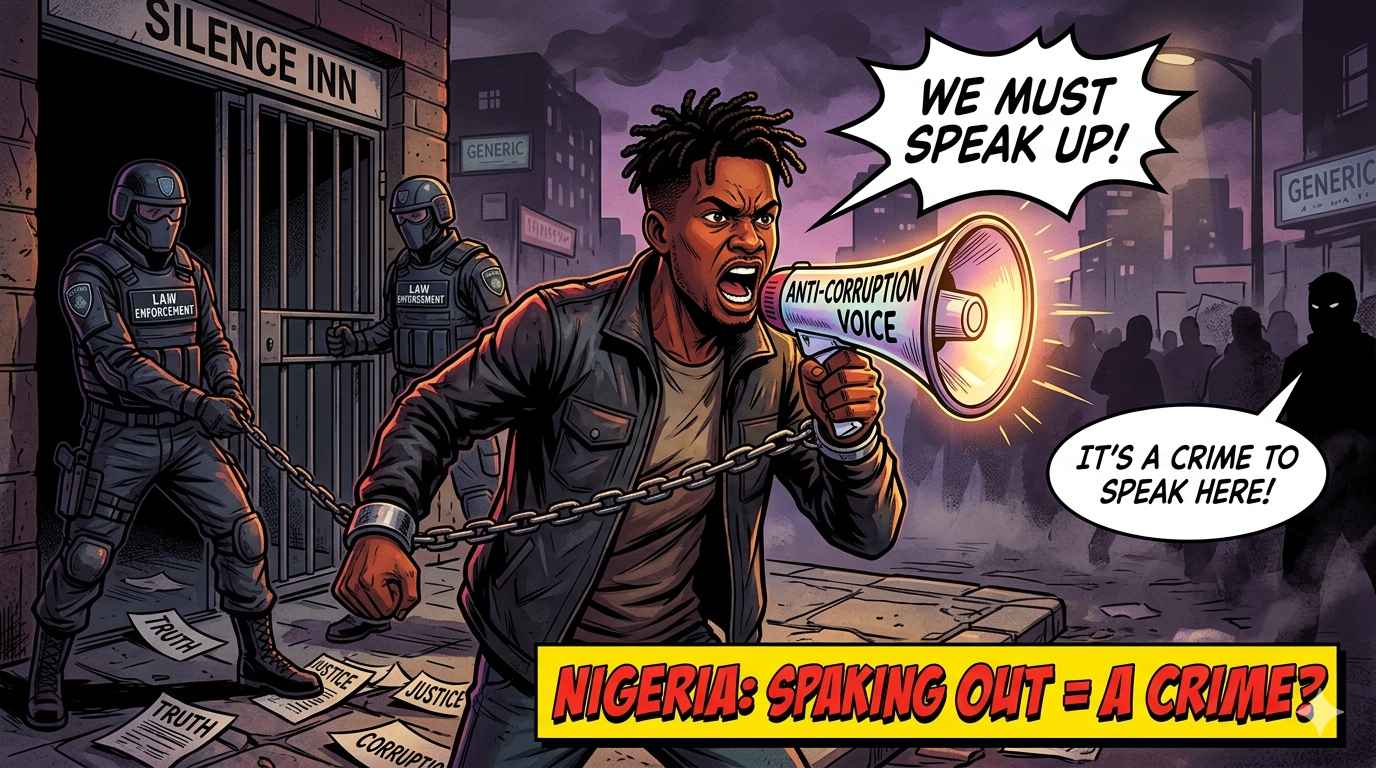
In Nigeria, Condemning Corruption Has Become a Crime. Here Is the Proof.
Two teachers were suspended for showing the world their broken classroom. A woman was allegedly beaten for posting a school video on social media. An advocate for frontline soldiers was allegedly chained to a tree for asking why soldiers were hungry. A corps member had her certificate withheld for saying the N33,000 allowance was not enough. Students were sent home from university for demanding a more effective transportation structure. In Nigeria, speaking up has become punishable. Silence, it turns out, is the only civic duty the government consistently enforces.
Let us start with a letter. It was dated May 18, 2026. It was signed by the Education Secretary of Ezza-North Local Government Area, Ebonyi State. And it said, in the crisp language of bureaucratic audacity, that two head teachers from a community primary school were hereby “suspended indefinitely” for “gross misconduct” and for “sabotaging the effort of our education-loving governor of Ebonyi State, Francis Nwifuru.” What had the teachers done? They were accused of being responsible for the circulation of a viral video showing the school’s classrooms: unfinished block walls, no furniture, children learning on bare concrete floors in a building that had not been fit for purpose in years. The school was real. The conditions were real. The video was real. And the government’s response was to suspend the people who worked inside the building rather than fix the building. This is impunity in Nigeria in its purest, most operatic form. Not the impunity of the gun or the baton, though that comes later in this article. The impunity of the filing cabinet. Of the official letterhead. Of the bureaucrat who can punish the person who named a problem without once being asked to solve it.
Francis Nwifuru’s “Education-Loving” Government and the Classroom With No Walls
Francis Ogbonna Nwifuru
Governor Nwifuru is described in the suspension letter his subordinates issued as “education-loving.” This is the formal official description of a governor whose state’s education ministry, in that same moment, suspended two teachers not for failing the children in their care, but for failing to keep the failure quiet. Channels Television confirmed the suspension, signed by LGA Education Secretary Francis Nwonunku, which directed the teachers to hand over all government property immediately. Following national outrage, Governor Nwifuru reversed the suspension on May 21, 2026, through his Senior Special Assistant on New Media, Leo Oketa. The government also noted it was “already undertaking massive school building projects in Oriuzor, Ezza North.” The teachers were unsuspended. The classroom in the viral video has not, as of this writing, been confirmed as renovated. The question the suspension letter never answered remains open: if the school is in that condition, who is responsible for it? Not the teachers, certainly. They did not build it. They did not fund it. They did not leave it to rot for years. They simply showed up and taught inside it, until the day someone filmed it and the government decided that was the misconduct worth punishing.
The Forum of South-East Academic Doctors (FOSAD) published a statement demanding reinstatement and calling the viral video “an urgent wake-up call demanding immediate government attention.” Their key line is worth sitting with: “The viral video should not be treated as an embarrassment to be suppressed, but rather as an urgent wake-up call.” The government’s first instinct was precisely the opposite. Suppress. Punish. Suspend. The embarrassment was the film, not the conditions that created it. That inversion, that reflex to shoot the messenger before reading the message, is not a bug in impunity in the Nigerian society. It is the entire feature set.
Eugene Chita Epelle and the Woman Who Filmed a School Nobody Was Fixing
Eugene Chita Epelle
On March 1, 2026, a young woman named Ogadinma Minnie Uchechi (also identified as Winnie Miller) posted a video on social media showing the deplorable condition of the only secondary school serving her community of Oduoku in Ahoada West, Rivers State. According to her account, reported by SaharaReporters, the council chairman, Eugene Chita Epelle, came to her home the following Sunday around noon. He confronted her mother, told her the video had generated too many phone calls, and instructed his brother, Monday Chita Epelle, to physically assault her. She was allegedly strangled. She showed neck injuries to cameras. She said: “If not for the intervention of my neighbors, he would have succeeded in killing me like he said.” The chairman later denied the accusations. He claimed he had only stopped by because he knew the family. The Punch editorial board called for his immediate resignation. A coalition of Civil Society Organisations under the Human Rights Clinic wrote to the Commissioner of Police demanding investigation, arrest, and prosecution. VeryDarkMan gave the chairman two weeks to fix the school. An alleged N2.5 million was transferred to Uchechi’s account which she publicly rejected, saying she had not consented to any financial settlement. As of reporting in March 2026, no prosecution of the chairman has been publicly confirmed. The school that started everything remains the only secondary school in the community.
Two incidents. Two deplorable schools. Two different women who did what any responsible citizen should do: documented a failure, posted it, and asked for intervention. In both cases, the government’s reflexive response was not to examine the school. It was to examine the woman. In Ebonyi, the teachers were suspended. In Rivers, a woman was allegedly beaten. The school is never the problem. The person who showed you the school is the problem. This is impunity of the Nigerian political elite rendered in its most elementary and most revealing form.
In Nigeria, posting a video of a broken school can get you suspended, beaten, or both. Building the broken school in the first place? That is just governance. Nobody gets punished for that.
Anuoluwa Soneye, NarrivonSenator Elisha Abbo: On Camera, On Tape, On Senate Grounds
Senator Elisha Abbo
On May 11, 2019, a CCTV camera inside an adult toy shop in Wuse 2, Abuja, captured one of the most remarkable pieces of footage in Nigerian political history. In it, a man identified as Senator Elisha Abbo, then the youngest senator in the National Assembly, repeatedly slapped and physically assaulted a woman named Osimibibra Warmate, while an armed mobile police officer stood nearby. The officer’s response to watching a senator beat a woman? He attempted to arrest the woman being beaten. The footage is available on YouTube and has been viewed by millions. Abbo later admitted he was the man in the video, though he claimed the footage was “distorted.” In July 2020, a Zuba magistrate court dismissed criminal charges against him, despite the video evidence and his own partial admission. In September 2020, the FCT High Court ordered him to pay N50 million in damages to Warmate in a civil suit. He paid the civil damages. He completed his senatorial term. He suffered no loss of his legislative seat. The police officer who tried to arrest the victim, rather than the senator who assaulted her, has never been publicly named or held accountable for that choice.
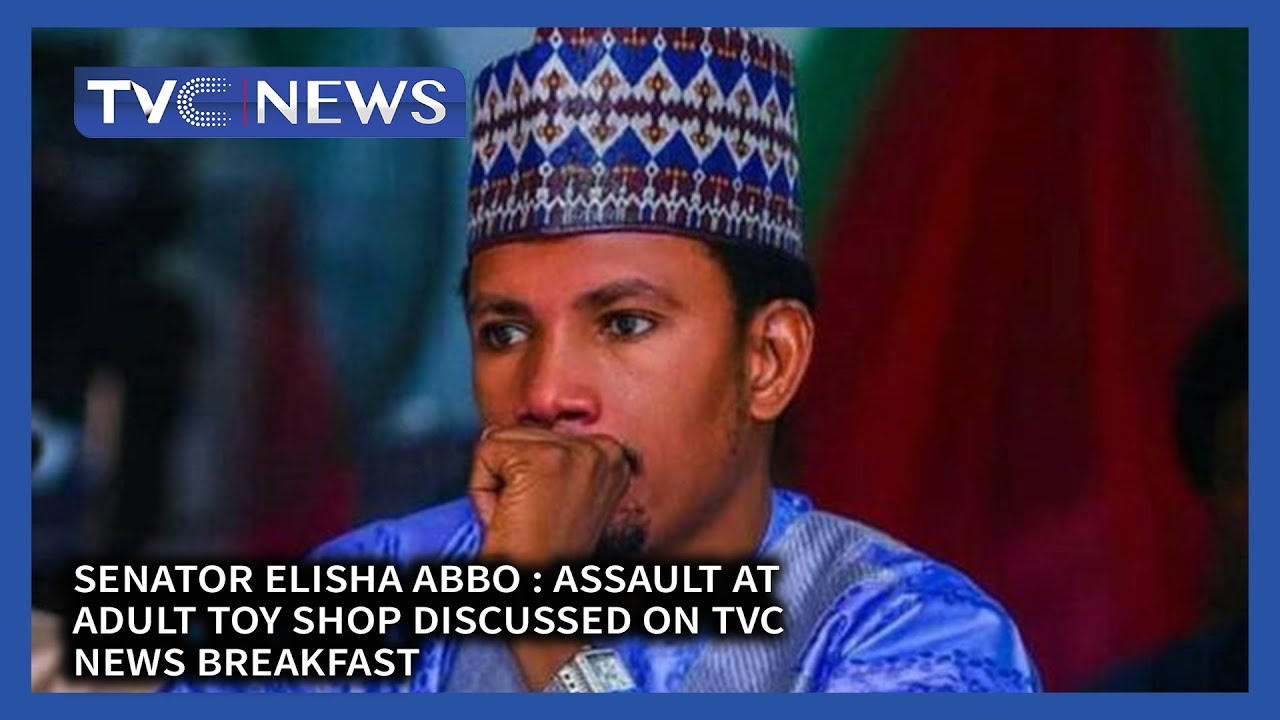
The Abbo case is important because it crystallizes the argument this article is making with forensic clarity. Here is a sitting senator, caught on professional CCTV footage, committing an assault. The footage is clear. His face is visible. The victim is in tears. The police officer present chooses to protect the powerful, not the assaulted. Criminal charges are filed. Criminal charges are dismissed by a court. A civil award is made. The senator returns to the Senate, votes on legislation, represents his constituents, and serves out his term. No suspension. No recall. No consequence from the institution he served. The Senate Ethics Committee looked and apparently did not look hard enough. Compare this to a teacher in Ebonyi who may have filmed a classroom on a phone, and received an indefinite suspension within days. The camera is the same. The Nigerian legal system is not. Impunity in Nigeria is not random. It has a consistent direction: away from the powerful and toward the powerless.
“Power does not corrupt. Fear corrupts. Perhaps the fear of a loss of power.”
John Steinbeck, The Short Reign of Pippin IV, 1957
From Justice Crack to Raye to OAU: A Consistent Curriculum in Silencing
The Ebonyi teachers, the Rivers woman, and Senator Abbo are three data points on the same graph. But the graph has many more. Justice Mark Chidiebere (Justice Crack) posted a video about Nigerian soldiers eating poorly. He was allegedly picked up by the military, chained to a tree for 72 hours, and is now facing court charges of distributing false information. His trial continues. Advocacy in Nigeria about what frontline soldiers are eating has become a prosecutable offence. The soldiers are still eating the same food. Justice Crack is still on bail.
Ushie Rita Uguamaye, the corps member known as Raye, posted a TikTok in March 2025 saying the N33,000 NYSC allowance could not feed anyone in Lagos. She said eggs that once cost N800 now cost N6,500. She said President Tinubu was a “terrible leader.” She was summoned. Her Local Government Inspector attempted to pressure her to retract the video. Her NYSC certificate was later withheld, which the NYSC attributed to a missed biometric clearance. Amnesty International called the timing into question and demanded the certificate be released. The certificate situation was eventually resolved after public pressure. But not before she had learned, publicly, what the cost of honest economic commentary can be in Nigeria.
In April 2026, students of Obafemi Awolowo University in Ile-Ife declared a lecture boycott because the campus transportation system introduced through a first lady donation was inadequate. They had a legitimate complaint. The buses were not working. The management’s response was to shut the entire campus for three weeks and send 35,000 students home. The appropriate response to “our buses are not working” was apparently to remove the students who needed the buses. And at the University of Lagos, the Students’ Union Government was banned for a period following student protests about tuition fee increases, because the right to organize around the issues that directly affect your education is, in Nigeria, a privilege that can be revoked by the same institution that benefits from your tuition.
The Nigerian government does not have a problem with people filming schools. It has a problem with people filming schools and then expecting the schools to be fixed. That expectation, apparently, is the crime.
Anuoluwa Soneye, NarrivonHow a Law Designed to Protect Nigerians Has Been Used Against Them
The Cybercrime (Prohibition, Prevention, Etc.) Act was introduced into Nigerian law to address genuine digital threats: fraud, hacking, identity theft, and the documented dangers of online criminal activity. Nigerian activists and free expression advocates have long warned that the legislation, as drafted and as enforced, creates a legal framework so broad that it can be, and has been, applied to anyone who posts content that embarrasses a public official or challenges a government narrative. The Act’s provisions on “cyberstalking” and “sending offensive messages” are drawn wide enough to encompass a tweet, a TikTok, a Facebook post, or a WhatsApp message that a sufficiently motivated official finds objectionable.
As we documented in our coverage of ASP Isokpehi, Nigerian police moved rapidly to investigate a blogger who criticized government policy while the same police system had historically been slow to investigate officers caught on camera committing assault. The Cybercrime Act sits at the center of this asymmetry. It gives the state a legal instrument for criminalizing commentary. It does not give citizens an equivalent instrument for holding the state accountable. Activism in Nigeria is therefore not a symmetrical activity. The citizen advocates with a phone and a moral obligation. The state advocates with lawyers, prosecutors, and legislation. The tools are not equal. And the outcomes confirm it.
The result is a documented chilling effect. As we explored in our examination of government complicity in insecurity, Justice Crack’s arrest happened within days of his army welfare post. The Raye case escalated within weeks of her TikTok. Ella, the BRT content creator, needed to issue a public safety statement after being threatened for filming a bus queue. Each of these cases teaches the same lesson to every person watching: document a problem and you become the problem. That is a curriculum and not a coincidence.
“Educate and inform the whole mass of the people. Enable them to see that it is their interest to preserve peace and order, and they will preserve them. And it requires no very high degree of education to convince them of this.”
Thomas Jefferson, Letter to Colonel Yancey, 1816
Speaking Up Must Not Be Punished. It Must Be Protected.
This article has documented a pattern. Not a theory. A pattern, with names, dates, letters, video evidence, and court records. Two teachers punished for a classroom the government had failed to build properly. A woman allegedly beaten for posting a video that community leaders had told her was the government’s responsibility to fix. A senator who assaulted a woman on camera and completed his full legislative term. An advocate for frontline soldiers allegedly chained to a tree for asking why soldiers were hungry. A corps member whose certificate was withheld for economic commentary. University students sent home for wanting better buses.
Every single one of these incidents involves the same fundamental act: a citizen documented a failure of governance and communicated it. Every single one of these incidents produced a response aimed at the citizen rather than the failure. The classroom was not renovated before the teachers were suspended. The school in Rivers State was not fixed before the woman was allegedly beaten. The senator’s seat was not revoked before the court awarded N50 million in civil damages. The soldiers’ food was not improved before Justice Crack was charged. Is speaking up in Nigeria a crime? Not officially. Not on paper. But in practice, in the lived experience of every Nigerian who has ever posted a video, filed a complaint, or said in public what they knew to be true about the institutions governing their lives, the answer arriving consistently from the system is: not a crime, but definitely punishable.
What does this produce? It produces the docility we have written about extensively. It produces the silence that protects bad governance. It produces the exhaustion that makes people stop filming schools and start scrolling past them. And it produces, ultimately, more broken schools, more hungry soldiers, more corrupt senators, because the feedback loop that tells power when it has failed has been systematically severed by the fear of consequence.
At Narrivon, we exist to say that this is not acceptable. Not because saying so is safe. But because staying silent is more dangerous. Every teacher who showed the world that classroom was doing the governor’s job better than the governor. Every woman who filmed a broken school and posted it was providing public accountability that the system failed to provide itself. Every activist who names a problem before the government acknowledges it is doing what citizens in a functional democracy are supposed to do.
The Nigeria of our dreams is not a Nigeria where classrooms are secretly deplorable and the secret is well kept. It is a Nigeria where a teacher can say “this classroom is broken” and the government says “thank you, we will fix it immediately,” not “you are suspended indefinitely.” Getting to that Nigeria requires citizens who refuse to accept the punishment of truth-telling as the price of civic participation. It requires people who will film the classroom anyway. Post the video anyway. File the complaint anyway. Show up to the town hall anyway. And who will not be silenced by a suspension letter, a visit from a chairman’s security personnel, or a clause in the Cybercrime Act that was never designed to protect them and is now deployed against them.
Advocacy in Nigeria is the minimum viable requirement for a functioning democracy. And every Nigerian who stays silent, deletes the post, or decides the risk is too high, makes the broken classroom a little more permanent and the education-loving governor a little more comfortable in his silence.
“The ultimate tragedy is not the oppression and cruelty by the bad people but the silence over that by the good people.”
Martin Luther King Jr., widely attributed
Frequently Asked Questions
Why were the Ebonyi teachers suspended?
Two head teachers from a community primary school in Ezza-North LGA, Ebonyi State were suspended indefinitely on May 18, 2026, after a viral video showed pupils learning in classrooms with unfinished block walls and inadequate facilities. The suspension letter, signed by LGA Education Secretary Francis Nwonunku, accused the teachers of gross misconduct and sabotaging the efforts of Governor Francis Nwifuru. Governor Nwifuru reversed the suspension on May 21, 2026, following national outrage.
What happened to the woman who posted a school video in Rivers State?
Ogadinma Minnie Uchechi (also identified as Winnie Miller), a resident of Oduoku community in Ahoada West, Rivers State, posted a video on March 1, 2026 showing the deplorable condition of the only secondary school in her community. She alleges that Executive Chairman Eugene Chita Epelle subsequently came to her home and instructed his brother to physically assault her. She showed neck injuries and rejected a N2.5 million payment she says was transferred without her consent. No formal prosecution of the chairman has been publicly confirmed.
What happened with Senator Elisha Abbo’s assault case?
Senator Elisha Abbo was caught on CCTV video assaulting Osimibibra Warmate at an adult toy shop in Wuse 2, Abuja on May 11, 2019. An armed police officer present attempted to arrest the victim rather than the senator. A magistrate court dismissed criminal charges in July 2020 despite the video evidence. The FCT High Court ordered Abbo to pay N50 million in damages in September 2020 in a civil suit. He served out his full senatorial term.
How is the Nigerian Cybercrime Act used against activists?
The Cybercrime Act’s broad provisions on offensive messaging and cyberstalking have been applied to journalists, bloggers, and activists who post content critical of public officials. Justice Mark Chidiebere (Justice Crack) was arraigned on three counts after posting an army welfare video. Corps member Ushie Rita Uguamaye (Raye) faced institutional retaliation after posting an economic commentary TikTok. Critics argue the Act functions more as a tool of intimidation than a protection of citizens.
Sources and Further Reading:
Ebonyi suspends two head teachers over viral classroom video (Channels TV, May 2026) •
Gov Nwifuru lifts suspension of Ebonyi head teachers (Channels TV, May 2026) •
Ebonyi government suspends head teachers over viral classroom video (EduGist, May 2026) •
Woman alleges Rivers council chairman ordered her beating (SaharaReporters, March 2026) •
Ahoada West chairman must go (The Punch editorial, March 2026) •
Woman beaten by Rivers LGA chairman rejects N2.5 million (AmiLoaded, March 2026) •
Court fines Senator Elisha Abbo N50m for assault (Channels TV, September 2020) •
Senator Elisha Abbo assault video (YouTube) •
NYSC’s retaliation against Raye (Leadership Newspaper, 2025) •
OAU sends students home for 3 weeks after protest (FIJ, April 2026)