
Corruption in Nigeria Does Not Just Steal Budgets. It Steals the Voice You Need to Fight It.
A Federal High Court sentenced a former acting Accountant-General to 72 years in prison in March 2026, and that sentence made national news precisely because it is so rare. A Dataphyte review of 393 corruption cases against public officials between 2013 and 2026 found that over 60 percent remain unresolved. Meanwhile, a police constable earns roughly N48,000 a month, and a full professor at a Nigerian university barely clears N500,000. This article is about the straight, unbroken line connecting those two facts, and why that line eventually runs through your own wallet.
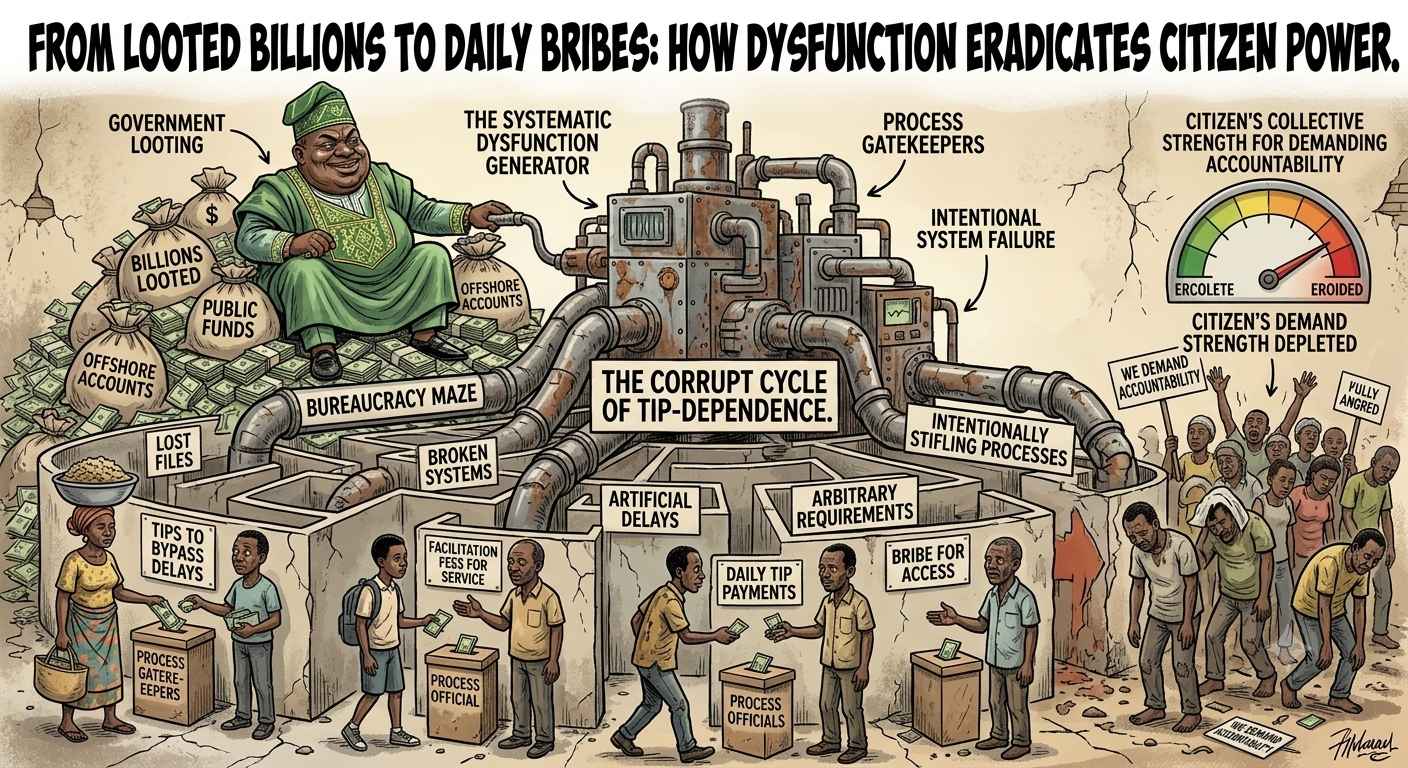
There is a particular kind of exhaustion that settles over a country when its citizens have watched the same play performed too many times. Someone in a position of enormous public trust is accused of diverting billions. There is outrage. There is a court date. There is an adjournment. There is another adjournment. There is, eventually, either a quiet acquittal, a technical dismissal, or a conviction that arrives so many years later it barely registers as news. Corruption in Nigeria operates on this delay as a design feature, not a malfunction. But this article is not simply about the scale of theft at the top. It is about something far more insidious: how that scale of theft, sustained over decades, has reshaped the moral architecture of everyday Nigerian life so completely that the average citizen, the person with no access to a single naira of stolen public funds, now finds themselves too compromised to demand the accountability the country desperately needs.
Looting in Nigeria: The Data Behind Why Nothing Seems to Stick
Let us start with the receipts, because vague outrage about corruption in Nigeria has never moved anyone to action the way specific numbers do. A Dataphyte data review of 393 corruption cases involving Nigerian public officials between 2013 and 2026 found that only 144 cases have reached final judgment, leaving more than 60 percent still pending in courts across the country. Across those cases, a combined total of N3.61 trillion, $1.33 billion, and €26,170 has been linked to the corruption allegations reviewed. The data revealed a telling pattern: of 35 former governors prosecuted over the fourteen-year period, cases involving elected officials took an average of 6 to 15 years to reach judgment, compared to 2 to 5 years for appointed officials such as ministers and agency heads. Former Abia State Governor Orji Uzor Kalu was arraigned in 2007 and convicted in 2019, a twelve-year trial, only for the conviction to be overturned by the Supreme Court in 2020 on a technicality. Former Taraba State Governor Jolly Nyame was charged in 2007 and finally sentenced in 2018, eleven years later.
There are exceptions that prove how rare timely justice actually is. In March 2026, a Federal High Court in Abuja sentenced former acting Accountant-General of the Federation Chukwunyere Nwabuoku to 72 years in prison after finding him guilty on nine counts of money laundering connected to an alleged N868 million fraud committed while he served as Director of Finance and Accounts in the Ministry of Defence. He was arraigned in January 2025, and the conviction arrived just 14 months later, a timeline Dataphyte’s own analysis flagged as unusually fast by Nigerian standards. That rarity is the point. The system can move quickly when it wants to. It usually does not want to.

How Corruption in Nigeria Underfunds the People Meant to Protect and Serve You
Here is the direct, mechanical link between billions allegedly diverted at the top and the quality of daily governance you experience. Every naira that disappears into an unresolved court case is a naira that did not go into the budget line for police welfare, academic salaries, or civil service reform. A Nigerian police constable earns approximately N48,113 at entry level under the Consolidated Police Salary Structure, with rank-and-file officers reportedly taking home between N65,000 and N90,000 monthly including allowances as of 2026. Officers in barracks do not qualify for the rent allowance at all, and multiple documented reports over the years have described the physical condition of Nigerian police barracks as severely dilapidated, overcrowded, and lacking basic sanitation. A full professor at a Nigerian federal university, the highest rung of the nation’s academic ladder, someone who has spent a minimum of a decade earning a doctorate and building a research career, earns a monthly salary that frequently sits below N500,000 depending on the institution and length of service.
This is not a coincidence of poor budgeting. It is the direct arithmetic consequence of a system where looting in Nigeria at the top competes with, and consistently wins against, adequate institutional funding at the base. When N109.5 billion allegedly walks out of the Accountant-General’s office, that is not merely an abstract loss. It is a specific, quantifiable subtraction from what could have funded police welfare reform, university endowments, or civil service pay restructuring for that fiscal year. As we documented in our coverage of the Justice Crack arrest, soldiers’ poor feeding conditions became such an open secret that a young activist was allegedly detained for filming it. The soldiers were still eating the same food after his arrest. The system did not fix the underlying scarcity. It simply punished the person who pointed at it.
Police constable, entry level: approximately N48,113 to N90,000 monthly with allowances
Full professor, Nigerian federal university: frequently below N500,000 monthly
Corruption cases against public officials, 2013 to 2026: 393 reviewed, over 60 percent still unresolved
Total value linked to those 393 cases: N3.61 trillion, $1.33 billion, and €26,170
Corruption in Nigeria Trickles Down: From the Checkpoint to the University Secretariat
An underpaid institution does not simply suffer in silence. It adapts, and the adaptation is rarely pretty. When a constable earning barely enough to feed a family is posted to a highway checkpoint with the discretionary power to detain a vehicle, the incentive structure writes itself. The Guardian Nigeria documented how multiple checkpoints and extortion along Nigerian trade corridors have become a significant deterrent to investors and businesses, with goods delayed and costs inflated simply to move legally acquired cargo from one point to another. This is not a story about a few bad apples. It is the predictable behavior of an institution that has been starved of the resources to function on salary alone, and has quietly filled the gap with informal, extralegal taxation of the public it is meant to serve.
The same pattern replicates itself everywhere the underpaid civil service meets the public. The passport office clerk who could process your application in the standard timeframe suddenly discovers that timeframe stretches indefinitely unless a “special arrangement” changes the calculus. The university bursary staff member who could release your certificate on schedule finds a reason to delay it until an “appreciation” appears. The NEPA or now Discos meter technician who could fix your connection during a routine visit finds the fault more complicated than it is, until a tip resolves the complexity instantly. None of this is coincidental inefficiency. It is a functioning, if deeply unjust, alternative economy that fills the exact vacuum left by inadequate institutional funding, which itself is the direct downstream consequence of the billions that disappear upstream and are never recovered through Nigeria’s painfully slow justice system.
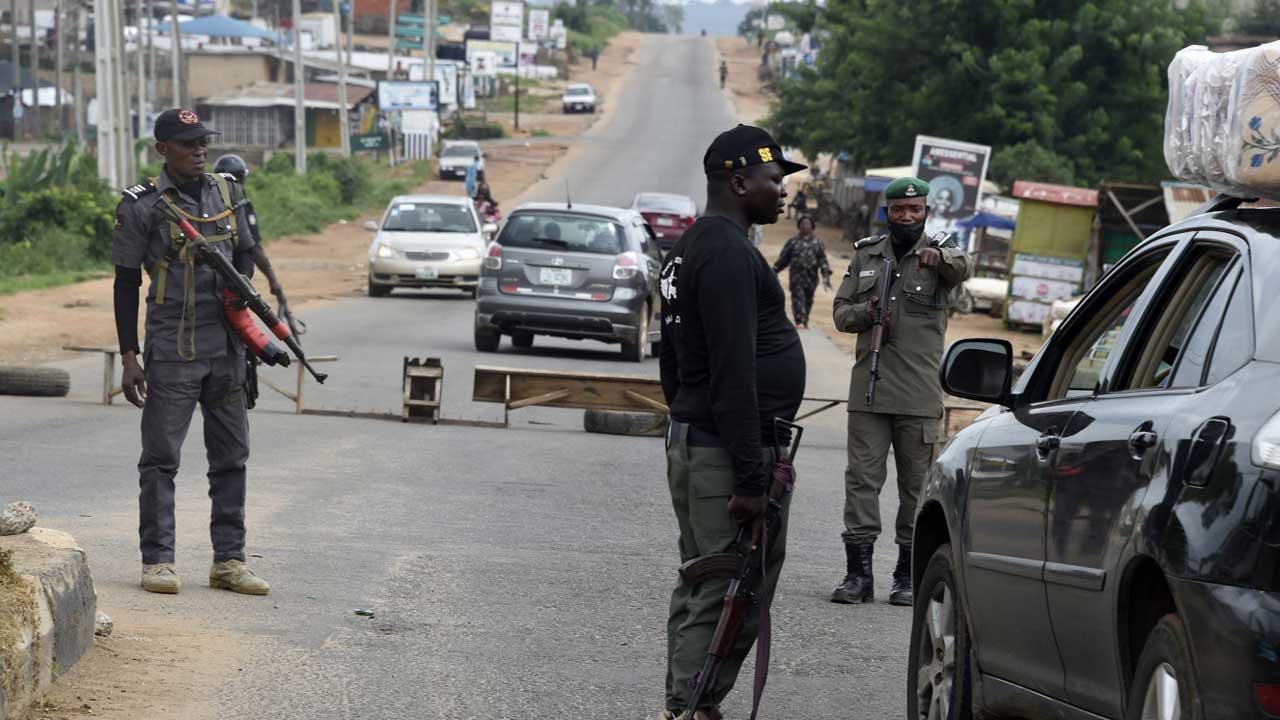
A constable earning forty eight thousand naira a month is not a moral failure waiting to happen. He is the predictable output of an institution starved by decades of unrecovered looting. The checkpoint bribe he asks you for is a symptom. The disease is the billion that never came back.
Anuoluwa Soneye, NarrivonHow Corruption in Nigeria Recruits Ordinary Citizens Into Its Own System
Here is where this article asks something uncomfortable of the reader, because honesty requires it. Consider the last time you needed something from a Nigerian institution urgently. Perhaps it was a passport, needed within days for an unexpected travel emergency, and the standard processing timeline simply would not accommodate reality. Perhaps it was your National Youth Service Corps posting, and the thought of being sent to a remote community with no functioning healthcare, unreliable electricity, and a six-hour journey from anywhere familiar felt genuinely unbearable, especially when insecurity has made cross-country travel itself both dangerous and, given fuel and transport costs currently running as high as half a month’s minimum wage for a single long-distance trip, prohibitively expensive. Perhaps it was your car particulars, fully complete and valid, and yet a police officer at a checkpoint found a reason to detain you until a “settlement” resolved the confusion.
In each of these situations, a significant number of Nigerians make a small, quiet, understandable decision to pay something to move the process along. This is not a defense of that decision. It is an acknowledgment of the trap it represents. Once you have paid to influence your NYSC posting, once you have tipped a civil servant to do the job they are salaried to perform, once you have settled an officer at a checkpoint rather than endure an unnecessary detention, you have become, in the smallest possible way, a participant in the exact system of informal, extralegal transaction that you are simultaneously furious at when you see it practiced at the scale of billions by a senator or a minister. This does not make you equally culpable. Scale matters enormously, and there is a vast moral distance between a citizen paying survival money to a checkpoint officer and a public official allegedly diverting N109.5 billion in fraudulent contracts. But the psychological effect on your own willingness to demand accountability is real and well documented in behavioral research on corruption normalization: participation, even coerced or survival-driven participation, quietly erodes the conviction required to demand change from a position of complete moral clarity.
Corruption in Nigeria and the Family Line: When Survival Produces Its Own Compromises
Extend this logic one step further, into a space many Nigerians are reluctant to discuss openly. As legitimate economic pathways narrow under the weight of inflation, unemployment, and a business environment made harder by exactly the checkpoint extortion and institutional dysfunction already described, survival pressure has pushed a measurable number of Nigerian households into some relationship, direct or adjacent, with illegal income. This does not require every household to have a family member running an internet fraud operation, though such cases are documented and prosecuted regularly by the EFCC. It can be as indirect as a relative who accepts payment to bypass a queue, a cousin who works a customs desk and occasionally facilitates undeclared goods for a fee, or a nephew whose primary income source nobody in the family asks too many pointed questions about, because the money helps with school fees that would otherwise go unpaid.
The honest question this article poses is this: how loudly can a household reasonably demand justice and accountability from the top when it is quietly benefiting from, or has simply chosen not to interrogate, a smaller version of the same dysfunction closer to home? This is not an argument for silence. It is an argument for clarity about why silence has become so widespread. As we examined in our psychological analysis of corruption in Nigeria, the normalization of small-scale compromise across an entire society does not happen because Nigerians lack a moral compass. It happens because a functioning moral compass requires the economic security to act on its readings, and that security has been systematically eroded by the very corruption the compass is trying to point toward.
“He who is not able to live with his own conscience becomes the accomplice of those who have none.”
Adapted from classical moral philosophy, widely cited in anti-corruption discourse
Corruption in Nigeria Can Be Confronted, But Only If We Reclaim the Moral Ground It Has Taken From Us
This article has not been an argument that ordinary Nigerians are equally responsible for the state of the nation as the officials facing 393 documented corruption cases. That would be a dishonest equivalence, and this publication does not deal in dishonest equivalences. What this article has argued is more precise: that corruption in Nigeria at the scale we have documented, from the N3.61 trillion linked to unresolved cases to the individual constable earning less in a month than a single checkpoint shakedown can sometimes net in a week, creates the exact conditions under which ordinary citizens become quiet, reluctant participants in smaller versions of the same broken logic, simply to survive institutions that have been deliberately starved of the resources to function honestly.
Recognising this trap is the first step toward escaping it, not an excuse for staying inside it. A citizen who understands precisely why they felt compelled to pay a small bribe last Tuesday is far better positioned to demand structural change than one who pretends the compromise never happened. As we explored in our detailed breakdown of the true cost of looting in Nigeria, every voice that names a specific allegation, follows a specific court case to its conclusion, or refuses to let a scandal fade quietly out of public memory raises the long-term cost of impunity for the people still considering it. That work does not require moral perfection from the person doing it. It requires only the willingness to keep demanding, loudly and specifically, that the institutions failing us be adequately funded, properly staffed, and genuinely held accountable, so that the constable, the professor, and the civil servant no longer need an informal economy to survive, and so that neither do we.
At Narrivon, we believe the Nigeria of our dreams is not built by citizens waiting to become perfectly uncompromised before they speak. It is built by citizens who act right where they can, who speak up even while acknowledging their own imperfect position within a deeply imperfect system, and who have the guts to demand more from the institutions that created the very conditions forcing so many of us into small, survival-driven compromises in the first place. The billions will not return themselves. The checkpoints will not disappear on their own. But every voice added to this demand chips away, slowly, at a system that has counted on our silence and our shame for far too long.
Frequently Asked Questions About Corruption in Nigeria and Institutional Dysfunction
How many corruption cases in Nigeria actually reach conviction?
A Dataphyte review of 393 corruption cases involving Nigerian public officials between 2013 and 2026 found that only 144 cases, roughly 40 percent, have reached final judgment. More than 60 percent remain unresolved at various stages of trial. Cases involving elected officials such as governors typically take 6 to 15 years to reach judgment, while cases involving appointed officials like ministers are generally resolved faster, within 2 to 5 years.
How much does a Nigerian police officer earn?
As of 2026, a Nigerian police constable earns approximately N48,113 monthly at entry level under the Consolidated Police Salary Structure (CONPOSS), with rank-and-file officers reportedly taking home between N65,000 and N90,000 including allowances following a partial salary structure review. Officers residing in barracks do not qualify for the rent allowance, which otherwise ranges between N30,000 and N50,000 monthly for those in private accommodation.
What is the connection between large scale corruption and small scale bribery in Nigeria?
Large scale corruption in Nigeria, involving billions of naira allegedly diverted through fraudulent contracts and unrecovered public funds, directly reduces the resources available to adequately fund institutions like the police, civil service, and academia. This underfunding creates conditions where underpaid officials and workers develop informal, extralegal means of income, such as checkpoint extortion or requiring tips for basic services, which in turn draws ordinary citizens into small-scale bribery simply to access services they are legally entitled to.
Why do ordinary Nigerians find it difficult to demand accountability for corruption?
Sustained institutional dysfunction driven by large scale corruption in Nigeria often forces ordinary citizens into small, survival-driven compromises, such as paying bribes for passports, NYSC posting preferences, or basic civil service processes. This participation, even when coerced by economic necessity, can psychologically weaken a citizen’s sense of moral standing to demand systemic accountability, contributing to widespread civic fatigue and reduced willingness to speak up against corruption at higher levels.
Sources and Further Reading:
60% of corruption cases among public office holders in Nigeria remain unresolved (Dataphyte, April 2, 2026) •
N868m fraud: Court sentences ex-Accountant-General Nwabuoku to 72 years (Channels Television, March 23, 2026) •
Nigerian Police Salary 2026: CONPOSS Pay by Rank •
Investors shun Nigerian ports due to multiple checkpoints, extortion (The Guardian Nigeria) •
EFCC arrests 52 Yahoo Yahoo boys in Benin (PM News Nigeria, May 2021)