Demarketing Nigeria: Who Is Really Doing It and Where Are They Standing?
A man facing N80 billion in money laundering charges was cleared by his party to run for the Senate. Another man under probe for N1.3 trillion allegedly went quiet after defecting to the ruling party. The president’s son was accused of paying Nigerians abroad to cheer. And the government says it is the citizens who are demarketing Nigeria. We have questions. More importantly, we have receipts.
Here is a question worth asking, very slowly and very clearly: what, exactly, is demarketing Nigeria? Is it the teacher who filmed a broken classroom and was suspended? Is it the woman who posted a video of a dilapidated school and was allegedly beaten by the local government chairman? Is it the corps member who said the N33,000 allowance could not buy eggs in Lagos? Is it the soldier who complained about his food to a blogger who was then arrested? Because if the answer to any of those questions is yes, then who is demarketing Nigeria is apparently anyone who points a camera at the reality of it. But if the question is taken seriously, if we genuinely want to know what is putting Nigeria in bad light before the world, then the answer is not in the phone of a secondary school student in Ahoada West. It is in the court rooms of Maitama, in the EFCC detention facilities, in the social media videos from London, and in the senatorial clearance forms signed by a party that looked at a man with 19 pending money laundering charges and said: yes, this is who we want to send to the National Assembly. Welcome to the real story of marketing and demarketing Nigeria.
Ex-Gov Yahaya Bello: N80 Billion in Court, Senate Ticket in Hand
Alhaji Yahaya Adoza Bello, @OfficialGYBKogi
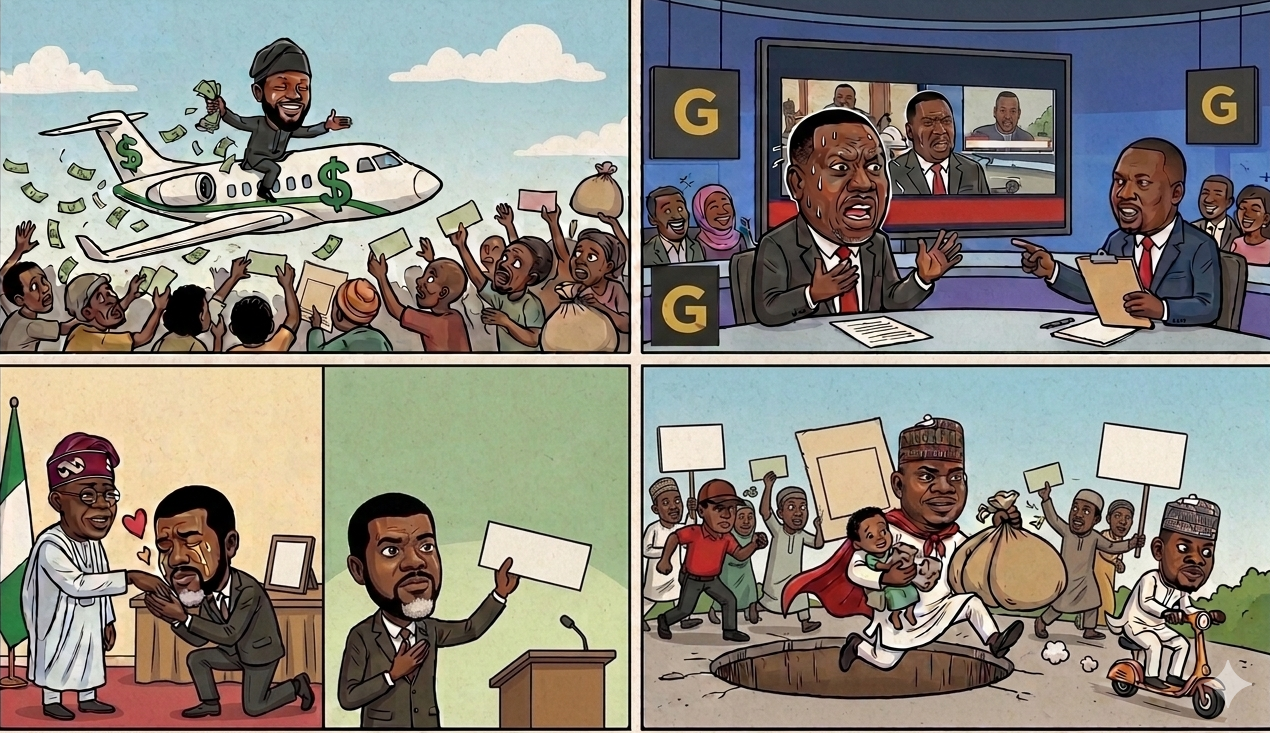
For eight years, Alhaji Yahaya Bello governed Kogi State. A state where civil servants reportedly went months without salaries. A state where electricity, roads, and functional healthcare remained aspirations rather than infrastructure. A state where the internally generated revenue remained among the lowest in the federation. When Bello handed over in January 2024, he left behind not a legacy of development but a set of bank records that the EFCC found very interesting. The EFCC prosecution, confirmed on the EFCC’s own website, has presented evidence to court showing that N1.09 billion was withdrawn from the Kogi State Government House Administration Account in just three days. Bello was charged on 19 counts of money laundering totalling N80,246,470,088.88. He was initially declared wanted, then appeared at the EFCC in a dramatic September 2024 episode in which the commission reportedly declined to arrest him, only to try to arrest him later at the Kogi State Government Lodge. He eventually surrendered in November 2024, was arraigned in December 2024 before Justice Emeka Nwite of the Federal High Court, Maitama, Abuja, and pleaded not guilty to all 19 counts. Despite this ongoing trial, the APC cleared him to contest the Kogi Central Senatorial seat in May 2026. Yahaya Bello wins Kogi Central ticket while his case is still in court. He denies all charges.
Let us look at what was presented in court, because the details matter. A prosecution witness testified that N46.5 million was transferred from the account of a company called Kunfayakun Global Limited to the American International School, Abuja (AISA), an elite private school, for the education of Yahaya Bello’s five children. Their names are confirmed in court documents: Zayan, Zara, Farid, Na’ima, and Nana Fatima Bello. The payments were made in US dollars. They were made in advance, enough to cover fees until each child graduated. This is not alleged. This is tendered in court, admitted as exhibits, and is on the public record of federal court proceedings.
Now hold that detail next to the children of Kogi State sitting on bare classroom floors. While their governor allegedly paid his children’s school fees in dollars, in advance, at one of the most expensive schools in the country’s capital, teachers who exposed broken classrooms were being suspended across Nigeria for drawing attention to what their students were sitting on. This contrast is not incidental. It is the story of demarketing Nigeria. Not the camera that filmed it. The conditions that required filming.

Ex-Governor Okowa and the Case That Got Very Quiet After a Party Change
Dr Ifeanyi Arthur Okowa
In November 2024, the EFCC arrested former Delta State Governor Ifeanyi Okowa at its Port Harcourt office. The Punch, which broke the story, confirmed through EFCC sources that Okowa was being investigated over the alleged diversion of N1.3 trillion in 13% derivation funds from the Federation Account between 2015 and 2023, the period of his governorship. He was also accused of failing to account for an additional N40 billion allegedly used to acquire shares in UTM Floating Liquefied Natural Gas. After spending two nights in EFCC custody, he was granted administrative bail. His international passport was seized and he was barred from traveling. Less than six months later, in April 2025, Okowa, his successor Governor Sheriff Oborevwori, and a large contingent of Delta State PDP legislators defected to the ruling APC. The EFCC, which had been vocal about his case in November 2024, went conspicuously quiet after the defection. By October 2025, the EFCC found it necessary to publicly insist, through its Director of Legal and Prosecution, that the investigation was still “active,” which is precisely the kind of statement agencies make when people have noticed the conspicuous silence. Okowa denies all allegations.
The EFCC and Okowa situation is a case study in what Nigerians have long suspected about anti-corruption institutions: the effectiveness of prosecution appears to correlate with the political convenience of prosecution. A governor accused of misappropriating N1.3 trillion is arrested in November. He joins the ruling party in April. By October, the investigation is still “ongoing” but somehow not ongoing enough to produce a courtroom. This observation is not an accusation of a deal. It is a documented sequence of events that, when placed before a watching world, communicates something clear and damaging about how Nigeria works. That communication is what is demarketing Nigeria before international investors, diplomatic partners, and multilateral institutions. Not the Nigerian citizen who shared the story. The story itself.
Seyi Tinubu, Abroad Nigerians, and the Optics of a Presidential Visit
During President Bola Tinubu’s official visit to the United Kingdom, videos emerged and circulated across Nigerian social media, X, TikTok, and WhatsApp, alleging that Seyi Tinubu, the president’s son, had paid Nigerians in the UK £500 each to show up and provide a welcoming crowd for the presidential visit. The YouTube video covering these allegations was widely shared and generated significant attention. The allegations, and the videos supporting them, reached not just Nigerians at home but Nigerians abroad, British journalists, and international observers who were already watching Nigeria’s political landscape with a particular kind of sustained skepticism.

Whether the specific allegation is proven or not, the mere fact that it was believable, that millions of Nigerians looked at it and said “of course,” is itself the answer to the question of who is demarketing Nigeria. A country whose political culture has normalized the purchase of crowds, the rental of support, and the theatre of manufactured enthusiasm does not get the benefit of the doubt when its government officials are accused of doing exactly that in foreign capitals. As we have documented in our coverage of how Nigerian politicians weaponize poverty, the currency of Nigerian political engagement, from the ward level to the presidential level, is often the handout. Rice in traffic. Cash in envelopes. And allegedly, pounds sterling in London.
And then there are the “Renewed Hope” campaign posters and banners spotted in foreign locations during presidential visits, which prompted the entirely reasonable question: if the renewed hope is for Nigeria, why is it being advertised abroad? The answer, presumably, is that the hope needs to be made visible wherever the cameras are. And the cameras are increasingly also in the hands of Nigerians abroad who are asking why a country with 95 million people in poverty is spending on political branding in Europe rather than school furniture in Kogi State.
Reno Omokri, Daniel Bwala, and the Problem with Our Ambassadorial Face
Nigeria’s image abroad is not made only by its governors and their court cases. It is also made by the people it appoints to speak for it. As Narrivon documented in detail in our examination of political amnesia in Nigeria, two of the most prominent voices representing the Tinubu administration internationally are Reno Omokri and Daniel Bwala. Both men have a documented history of publicly made statements that were later publicly reversed after their alignment with power changed.
Reno Omokri, Nigeria’s Ambassador-designate to Mexico, spent years as one of the most withering critics of the political figures he now represents. His archive of commentary is publicly accessible and widely circulated. Daniel Bwala, appointed Special Adviser on Policy Communication, was a vocal opposition figure before becoming one of the administration’s most visible defenders. In a March 2026 Al Jazeera interview, he was pressed on the very positions he had publicly held before his appointment. The interview was not comfortable viewing.
“The reputation of a thousand years may be determined by the conduct of one hour.”
Japanese proverb
The question this raises is not personal. It is institutional. When a country’s official representatives have publicly documented records of saying the opposite of what they now officially maintain, the message it sends to foreign governments, international institutions, and global observers is that position in Nigeria is determined not by conviction but by proximity to power. If the people chosen to represent Nigeria’s interests and image are known for their political elasticity, then the natural conclusion any reasonable foreign observer will draw is that Nigerian political culture does not value consistency, integrity, or principled positions. That conclusion is not made by the citizens who document it. It is made by the behavior that makes it documentable.
World Bank Blocks Comments From Nigerians Over $1.25 Billion Loan Backlash
In May 2026, something happened that may be unprecedented in the history of multilateral lending institutions. Thousands of Nigerians flooded the World Bank’s Instagram page demanding that the institution stop approving loans for the Nigerian government. The trigger: reports that President Tinubu’s administration was seeking a fresh $1.25 billion loan, scheduled for board approval on June 26, 2026. The response from the public was immediate, loud, and organized. Nigerians descended on the World Bank’s social media accounts with one consistent message: stop lending money to a government that does not spend it on us. The World Bank restricted Instagram comments over the Nigeria loan backlash, as confirmed by The Punch on May 14, 2026. Nigeria Communications Week confirmed that the World Bank locked their comment section after the scale of the protest made their page unmanageable. The World Bank has locked their comment section because of Nigerians. That sentence deserves to sit alone.
Think about what this moment communicates to the world. World Bank blocks comments from Nigerians after a loan approval announcement. Not a protest on the streets. Not a press conference by opposition politicians. Comments. On Instagram. From ordinary Nigerians who looked at a $1.25 billion borrowing announcement and decided, collectively and publicly, that the only honest response was to tell the lender directly: do not give this money to our government. They have a record. World Bank restricts comments over Nigeria loan backlash is a headline that appeared in international tech media, Nigerian news, and financial commentary platforms simultaneously. It became a story not because it was manufactured but because it was genuine. A population’s documented distrust of its own government, expressed with enough volume to force a multilateral institution to disable public engagement on its page, is not a social media moment. It is a referendum. And this referendum is the most honest statement about demarketing Nigeria that the country’s leadership has ever produced. Not the citizens who wrote the comments. The governance record that made those comments feel necessary.

When the President Meets Victims at the Airport and Terrorists Get Graduation Ceremonies
The picture that demarketing Nigeria paints for the world is a very specific one. It is a picture in which bandits post TikTok videos announcing attacks on communities and remain free, while journalists who report on these attacks face arrest. As we explored in our investigation into whether the government is complicit in insecurity, the response to the insecurity crisis has been shaped more by optics than by outcomes. The president met grieving victims of a massacre at the airport rather than at the site of the massacre, choosing the logistics of a presidential visit over the symbolism of standing where people actually died. Meanwhile, 744 former terrorists received graduation ceremonies, certificates, and vocational training at state expense, with the Chief of Defence Staff comparing them to the biblical prodigal son. The families of their victims received condolence visits and press releases. This is the government’s response to insecurity in Nigeria, and it is watched by the same international community that is being asked to take Nigeria seriously as a safe destination for investment, diplomacy, and partnership.
And then there is the City Boy Movement. Seyi Tinubu launched it in Lagos as a youth political engagement vehicle. As we have analyzed before, Nigerian political campaigns have a consistent structure: palliatives before elections, silence after them. The City Boy Movement appointed Obi Cubana as South-East Coordinator and Cubana Chief Priest as Imo State Director. It distributes cash, goods, and attention in communities in ways that look less like civic engagement and more like purchasing loyalty in advance of a ballot. This approach to politics, which treats poverty as a tool and citizens as customers rather than constituents, is observed by the international community. And it communicates, with clarity, that Nigerian governance prioritizes the next election over the next generation.
Nigeria is not being demarketed by citizens filming broken schools. It is being demarketed by the governors who left the schools broken, the parties that cleared those governors for the Senate, and the sons of presidents who allegedly pay people to clap in foreign capitals.
Anuoluwa Soneye, NarrivonWho the World Sees When It Looks at Nigeria Is Who Nigeria Has Put in the Window
Here is the simplest answer to the question of who is demarketing Nigeria. The world does not learn about Nigeria from TikTok videos of broken classrooms. It learns about Nigeria from what Nigeria does to the people who film the broken classrooms. It learns from the fact that a man with 19 pending money laundering charges can be cleared for a national legislative seat. It learns from the probe that went quiet after a party switch. It learns from the diplomat whose publicly documented positions reversed completely when the paycheck changed. It learns from citizens petitioning international creditors not to trust their own government. These are not the actions of a nation that is being unfairly represented by its critics. They are the actions of a nation that keeps choosing, election by election, appointment by appointment, clearance by clearance, to put its most compromised faces in the front window.
This article is not a verdict on any person. Every allegation cited here is denied by the persons accused, and the courts have not concluded on the most significant of them. What this article is, is a record. A record of the cases that are confirmed to exist. Of the party decisions that are confirmed to have been made. Of the international image that those decisions produce. And of the gap between what the government calls demarketing and what actually makes the world look at Nigeria with skepticism.
Closing that gap does not start with arresting teachers for filming classrooms. It starts with building classrooms that do not need to be filmed. It starts with political parties that look at a candidate with N80 billion in charges and say: not yet. It starts with anti-corruption agencies that do not need to publicly assure the public that a probe is “still active” months after a high-profile party switch. It starts with diplomats and political representatives whose positions are consistent with their values rather than with the payroll. And it starts with citizens who refuse to accept that their job is to be quiet while their country’s image is damaged from the top, then blamed on them when they speak up about it.
At Narrivon, we believe that marketing Nigeria properly requires first being honest about what is demarketing it. And being honest about that requires exactly the kind of civic courage that the teachers in Ebonyi showed, that Winnie Miller showed in Rivers State, that Justice Crack showed about the army’s food. That courage is not the problem. It is the only path to the solution.
“The true test of a country’s greatness lies not in whether it has problems, but in whether it has the courage to confront them honestly.”
Adapted from Nelson Mandela, Long Walk to Freedom, 1994
Frequently Asked Questions
What is Yahaya Bello’s EFCC case about?
Alhaji Yahaya Adoza Bello, former Governor of Kogi State from 2016 to 2024, is being prosecuted by the EFCC on 19 counts of money laundering totalling N80.2 billion. Evidence tendered in court includes payments of approximately N46.5 million to the American International School, Abuja for his children’s school fees, paid in dollars and in advance until graduation. His trial is ongoing before Justice Emeka Nwite of the Federal High Court, Abuja. Despite the ongoing trial, the APC cleared him to contest the Kogi Central Senatorial seat in 2026. Bello has denied all charges, calling them politically motivated.
What is the Okowa EFCC case about?
Former Delta State Governor Ifeanyi Okowa was arrested by the EFCC in November 2024 over the alleged diversion of N1.3 trillion in 13% derivation funds from the Federation Account during his 2015 to 2023 tenure. He was also accused of N40 billion in unaccounted funds. After being granted administrative bail, his passport was seized. In April 2025, Okowa defected to the ruling APC. The EFCC in October 2025 insisted the investigation was still active. Okowa denies all allegations.
What happened with Seyi Tinubu and UK Nigerians?
During President Tinubu’s official visit to the United Kingdom, allegations circulated widely on Nigerian social media that Seyi Tinubu had paid Nigerians in the UK £500 each to show up and cheer for the president. The videos went viral and generated significant international attention. No official statement has conclusively addressed the specific allegation.
What is the City Boy Movement in Nigeria?
The City Boy Movement (CBM) was launched by Seyi Tinubu as a youth political movement in support of the Tinubu administration. Critics have described it as a politically motivated palliative-sharing vehicle operating ahead of the 2027 election cycle. Prominent figures including Obi Cubana were appointed as regional coordinators. Critics argue it represents a transactional approach to political support rather than genuine policy-based citizen engagement.
Sources and Further Reading:
EFCC: How N1.09bn vanished from Kogi Government Account in three days (EFCC, June 2025) •
Yahaya Bello paid children’s school fees in dollars, in advance (EFCC, March 2026) •
EFCC details N46.5m school transfers at Yahaya Bello trial (Daily Post, February 2026) •
Despite N80.2bn fraud case, APC clears Yahaya Bello for Senate (Pulse Nigeria, May 2026) •
EFCC arrests ex-Delta Governor Okowa over alleged N1.3 trillion fraud (The Punch, November 2024) •
EFCC claims Okowa N1.3 trillion probe ongoing despite APC defection (SaharaReporters, October 2025) •
World Bank restricts Instagram comments over Nigeria $1.25bn loan backlash (The Punch, May 14, 2026) •
World Bank blocks social media comments from Nigerians over loan backlash (Nigeria Communications Week, May 2026) •
EFCC declares Yahaya Bello wanted over alleged N80.2bn fraud (ICIR Nigeria, April 2024) •
Seyi Tinubu accused of paying UK Nigerians (YouTube)
Leave a Reply