
Understanding the Impact of Corruption on Nigeria: The Bill Nobody Actually Reads
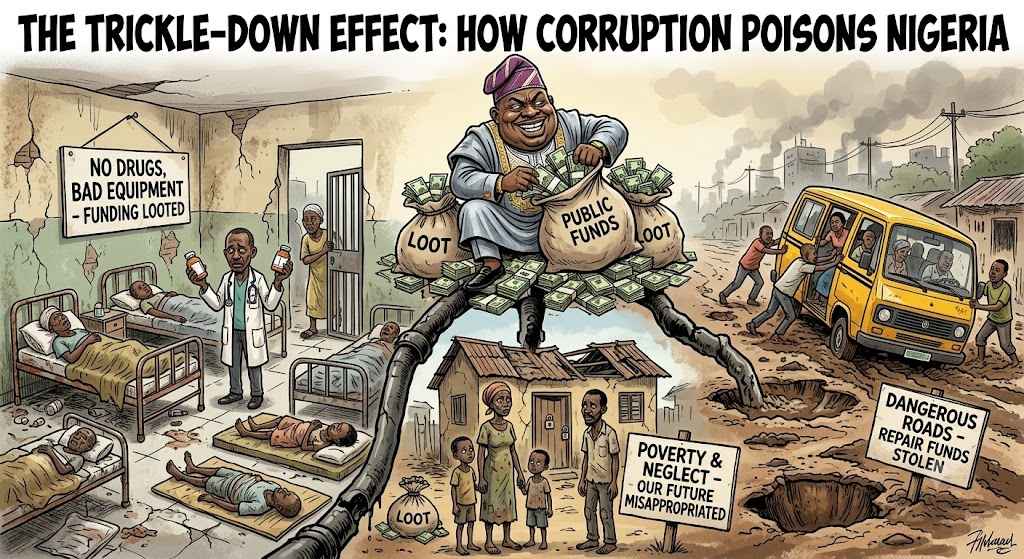
Six former senior Nigerian public office holders are currently in court over more than N394 billion in alleged diverted funds. That figure is so large it stops meaning anything the moment you read it. So let us make it mean something. N394 billion is not a number on a courtroom document. It is the road your neighbour’s father died trying to cross at night because there were no streetlights. It is the drug the hospital did not have when your cousin needed it. It is the pension your grandmother is still waiting for. Corruption in Nigeria does not steal money. It steals specific, individual, irreplaceable things from specific, individual, irreplaceable people. This article is about learning to see the second thing every time someone reports the first.
Nigerians have become fluent in a very particular kind of numbness. Someone reports that a former minister allegedly diverted N19.4 billion in contracts. We scroll past it the way we scroll past a weather forecast. Someone else reports N109.5 billion allegedly laundered through fraudulent government deals. We register it, mildly, the way you register a distant thunderclap, and move to the next post. This numbness is not stupidity. It is a coping mechanism developed over decades of exposure to figures too large to hold in the mind and too frequent to sustain outrage over. But corruption in Nigeria is not an abstraction happening somewhere else, to some entity called “the government,” with no bearing on your actual Tuesday. Every naira allegedly diverted was earmarked, in the government’s own budget documents, for something. A road. A hospital wing. A teacher’s salary. A pension fund. Looting in Nigeria does not simply vanish public money. It cancels a specific, budgeted plan to make your life measurably better, and replaces it with silence.
Looting in Nigeria: What N394 Billion in Alleged Fraud Actually Costs You
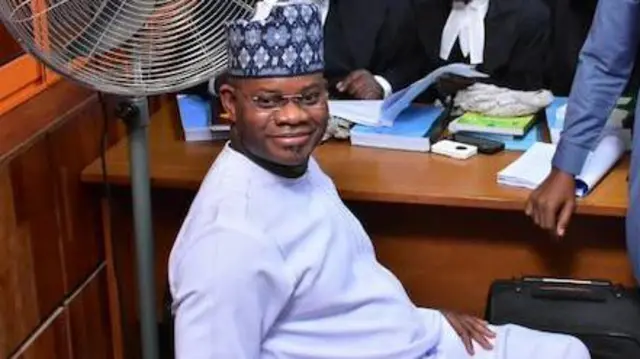
Let us look at what is currently sitting in Nigerian courtrooms, not as headlines, but as documented, ongoing legal proceedings. Six former senior public office holders are facing prosecution or have recently faced judgment over allegations involving more than N394 billion in diverted public funds, according to a documented compilation of active EFCC cases. Ahmed Idris, former Accountant-General of the Federation, was arrested in May 2022 over alleged money laundering and the diversion of about N109.5 billion through fraudulent contracts. He is separately standing trial on a 16-count charge covering an alleged additional N110.4 billion. Former Kogi State Governor Yahaya Bello faces a 19-count charge involving about N80.2 billion in public funds allegedly diverted during his tenure. Former Aviation Minister Hadi Sirika is on trial over an alleged N8.06 billion contract fraud, accused of awarding N19.4 billion in contracts connected to family members. All defendants in these cases have pleaded not guilty, and no final convictions have been secured in most of them as of this writing.
Nigeria’s average cost of constructing one kilometre of two-lane asphalt road, according to published federal budget breakdowns, ranges between N800 million and N1.2 billion depending on terrain and materials.
N109.5 billion, the amount Ahmed Idris allegedly diverted, could fund between 91 and 137 kilometres of new asphalt road at those rates.
Alternatively, at an average primary health centre construction and equipping cost of roughly N150 million, the same amount could fund over 700 fully equipped primary health centres.
This is illustrative arithmetic, not an audited government plan. But it demonstrates the scale of what a single alleged diversion represents in real infrastructure terms that ordinary Nigerians would have felt in their daily lives.
Corruption in Nigeria and the Injustice It Normalises: The Story of Bumpa’s Co-Founder
Sustained corruption in Nigeria does not stay contained within government ministries. It reshapes the entire system of consequence, until injustice becomes something Nigerians expect by default, regardless of a victim’s wealth or status. Adetunji “Teejay” Opayele, the 32-year-old co-founder and Chief Technical Officer of the successful Nigerian tech startup Bumpa, was killed on March 4, 2025, when his power bike, on which he was riding home from the gym along Ozumba Mbadiwe Road in Victoria Island, Lagos, was allegedly struck by a vehicle driven by Abiola Adams-Odutayo. According to the family’s petition and multiple confirmed reports, Adams-Odutayo allegedly refused to assist the injured Opayele at the scene because she did not want blood to stain her car. Bystanders reportedly had to convince a separate driver to transport him to hospitals that then refused to admit him. He was eventually taken to a general hospital, where he was pronounced dead.
Opayele co-founded Bumpa in 2018, a company that had processed over N160 billion in transactions for roughly 60,000 small and medium enterprises across Africa by the time of his death, and had secured $4 million in seed funding. He was, by any definition, a Nigerian success story, precisely the kind of person the “just make money and escape the system” mentality holds up as the goal. And yet, over 16 months after his death, as of the most recent confirmed court update, his trial remains unresolved, marked by repeated adjournments: for a bereaved prosecutor, for heavy rainfall, for extended cross-examinations. Amnesty International publicly called for justice in the case. Over 35,000 Nigerians signed a Change.org petition. None of it has yet produced a conclusion. This is the same institutional slowness that left Pelumi Onifade’s family waiting six years for a DNA confirmation. Money, success, and public sympathy did not accelerate Opayele’s case. This is the sharpest possible rebuttal to the idea that individual financial success is a substitute for a functioning justice system. You can build a company processing N160 billion in transactions and still become another case number in a court system too slow, too compromised, or too indifferent to deliver timely justice.
Corruption in Nigeria Becomes Impunity When It Is Sustained Long Enough to Feel Ordinary
When corruption in Nigeria persists for decades without meaningful consequence, it stops being a scandal and becomes simply how things work. This is the mechanism of impunity: repetition removes shame. Senate President Godswill Akpabio has an unresolved N108 billion probe that has never concluded, has been Senate President since 2023, and once told an EFCC chairman nominee during a Senate screening that arresting a former governor should not resemble “taking Pablo Escobar.” Nyesom Wike publicly called a uniformed naval officer a fool during a land dispute and faced no formal sanction. A fictitious government agency secured a N1.3 billion budget line, Federal Secretariat office space, and CBN accounts, and nearly a year passed before the matter became a public scandal. These are not isolated incidents. They are evidence of a system where the exhibition of impunity, in speech and in action, has become unremarkable enough to happen in full public view, on camera, without any expectation of consequence.
“Corruption, embezzlement, fraud, these are all characteristics which exist everywhere. It is important that we do not think that corruption is a natural characteristic of Africa.”
Wole Soyinka, Nigerian Nobel Laureate, widely cited
Impunity has an economic signature as clearly as it has a moral one. When theft is punished rarely and inconsistently, the rational calculation for anyone with access to public funds shifts. The risk of consequence becomes small enough to discount against the near-certainty of reward. This is not a uniquely Nigerian psychological failure. It is basic incentive structure, and it explains why 60% of corruption cases involving public office holders in various documented anti-corruption assessments never reach prosecution, let alone conviction. The absence of consistent consequence is not a side effect of the corruption problem. It is the engine that keeps producing more of it.
Corruption and Embezzlement of Public Funds: How the Poverty Gap Gets Built, One Diversion at a Time
The economics of corruption and embezzlement of public funds is not complicated once you strip away the scale. Imagine a village where the community fund, meant to build a well for everyone, is instead taken by three people who use it to dig private wells on their own land. The village still has no water. The three people now have wells, land value, and the resources to extract even more from the community’s shared systems going forward. Scale that pattern by a factor of 220 million people and several decades, and you have Nigeria’s current wealth distribution. A small number of individuals and families have accumulated resources so vast that they operate in an entirely different economic universe from the majority. The vast majority operate in a system that was structurally starved of the investment needed to give them a fair chance.
This is the effect of corruption on economic development in its most direct form. Development requires compounding public investment: a functioning school system that produces a skilled workforce, functioning roads that reduce the cost of moving goods, functioning healthcare that keeps that workforce alive and productive. Each act of diversion is not simply a one-time loss. It is a broken link in a compounding chain that was supposed to build toward broader prosperity over time. As we have documented in our analysis of how Nigerian politicians weaponise hunger for votes, the same poverty created by decades of diversion is then leveraged politically to secure the very power that enables further diversion. It is a closed loop, and breaking it requires citizens who refuse to participate in either half of the cycle.
Looting in Nigeria and the National Image Cost Nobody Budgets For
There is a cost to corruption in Nigeria that never appears in any EFCC press release, because it is not measured in naira. It is measured in visa rejections, in the extra scrutiny Nigerian passports receive at foreign airports, in the blanket suspicion that follows Nigerian business proposals in international markets. When the world repeatedly watches billions allegedly disappear from Nigerian public accounts with minimal consequence, it forms a national image, fair or not, that treats every individual Nigerian as a potential extension of that pattern. Someone once described this dynamic as “demarketing Nigeria,” and the phrase captures something precise: the country’s brand, in the eyes of international partners, investors, and immigration officers, has been shaped less by the talent and integrity of its majority than by the visible, repeated failures of a minority who were never adequately held accountable.
This creates a genuinely tragic feedback loop. Nigerians, denied fair opportunities abroad partly because of this national image problem, sometimes turn to increasingly desperate, occasionally illegal, means to access those same opportunities, which then reinforces the very stereotype that excluded them in the first place. As we examined in our coverage of the World Bank comment lockdown following the $1.25 billion loan backlash, Nigerians themselves are acutely aware of this dynamic, which is precisely why so many flooded international institutions demanding they stop extending credit to a government whose track record with public funds remains this contested.
The value of a Nigerian’s life is roughly the quality of the institutional systems they are born into, multiplied by the resources they manage to gather, while accounting for the fact that gathering those resources inside a broken system takes several times the effort it should. Corruption in Nigeria does not just steal money. It sets the multiplier against every single citizen from birth.
Anuoluwa Soneye, NarrivonCorruption in Nigeria Will Not End Itself. Every Documented Voice Is Still Part of the Cost-Benefit Calculation.
This is the question that ends every honest conversation about corruption in Nigeria: so what should we do? The hopelessness behind that question is understandable and deserves a real answer, not a slogan. Here is the honest one. Individual voices rarely stop a single act of corruption in the moment it happens. What individual, documented, persistent voices do is raise the long-term cost of impunity for the people considering it. Every article that names a specific allegation with its exact figures. Every petition that keeps a case like Adetunji Opayele’s in public view past its sixteenth adjournment. Every citizen who reads a court update rather than scrolling past it. Every person who refuses to accept “sophisticated crime” as an adequate explanation for a fake government agency getting a real budget line. These are not symbolic gestures. They are inputs into the same incentive calculation that currently favours theft. When the reputational, social, and eventually legal cost of corruption rises consistently enough, the calculation shifts, slowly, imperfectly, but genuinely.
A better Nigeria cannot be achieved without corruption being confronted directly and persistently, met with the full, consistent, unglamorous force of functioning institutions rather than sporadic, headline-driven crackdowns that fade once public attention moves elsewhere. The docility that treats N394 billion in alleged fraud as background noise is itself part of the cost structure that keeps corruption cheap for the people doing it. Citizens do not need to wait for a perfect anti-corruption agency or an uncorrupted judiciary to begin raising that cost today. Attending a court hearing when you can. Sharing verified information rather than letting a case quietly disappear from memory. Asking, publicly and specifically, what happened to a specific billion naira allocation rather than accepting vague, general outrage as sufficient. Voting with a clear-eyed understanding of a candidate’s actual record rather than their charisma or tribal affiliation.
At Narrivon, we believe the Nigeria of our dreams is not built by citizens who escape the system through personal wealth alone, leaving the system exactly as broken as they found it for everyone behind them. It is built by citizens who do right even when it costs them something, who speak up even when the backlash is immediate, and who understand that demanding accountability is not naive idealism but the only mathematically sound long-term strategy against a system that currently rewards silence. The bill for corruption in Nigeria is being paid, right now, by someone. The question this article leaves you with is simple: will you spend your voice helping to reduce that bill, or will you spend your silence helping someone else avoid paying it?
Frequently Asked Questions About the Impact of Corruption on Nigeria
How much money has been allegedly lost to corruption in Nigeria in recent years?
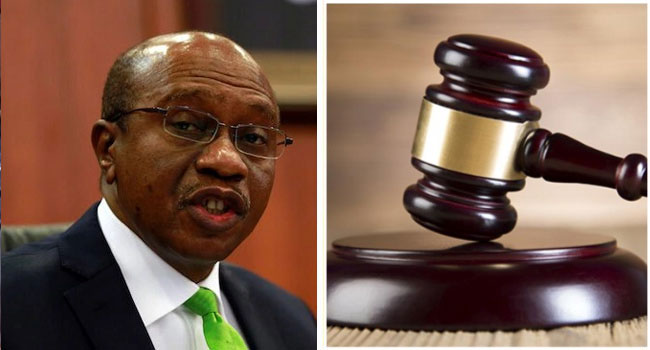
According to a documented compilation of active EFCC prosecutions, six former senior Nigerian public office holders are currently facing charges or have faced judgment involving more than N394 billion in alleged diverted public funds. This includes Ahmed Idris (former Accountant-General, approximately N109.5 billion and a separate N110.4 billion charge), Yahaya Bello (approximately N80.2 billion), Hadi Sirika (approximately N8.06 billion, with N19.4 billion in related contracts), and Godwin Emefiele (approximately $4.5 billion and N2.8 billion). These figures represent allegations currently before Nigerian courts, and defendants have pleaded not guilty in ongoing cases.
What is the real-world impact of corruption on ordinary Nigerians?
The impact of corruption on Nigeria’s economy translates directly into unbuilt roads, underfunded hospitals, unpaid pensions, and underresourced schools. Public funds allocated for specific infrastructure and social projects, when diverted, represent a direct and permanent loss of the services those funds were meant to provide. This is often described as the opportunity cost of corruption, the specific, tangible benefit that never materialised because the money that would have funded it was diverted elsewhere.
What happened to Bumpa co-founder Adetunji Opayele?
Adetunji “Teejay” Opayele, the 32-year-old co-founder and CTO of Nigerian tech startup Bumpa, was killed on March 4, 2025, when his power bike was allegedly struck by a vehicle driven by Abiola Adams-Odutayo along Ozumba Mbadiwe Road, Victoria Island, Lagos. The driver allegedly refused to assist him at the scene. Despite Amnesty International’s calls for justice and over 35,000 signatures on a Change.org petition, the trial has faced multiple adjournments and remained unresolved more than 16 months after his death, illustrating how systemic dysfunction affects justice outcomes regardless of a victim’s success or status.
How does corruption affect Nigeria’s national image internationally?
Repeated, high-profile corruption cases with limited consequences shape international perceptions of Nigeria and Nigerians, contributing to increased visa scrutiny, reduced international business trust, and a general skepticism toward Nigerian institutions and individuals abroad. This phenomenon has been described by commentators as “demarketing Nigeria,” and it creates a feedback loop in which Nigerians denied legitimate opportunities due to this national image sometimes resort to illegitimate means to access them, further reinforcing the negative perception.
Sources and Further Reading:
Full list: 6 powerful ex-public office holders in N394bn fraud allegations (Legit.ng, July 2026) •
Alleged $4.5bn fraud: Court admits Emefiele’s statements to EFCC as evidence (Channels Television, July 9, 2026) •
Court orders forfeiture of former Accountant-General Ahmed Idris’ houses (Premium Times Nigeria) •
Multiple adjournments keep Adams-Odutayo on trial 15 months after Bumpa co-founder’s death (FIJ, June 2026) •
Amnesty International calls for justice over Bumpa co-founder’s death (Vanguard, March 2025) •
Supreme Court restores final forfeiture of Emefiele’s properties (SaharaReporters, July 2026) •
Nigeria corruption and poverty coverage (BBC Pidgin)