
N400,000 for a Carton of Sardines: The Receipts Behind Nigeria’s Poverty
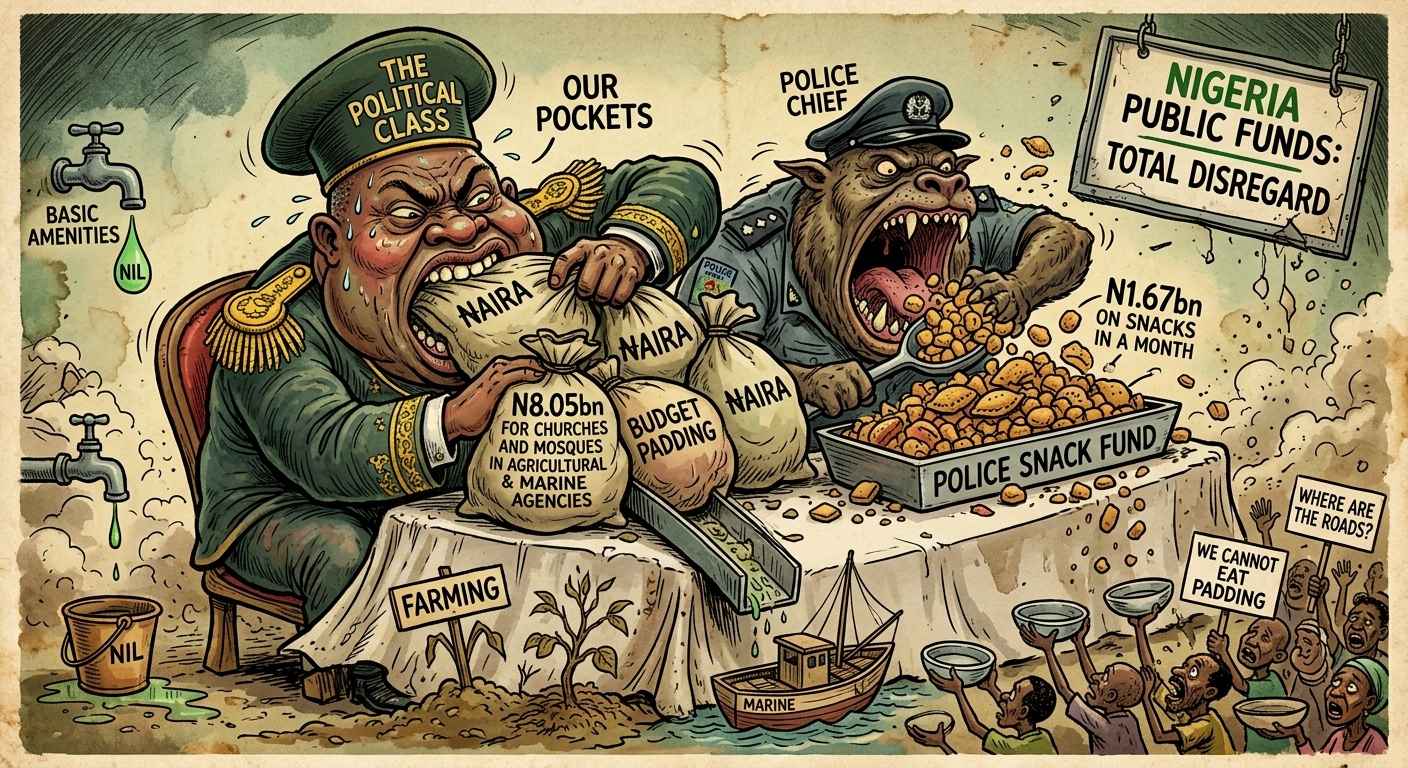
The Nigeria Police Force spent N1.67 billion on snacks in a single month. One carton of sardines on that bill cost N400,000. The 2026 national budget sets aside N8.05 billion for churches and mosques, tucked inside agencies whose actual job is agriculture, marine research, and cooperative colleges. This is corruption with a receipt number, a market price comparison, and a line item you can trace back to a specific hungry Nigerian who did not get what that money was supposed to buy.
Nigerians have grown numb to big numbers. Trillions get mentioned in budget speeches the way weather gets mentioned in small talk, present, expected, and quickly forgotten. But the mismanagement of public funds in Nigeria is not actually abstract. It has an itemised receipt. It has a Govspend portal entry. It has a market price sitting right next to the inflated price the government paid, so close together that the gap between them is not a rounding error, it is a heist wearing an invoice. This article walks through the documented receipts, the line items pulled from public payment portals and investigative reporting, and then asks the only question that matters: where did that money not go, and who paid for its absence?
NPF Spent N1.67bn on Snacks: A Masterclass in Public Fund Mismanagement
In December 2024 alone, according to a Foundation for Investigative Journalism review of the public payments portal Govspend, the Nigeria Police Force spent a total of N1.67 billion on biscuits, sardines, beverages and canned foods, with one carton of sardines alone costed at N400,000, against a genuine market price of roughly N88,000 to N96,000 for the same item. This was not a one-off anomaly. It was a documented pattern stretching back years and continuing into 2026. Between August 2023 and December 2024, the NPF paid a single vendor, Danlokey Systems Limited, N751.2 million for food, fuel, IT equipment, office supplies and training, of which N209.8 million went purely to snacks. A carton of cream crackers that should cost N4,200 at the low end or N33,000 at the premium McVitie’s end was billed to the police at N355,343. A carton of Owens Rich Biscuits, market price under N5,000, was invoiced at over N100,000.
Milo powder: police paid N851,942 per carton against a real market price under N50,000
Cornflakes: police paid N574,242 per carton, December 26, 2023
Peak Milk: police paid N7.7 million for a single carton, April 16, 2024
Titus Sardines: police paid up to N430,000 per carton against a market price of N75,500 to N87,000
Carla Rose toilet rolls: police paid N13.3 million for 24 packets, against a real cost under N1.32 million
Ten Toyota Prado V6 SUVs: N1.737 billion paid in a single day, May 9, 2026, under Acting IGP Tunji Disu, roughly N173.7 million per vehicle
One man, according to a separate SaharaReporters investigation, registered five companies within 48 hours and secured N3.4 billion in inflated police contracts across 366 separate payments. This is not disorganised spending. It is a system, with named vendors, repeat business, and a pricing structure so consistent in its inflation that it reads less like waste and more like an agreed rate card. As we detailed in our broader breakdown of corruption’s true cost in Nigeria, every inflated invoice like this is a direct subtraction from what should have gone to police welfare, equipment, or the barracks conditions officers actually live in.

A carton of sardines that costs eighty seven thousand naira at the market was billed to the police at four hundred thousand. That gap, multiplied across a single month, becomes one point six seven billion naira. Nobody needs a forensic audit to see this. You need a calculator and functioning eyes.
Anuoluwa Soneye, NarrivonNigeria Budget Padding Extends From Snacks to SUVs Without Missing a Beat
Just three months after Acting Inspector-General Tunji Disu assumed office in February 2026, records reviewed by SaharaReporters showed the police spent N1.737 billion in a single day, May 9, 2026, on ten Toyota Land Cruiser Prado V6 vehicles, procured through Mujaf Automobile Nigeria Ltd in two identical payments of N868.697 million each. That works out to roughly N173.7 million per vehicle, a figure that would comfortably purchase two to three brand new Prados at retail import price with change left over. This happened while, according to the same reporting, the police under the previous IGP had spent over N239.4 million in 2025 alone on the same category of inflated food purchases documented above. The pattern does not discriminate by leadership change. It survives the transition from one Inspector-General to the next, which tells you the problem is not one man’s judgment. It is a procurement culture that has learned it will not be interrupted.
This is where the mismanagement of public funds in Nigeria stops being a headline and starts being arithmetic that ordinary citizens can feel directly. N1.74 billion spent on ten SUVs in one day is roughly what it would cost to fully equip several primary healthcare centres, or clear months of unpaid pension arrears in a mid-sized state. Every naira spent above genuine market price on a Prado or a carton of sardines is a naira that a serving officer’s family, or a citizen waiting on a functioning police response, will never see returned in the form of better service.
Nigeria’s 2026 Budget Padding Reaches Its Most Absurd Form Yet
If the police snack scandal is mismanagement through inflated pricing, the 2026 Appropriation Act reveals mismanagement through a different mechanism entirely: the quiet insertion of unrelated projects into the budgets of agencies that have no business funding them. An analysis by Tracka, BudgIT’s project-tracking initiative, found that the Federal Government earmarked N8.05 billion in the 2026 budget for the construction, renovation and rehabilitation of 59 religious infrastructure projects, N6.14 billion for 52 mosque-related projects and N1.91 billion for seven church projects, despite the same budget carrying a N31.45 trillion fiscal deficit, representing 46 percent of total planned expenditure. This is a government borrowing nearly half of what it plans to spend, while simultaneously finding N1 billion for alternative power supply to a single mosque in Zamfara North, N280 million for mosque renovation and mini-grids in Zamfara Central, and N210 million for a mosque, an Islamiyya school, an administration office, a fence and an imam’s house in Tsafe Town.
The absurdity compounds when you look at which agencies are footing these bills. These religious allocations are not sitting inside a Ministry of Religious Affairs, because Nigeria does not have one. They are embedded inside the National Productivity Centre, the Nigerian Building and Road Research Institute, the Energy Commission of Nigeria, Federal Co-operative Colleges, the National Institute for Oceanography and Marine Research, and, most tellingly, the National Commission for Almajiri and Out-of-School Children Education, an agency whose entire mandate is pulling vulnerable children out of the streets and into classrooms. That commission was allocated N70 million for solar street lights in Sokoto communities, schools, and mosques, a project that, however well intentioned, sits oddly beside the millions of Almajiri children the same commission is supposed to be enrolling in actual education. Separately, N1 billion was set aside through the Industrial Arbitration Panel under the Ministry of Labour for musical and cultural equipment to churches in Bende Local Government Area, Abia State, later clarified by the Deputy Speaker’s office as N780 million after statutory deductions.

“All these are down to poor oversight by the National Assembly. In most cases, they are even the ones inserting, smuggling and padding these budgets. This explains why we have to go back to zero budgeting.”
Chukwunonso Ihuma, consultant economist and former central banker
Misappropriation of Funds in Nigeria Now Includes Palace Renovations at Scale
The religious allocations are, remarkably, not even the largest category of questionable spending Tracka identified in the same budget. Analysts found that N22.15 billion was earmarked for the renovation and furnishing of 106 palaces nationwide, again scattered across agricultural, tourism, and research institutes with no palace-related mandate. The Agricultural Research Council of Nigeria received N750 million to complete and furnish four palaces in Kogi State. The National Institute for Hospitality and Tourism received N700 million for palace and office projects in Plateau State. The Nigerian Building and Road Research Institute alone carried N3.92 billion in projects, including N1 billion for a pavilion and solar power at the Oluyin Palace in Iyin Ekiti and N525 million for a palace hall in Ojo, Lagos. Zoom out further, and roughly 78 ministries, departments and agencies across the federal government set aside nearly N400 billion combined for community halls, mosques, palaces and comparable projects, according to a wider review of the same budget cycle, spanning everything from the Ministry of Defence Headquarters to Federal Cooperative Colleges.
N8.05 billion across 59 church and mosque projects, embedded in 78 unrelated MDAs
N22.15 billion for the renovation and furnishing of 106 palaces nationwide
Approximately N400 billion combined across MDAs for halls, mosques and palaces
N70 million through the National Commission for Almajiri, an agency meant to educate out-of-school children, for solar street lights
N31.45 trillion fiscal deficit, representing 46 percent of the entire N68.3 trillion budget
Civil society groups have not stayed quiet. The Resource Centre for Human Rights and Civic Education publicly called for an investigation, with its representative stating: “It is difficult to justify spending public funds on projects outside the statutory mandates of government agencies when millions of Nigerians are struggling with hunger, unemployment and poor access to healthcare and education.” The Northern Christian Elders Forum separately urged the redirection of the funds toward security and job creation. Even inside the National Assembly, the Deputy Speaker’s office found itself publicly clarifying a controversial figure rather than defending the underlying principle of the allocation itself.
Mismanagement of Public Funds in Nigeria Translates Directly Into Hardship You Can Measure
Here is the arithmetic that makes all of this personal rather than abstract. Nigeria’s total public debt climbed to N159.28 trillion by the end of 2025, and the 2026 budget alone allocates N15.8 trillion purely to debt servicing, before a single naira reaches a hospital, a school, or a road. Against that backdrop, the government has continued seeking fresh loans, including Senate approval sought in April 2026 for external financing for the Sokoto-Badagry Superhighway, even amid what officials themselves described as an oil revenue windfall from the petrol subsidy removal and the disruption of global supply during the US-Iran conflict. As we examined in our analysis of how corruption in Nigeria compromises ordinary citizens, every inflated police invoice and every misplaced palace allocation is not a victimless accounting quirk. It is money borrowed from Nigeria’s future, at interest, to overpay for biscuits today.
The opportunity cost is not hypothetical. N1.67 billion, the police’s monthly snack bill at inflated rates, could fund a meaningful primary healthcare intervention across multiple local government areas. N22.15 billion for palace renovations could clear a significant share of unpaid pension arrears in several states simultaneously. N8.05 billion for churches and mosques, however sincerely intended by some of its proponents, arrives at the exact moment millions of Nigerian children remain out of school and the naira’s purchasing power continues to erode under 30 percent-plus inflation. As we explored in our examination of Nigeria’s entitlement culture, a governing class that treats public funds as available for palace pavilions and inflated snack contracts, while citizens are told to sacrifice and endure hardship, has inverted the basic logic of public service.
Ending Mismanagement of Public Funds Requires Citizens Who Read the Receipts
What connects the sardines, the Prados, the churches, the mosques and the palaces is not a single villain. It is a system that has learned Nigerians will express outrage on social media for roughly 48 hours and then move on, because the next scandal is always one news cycle away. The same National Assembly whose president has an unresolved N108 billion probe is the institution economists point to for “inserting, smuggling and padding” these very budget lines. The silence that follows each revelation, the absence of a single named official held accountable for a N400,000 carton of sardines, is itself the scandal, arguably larger than the individual line items.
At Narrivon, we believe the Nigeria of our dreams requires citizens who do right, think right, act right, and refuse to let a documented, market-price-comparable invoice for inflated biscuits disappear from public memory after a single viral post. It requires demanding that BudgIT’s Tracka analysis, and FIJ’s Govspend investigations, translate into actual consequence: a named contractor barred from future government business, a procurement officer questioned under oath, a line item struck from the budget before it is signed rather than defended after the fact. The receipts already exist. The market prices are already public. What is missing is not information. It is the sustained, collective refusal to let this be normal.
Frequently Asked Questions About Nigeria’s Budget Mismanagement
How much did the Nigeria Police Force spend on snacks and why is it controversial?
According to a Foundation for Investigative Journalism review of the Govspend public payments portal, the Nigeria Police Force spent N1.67 billion on biscuits, sardines, beverages and canned foods in December 2024 alone, with one carton of sardines costed at N400,000 against a genuine market price of roughly N88,000 to N96,000. Separate investigations found similar inflated pricing patterns across multiple vendors and years, including N355,343 for a carton of cream crackers that should cost between N4,200 and N33,000, and N851,942 per carton of Milo against a real cost under N50,000.
How much did the police spend on vehicles in 2026?
Records reviewed by SaharaReporters showed the Nigeria Police Force spent N1.737 billion in a single day, May 9, 2026, on ten Toyota Land Cruiser Prado V6 vehicles procured through Mujaf Automobile Nigeria Ltd, at approximately N173.7 million per vehicle. This occurred under Acting Inspector-General Tunji Disu, roughly three months after he assumed office in February 2026.
Why does the 2026 Nigerian budget include money for churches and mosques?
An analysis by Tracka, BudgIT’s project-tracking initiative, found that the 2026 Appropriation Act earmarked N8.05 billion for 59 church and mosque projects, embedded inside 78 ministries, departments and agencies whose statutory mandates have nothing to do with religious infrastructure, including agricultural, marine research, and cooperative college agencies. This occurred despite the budget carrying a N31.45 trillion fiscal deficit, representing 46 percent of total planned expenditure. Civil society groups including CHRICED have called for an investigation into the allocations.
How much was budgeted for palace renovations in the 2026 budget?
Tracka’s analysis found N22.15 billion earmarked for the renovation and furnishing of 106 palaces nationwide, distributed across agencies including the Agricultural Research Council of Nigeria, the National Institute for Hospitality and Tourism, and the Nigerian Building and Road Research Institute. Combined with mosque and community hall allocations, nearly N400 billion was set aside across roughly 78 federal agencies for similar projects in the same budget cycle.
Sources and Further Reading:
NPF spent N1.67bn on snacks in one month (FIJ) •
Police paid Danlokey Systems Limited N751m in 16 months (FIJ, October 2025) •
Nigeria Police under new IGP Disu spent N1.74 billion in one day on 10 Toyota Prados (SaharaReporters, July 2026) •
One man registers 5 firms within 48 hours, secures inflated N3.4bn police contracts (SaharaReporters) •
FG earmarks N8.05bn for churches, mosques despite N31.45tn budget deficit (The ICIR, July 2026) •
Controversy trails 2026 budget amid palace, church allocations, delays (Guardian Nigeria, July 2026) •
Budget 2026: Govt agencies vote N400bn for mosques, palaces, halls •
CHRICED faults 2026 budget, seeks probe of N8.05bn religious project allocations (Nigeria Info FM)