
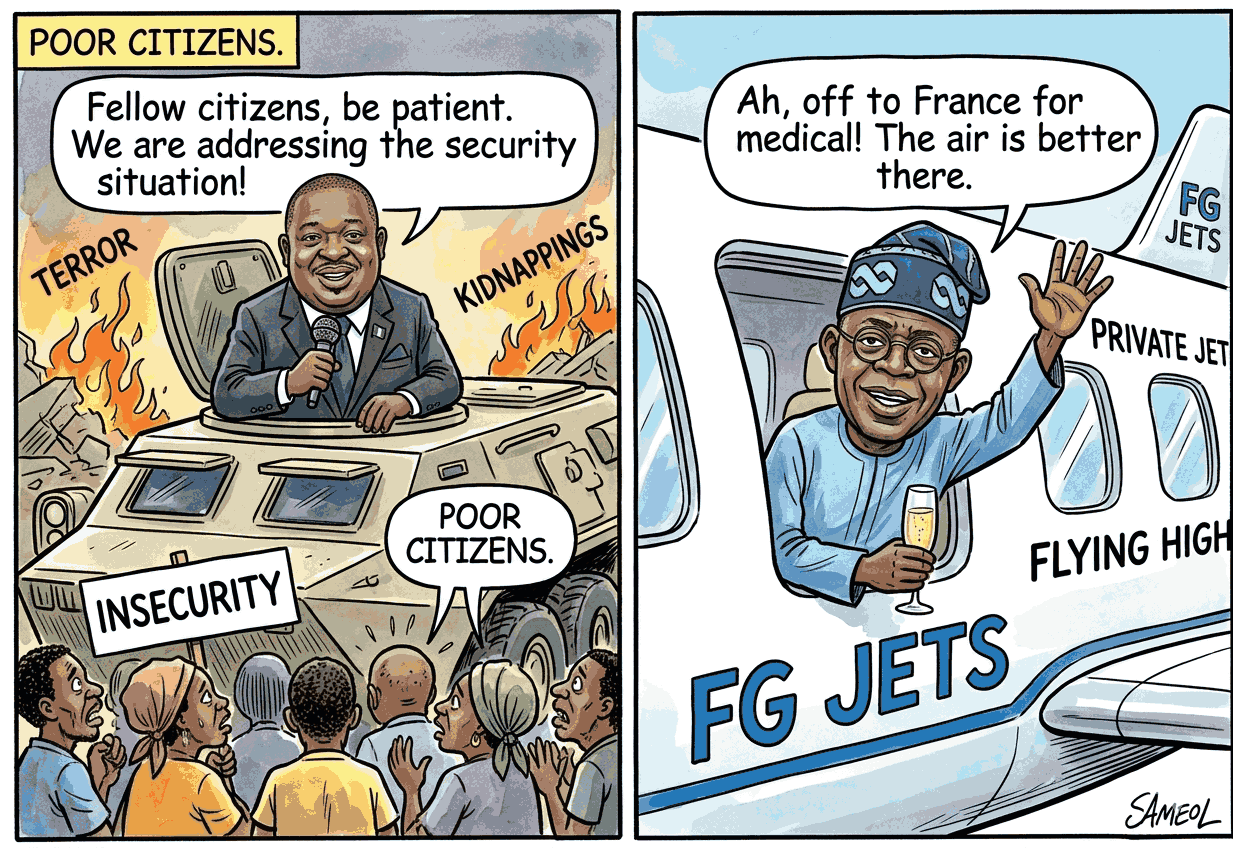
The Empathy Deficit: How Nigerian Politicians Turned Grief Into a Photo Op
Tinubu flew to Jos, never left the airport, told grieving families the airport has no electricity, then flew back to Lagos for Easter. Mutfwang addressed massacre survivors from inside an armoured tank. VeryDarkMan, a private citizen with a phone, walked into Yelewata so the President didn’t have to. This is what Nigerian leadership looks like in 2026.
There is a woman named Rhoda Favour Ayuba. You may have seen the video. She is sitting on the ground, clutching the lifeless body of her son, Ayiba. Her face tells the entire story of what it means to be a Nigerian citizen in 2026: the shock that has moved past shock, the grief that has calcified into something beyond weeping, the particular horror of a mother who must now explain to herself why the country that took her son cannot produce the decency to explain itself in person. That image, which shook the nation and briefly stirred a debate about what governance actually owes the governed, is the context for everything that follows. Remember her face as you read this. Because every political response described below was, ultimately, a response to her.
Tinubu’s Jos Visit: A Masterclass in Missing the Point
Bola Ahmed Tinubu
Bola Tinubu, known popularly as “Jagaban” or the “Asiwaju,” is Nigeria’s 16th President, inaugurated May 29, 2023. Before the presidency, he served two terms as Governor of Lagos State, transforming it into the most commercially significant state in the federation. He is widely credited as the political architect of the APC, the party under which he eventually won the presidency. His administration has been defined by the removal of the fuel subsidy, floating of the naira, and persistent insecurity across multiple geopolitical zones. His 2023 election campaign promise: “If I don’t fix electricity in Nigeria, don’t vote for me again.”
On the night of March 29, 2026, Palm Sunday, gunmen attacked the Angwan Rukuba community in Jos North Local Government Area of Plateau State. At least 28 people were killed, including students and staff of the University of Jos. The attack was not the first on Plateau communities. It was, in the grim arithmetic of Nigerian governance, the latest. Four days later, on April 2, 2026, President Tinubu flew to Plateau State to commiserate with victims.
He never entered Jos.
Victims and their grieving families, some of whom had buried their children within the previous 24 hours, were transported to meet the President at Yakubu Gowon Airport in Heipang, roughly 40 minutes by road from Jos city. The airport is not in Jos. The attack did not happen at the airport. But the airport was where the president was, and so the mountain moved to Mohammed, because Mohammed had a schedule.
In that hall near the airport, with the bereaved seated before him, the President of the Federal Republic of Nigeria offered this: “You have no light at the airport, and I have to fly back within the next 10 minutes. To the victims, there is nothing I can give you, whether it is money in millions, but console you and promise you that this experience will not repeat itself.”
The President of a country whose stated election promise was “if I don’t fix electricity, don’t vote for me again,” visited Jos and blamed the darkness at the airport on the people of Plateau. The irony did not even have the dignity to be subtle.
Anuoluwa Soneye, NarrivonLet us examine what happened here with the precision this moment deserves. The airport at Heipang has no runway lights. This is why nighttime flights are impossible. The runway lights are a federal infrastructure responsibility. The president is the head of the federal government. And the president’s response to this reality was not embarrassment or contrition. It was an announcement. You have no light. Not “we have failed to give you light.” Not “I am ashamed that I cannot fly out of this airport at night because my government has not fixed it.” But a casual accusation directed at grieving people: your airport has no light. As if the residents of Plateau State had personally refused to install navigational aids on a federal runway as a personal inconvenience to the President’s schedule.
Commentator Ugoji Egbujo captured the geography of the insult precisely: Yakubu Gowon Airport is not in Jos. It is in Heipang. The flight from Abuja to Jos is less than 15 minutes. If the president had left Abuja in the morning rather than the afternoon, he could have driven 40 minutes into the city, walked through Angwan Rukuba, seen the houses where people were killed, held the hands of the families, and been back at the airport before dusk. He chose not to. The afternoon schedule was a choice. The 10-minute visit was a choice. And telling the bereaved that you have to leave because their airport has no lights is, clinically speaking, one of the most astounding exhibitions of political tone-deafness in recent Nigerian memory.
After the brief airport meeting, President Tinubu flew to Lagos to begin the Easter holiday. This was not reported as ironic. In Nigeria, it was barely reported as unusual.
“The first responsibility of a leader is to define reality. The last is to say thank you. In between, the leader is a servant.”
Max De Pree, Leadership Is an Art, 1989
Governor Mutfwang and the Armoured Personnel Carrier of Empathy
Caleb Mutfwang
Caleb Mutfwang, a lawyer by training and career politician, assumed office as Plateau State Governor in May 2023. He governs one of Nigeria’s most persistently volatile states, where farmer-herder conflicts, ethnic violence, and communal attacks have killed thousands of people over decades. His administration has pledged repeatedly to restore lasting peace to the Plateau.
If the President’s airport visit was an insult delivered with the soft tongue of scheduling constraints, the Governor’s visit to the actual crime scene was its own distinct species of absurdity. Governor Mutfwang drove to Angwan Rukuba in an armoured personnel carrier, a military-grade vehicle used in high-risk operations, with its roof hatch open, from which he stood and addressed residents as his aides in suits balanced on the vehicle around him.
The residents responded with what can only be described as earned rage. “Come down to address us. We will not listen to you,” they chanted. “It is a lie. It is a lie,” others shouted in Hausa. One resident’s observation in a Premium Times report was quietly devastating: “He said he feels our pain, but people wanted to see him stand with them physically, not from inside a security vehicle. It raises questions.”
The Governor later explained himself on Channels Television with what may be the single most unintentionally revealing political explanation of 2026. He said he stood in the roof hatch, “part of the reason they put me in the ATC was for me to gain height in order to address the crowd.” The armoured vehicle, built to withstand military gunfire, was deployed in a grieving community as a loudspeaker stand. The irony writes itself, slowly, with the patience of a people who have heard too many speeches from too many elevated positions.
A governor who needs an armoured tank to visit the citizens he governs is not governing those citizens. He is occupying the same geographical space as them while being protected from them. That is not leadership. That is occupation.
Anuoluwa Soneye, NarrivonThe image of Mutfwang in the hatch of an armoured vehicle, addressing massacre survivors from above, while heavily armed troops formed a perimeter, is the visual metaphor for everything that is wrong with Nigerian political leadership in a single photograph. The gap between the ruler and the ruled, which we reference abstractly when discussing governance failures, is literally visible in that image. The armour is the policy. The hatch is the condolence. The perimeter of guns is the relationship.
Yelewata, Mass Burials, and the Normalisation of Massacre
These two events did not happen in isolation. They are the most recent chapter in a recurring narrative that Nigeria has been writing with blood for decades. Let us go back eight months, to June 13-14, 2025, when suspected armed herders attacked the Yelewata community in Guma Local Government Area of Benue State.
They came at night with gallons of fuel and AK-47 rifles. They opened doors, poured the fuel, and set the houses on fire. When residents tried to flee, they were shot. By dawn, over 300 people were dead. Children burnt alive in their homes. Crops destroyed. The town reduced to ash. It was, by any civilized standard, a war crime committed against unarmed farmers in the middle of a country that has a president, a constitution, and a national security architecture that costs billions of naira annually to maintain.
President Tinubu’s response? A press statement. When he eventually visited Benue, he stopped in Makurdi, the state capital, where he gathered politicians and traditional rulers in a decorated hall for speeches and photographs. He did not go to Yelewata. He did not see the carnage. He did not walk through the charred ruins of homes where families were incinerated. He offered dialogue with the attackers as a solution. The President called for reconciliation with people who came with fuel and guns in the night.
The Benue State Government’s response when confronted with why they could not quickly reach Yelewata after the attack? The roads were flooded. The rains had made access difficult. Here is the exquisite irony that Nigerian governance delivers with such mechanical consistency it could be automated: the excuse for why the government could not respond to a massacre is a road and drainage problem. The same government that should have fixed the roads is using the unfixed roads as its alibi for not showing up after the massacre. The government is citing its own failure as a defense of its failure. This is not incompetence. This is a closed loop of negligence so perfectly constructed that it almost deserves to be studied.
“The mark of a great leader is not their ability to avoid crises, but how they respond when crises arrive.”
Winston Churchill, widely attributed
VeryDarkMan in Yelewata: When a Private Citizen Outleads the President
Martins Vincent Otse, known as VeryDarkMan (VDM)
VeryDarkMan is a private Nigerian citizen who built a massive social media following through unfiltered, often provocative commentary on Nigerian governance, celebrity culture, and social issues. He holds no elected or appointed position. He has no motorcade, no armoured vehicle, no security detail. He is, by every formal definition, a regular person. He is also, by recent demonstrated record, more willing to be present at scenes of national tragedy than most of the people being paid to govern the country.
On June 15, 2025, one day after the Yelewata massacre, VeryDarkMan drove to Yelewata and walked through it. He did not have a press entourage. He did not have an APC or a security convoy. He walked through the burned-out homes and witnessed what the government had described in bloodless bureaucratic language as “a security incident.” He recorded what he saw: children burnt to ashes, homes destroyed, a community reduced to rubble. He went live on his platforms with footage that the presidency’s press releases had not produced and would not produce.
He then drove to Makurdi and joined the protest at Wurukum Roundabout, where thousands of Benue youths had gathered to demand answers. When police fired tear gas on the mourners, he was there too, in the crowd, not in a hall. He said from that protest: “Before coming here, I saw alarming things I have never seen in my life. I saw children burnt to ashes, a lot of children, a lot of people, crops and people’s food were burnt in Yelewata, and we have a government.”
The man the country calls its president had not been to Yelewata. The man the country calls its social media loudmouth had. Think about what that contrast tells you about where the empathy in this country actually lives. It does not live in Aso Rock. It does not live in the Government House in Makurdi. It lives in people who have not yet been given enough money and enough insulation from consequence to stop feeling what other people feel.
What Leadership Actually Looks Like
For those who might argue that expecting presidents to personally visit massacre sites is unreasonable theatre, we offer a quick tour of the world for calibration purposes.
President Tinubu visits Jos four days after 28 are killed. He conducts the entire visit at the airport, 40 minutes from the attack site. He tells grieving families the airport has no electricity and that he has 10 minutes before flying back to Lagos. He announces 5,000 CCTV cameras as a security solution. He flies to Lagos for Easter.
Prime Minister Jacinda Ardern flies to Christchurch the same day 51 people are killed in a mosque shooting. She wears a hijab in solidarity, goes directly to the families, kneels with the bereaved, names them, holds them. She says: “They are us.” Within days she announces significant gun reform. She refuses to name or publicise the attacker. The world takes note of what leadership looks like.
“It takes courage and strength to be empathetic, and I’m very proudly an empathetic and compassionate leader.”
Jacinda Ardern, former Prime Minister of New Zealand, on her leadership philosophy
Ardern did not visit Christchurch from an armoured vehicle. She did not tell the families that the airport had no electricity. She did not give herself ten minutes and then fly home for the long weekend. She went to the pain. She sat in it. She changed laws in response to it within weeks. The entire international community, including UN Secretary-General António Guterres, marked her response as a model for how leaders should behave when their citizens are killed. This is not an impossibly high standard. It is the standard. The gap between that standard and what Nigerians received in April 2026 is a gap that deserves to be named, measured, and kept in public memory as long as the current political class remains in power.
The Debate Nigeria Must Stop Having Wrong
Every election cycle, a reliable constituency of Nigerian voters defends their choice of candidate with one particular argument: he has experience. He has been governor. He has been minister. He has been senator. He knows how the system works. He is not a rookie. And experience, this argument goes, is what Nigeria needs.
Let us measure that argument against its fruits. The politicians who have held Nigerian office for the longest time, the career political class, the men who have navigated every transition since the 1990s, have collectively presided over a country that cannot fix the runway lights at its own airports, cannot protect farming communities from being burnt alive in the night, and cannot produce a sitting president willing to drive forty minutes into a grieving community to be physically present with the people whose deaths he is supposed to be constitutionally committed to preventing. This is what experience without empathy produces: technically sophisticated governance failure.
Experience tells a leader what levers to pull. Empathy tells them who is being crushed beneath those levers. A leader who can fluently explain the mechanics of the NNPC cannot feel the weight of a mother carrying her dead son. A governor who knows every LGA chairman in Plateau State by name cannot, from inside an armoured vehicle, absorb the rage of a community that watched their neighbors die while the government was in Abuja attending a party convention. The knowledge of how power works is not the same as the felt sense of why power must be exercised in service of human beings rather than in the service of its own perpetuation.
The voters who continue to support leaders who govern them from behind armour, who visit their tragedies with ten-minute schedules and excuses about runway lights, who are further from the common citizen in disposition than in any formal sense of geographical distance, are not making a rational error. They are making an ideological error. They have been convinced, by tribal loyalty or financial dependency or both, that the experience of political survival is the same thing as the capacity for public service. It is not. They are as different as a funeral director and a friend.
“Leadership is not about being in charge. It is about taking care of those in your charge.”
Simon Sinek, Leaders Eat Last, 2014
On the Politics of Being Human
Here is the underlying truth of everything described above. The Jos airport visit, the armoured tank in Angwan Rukuba, the Makurdi hall visit after Yelewata, the excuses about flooded roads and missing runway lights, these are not accidents of character. They are the logical product of a system in which leaders are never held to a standard of human decency because the citizens who elect them have stopped believing that human decency is something politicians owe them.
When you accept a ten-minute airport visit as a condolence, you have told your leader that the airport is enough. When you watch a governor address you from an armoured tank and describe it as security protocol, you have told him that the tank is acceptable. When you vote again for the man who watched your community burn and sent a press statement, you have communicated that press statements are equivalent to governance. The political class’s lack of empathy is not a cause. It is a symptom. The cause is a citizenry that has progressively lowered its expectations to match the performance being delivered, until the performance required is so minimal that it can be executed from the departure lounge of a federal airport in ten minutes, with a promise that this will not happen again.
It will happen again. It has happened before. The same promises were made in Benue after Yelewata. The same promises have been made after every massacre in every state for the last twenty years. The politicians making the promises are the same politicians who built the system that makes the massacres possible, who underfund the security architecture, who allow impunity to calcify through non-prosecution, who use elections to do the political arithmetic of which communities matter enough to govern properly. Corruption in Nigerian governance is not just financial. It is emotional. It is the corruption of the capacity to feel what another person feels and act in response to it.
A radical reorientation of Nigerian politics must begin with a simple demand: that the people who want to lead Nigeria must first be capable of feeling Nigeria. That before we ask about their experience in governance, we ask about their proximity to the governed. That before we ask how many years they have been in politics, we ask whether they have the basic human capacity to sit in a community that has just buried twenty-eight of its people and stay there, in the discomfort, in the grief, in the accountability that physical presence creates.
VeryDarkMan, a private citizen with a phone and a conscience, did this. He drove to Yelewata. He walked through the ash. He went live. The President of Nigeria did not. The lesson is not about VeryDarkMan’s courage. The lesson is about what we have decided to require from the people we call our leaders. Right now, we require less of them than we require of a random man with an Instagram account. Until that calculus changes, the next condolence visit will also be an airport condolence. And the one after that. And the runway lights will still be broken. And someone will announce it as if it is someone else’s fault.
“Do not allow people who cannot feel your pain, who do not share in your pain, to lead you.”
Adapted from the Narrivon editorial position on empathetic leadership in Nigeria
Rhoda Favour Ayuba deserves a president who came to her. So do the families of the 300 in Yelewata. So do the communities of Plateau and Benue that have been burying their dead in mass graves while the political class attends conventions and plans the 2027 campaign. They all deserve the standard that Jacinda Ardern set in Christchurch in 2019: that a leader, when their people are killed, goes to the pain. Sits in it. Stays. And then changes something because of what they felt while they were there.
That is not too much to ask. That is the minimum. And until Nigerians demand the minimum and mean it at the ballot box, the airports will remain dark, the tanks will continue to double as empathy vehicles, and the dead will be remembered at the departure lounge, in ten minutes, before the next flight.
Frequently Asked Questions
What happened during Tinubu’s visit to Jos after the Palm Sunday massacre?
On April 2, 2026, four days after the Palm Sunday attack in Angwan Rukuba that killed 28 people, President Tinubu flew to Plateau State but conducted his entire visit at Yakubu Gowon Airport in Heipang, about 40 minutes from Jos. Victims were transported to meet him. He told those gathered: “You have no light at the airport, and I have to fly back within the next 10 minutes. There is nothing I can give you but console you and promise you that this experience will not repeat itself.” He then flew to Lagos for Easter.
Why did Governor Mutfwang use an armoured vehicle to address Angwan Rukuba residents?
Plateau State Governor Caleb Mutfwang visited Angwan Rukuba in an armoured personnel carrier after the Palm Sunday attack. He addressed residents from the vehicle’s roof hatch while heavily armed security personnel surrounded him. Residents chanted “Come down to address us” and called him a liar. The governor later defended his use of the vehicle, citing security advice and claiming he needed the height to project his voice.
What was VeryDarkMan’s role in the Yelewata massacre coverage?
Following the Yelewata massacre in Benue on June 13-14, 2025, in which over 300 people were killed, social media activist VeryDarkMan physically visited the community on June 15, witnessed and recorded the devastation firsthand, and joined protests in Makurdi where police fired tear gas on mourners. His on-ground documentation forced national attention onto the massacre while no sitting federal official made a comparable visit.
Is experience or empathy more important in Nigerian leadership?
Nigeria’s governance crisis demonstrates that experience without empathy produces technically proficient impunity rather than meaningful leadership. Experience tells a leader what levers to pull; empathy tells them who is being crushed beneath those levers. The most experienced Nigerian politicians have presided over decades of worsening insecurity and governance failures precisely because their experience has served personal advancement rather than public good.
Sources and Further Reading:
Outrage over Tinubu’s ‘no light’ comment at Jos airport (Daily Trust, April 2026) •
PDP faults Tinubu’s airport-only visit to Jos (Channels TV, April 2026) •
Emperor Tinubu and the Jos massacre (Vanguard, April 2026) •
Tinubu’s condolence visit at the front porch (The Punch, April 2026) •
Governor Mutfwang under fire for visiting survivors in armoured tank (Premium Times, April 2026) •
Mutfwang defends armoured vehicle use (Peoples Gazette, April 2026) •
Northern Islamic cleric condemns Tinubu’s Jos visit (SaharaReporters, April 2026) •
VeryDarkMan helps end Benue protest after Yelewata massacre (Vanguard, June 2025) •
Untold story of the Yelewata massacre (Daily Post, June 2025) •
Jacinda Ardern: Empathic leadership in crisis (Medium)