They Arrested a Man Named Justice for Seeking Justice. That Is Not Irony. That Is Nigeria.
Justice Mark Chidiebere posted a video about Nigerian soldiers eating poorly. The army picked him up, allegedly chained him to a tree, and left him outside for 72 hours. Just eleven days before, 744 ex-terrorists had graduated with certificates and gone home. The country that pampers insurgents cannot stand a blogger who asked a welfare question. Welcome to the version of Nigeria that is currently on trial.
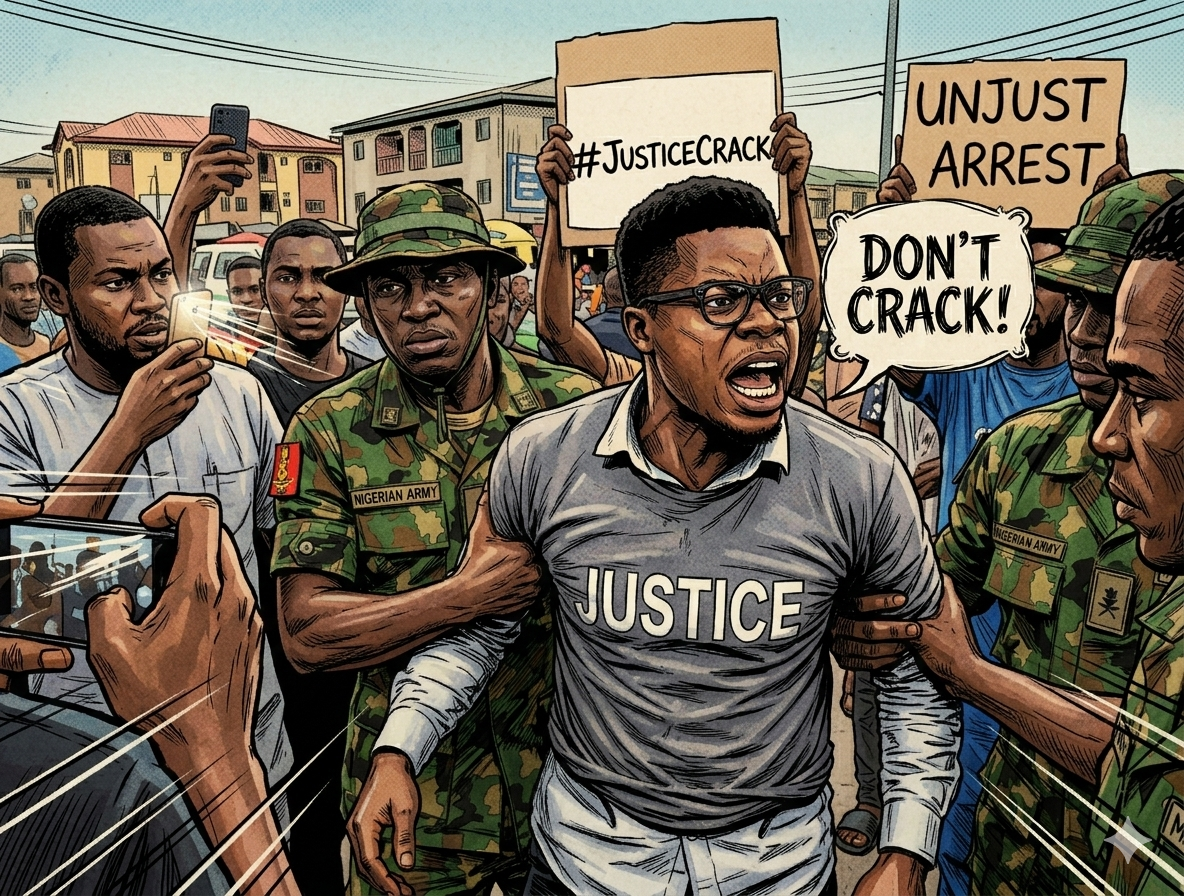
His name is Justice. And that is not a metaphor. It is the man’s actual name. Justice Mark Chidiebere. Social media activist. Blogger. The person who, in the week of April 28, 2026, received a phone call that changed his life and disappeared from public sight, only to resurface as a DSS detainee facing criminal charges for the radical act of posting a video. The video showed Nigerian soldiers complaining about their food. For this, Justice Crack was allegedly chained to a tree in the open air for 72 hours. Let that sit for a moment. A man named Justice, allegedly chained and left under the sun, because he asked the Nigerian Army to feed its soldiers properly. In the same country where known terrorists are given vocational training and graduation ceremonies. The irony is not subtle. The irony is dressed in army uniform and has a press release.
The Man, the Video, and the 72 Hours Under the Sun
Justice Mark Chidiebere, known as Justice Crack
Justice Mark Chidiebere, better known online as JusticeCrack, is a Nigerian social media commentator known for documenting alleged human rights abuses, poor welfare conditions for frontline soldiers, and government accountability issues. He had previously been vocal about the alleged extrajudicial killing of NYSC member Abdulsamad Jamiu by soldiers in Abuja. In the days before his arrest, he posted a now-viral video featuring Nigerian soldiers complaining about poor feeding conditions and general welfare neglect. The video spread rapidly across social media platforms, generating national conversation about how the country treats the men and women it sends to fight terrorists. For this, Justice Crack was picked up on April 28, 2026, after receiving a mysterious phone call, and disappeared from public view. A family member, in a video shared on X by @drkenon2, claimed that Justice Mark Chidiebere had allegedly been tied to a tree and left outside in the sun for 72 hours. “He was tied to a tree and he was left outside for 72 hours and he’s been tortured by the military. What’s his crime? His crime is that he spoke for the oppressed Nigerians,” she said through tears.
After days of national outrage and demands for his whereabouts by the Nigerian Bar Association, RULAAC, and activist Omoyele Sowore, the Nigerian Army broke its silence on May 2, 2026. An official statement was signed by Colonel Appolonia Anele, Acting Director of Army Public Relations. The Army said it had been “drawn to the complaint made by some soldiers regarding their feeding and other matters relating to their welfare as posted on social media by a blogger/social media influencer, Justice Mark Chidiebere (Justice Crack).” So far, so clear. Justice Crack posted soldiers’ welfare complaints. The Army investigated. Fine. But then the statement went further. The Army alleged that Justice Mark Chidiebere had “seemed to be inciting soldiers to create discontent within the system” and that there was “a chat bordering on subversion.” He was subsequently handed over to civil authorities for “further investigation and possible prosecution.” As of May 8, 2026, he had been arraigned before Federal High Court Judge Justice Joyce Abdulmalik on a three-count charge of circulating false information and publishing materials capable of causing public unrest. The case was adjourned to May 25, 2026.

The Press Release That Said Everything While Claiming to Say Nothing
The Nigerian Army statement of May 2, 2026, is a document worth reading carefully, because it demonstrates something important about how institutions communicate when they have done something they cannot fully defend. The statement runs several paragraphs. It uses words like “sovereignty,” “discipline,” “national security,” and “rule of law.” It mentions subversion four times. It mentions the soldiers’ welfare once, almost as an aside, before pivoting to explain why discussing soldiers’ welfare is actually a threat to national security. The architecture of the statement is designed to make Justice Crack’s arrest feel inevitable, constitutional, and proportionate. It is not.
The key sentence in the Army’s statement is this one: “A situation where civilians cultivate vulnerable personnel towards acts of subversion has far-reaching implications on discipline and national security.” In other words, the Army’s position is that a Nigerian citizen who speaks to Nigerian soldiers about their welfare is “cultivating vulnerable personnel.” The soldiers, in this framing, are not adults with legitimate grievances. They are “vulnerable personnel” who must be protected from the dangerous knowledge that their food is inadequate. You might be forgiven for thinking this raises a question. If the food is actually fine, why would the knowledge of it being inadequate demoralize anyone? You would be right. That question is precisely the one the Army has not answered.
In a widely shared commentary, a pro-government writer argued that “isolated welfare lapses exist in every army, including the US, UK, and Russia.” Here is Narrivon’s direct response to that entire framework:
Pardon your en and em dashes. This is far too worded to say nothing. The only truth here is “Nigeria is not at peace.” Every other claim is a lazy attempt to “subvert” the truths, and no amount of press releases and paragraphs can succeed in doing that.
If the troops are not underpaid, underfed and ill-armed, the testament of a critic going public cannot demoralize or demotivate them. It would simply be absorbed as a joke. If someone posted that same video and claimed it was what the US troops feasted on, no one will bat an eye, because the joke is dead on arrival.
Obviously, it is an issue of national concern, because it raises serious questions around accountability: the welfare of the frontline soldiers, especially in a time where Nigeria is not at peace; the rot in the system that paves the way for poor welfare; and the villainy of the characters who oversee this cancerous system.
And bringing this bit into this particular context: “Isolated welfare lapses exist in every army, including the US, UK, and Russia.” The only explanation for writing that sentence about Nigeria is AI.
Forget the Video. Talk About the Rations. The Salaries. The Barracks.
Let us talk about what Justice Mark Chidiebere was actually drawing attention to, because the framing of his arrest as a security issue is designed to prevent exactly this conversation. JusticeCrack posted a video about what Nigerian soldiers were eating. That video went viral not because Nigerians are easily shocked by army food, but because what the soldiers described resonated as deeply, embarrassingly plausible.
The welfare of Nigerian soldiers is a documented, long-running national crisis. A private in the Nigerian Army earns a basic salary in the range of N30,000 to N50,000 per month at lower grades, depending on rank and allowances. This is the person being sent into the bush in Borno, Zamfara, and Plateau to fight Boko Haram and armed bandits with AK-47s, sometimes with inadequate ammunition, in vehicles that occasionally break down mid-patrol. As we have previously documented in our coverage of insecurity in Nigeria, the security forces are chronically overstretched, with the army deployed across two-thirds of the country’s states simultaneously.
Barracks conditions in several states have been reported by soldiers themselves to include dilapidated buildings, inadequate toilets, no running water, and roofs that leak in the rain season. Welfare allowances for families of soldiers killed in action have in several documented cases been delayed for months or even years after the death. The wider insecurity crisis cannot be separated from the material condition of the people fighting it. A malnourished, underpaid, poorly housed soldier is not a person prepared to die defending a country that has not bothered to make his life worth living in return.
The army did not arrest Justice Crack because his video was false. They arrested him because it was true. A lie about soldiers’ rations would not demoralize anyone. Only the truth does that.
Anuoluwa Soneye, NarrivonAnd then there are the “Ogas.” The generals. The senior officers. The men who attend international defence conferences, receive operational vehicles as personal privileges, live in official residences that bear no resemblance to the barracks of the privates they command, and retire to consultancy roles and board appointments with the connections they built during service. The contrast between the welfare of a Nigerian Army private and a Nigerian Army general is not a modest gap. It is a chasm that has been carefully constructed and carefully maintained. It mirrors the wider structure of corruption in Nigerian governance: the people at the top consume the resources meant to support the people at the bottom, and then arrest the person who mentions it.

Lekki. OAU. Justice Crack. This Is Not a Coincidence. This Is a Policy.
On October 20, 2020, Nigerian soldiers opened fire on unarmed protesters at the Lekki Toll Gate in Lagos during the EndSARS demonstrations. Young Nigerians had gathered to demand an end to police brutality. They were waving flags and singing the national anthem. The ECOWAS Court of Justice, in a ruling in June 2024, declared the Nigerian government guilty of human rights abuses for those actions. The Lagos State judicial panel described the event as a “massacre.” As of today, not a single soldier has been prosecuted for what happened that night. Not one. The message the state sent by its inaction was clear: expressing discontent about how this government treats its citizens is dangerous. Holding the state accountable in public is a risk. Doing it in a crowd, with flags, in front of cameras, can get you shot.
In April 2026, students of Obafemi Awolowo University in Ile-Ife declared a 72-hour lecture boycott because the university had introduced a new campus transportation system that was creating more problems than it solved. The university’s response was to shut the entire campus and send 35,000 students home for three weeks. The students had a valid complaint. The buses donated by the First Lady were not adequate. The management’s response was not to fix the buses. It was to remove the students who were complaining about them. When asking for better treatment results in punishment rather than improvement, the institution is no longer asking you to be patient. It is telling you to be silent.
And then came Justice Crack. Same pattern. Different uniform. Justice Mark Chidiebere posted a video. The government did not fix the welfare problem the video exposed. The government arrested the person who posted it. Allegedly chained him to a tree for 72 hours. Transferred him to the DSS. Arraigned him in court. The soldiers whose welfare he was advocating for are still in military custody. The food they complained about has not, as far as the public knows, been upgraded. The act of speaking about the problem has been criminalized. The problem itself has not been addressed.
“There is no crueler tyranny than that which is perpetuated under the shield of law and in the name of justice.”
Charles de Montesquieu, The Spirit of the Laws, 1748
This is not a coincidence of three events happening in the same year. This is a governance philosophy. And that philosophy says: you may disagree with us privately, you may suffer in silence, but the moment you make your suffering visible, the moment you post a video, boycott a class, or march down a road, the weight of institutional power will fall on you with extraordinary efficiency. The same efficiency, one cannot help noting, that is never deployed against the actual problems being complained about.
744 Graduation Gowns and One Tree in the Open Air
About eleven days before Justice Crack was allegedly chained to a tree, the Nigerian government had held a graduation ceremony for 744 former terrorists. As we reported extensively in our piece on the government’s soft response to insecurity in Nigeria, on April 17, 2026, 744 former Boko Haram members and other insurgents completed the Operation Safe Corridor rehabilitation programme in Gombe. There were speeches. There was applause. The Chief of Defence Staff had recently compared these same individuals to the biblical prodigal son, arguing they deserved a second chance rather than elimination. They received vocational training, psychosocial support, and certificates confirming their successful deradicalisation.
Let us hold both of these things next to each other without blinking. A man who posted a video asking that soldiers be fed properly: allegedly chained to a tree, tortured according to family sources, arraigned before a court, facing criminal prosecution. Seven hundred and forty-four people who spent years burning villages, kidnapping children, and killing soldiers and civilians: graduated, deradicalised, welcomed back into society with a ceremony. The state that cannot find a way to adequately feed and house the soldiers fighting Boko Haram spent resources organizing a graduation for the people those soldiers were sent to fight. And then arrested the man who dared to point out that the soldiers were hungry.
This is not irony. This is a worldview. It is the worldview of a state that has decided, consciously or through sheer institutional negligence, that the management of optics is more important than the management of reality. Rehabilitating terrorists is a photogenic act of “mercy.” Fixing soldiers’ rations is invisible, thankless, budget-line governance work that nobody will tweet about. And punishing the person who makes the inadequacy visible is a warning to the next person who is thinking about filming anything.
Nigeria arrested a man named Justice for seeking justice, just eleven days after terrorists received graduation certificates. If this country were a novel, the editor would send it back for being too on the nose.
Anuoluwa Soneye, NarrivonWhen the Legal Community Raises Its Voice
One of the most significant developments in the Justice Crack case has been the response from Nigeria’s legal community. The Foundation for Digital Justice, in a statement signed by Senior Counsel Festus Ogun on May 8, 2026, called for Justice Mark Chidiebere’s immediate and unconditional release. The Foundation described his continued detention and prosecution as “a concerning abuse of prosecutorial powers and a violation of the right to freedom of expression.” It called on the Attorney General of the Federation, Lateef Fagbemi SAN, to discontinue the charges. “This pattern of intolerance towards criticism and public accountability is inconsistent with democratic principles and Nigeria’s international human rights obligations,” the statement read.
The Nigerian Bar Association (NBA) also expressed constitutional concern, warning against the use of detention and criminal prosecution in ways that suppress lawful expression. The NBA said the matter raised questions about the balance between national security and the fundamental rights of Nigerian citizens to freedom of expression, personal liberty, and access to information. RULAAC, the Rule of Law and Accountability Advocacy Centre, had earlier demanded that security agencies disclose his whereabouts. Activist Omoyele Sowore, on his X account, named Brigadier General W.A. Adegoke as the person who picked up JusticeCrack, alleging his vehicle had been spotted at the offices of the Defence Intelligence Agency.
These institutional responses matter. They are the difference between a story that fades in 72 hours and one that builds into a pressure point. As we noted in our coverage of the Effurun shooting, accountability in Nigeria does not happen automatically. It is demanded, loudly, by people willing to stay awake past the trending period. The Foundation for Digital Justice, the NBA, and every citizen who shared, commented, and kept this story alive are doing exactly what democracy requires.

The Nigeria of Our Dreams Has a Prerequisite: Nigerians Who Refuse to Shut Up
The story of Justice Crack, Justice Mark Chidiebere, is not ultimately about one man. It is about what happens when a state decides that the problem is not the thing being complained about but the person doing the complaining. It is about a system that moves with remarkable speed to arrest a blogger and remarkable slowness to fix a soldier’s ration. It is about the comfort the powerful draw from silence, and the lengths they will go to manufacture that silence when it does not arise naturally.
Lekki Toll Gate protesters were shot and no soldier was charged. OAU students protested poor buses and a university sent 35,000 people home. Justice Crack posted a welfare video and was allegedly chained to a tree. In each case, the pattern is the same. The complaint is legitimate. The response is punitive. The problem remains unsolved. And the message to everyone watching is: this could be you. Stay quiet. Mind your business. Do not film the food. Do not ask about the barracks. Do not stand on a road with a flag. Because the institutional machinery of this country moves fast when it wants to, and it moves fast when it wants to silence you.
But here is the thing that the people doing the silencing have historically always been wrong about. Silence does not produce stability. It produces pressure. Every voice that is shut down creates ten more that are watching and calculating whether the risk is worth it. Every JusticeCrack who is allegedly chained to a tree produces a generation of Nigerians who see exactly what this system values and what it does not. And a generation that has watched its people allegedly chained for asking welfare questions, shot for waving flags, and sent home from university for wanting better buses, is a generation that is storing information. Not forgetting it.
At Narrivon, we believe the Nigeria of our dreams is not a fantasy. It is a project with a very specific first step: becoming the kind of citizen who is harder to silence than to govern. That means documenting what happens. Sharing what is confirmed. Demanding that institutions answer for their actions. Supporting the organizations, like the Foundation for Digital Justice, that are doing the legal work on behalf of people who have been swallowed by the system. As we wrote in our Love Letter to the Nigerian People, the most dangerous thing in Nigeria right now is not an armed soldier or a corrupt official. It is a citizen who has decided that nothing can change and that staying quiet is the safest option.
It is not. It has never been. Every country that moved from dysfunction to dignity moved because enough people decided that speaking was not optional. They did it at great personal cost. Lekki. JusticeCrack. The wives in black T-shirts outside the Ministry of Works. The OAU students who blocked the road for better buses. These people are not reckless. They are early. They are the beginning of a country that has decided to hold itself to a higher standard, one documented welfare complaint at a time, one viral video at a time, one court date at a time. The work is slow. The cost is real. And it is the only way it has ever been done.
“Our lives begin to end the day we become silent about things that matter.”
Martin Luther King Jr., widely attributed
Justice Crack spoke about things that matter. He is in court on May 25, 2026. This story is not over. And as long as Narrivon exists, neither will the telling of it.
Sources and Further Reading:
How Nigerian Army abducted Justice Crack, chained him to tree for 72 hours (SaharaReporters, May 2, 2026) •
Why we arrested Justice Crack, Army explains (The Punch, May 2026) •
Justice Crack: Why we arrested social media influencer (Vanguard, May 2026) •
Nigerian Army clarifies arrest of Justice Crack (Daily Post, May 2, 2026) •
Nigerian Army transfers Justice Crack to DSS (SaharaReporters, May 4, 2026) •
Foundation for Digital Justice demands release of Justice Crack (The Nation, May 8, 2026) •
Army arrests activist over video of soldiers alleging poor feeding (ICIR Nigeria, May 2026) •
Nigerian Army warns soldiers against social media use after Justice Crack outrage (SaharaReporters, May 7, 2026) •
OAU sends students home for 3 weeks amid protest (FIJ, April 2026) •
OAU shuts down campus after students protest (Premium Times, April 2026) •
2020 Lekki Toll Gate shooting (Wikipedia)