
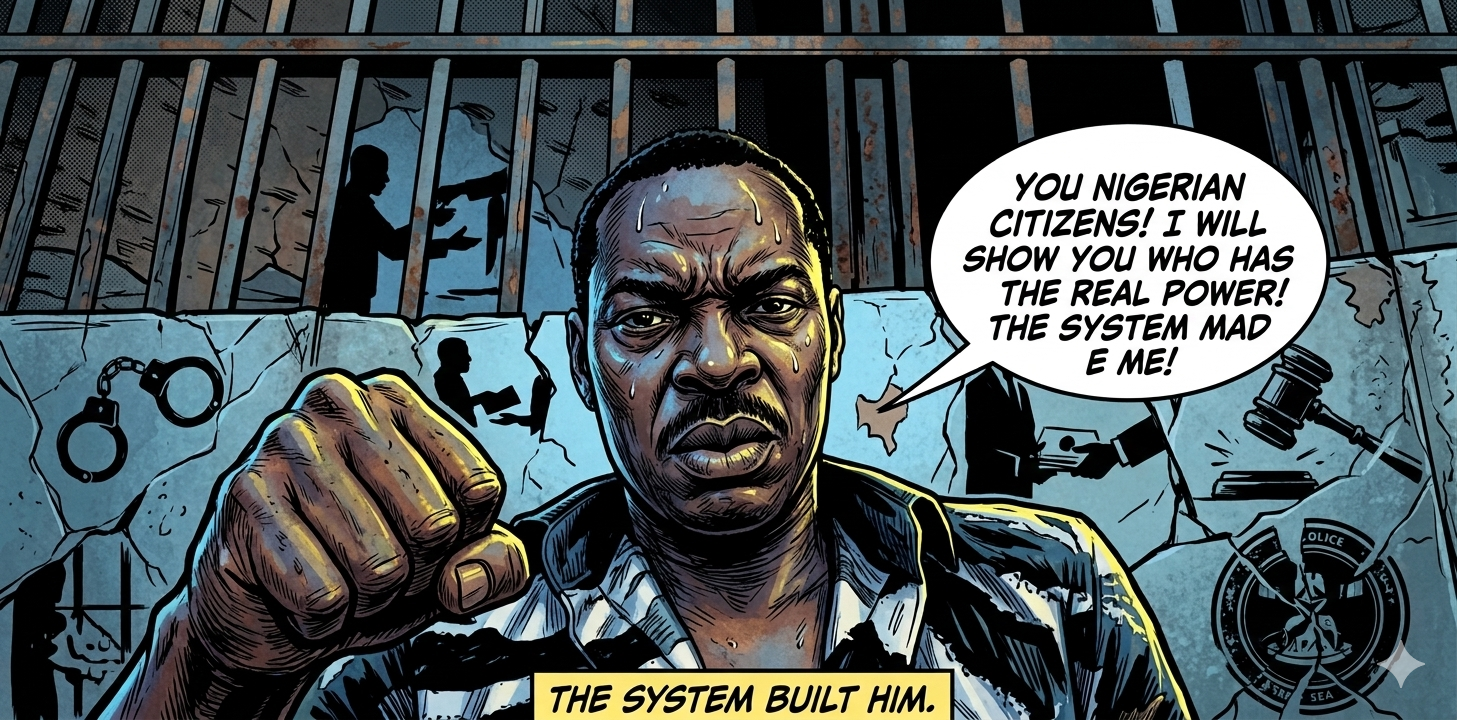
ASP Isokpehi, the Nigerian Police Force, and the System That Built Them Both
ASP Newton Isokpehi of the Anambra State Command went viral on Wednesday after threatening to kill any Nigerian who filmed him on duty. He has served for 26 years. He buys his own uniform. His colleague shot a bound man dead three weeks ago. Another colleague shoots unarmed protest crowds. Welcome to the Nigerian Police Force, where the dysfunction is not the exception. It is the product.
On Wednesday, May 21, 2026, a video appeared on TikTok and then on every other platform that carries Nigerian outrage. In it, a uniformed officer identified as ASP Newton Isokpehi, posted from his own TikTok account under the name “Newton Isokpehi for life,” addressed the camera directly and said: “Any day I’m on duty as a police officer, carrying my rifle and doing my job, let somebody come and video me. That oga who gave you people the order to video us, he will go and do your burial. He will bury you. The number of you that I kill, he will be the one to bury all of you.” He went further. He said he could shoot all passengers inside a vehicle if someone tried to film him. He said this while wearing his uniform. While holding the authority of the state. And, one must note, while operating under a March 2026 Federal High Court ruling that explicitly affirmed Nigerians’ constitutional right to film police officers on duty. The court, the force headquarters, and the Lagos Commissioner of Police had all said: citizens can film. ASP Isokpehi sparked outrage by saying, essentially: over my dead body. Or yours. Preferably yours.
ASP Newton Isokpehi: Twenty-Six Years in the Force and One Very Loud Rifle
ASP Newton Isokpehi
ASP Isokpehi is a serving officer of the Nigeria Police Force, attached to the Anambra State Command. The Punch confirmed his identity through his TikTok account, where multiple videos of him in uniform were still visible at the time of reporting. In his viral threat video, ASP Newton Isokpehi did not just make threats. He offered context. He said officers like him are mistreated, poorly compensated, and that the public filming them is one humiliation too many on top of a career of institutional neglect. He complained about poor working conditions. In his apology video, posted after the backlash, he cited 26 years of service and said his comments were made out of frustration. The Anambra State Command, in a statement signed by DCP Ngozi Ezeabata on behalf of Commissioner of Police Ikioye Orutugu, confirmed his arrest. Force headquarters, through DCP Anthony Placid, the Force PRO, described his conduct as “unacceptable, unprofessional, and inconsistent with the ethics, standards, and code of conduct of the Nigeria Police Force.” He was subjected to a drug test. Disciplinary proceedings have commenced. The outcome, the command assured, would be made public. This is, of course, what they always say.
There are two things worth holding together when thinking about ASP Isokpehi’s viral outburst. The first is that what he said is indefensible. A uniformed officer threatening to kill civilians for exercising a court-confirmed constitutional right is not a grey area. It is a direct and credible threat from a person carrying a loaded firearm and the authority of the state. The second is that what he described about his working conditions is very likely true. The frustration in his voice is not performance. It is the sound of a man who has spent 26 years in a system designed to underpay, underfeed, underequip, and undervalue him, and who has now decided that the citizens are the problem. This is exactly how politics in Nigeria works in practice. The system makes the officer miserable. The officer makes the citizen afraid. And the people at the top of the system, who created both the miserable officer and the afraid citizen, watch from their motorcades and express concern.
“A policeman’s lot is not a happy one.”
W.S. Gilbert, The Pirates of Penzance, 1879. Written as satire. In Nigeria, it functions as a policy document.

ASP Isokpehi Is Not the Problem. He Is the Product.
Three weeks before ASP Isokpehi sparked outrage on TikTok, another officer, ASP Nuhu Usman of the Delta State Command, shot a young man named Oghenemine Ogidi dead in a public motor park in Effurun. Oghenemine, known as Mene Ogidi or OG Millan, had his hands tied behind his back. He was begging for his life. He was not armed. He was not a threat. He was shot anyway. Narrivon covered this in full. The Delta State Police spokesperson was asked why this happened and suggested the answer might be “spiritual.” The Inspector-General of Police at the time promised swift justice. As of this writing, the case continues its slow journey through a system not historically known for speed when the accused wears a badge.
These two events, Isokpehi’s threat and Nuhu Usman’s killing, are not separate stories. They are the same story, told in different registers. One officer threatens to kill. Another officer kills. Both officers cite or imply frustration with their conditions. Both officers are attached to state commands whose senior officials have expressed the appropriate shock and disappointment. Both incidents produce the appropriate national outrage. Both incidents will be followed by the appropriate disciplinary statement. And both incidents are part of a pattern that goes back decades and has never once been resolved by the kind of disciplinary action that would actually deter the next officer from doing the same thing.
Beyond these two recent cases, the catalogue of confirmed extrajudicial killings and brutality by Nigerian security forces is extensive and documented. Amnesty International documented at least 82 cases of torture, ill-treatment, and extrajudicial execution by SARS alone between January 2017 and May 2020. A 16-year-old girl, Tina Ezekwe, was shot dead by a policeman at a Lagos bus stop on May 28, 2020 while waiting for transport. Kolade Johnson was shot dead by a Rapid Response Squad officer at a viewing centre in Lagos on March 31, 2019 while watching a Champions League match. Chima Ikwunado died in police custody in Rivers State in 2019 after being reportedly strung upside down for days. Each death was followed by a statement. Each statement was followed by an investigation. Each investigation was followed by silence. And then the next one happened.
The Nigerian Police Force does not have a bad-officer problem. It has a system problem. Bad officers are not anomalies that slip through the cracks. They are graduates of a system that produces them reliably, at scale, and then expresses surprise each time they graduate.
Anuoluwa Soneye, NarrivonAn Underpaid Officer With a Loaded Rifle: Who Designed This and Why?
Here is the welfare argument in its most honest form, and it is an argument worth taking seriously before tearing apart. ASP Newton Isokpehi said in his apology video that police officers buy their own uniforms. That they are poorly paid. That they are not cared for by the country. This is not untrue. Nigerian police officers at the lower ranks earn salaries that do not meet the basic cost of living in any Nigerian city. Their barracks, in many locations, are documented to be in states of disrepair. Their feeding conditions have been the subject of public complaints from serving officers themselves, most recently in the army welfare video that led to the arrest of activist Justice Crack. The tools they are given to do dangerous jobs, including vehicles, communications equipment, and protective gear, are often inadequate. A junior officer patrolling a volatile community may genuinely be operating on empty in every sense of the word: empty stomach, empty pay slip, empty support structure.
All of this is real. And none of it is an accident.
The question that insecurity in Nigeria consistently fails to produce is this one: who benefits from having armed, discontented, hungry officers scattered across the country with no accountability structure? The answer, when you follow the logic of politics in Nigeria, is the same people who have built a system where the best-equipped police teams, the most polished uniforms, the most modern vehicles, the heaviest weaponry, are not deployed to crime hotspots or insecurity flashpoints. They are deployed to government house gates. To escort convoys for governors. To protect senators in the National Assembly. To stand guard outside the homes of politicians. As we documented in our coverage of insecurity in Nigeria, IG Kayode Egbetokun himself told the government that over 100,000 officers were assigned to VIP protection rather than public policing. Over 100,000 of Nigeria’s 371,000 officers, guarding the minority, while the majority of Nigerians are left to manage with hungry, frustrated, poorly equipped counterparts at street checkpoints.

The Extortion Culture That Nobody at the Top Claims to Know About
Ask any Nigerian adult about their most recent encounter with a police checkpoint and you will get one of two types of stories. Type one: the officer was professional and the interaction was brief. Type two: there was a negotiation. It may have started with “oga, show something,” escalated briefly to “open your boot,” and concluded with N200, N500 or even N500,000 changing hands and both parties pretending the transaction did not happen. No law was broken. No charge was filed. A toll was collected. The road continued. This has happened to so many Nigerians so many times that it has ceased to feel like corruption and started to feel like a transport surcharge. That normalization is its own disaster.
Numerous accounts from serving and retired officers have suggested that checkpoint collections are not random individual decisions but are structured into daily informal quotas that flow upward through the command hierarchy. There is, as the user aptly notes, no hard documentary evidence that would satisfy a court, and we will not present speculation as fact. What we can say, with confidence, is this: the checkpoint extortion culture has been publicly documented, publicly reported, publicly condemned, and publicly unchanged for more than two decades. The people who run the Nigerian Police Force are not unaware of it. Senior officers have been in this institution long enough to have personally witnessed it. The fact that it persists is not a failure of information. It is a choice. And when it is a choice that persists for 20 years without meaningful consequence, it begins to look very much like a policy.
It is against this backdrop that the story of the new Inspector-General of Police, Tunji Disu, becomes relevant. There is, in Nigeria, a tradition of new IGPs arriving with reform language, fresh promises, and genuine early goodwill. IGP Disu has been described even by ASP Isokpehi himself, in his apology video, as someone “working to improve the welfare of officers.” We hold onto that with cautious hope. Because the reform Nigeria needs from its police force is not just welfare improvement for officers, necessary as that is. It is the kind of structural change that breaks the chain between hungry junior officers, profitable checkpoints, and the senior officials who benefit from the culture of silence around both. That reform would require a man willing to make powerful enemies. Nigeria has not produced many of those in police leadership. But there is always the possibility of a first.
EndSARS, Lekki, and the Night the Mask Fell Off Completely
If you want to understand what the Nigerian Police Force and its sister security agencies are ultimately for, October 20, 2020 is a useful reference point. For thirteen days, young Nigerians had organized one of the most disciplined, most widely observed protest movements in the country’s post-military history. The EndSARS movement demanded five specific things, including police accountability, compensation for victims of brutality, and the prosecution of officers involved in crimes. They were peaceful. They had first aid stations. They had lawyers on standby for anyone arrested. They sang the national anthem at the Lekki Toll Gate in Lagos. Then soldiers arrived. The lights went out. People were shot.
Amnesty International confirmed at least 12 deaths at Lekki. The ECOWAS Court of Justice, in June 2024, ruled that the Nigerian government was guilty of human rights abuses that night. The Lagos judicial panel described it as a massacre. Not a single soldier or police officer has been prosecuted for what happened. The government responded to a protest against police brutality with police and military brutality. And then called for calm. As we have documented at length, the same government that deployed soldiers against EndSARS protesters later graduated 744 ex-terrorists from a rehabilitation programme and called them prodigal sons deserving a second chance. The young Nigerians who survived Lekki have not received equivalent mercy or equivalent attention.
This is the inversion at the heart of insecurity in Nigeria as it relates to the security forces. The force that should protect citizens from violence has, on documented multiple occasions, been the source of the violence. The people at the checkpoints begging for N200 are the same people who arrive at protests with live ammunition. The institution that should be the buffer between ordinary Nigerians and harm has, too often, functioned as the instrument of that harm on behalf of the powerful. And as we argued in our piece on the docility of Nigerians, the most damaging thing about this is not what it does to the people who are shot. It is what it does to the people who watch and decide that speaking up is not worth the risk.

The Press Release as a Governance Strategy
Here is the cycle, which has been running so long it has developed its own rhythm. An officer does something indefensible. A video goes viral. Nigerians trend the hashtag. The police issue a statement describing the conduct as “unacceptable.” An arrest is made. A disciplinary proceeding is opened. The news cycle moves on. The disciplinary proceeding quietly disappears into institutional process. The officer involved is either quietly reinstated, quietly transferred, or quietly let go without public consequence. The next incident happens. Repeat.
This is not a failure of institutional response. It is the institutional response. The press release is not an attempt to fix the problem. It is an attempt to absorb the outrage at a cost low enough that nothing structural has to change. The statement from Force headquarters condemning ASP Isokpehi was issued within 24 hours. The arrest of ASP Nuhu Usman for shooting Mene Ogidi was announced within 48 hours. SARS was dissolved within days of the 2020 protests. Speed in announcements. Slowness in consequences. That gap is not an accident. It is a feature. Because real consequences would require real reform, and real reform would threaten the architecture of control that the current system has built over decades.
Nigeria spends significant resources on its security forces. The defence and security budget is one of the largest line items in the annual appropriations. The money exists. The training capacity exists. The institutional framework for accountability exists, on paper. What does not consistently exist is the political will to apply it in ways that actually change behavior. Not for officers who extort at checkpoints. Not for officers who shoot protest crowds. Not for officers who threaten to kill citizens for using their phones. The cure, in every case, is suppression of the symptom, a press release, an arrest, a promise, and then nothing, rather than treatment of the disease, which would require those at the top of the system to confront what the system was actually built to do.
“The state calls its own violence law, but that of the individual crime.”
Max Stirner, The Ego and Its Own, 1844
What Comes After the Outrage Has to Be Different This Time
ASP Isokpehi sparked outrage this week, and the Anambra State Command moved quickly to arrest him, which is the right first step. But an arrest is only meaningful if it leads to a consequence that other officers observe and internalize. If ASP Newton Isokpehi is quietly reinstated in six months, the lesson every officer in the force will draw is the same lesson Nuhu Usman’s colleagues are drawing from his case, and the same lesson the soldiers at Lekki have been teaching since 2020: you can do this. The announcement will come. The hashtag will trend. The outrage will peak and fade. And then you will be fine.
The only thing that breaks this cycle is sustained, organized, documented public pressure that does not allow the announcement to become the punishment. That means following up on the Isokpehi case in three months, in six months, in a year. It means building a public record that tracks what happens to the officers arrested in these incidents beyond the press release. It means demanding, as citizens, that the structural issues, the welfare, the chain of accountability, the deployment of officers to VIP protection instead of public safety, are addressed by the new IGP Tunji Disu’s administration with the same urgency that the condemnation statements are issued.
The corruption in Nigerian governance that produces ASP Isokpehi is not confined to the police force. It runs through every institution, as we have examined in our piece on the psychology of corruption in Nigeria. It is the same logic that produces ministers who threaten journalists, military officers who arrest welfare critics, and politicians who govern for themselves. The Nigerian Police Force is a mirror. What you see in it is what the entire system looks like up close. And what it will continue to look like until enough citizens decide that watching the cycle repeat is no longer acceptable.
At Narrivon, we document these incidents because the record matters. Because in a country where institutions work hard to suppress memory, written documentation is a form of resistance. But documentation alone is not enough. It must be accompanied by the kind of sustained, informed civic engagement that makes it impossible for the powerful to simply wait out the news cycle. Share this article. Ask questions about the Isokpehi disciplinary outcome in three months. Demand answers about Mene Ogidi’s case. Stay awake about Justice Crack’s May 25 court date. Be the Nigerian that the system was not built for: one who does not forget.
The Nigerian Police Force will keep producing ASP Isokpehi as long as the system that produced him remains unchanged. Arresting the man is not the same as fixing the machine. And fixing the machine requires citizens who are paying attention long after the hashtag has died.
Anuoluwa Soneye, Narrivon
Sources and Further Reading:
Police officer threatens to kill anyone who films him (The Punch, May 21, 2026) •
Police arrest ASP Newton Isokpehi (The Punch, May 22, 2026) •
ASP Isokpehi: I’ll kill anyone who films me (Premium Times, May 2026) •
Police detain ASP Newton Isokpehi (Legit.ng, May 2026) •
Viral video: ASP Isokpehi sparks outrage (Pulse Nigeria, May 21, 2026) •
ASP Isokpehi apologizes, blames frustration (TheNiche, May 2026) •
Police Force condemns ASP Isokpehi (The Sun Nigeria, May 2026) •
Pattern of unlawful killings by SARS (Amnesty International, October 2020) •
2020 Lekki Toll Gate shooting (Wikipedia)