
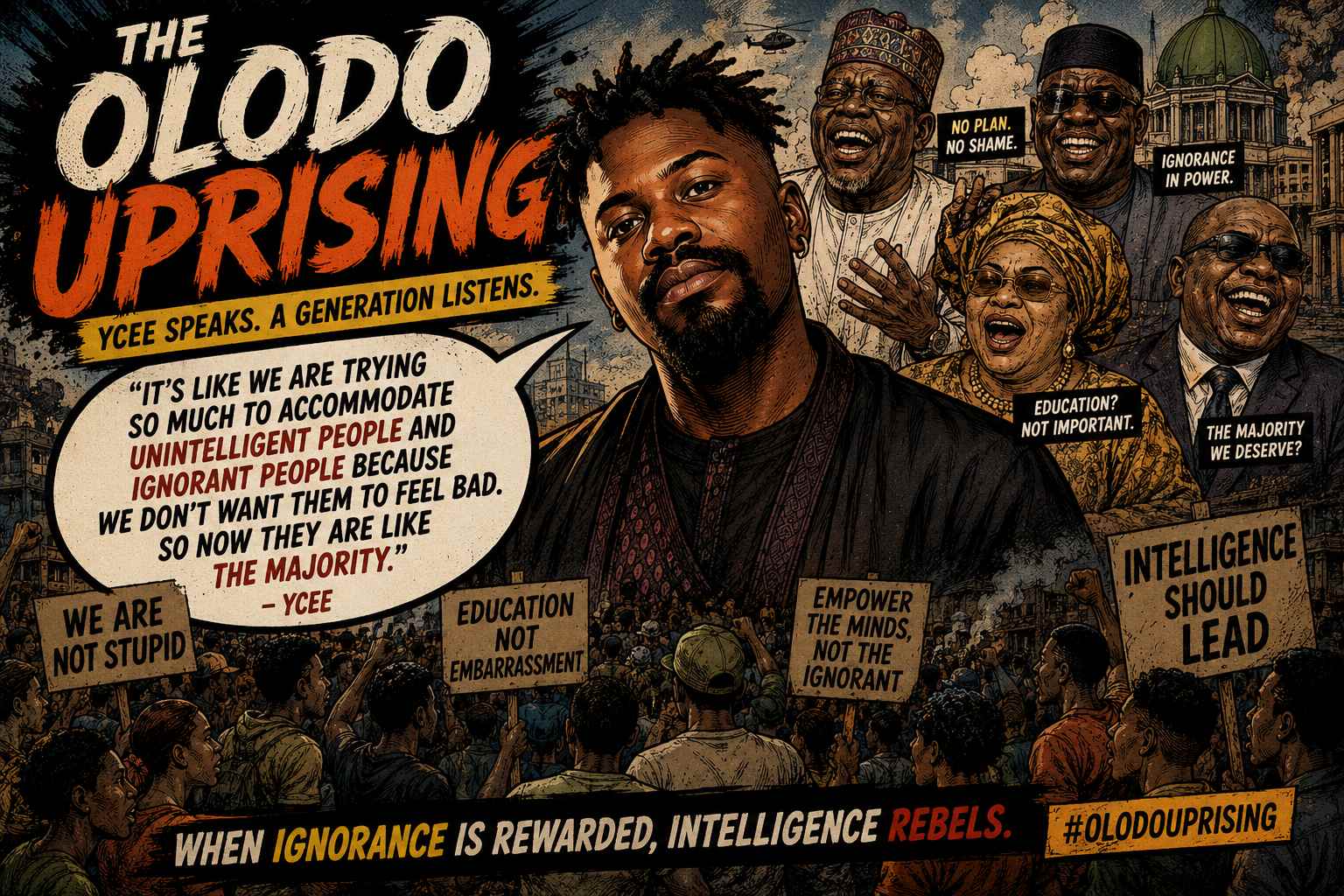
The Olodo Uprising: Ycee Named It. Nigeria Proved His Point by Responding to It.
On the Afropolitan Podcast, rapper Ycee said Nigeria is experiencing an Olodo Uprising, a cultural moment where ignorance is celebrated, viral behavior is rewarded, and intellectual achievement is quietly mocked. He said we are accommodating the unintelligent so hard that they have become the majority. The national debate that followed proved him right in ways no podcast ever could. People pulled up net worths. Fans defended their streamers. Nobody actually addressed the argument. The Olodo Uprising was in the response.
Let us start with the word. Olodo is Yoruba slang, traditionally applied in Nigerian schools to describe a pupil who cannot keep up academically. The dull student. The one who looks at the blackboard and sees nothing connecting. It carries a sting. It has always carried a sting. But Ycee, the Nigerian rapper whose real name is Ayoleyi Hanniel Solomon, did something interesting with it on the Afropolitan Podcast. He extended it beyond the classroom. He did not use it to describe a child who cannot read. He used it to describe a culture that no longer wants to. A society that has decided, gradually and with increasing confidence, that the rewards for ignorance are now greater than the rewards for knowledge, and that the social ladder is better climbed through viral behavior, clout, and money than through competence, values, and intellectual development. He called it the Olodo Uprising. And then Nigeria went online to disprove him by doing exactly the thing he described.
Ycee and the Olodo Uprising: The Exact Words and Why They Started a Fire
Ycee (Ayoleyi Hanniel Solomon)
Ycee is not a career academic. He is a rapper who has navigated the Nigerian music industry long enough to have watched it change in ways that appear to have concerned him deeply. On the Afropolitan Podcast, he made two specific statements that Channels Television, TheCable, and multiple other outlets confirmed verbatim. First: “It’s like we are trying so much to accommodate unintelligent people and ignorant people because we don’t want them to feel bad. So now they are like the majority.” Second: “People don’t even want to go to school anymore. It’s not even just Yahoo culture. Now we have Peller culture.” He clarified that his reference to Peller was not a personal attack on the streamer but a critique of the broader clout-chasing trend that Peller’s success had come to represent for a generation of young Nigerians who see virality as the most viable career path. The distinction matters legally and personally. But the cultural argument it sits inside does not depend on Peller’s character. It depends on what Peller’s kind of success communicates to a 16-year-old in Surulere who is trying to figure out what to do with his life.
The response to Ycee’s Olodo Uprising comment was immediate, national, and, from a certain angle, hilarious in the most depressing way possible. Some people agreed with him entirely. Some felt he was being elitist. Some argued that Peller had built a genuine business through social media skill and deserved his flowers. And a significant contingent, in the act of defending their position that money and success are the correct metrics for evaluating a person’s worth, went online and pulled up the respective net worths of Ycee and Peller as their rebuttal. They said: look at how much more Peller earns. Therefore Ycee is wrong. The man had said the problem with Nigeria is that we measure everything by money. The response was: here is how much money each person has. The Olodo Uprising was not just the topic of the debate. It was the method of it.

The Olodo Uprising Debate Proved That the Olodo Culture Is Already Here
The Olodo Uprising debate has two sides, and both of them are worth taking seriously, even if one of them is considerably harder to sustain under pressure. Side one: Ycee is correct that Nigeria is experiencing a cultural devaluation of intellectual achievement. Side two: Peller and creators like him have built genuine skills, genuine audiences, and genuine income through the internet, and reducing their success to “ignorance” dismisses a form of intelligence that traditional education does not capture. Side two is a fair point. It is a genuinely fair point. The ability to build and sustain an online audience is a real skill. Literacy and formal education are not the same thing, and many people who struggle in traditional classrooms possess other forms of intelligence that deserve recognition.
The problem is that this fair point was not the argument Ycee made. He did not say streaming is not a skill. He said we are building a culture that treats viral success as the only valid version of success, while intellectual achievement is increasingly invisible, unrewarded, and in some circles, actively mocked. There is a meaningful difference between those two arguments. And the fact that most of the Olodo Uprising debate collapsed into “but Peller earns more money” confirms the very thing Ycee was concerned about. In a society where the measure of a conversation’s outcome is determined by who has the higher net worth, the Olodo Uprising has already happened. It is the operating system of the argument.
Ycee said Nigeria was replacing intellectual value with money metrics. People responded by comparing his bank account to a streamer’s. The Olodo Culture is not coming. It arrived. It is moderating the debate about itself.
Anuoluwa Soneye, NarrivonPeller Culture Responds to the Olodo Uprising Debate: What He Said and What It Revealed
Habeeb Hamzat, known as Peller
When Ycee named “Peller culture” on the Afropolitan Podcast, Peller (Habeeb Hamzat) responded swiftly and publicly on his Instagram Stories. Confirmed verbatim by Legit.ng, Blueprint, PM News, Arise TV, and Pulse Nigeria, he wrote: “The same olodo uprising wey una dey use promote una noise, very anyhow OG. If you’re an elderly person, respect yourself. Must you mention names? You yourself are an illiterate because, as an elderly man with sense, you should be able to make your point without mentioning anyone’s name.” In a second response, he added: “Your hatred got nothing on me. I swear to God, I’m frustrated. People want me to be thinking. They want me to quit my career.” He also alleged that public figures who criticize him have privately reached out to his management for promotional collaborations. He said he “knows Ycee’s music but doesn’t know his face.” Peller’s partner Jarvis separately argued that many young Nigerians turned to social media careers because of unemployment and economic hardship, a fair and separate point that deserves its own conversation. Singer Portable also joined the response, asking: “You wey go school wetin you use your money do? How many car you get?” Take a moment with that last sentence. It is perhaps the clearest single articulation of the Olodo culture this article is discussing.
Here is what Peller’s response tells us, not about Peller as a person, but about the Olodo Uprising as a cultural moment. He called Ycee “an illiterate” for the act of publicly naming someone while making a broader argument. This is the logic of the culture: you cannot make an intellectual argument about public behavior if doing so involves naming public figures. The argument must be abstract or it is disrespectful. And if you persist with the argument, you are “promoting noise” and “bitter.” Portable summed up the entire counter-argument in one question: how many cars do you have? Not: is your argument correct? Not: is this a problem for society? But: how many cars? The Olodo Uprising debate was won by Ycee the moment his opponents began responding. They just did not notice.

Peller Culture, Yahoo Culture, and What Nigeria Has Confused Education With
Here is the distinction the Olodo Uprising debate keeps colliding with but never quite landing on. School and education are not the same thing. School is an institution. Education is a process. The process of education involves the acquisition and internalization of knowledge, skills, values, ethical reasoning, empathy, critical thinking, and the capacity to contribute to the society you inhabit. School can deliver education. It can also fail to. And in Nigeria, it has, systematically and at scale, failed to.
Start from the family. The first institution of education in any society is the home. Children who grow up in households where they are taught the difference between right and wrong, where they observe adults making principled decisions, where reading and curiosity are modeled and rewarded, arrive at school with the foundations of education already laid. In Nigeria, as we have explored in our piece on religion and culture’s influence on Nigerians, the family unit has been placed under enormous economic and social pressure that makes consistent, values-based parenting difficult for a significant portion of households. Then the child goes to school. A school with incomplete walls, inadequate teachers, outdated curricula, no science labs, and a culture of rote memorization rather than critical thinking. We have documented classrooms in Ebonyi State where pupils sit on bare concrete under unfinished walls. This is the environment that is supposed to produce education. It produces certificates. Sometimes. The two are not the same.
When these two institutions, home and school, both fail to deliver education in its full sense, the result is not ignorance of subject matter. It is the deeper failure: a generation that has never been taught to value what education is actually for. Not the certificate. The formation of a person who can think, reason, empathize, build, and contribute. Finland’s National Core Curriculum, widely referenced as one of the world’s most effective educational frameworks, explicitly includes “transversal competencies”: ethical thinking, cultural and communicative competence, self-care, multiliteracy, and participation in building a shared world. These are not extra-curricular softness. They are the core of what education does. Nigeria’s curriculum includes Social Studies, which theoretically covers values like integrity, patriotism, and social participation. In practice, it is memorized, examined, and forgotten. The values it describes are never demonstrated by the adults around the child, never reinforced by the institutions the child inhabits, and never rewarded by the society the child will eventually join. So the child grows up and discovers that the actual rules of the game are: money validates you. Everything else is background noise. That is the seed of the Olodo Uprising. It was planted long before Peller had a streaming account.
The JAMB cut-off mark reduction is the government’s own statistical contribution to this conversation. In 2025, the minimum JAMB score for university admission was 160. By May 2026, JAMB’s policy meeting reduced the minimum to 150. The floor of academic entry is being lowered, not raised. A score of 150 out of 400 is 37.5 percent. That is the minimum threshold for entering a Nigerian university. And even at that threshold, official JAMB data from the 2025 UTME showed that 70.7 percent of candidates, over 1.3 million people, scored below 200. The country is not lowering the bar because the students are overwhelmingly brilliant and the space is too small. It is lowering the bar because the bar is becoming harder to reach and the conversation about why that is, about the broken schools, the disrupted curricula, the inadequate teachers, the ASUU strikes, and the families that cannot support consistent learning, is not happening anywhere near the JAMB policy meeting. Instead, the minimum score is adjusted downward and the system continues to produce graduates who have cleared the adjusted hurdle without having been genuinely educated in the process. This is the institutional evidence for the Olodo Uprising. Not a podcast. A policy decision.

The Olodo Uprising Is Not About Intelligence. It Is About Values. And That Is Much Worse.
Here is the argument this article is making that the mainstream Olodo Uprising debate has largely missed. The real danger of Olodo culture is not the loss of doctors and engineers, though that is a real loss. It is the loss of values. And the reason that matters more is this: a society can import knowledge. It can hire expertise. It can bring in the technical solutions it needs. What it cannot import or hire is a citizenry that believes in honesty, accountability, shared responsibility, and the use of public resources for public good. Those qualities have to be grown from the inside. And they are grown through the process of education in its complete form: the values, the ethics, the empathy, the reasoning. Not the certificate.
When Peller culture or any equivalent of it becomes the dominant social model, the loss is not primarily that fewer people study engineering. The loss is that the model communicates something specific to the next generation: that you can mock people publicly, that you can waste resources for entertainment, that the people who pander to you do not require you to treat them with dignity, and that none of this affects your social standing. In fact, it improves it. When that model accrues millions of followers who see it as the template for success, the long-term effect is a society where the person with the most followers is not required to be good. Where power is not accountable to standards. Where character is irrelevant to status. That is not an entertainment problem. That is a governance problem in its most embryonic form. Because the 16-year-old who learns that money and clout exempt you from values grows up and enters every institution in the country carrying that belief.
“The aim of education is the knowledge not of facts but of values.”
William S. Burroughs, widely attributed
The Yahoo culture that preceded Peller culture taught a generation that money obtained through dishonesty was socially acceptable if the money was large enough. The culture that produced Yahoo Boys did not produce criminals from nowhere. It produced them from a social environment where the question “how did you get it?” had been quietly replaced by “how much did you get?” The Olodo Uprising is the acceleration of that trajectory. When your Instagram metrics are your character reference, you do not need values. You need content.
Olodo Uprising Symptoms in Nigerian Politics: The Culture Has Already Reached the Top
If you want to see what happens when Olodo culture reaches national leadership, you do not have to look far. A presidential spokesman recently measured Nigeria’s hunger levels by asking his domestic staff how they were managing. The First Lady advised economically struggling Nigerians to start akara and kuli-kuli businesses as an empowerment strategy. These are not failures of intelligence. They are failures of values. Specifically, the value of being required to genuinely understand the lives of the people you serve before you speak about those lives in public. In a society where the metric is visibility and authority rather than competence and empathy, you do not need to understand the people you govern. You need to be seen governing them. The Olodo Uprising is not just on TikTok. It is in the policy briefing room. It is in the office of the man who publicly calls a military officer a fool and describes democratic agreements as “gentlemanship” violations.
The connection is precise. A culture that measures worth by visibility and money, and removes values from the equation, does not stay on social media. It runs for office. It wins primaries. It gets appointed. It governs. And when you look at the ballot and see a field of candidates none of whom appear capable of solving the problems their constituents have, the Olodo culture is the through-line. Not because these leaders are stupid. Because the system selected for visibility over character, for loyalty over merit, for tribal or religious affiliation over demonstrated competence, in exactly the way that social media selects for engagement over truth. The Electoral Act 2026, written by people who will contest under it, is the Olodo culture in legislative form. The rules are written by the people the rules should constrain.

Fan Loyalty, Peller Culture, and the Intellectual Debt We Are Running Up
One of the most revealing aspects of the Olodo Uprising debate is who could not engage with it. A significant portion of the people who pushed back against Ycee were, by their own social media output, unable to separate the argument from the person their argument was adjacent to. Peller was mentioned. Therefore the argument was about Peller. Therefore the argument was an attack. Therefore the argument was wrong. This is fan loyalty functioning as a substitute for critical thinking. It is not unique to Nigeria. Fan culture globally has demonstrated the capacity to insulate figures from criticism by converting any engagement with their behavior into an act of personal aggression against their followers. But in Nigeria, where the stakes of the debate are not about a streamer’s reputation but about what a generation of young people learn to value, the cost of that fan loyalty is higher than most people have been willing to calculate.
There is also the “school na scam” campaign to contend with. This is not a fringe position. It is an active, growing movement among young Nigerians who have watched graduates struggle, watched the educated poor, watched people with degrees unable to find employment while content creators with no formal credentials earn what professors do not. Their observation is accurate. Their conclusion is worth examining. The conclusion, often, is that school is the problem. But the observation, looked at carefully, actually says something different. It says that the institutional rewards for education have collapsed. That is a different problem. The solution to a broken reward system is not to abandon the thing being rewarded. It is to fix the system. The Olodo Uprising is, in part, the result of a generation that has correctly identified a broken system and incorrectly concluded that the solution is to burn down the value the system was supposed to recognize.
“An investment in knowledge pays the best interest.”
Benjamin Franklin, widely attributed

Ycee Named the Olodo Culture. The Work of Reversing It Belongs to All of Us.
The Olodo Uprising is real. It is not, as some critics of Ycee argued, a classist dismissal of people who did not go to university. It is not a claim that Peller is a bad person. It is not an argument that money is unimportant. It is a warning that a society is beginning to lose something that cannot be easily recovered once it is gone: the collective belief that character matters, that values matter, that the way you treat people matters, that honesty matters, that the purpose of achievement is not just accumulation but contribution. Those beliefs are the product of education in its full form. Not the certificate. The formation.
The good news is that the Olodo Uprising debate itself is evidence that not everyone has been captured by it. The fact that Ycee felt strongly enough to name it. The fact that this article exists. The fact that you are reading it, engaging with it, thinking about it, is evidence that the capacity for that kind of engagement is alive. The docility that allows bad systems to persist is the same docility that allows anti-intellectual culture to go unchallenged. The antidote to both is the same: citizens who decide that the quality of their thinking, the depth of their values, and the consistency of their character are worth investing in and worth demanding from the people around them, including and especially the people who govern them.
You do not have to choose between making money and having values. You do not have to choose between enjoying content and thinking critically about it. You do not have to choose between celebrating streaming success and also expecting people who accumulate large platforms to use them with some awareness of the influence they carry. The Olodo culture presents these as binary choices. They are not. A fully educated person, in the complete sense of the word, knows how to hold complexity. That is, in fact, the point. We have seen what leadership looks like when it comes with both competence and values. We have seen what it looks like when it does not. The Nigeria of our dreams is built by people who know the difference and choose accordingly.
Frequently Asked Questions About the Olodo Uprising and Nigeria’s Anti-Intellectualism
What is the Olodo Uprising?
The Olodo Uprising is a term coined by Nigerian rapper Ycee on the Afropolitan Podcast in June 2026 to describe a cultural shift in Nigeria where unintelligent or ignorant behavior is increasingly celebrated, viral content and clout-chasing are rewarded above intellectual achievement, and society has begun measuring success exclusively by money and fame rather than values, character, or contribution. Ycee stated: “It’s like we are trying so much to accommodate unintelligent people and ignorant people because we don’t want them to feel bad. So now they are like the majority.”
What did Ycee say about Peller culture?
Ycee said: “People don’t even want to go to school anymore. It’s not even just Yahoo culture. Now we have Peller culture.” He clarified that his use of Peller’s name was not a direct personal attack but a reference to the broader trend of young Nigerians viewing viral streaming success as a more viable and desirable path than education or skill development. He described it as a critique of the “clout-chasing” phenomenon rather than a personal condemnation of any individual streamer.
What is the difference between school and education?
School is an institution designed to deliver education. Education is a process involving the acquisition of knowledge, skills, values, ethical reasoning, critical thinking, and empathy. You can attend school without receiving education in its full sense, and you can be educated without formal schooling. The Olodo Uprising debate is partly complicated by the fact that many Nigerians, understandably frustrated by a school system that has failed to deliver real education, have conflated the failure of the institution with the irrelevance of the process itself.
How does the Olodo Uprising connect to Nigerian politics?
The Olodo Uprising represents a values deficit that manifests at every level of Nigerian society, including in leadership. When political culture selects for loyalty, tribal affiliation, and financial resources over competence, values, and demonstrated capacity to serve, it follows the same logic as a social media culture that measures worth by followership rather than character. The result, in both spaces, is the elevation of people who are visibly powerful but not necessarily equipped to use that power for the public good.
Sources and Further Reading:
Ycee sparks debate over Olodo Uprising comment (Channels Television, June 26, 2026) •
Peller responds to Ycee’s Olodo Uprising comment (Legit.ng, June 26, 2026) •
Peller fires back at Ycee over Olodo Uprising (Blueprint, June 27, 2026) •
Peller to Ycee: You’re the illiterate (Arise TV, June 27, 2026) •
Peller responds to Ycee’s Olodo Uprising remark (Intel Region, June 2026) •
JAMB sets 150 as cut-off mark for university admissions 2026 (Vanguard, May 12, 2026) •
Ycee Olodo Uprising: academic decline and Peller culture debate (MicroSecond News, June 25, 2026) •
Ycee on the Afropolitan Podcast (Instagram, June 2026) •
The Cable analysis: Ycee and the Olodo Uprising (TheCable Facebook, June 2026) •
Finland National Core Curriculum and transversal competencies (Finnish National Agency for Education)