
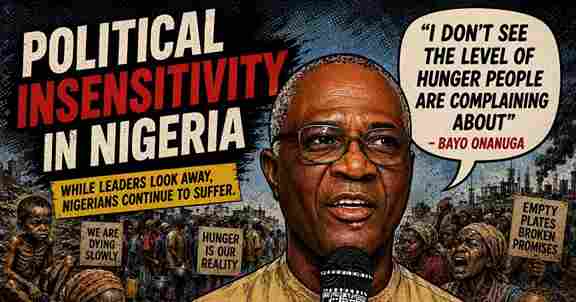
Political Insensitivity in Nigeria: When the People in Charge Cannot See the Plight of the People They Charge
On June 24, 2026, Bayo Onanuga, the Special Adviser to President Tinubu on Information and Strategy, sat down for an interview on Arise TV and told Nigeria something remarkable. He said he does not see the hunger. He looks at his domestic staff, asks how they are doing, and concludes that the level of hardship people keep describing is not quite what it seems. A bag of rice is currently selling for about N70,000. The national minimum wage is N70,000. Nigeria does not have a hunger perception problem. It has a leadership perception problem.
There is a line of questioning so old it has its own entry in Nigerian political history. When a government spokesman is asked about widespread hunger and economic hardship, what do they say? They say the situation is not as bad as described. They say the media exaggerates. They say the government is working. But on June 24, 2026, Bayo Onanuga went further than most. He produced an actual methodology. He explained how he personally verifies whether Nigeria is hungry. He asks the people who work for him. He looks them in the eye, says “how are things, how are you adjusting,” hears their answers, and draws his conclusion. This, in the year 2026, in a country of 220 million people with an official inflation rate above 30%, is the political insensitivity in its most refined and revealing form. Not the cruelty of a man who knows people are suffering and does not care. The more disturbing variety: a man who genuinely believes that asking his domestic employees how they are coping is a sufficient sample for determining the state of a nation’s hunger.
Bayo Onanuga: “I Don’t See the Level of Hunger Nigerians Are Talking About”
Bayo Onanuga
Bayo Onanuga is not a man without a history of understanding Nigerian hardship. He is a veteran journalist who worked through some of the most difficult periods in this country’s press history, including the military era when covering government could cost you your freedom. He knows what journalism looks like. He knows what evidence looks like. And on June 24, 2026, on Arise TV’s Prime Time programme, he produced evidence for one of the most significant claims any government spokesperson has made in recent memory, that the level of hunger Nigerians describe is not what it appears to be, and the evidence was: his domestic staff. Confirmed word for word on Arise TV’s own website and by Vanguard, The Sun, The Source, and West Africa Weekly, Onanuga said: “I am a Nigerian. I have people working for me privately. I don’t see the level of hunger people are talking about because I see them, and I keep asking them questions: how are things, how are they adjusting, what are the problems?” He also, in the same interview, dismissed media coverage of insecurity by saying: “The way they report insecurity is as if the entire country is consumed.” He described a recent road trip from Ibadan to Lagos where Google Maps rerouted him via Ijebu-Ode and he discovered a new concrete road. “I said, ‘Wow, when was this one built?'” He also noted that his travel time from Ajah to Lagos had dropped from two hours thirty minutes to one hour seven minutes thanks to the coastal road. He said: “Is that not beneficial? What are people talking about really?”
Let us give this its full due. Bayo Onanuga is right that some roads have improved. He is right that some government projects have been delivered. He is right that not every Nigerian, in every corner of the country, experiences identical levels of hardship. What he is spectacularly wrong about is the method by which he arrived at his conclusion about the plight of Nigerians. Asking your household employees whether they are managing, in a country where people are terrified of losing the jobs that pay their only income, is not a hunger survey. It is a study in employment compliance. Nobody tells their boss they are struggling if they think honesty might cost them their income. And nobody who employs domestic staff, in a country where a single domestic salary can be the difference between a family eating and not eating, is in a position to experience the hunger they are supposedly measuring through those conversations. Bayo Onanuga says he doesn’t see hunger anywhere because he is standing in exactly the kind of place where hunger is least likely to present itself to him.

The Plight of Nigerians: What the Data Shows When You Look Beyond Your Domestic Staff
Here is what Bayo Onanuga would have found if he had asked not just his own employees but the data that his own government’s agencies produce. As of early 2026, Nigeria’s official inflation rate stands above 30 percent. A 50kg bag of rice, which is the standard measure of affordable food access for Nigerian families, currently costs about N70,000, according to verified market reports cited by Vanguard. The national minimum wage, which the government raised from N30,000 to N70,000 in July 2024, has not been fully implemented across all Nigerian states as of this writing. Even where it has been implemented, the real purchasing power of N70,000 in an economy with 30 percent inflation is significantly less than its nominal value. In practical terms, this means that a worker earning the minimum wage in Nigeria today cannot buy a single bag of rice with one full month’s salary and still have anything left to pay for rent, transportation, school fees, or any other expense. This is basic arithmetic. The plight of Nigerians is documented not by Twitter trends but by the price tag on a food item at the market closest to you.
The Peoples Gazette noted that since Tinubu assumed office on May 29, 2023, at least 19,980 fatalities and over 12,000 abductions have been documented. As we have documented at length in our coverage of the kidnapping crisis in Nigeria, these are not exaggerated media constructions. They are names. They are families. They are the communities that Onanuga suggested, in the same interview, the media was making sound “as if the entire country is consumed.” Nigeria has a problem. The problem is not how the media is covering it. The problem is what is happening inside it.
Bayo Onanuga surveyed his domestic staff and concluded Nigeria is not hungry. A bag of rice costs what a minimum wage worker earns in a month. The survey methodology needs work. The political insensitivity does not.
Anuoluwa Soneye, NarrivonPolitical Insensitivity in Nigeria Has a Long and Decorated History of Remarkable Statements
To be fair to Bayo Onanuga, he did not invent this genre. The Nigerian political elite’s ability to look directly at mass suffering and find a way to not quite see it has a documented lineage. In the Second Republic, Umaru Dikko, a cabinet minister in the Shagari government, made a remark that has lived in infamy for over four decades: that Nigerians had not reached the point of “eating from dustbins.” He said this during a period of visible economic hardship. The remark defined his political legacy more than any policy he implemented. Bayo Onanuga has now produced his own version of the Dikko moment, and the similarity is not accidental. Both statements come from men who are genuinely, structurally insulated from the economic reality they are being asked about. The problem is not that they are lying. The problem is that they are not. They genuinely cannot see it from where they are standing.
Senator Godswill Obot Akpabio, CON
Senate President Akpabio is a man whose capacity for accidental self-revelation has become one of the defining cultural contributions of the 10th National Assembly. On July 26, 2023, during a Senate plenary debate about halting an electricity tariff hike, Akpabio presented a motion for a vote, saying: “The prayer is that, let the poor breathe, and Senator Mustapha has seconded that the poor should breathe. Those who are in support of the additional prayer that the poor should be allowed to breathe, say ‘hi’ and those who are against say ‘nay.'” The senators said “Hi” and the chamber erupted in laughter. The clip went viral. Prof Pat Utomi said: “I am traumatized by this mocking of the poor by our Senate. In a decent society we should have had resignations by now. To mock the poor is to mock God.” On August 7, 2023, apparently having forgotten the chamber was on live television, Akpabio announced: “In order to enable all of us to enjoy our holiday, a token has been sent to our various accounts by the clerk of the National Assembly.” He was alerted mid-sentence that the proceedings were being broadcast nationally. He withdrew the statement. The token was real. The withdrawal was theatrical. And in July 2024, during a discussion about a planned protest over economic hardship, he said: “Those who want to protest can protest, but let us be here eating.” The senators stayed. The hungry people outside did not receive an invitation.

Senator Sunday Karimi and the Political Insensitivity of Nigeria’s N160 Million Explanation
Senator Sunday Steven Karimi
When the National Assembly’s procurement of 469 Toyota Land Cruiser and Prado SUVs at a reported price of approximately N160 million each became a national controversy, Senator Sunday Steven Karimi stepped forward as the designated explainer. His explanation was memorable. The Chairman of the Senate Committee on Services urged Nigerians to excuse the senators from public criticism of the vehicle purchase, arguing that the legislators needed such vehicles because of the terrible condition of Nigeria’s roads. The roads, it should be noted, are terrible because the people who make the decisions about road construction budgets are the same people in the legislature who are purchasing the vehicles. Senator Karimi’s argument, in its fullest form, is this: Nigeria’s roads are too bad for ordinary vehicles, so legislators need N160 million SUVs to survive them, and Nigerians should understand this and not complain. The average Nigerian uses the same bad roads in the same ordinary vehicle. The average Nigerian earns N70,000 a month. The average Nigerian’s vehicle does not qualify for a procurement budget. The average Nigerian is invited to understand.
The N160 million SUV story is not just a story about wasteful spending. It is a story about what happens when political insensitivity is not even experienced as insensitivity by the people expressing it. Senator Karimi was not trying to be outrageous. He was providing a genuine policy rationale. The roads are bad, the vehicles are appropriate, this is how governance works. What he was unable to see, from inside the system, is how that rationale lands for someone who cannot pay rent. As we have previously documented, Nigerian politicians have a sophisticated understanding of how to use poverty as a campaign tool. The disconnect is not between their intelligence and the situation. It is between their daily lived experience and the daily lived experience of the people they were elected to represent. These are people who have not stood in a market queue in years. Who have not checked the price of a bag of rice with their own hands in recent memory. Who do not receive a monthly salary that requires them to make the calculations that 220 million Nigerians make every morning before they leave their house. The disconnection is the consequence of a lifestyle so comprehensively different from the average Nigerian’s that the two worlds no longer share a reference point.
Nigerian Leaders Are Detached from Nigerians’ Struggles: Why This Is Not an Accident
The Tinubu government’s disconnect from Nigerians is not a communication failure. It is not a public relations problem. It is the predictable outcome of a political system that rewards people for accumulating and sustaining advantages that separate them from the majority, and then asks those same people to understand and represent the majority’s interests. A senator who has not paid for his own fuel in years cannot intuitively understand what the fuel subsidy removal meant to the family running a petty trading business in Onitsha. A minister who has not queued for a product in years cannot viscerally understand what it means when cooking gas prices triple. A presidential spokesman who asks his domestic workers how they are coping cannot understand that those workers will give him the answer most likely to preserve their employment, not the answer most accurately describing their economic reality.
This is not about bad people. It is about a system that has successfully removed its political class from the material conditions of the people they govern. As we noted in our coverage of the president’s own insecurity response, the empathy that governance requires is not a personality trait that some leaders have and others lack. It is a function of proximity. You cannot feel what you never encounter. And the Nigerian political elite has constructed, through decades of entitlement and institutional advantage, a life so insulated from the ordinary Nigerian’s experience that the gap is now not even visible to them. This is why Bayo Onanuga is not lying when he says he does not see the hunger. He is not lying. He genuinely does not see it. That is precisely the problem.
“One of the tests of the quality of a civilization is the treatment of its poor and underprivileged. It is not enough to have great wealth. One must know how to use it with wisdom and generosity.”
Franklin D. Roosevelt, 32nd President of the United States
The contrast with a leader like Governor Alex Otti of Abia State is instructive. When Otti visited a school and found children lined up outside to welcome him, his response was not to enjoy the reception. He rebuked the teachers for keeping children out of class. He noticed that no learning was happening and said so. That noticing, that specific awareness of what is actually in front of you as opposed to what you would like to see, is the essential quality that Nigerian political culture has consistently failed to reward and consistently failed to produce in sufficient numbers. Nigerian leaders are detached from Nigerians’ struggles not because they are uniquely heartless but because the system built around them is uniquely comfortable. The SUVs. The convoys. The domestic staff.
The Plight of Nigerians Demands Leaders Who Actually Know What That Plight Feels Like
Here is the straightforward argument this article is making. Good governance requires empathy. Empathy requires proximity. Proximity requires that the people making decisions about the lives of ordinary Nigerians have at least some meaningful, unmediated contact with how ordinary Nigerians actually live. Bayo Onanuga does not need to shop for rice himself to understand that N70,000 for a bag is devastating for a family earning N70,000 a month. He needs to encounter that information with the seriousness it deserves and allow it to inform how he speaks about Nigerian hunger, rather than measuring national hunger by the responses of his household employees.
Senator Karimi does not need to sell his SUV to understand that explaining a N160 million vehicle as a necessity required by bad roads, in a country where the people who designed those bad road budgets sit in the same chamber, is not an explanation that lands well with people who navigate those roads in okadas and danfos. He needs to understand that the defense of legislative luxury during a documented economic crisis is not a PR problem. It is a representation problem. It says, to the people who elected these senators, that you are not the primary constituency. The comfort of the office is.
At Narrivon, we have consistently argued that the Nigeria of our dreams is not produced by better spokesmen. It is produced by better citizens who demand better from the people they elect. That means calling out political insensitivity when it presents itself in a prime time interview on a national television station. It means sharing this article. It means asking, the next time a government official appears on television to discuss the economy, whether the person speaking has any meaningful contact with the economy they are describing. And it means voting, with clear eyes, for the people who demonstrate not just policy competence but the kind of proximity to your experience that makes their decisions likely to reflect your reality.
Bayo Onanuga said he does not see the level of hunger Nigerians are talking about. The people who are hungry are not asking him to see it. They are asking the government he represents to fix it. There is a difference between the two. That difference is the gap that good governance must close. And no amount of Google Maps travel time reduction from Ajah to Lagos will fill it for the family that cannot afford to make that journey in the first place.
Frequently Asked Questions About Political Insensitivity and the Plight of Nigerians
What did Bayo Onanuga say about hunger in Nigeria?
In an interview on Arise TV’s Prime Time programme on June 24, 2026, Presidential Special Adviser Bayo Onanuga said: “I am a Nigerian. I have people working for me privately. I don’t see the level of hunger people are talking about because I see them, and I keep asking them questions: how are things, how are they adjusting, what are the problems?” He also dismissed media coverage of insecurity as exaggerated, saying “the way they report insecurity is as if the entire country is consumed.” His remarks were confirmed by Vanguard, The Sun, The Source, Arise TV’s own website, and West Africa Weekly.
What is the current state of hunger and food prices in Nigeria?
As of mid-2026, a 50kg bag of rice costs between N70,000 and N100,000 in Nigerian markets, which is equal to or exceeds the national minimum wage of N70,000. Nigeria’s official inflation rate stands above 30 percent. The minimum wage was raised from N30,000 to N70,000 in July 2024 but has not been fully implemented across all states. Independent tracking databases have documented over 19,980 fatalities and 12,000 abductions since President Tinubu took office in May 2023.
What was the Godswill Akpabio “let the poor breathe” controversy?
On July 26, 2023, during a Senate debate on electricity tariffs, Senate President Godswill Akpabio put a motion to a vote in a manner that caused senators to laugh, saying “the prayer is that the poor should breathe.” The viral clip showed senators amused by the phrase during a period of severe economic hardship. Prof Pat Utomi condemned it as “mocking the poor.” Akpabio denied mocking Nigerians. He later announced holiday bonuses to senators on live television before withdrawing the statement when informed proceedings were being broadcast.
Why did Nigerian senators buy N160 million SUVs?
Senator Sunday Steven Karimi, Chairman of the Senate Committee on Services, defended the procurement of 469 Toyota Land Cruiser and Prado SUVs at approximately N160 million each for National Assembly members, explaining that the vehicles were necessary because of the poor condition of Nigerian roads. The explanation generated widespread public criticism, with many Nigerians pointing out that ordinary citizens navigate the same roads in far less expensive vehicles while earning the national minimum wage of N70,000 per month.
Sources and Further Reading:
Bayo Onanuga: I don’t see the level of hunger in Nigeria people are talking about (Arise TV, June 24, 2026) •
I don’t see the level of hunger Nigerians complain about, Onanuga (Vanguard, June 2026) •
Onanuga: I don’t see the level of hunger Nigerians complain about (The Sun, June 2026) •
The hunger and insecurity Bayo Onanuga refuses to see (Peoples Gazette, June 2026) •
Tinubu’s adviser Onanuga says he does not see hunger Nigerians are complaining about (West Africa Weekly, June 2026) •
Pat Utomi lambasts Akpabio for mocking poor Nigerians (SaharaReporters, July 2023) •
The many controversies of Senate President Akpabio (Daily Trust, July 2025) •
Akpabio’s ‘let the poor breathe’ comment (Leadership Newspaper, July 2023)