
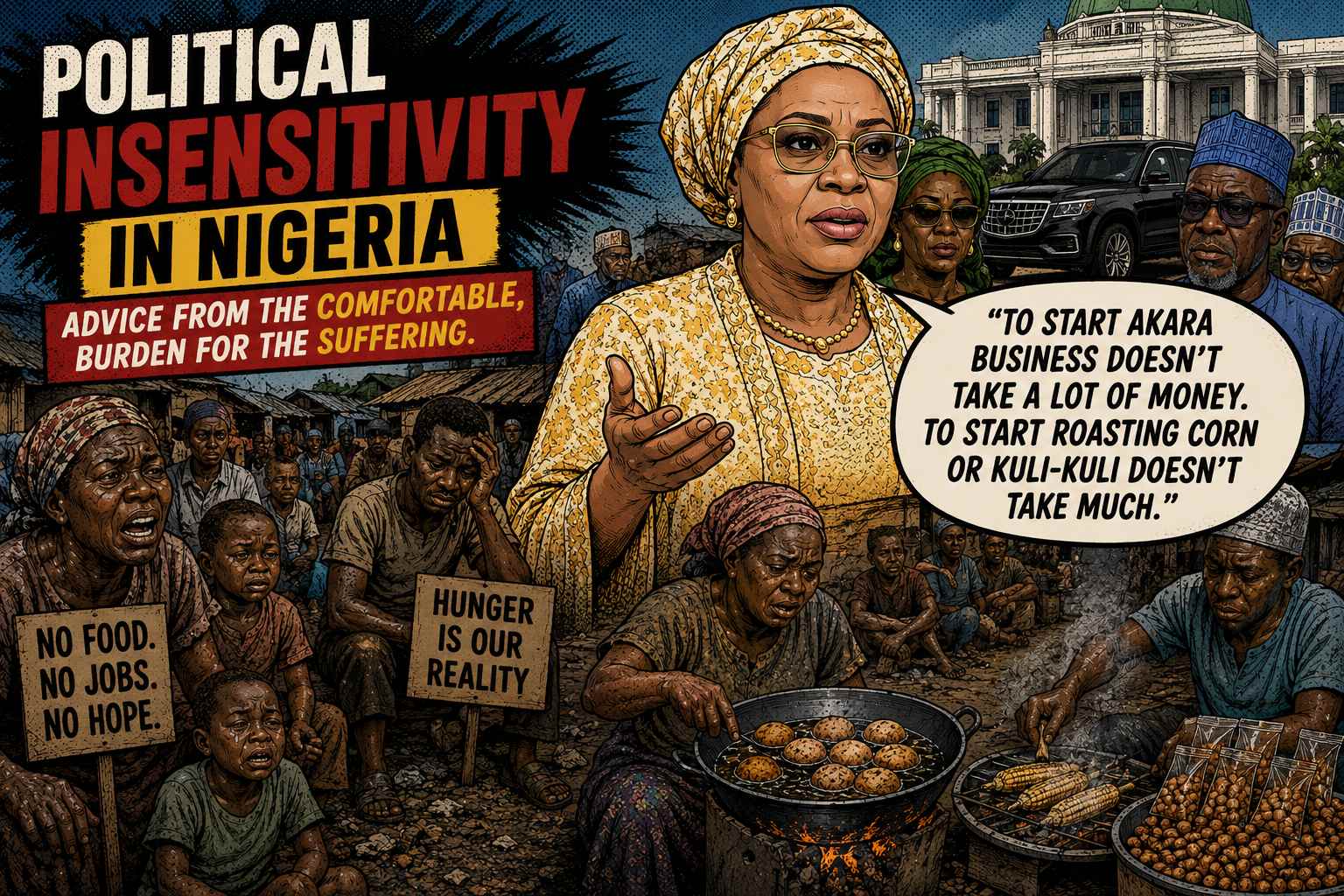
Remi Tinubu Said Start an Akara Business. So We Did the Maths.
On June 25, 2026, Nigeria’s First Lady told women who had received Renewed Hope Initiative grants that starting an akara or kuli-kuli business does not take much money. She said it with confidence. She said it with warmth. She said it as though it was a plan. We have done the arithmetic. It is not a plan. It is a sentence. And the gap between those two things is the entire story of political insensitivity in Nigeria.
Her name is Senator Oluremi Tinubu. She was born March 11, 1968. She is an Assistant Pastor at Haven of Glory Church in Lagos. She is a former senator who represented Lagos Central from 2011 to 2023. She is the First Lady of the Federal Republic of Nigeria. And on June 25, 2026, speaking at a meeting of the Renewed Hope Initiative where women had received small business grants, Remi Tinubu looked at the assembled recipients and said: “To start akara business doesn’t take a lot of money. To start roasting corn or kuli-kuli doesn’t take much. We didn’t give them a loan, we gave them a grant. We have encouraged Nigerians as best as we could.” She said it with the untroubled certainty of a woman for whom the cost of a bag of beans is not a number she has had occasion to track. Within hours, the backlash was national. Within days, it had become a phrase. Within this article, it becomes a budget.
Remi Tinubu Faces Backlash Over Akara: Let Us Run the Numbers First
The question is not whether selling akara is a legitimate business. It is. Akara sellers across Nigeria have built lives, educated children, and sustained households through exactly this trade. The question is whether, in 2026, with the specific economic conditions that the Tinubu administration’s own policies have produced, a grant-funded akara business constitutes an empowerment strategy worthy of a First Lady’s endorsement as a national response to economic hardship. Let us do the mathematics that the Renewed Hope Initiative’s communications team apparently did not.
Beans (10kg, one day’s production): N12,000 to N15,000
Palm oil (5 litres): N5,500 to N7,000
Seasoning, pepper, onions, salt: N3,000
Cooking fuel (gas or firewood per day): N3,000 to N5,000
Equipment, transport to market: N2,000 per day (ongoing)
Total daily input cost: N25,500 to N32,000
Selling price per piece of akara: N100 to N200 (standard size)
10kg beans produces approximately 100 to 150 pieces
Best-case daily revenue: N15,000 to N30,000
Net daily profit (best case, everything sold): N5,000 to N7,000
Monthly profit (operating 26 days, no rest, no sick days): N130,000 to N182,000
Now here is what a decent life in Nigeria costs each month in 2026. A decent single room self-contained apartment in Lagos (in the least): N200,000 to N400,000 per year, which is N17,000 to N33,000 per month. Food for a family of four (with a bag of rice now costing about N70,000 and N100,000): N80,000 to N120,000 per month. Transportation: N20,000 to N30,000. Electricity (often supplemented with generator): N15,000 to N25,000. School fees for two children: N20,000 to N50,000. Healthcare, clothing, miscellaneous: N20,000 to N30,000. Total monthly cost of a basic decent life: N172,000 to N288,000.
So the akara seller, if she fries every single day, sells every single piece, suffers no illness, faces no market downturns, operates without rest, and everything goes according to plan, earns roughly what it costs to live decently. There is no buffer for savings. No cushion for a slow week. No provision for the school fees that jump, or the gas cylinder that runs out, or the generator that dies. And this is the best-case scenario. The real scenario includes days when the beans go unsold, days when fuel prices spike overnight, days when the market is rained out, and the persistent reality that an akara business is not a ladder out of poverty. It is a way to stay close enough to the surface to breathe. Remi Tinubu faces backlash over akara not because Nigerians disrespect the trade. They respect it. They are doing it. They are exhausted by it. And they did not need the First Lady to discover it for them.
The First Lady told women to fry akara. We ran the numbers. You would have to fry every single day, sell every single piece, never be sick, never rest, and produce a month’s worth without a single bad day just to afford a one-bedroom apartment in Lagos. This is not empowerment.
Anuoluwa Soneye, NarrivonRemi Tinubu, APC Cars, and the Priorities That Nobody Announced
Here is the detail about Remi Tinubu’s approach to empowerment that received considerably less national attention than the akara statement. Around the same period in June 2026, weeks after the Oyo State kidnapping in which 32 people including schoolchildren were abducted and mathematics teacher Michael Oyedokun was beheaded on camera, First Lady Remi Tinubu donated cars to APC women leaders in opposition states. Cars. To party women leaders. In the weeks following a national emergency that claimed the life of a teacher and left children missing.
This is not a comparison made to be unfair. It is a comparison made to be accurate. The First Lady has resources. She allocates them. The allocation tells you the priority. When cars go to party loyalists and grants go to akara sellers, the message is not subtle. The political machinery receives vehicles. The masses receive business advice. As we have previously documented, the empathy deficit in this administration runs consistently in one direction. The machine is well resourced. The people are well advised. Just last week, the president’s own spokesman told Nigerians he did not see their hunger. This week, the First Lady told them to fry beans. It is beginning to look less like a series of unfortunate statements and more like a consistent communication philosophy.
Remi Tinubu’s Akara Plan and the President’s Sacrifice That Applies to Everyone Else
The akara statement does not exist in isolation. It exists alongside President Tinubu’s recurring theme of sacrifice, the ask that Nigerians endure the economic pain of subsidy removal and forex reforms in the faith that better days are approaching. In his 2024 Sallah message, Tinubu told Nigerians that their “sacrifices and expectations will not come to naught.” He has said versions of this repeatedly. The sacrifice language is consistent. What is also consistent is who is being asked to make the sacrifice. Fuel subsidy removal hit the petty trader hardest. Forex liberalization hit the small importer hardest. Inflation hit the family buying a bag of rice hardest. The administration that asks Nigerians to sacrifice has not asked itself to sacrifice alongside them. National Assembly members received N160 million SUVs while the country was being asked to endure. APC women leaders received cars while schoolchildren remained in captivity. And the First Lady announced that empowerment looks like kuli-kuli.
Sacrifice, as a governance strategy, works when it is shared. When the leadership visibly bears the same cost as the people it is asking to endure, the ask has moral weight. When the leadership asks for sacrifice from one direction and distributes vehicles in the other, the ask becomes something else entirely. As we have documented in our coverage of how Nigerian politicians use poverty as a tool, the pattern is familiar: the hardship is for the governed. The comfort is for the governors. And the most the governed can hope for, apparently, is a grant large enough to buy the beans for a batch of akara, and the advice, delivered with the warmth of a First Lady who has never checked the price of beans herself, that this is a start.

There is a sentence that Nobel laureate Wole Soyinka once used to describe a certain kind of Nigerian governance, paraphrasing: that the state speaks eloquently about the future while picking the pocket of the present. First Lady Remi Tinubu did not pick anyone’s pocket. She offered grants. She built roads through her husband’s administration. She gives to hospitals. None of that is false. The issue is not the akara business. The issue is the confidence with which it was offered as the answer to a question that requires far more than a recipe. The question Nigeria is asking its leaders in 2026 is: how do we live with dignity in a country where our wages cannot buy a bag of rice? The answer that came back from the First Lady of the Federal Republic was: have you considered frying beans?
At Narrivon, we believe that the Nigeria we deserve is governed by people who know the price of a bag of beans not because they were briefed on it but because they cannot avoid knowing it. People who understand that empowerment is not a grant for a business that earns, at best, enough to survive, but the systems, education, healthcare, security, and economic policy that make surviving no longer the highest ambition available to a Nigerian. That Nigeria is possible. We have seen glimpses of it. But it requires citizens who, when the First Lady says akara doesn’t take much, say: actually, we have run the numbers. It takes more than you think. And we deserve more than this.
Sources and Further Reading:
Remi Tinubu’s akara, roasted corn, kuli-kuli comment sparks backlash (Daily Post, June 26, 2026) •
Start akara, roasted corn business, Remi Tinubu advises poor Nigerians (Tribune Online, June 26, 2026) •
Remi Tinubu under fire after urging Nigerians to start akara businesses (Pulse Nigeria, June 26, 2026) •
You don’t need much to start akara business, Remi Tinubu (Legit.ng, June 26, 2026) •
Nigerians call out Remi Tinubu over akara remarks (Neusroom, June 26, 2026) •
Remi Tinubu incurs Nigerians’ wrath after urging them to embrace akara businesses (TheNiche, June 26, 2026) •
Celebrity voices challenging Remi Tinubu’s akara tips (Within Nigeria, June 27, 2026) •
First Lady Remi Tinubu donates cars to APC women leaders (Nigerian Bulletin) •
Tinubu Sallah message: Nigerians’ sacrifices will not come to naught (This Day, June 2024)