
Nyesom Wike and the Nigerian Democracy He Is Dismantling One “Agreement” at a Time
Ezenwo Nyesom Wike called a uniformed naval officer “a very big fool” on camera. He controls both the APC and PDP governorship candidates in Rivers State for 2027. He demolished the Rivers State House of Assembly complex during a political dispute. He says all of this is just agreements being honored. Nigeria calls it godfatherism. The dictionary calls it something else entirely.
There are some politicians who damage democracy quietly, through small daily corruptions, through the slow attrition of institutional integrity, through the patient, incremental capture of state resources and levers of power. And then there is Nyesom Wike. The Minister of the Federal Capital Territory of the Federal Republic of Nigeria. The man who conducts the dismantling of Nigerian democracy so publicly, so loudly, and with such theatrical confidence that you almost have to admire the audacity. Almost. Because behind every video, every press conference, every “agreement” invoked and every building demolished, there is a cost being paid by ordinary Nigerians who did not sign any agreement with anyone and who simply want a government that works for them rather than a godfather who works for himself. This is the full record of Ezenwo Nyesom Wike. And it is not a comfortable read.
Nyesom Wike: Who He Is, What He Has, and How He Got Both
Ezenwo Nyesom Wike, CON, GSSRS
Nyesom Ezenwo Wike CON GSSRS is one of the most powerful political figures in Nigeria, which is either a tribute to his political acumen or a devastating commentary on what Nigerian politics rewards, depending on your perspective. He served as Governor of Rivers State for eight years, during which he built a reputation for aggressive governance, large-scale infrastructure projects, and an equally large-scale intolerance for political opposition. He ran for the PDP presidential ticket in 2022, came third, and when the party picked Atiku Abubakar as its candidate, Wike spent the 2023 election visibly undermining his own party’s candidate and building the political bridges that would eventually land him in Aso Rock as Minister of the Federal Capital Territory under Bola Tinubu’s APC government, the same APC he had spent years fighting as a PDP man. For those keeping score, this is not hypocrisy. It is a strategy. A very successful, very Nigerian strategy. As we have documented in our examination of political integrity in Nigeria, the market for political conviction is reliably priced around the going rate for ministerial portfolios.
As FCT Minister, Nyesom Wike has overseen the demolition of hundreds of structures in Abuja, some with disputed legal authority. He has confronted contractors, disputed land ownership claims with the kind of personal directness that ministers are not typically known for, and become simultaneously one of the most active and most controversial holders of that office in recent memory. The activity is real. The infrastructure projects in Abuja are visible and confirmed. The question that his critics ask, with increasing urgency, is not whether he is building things. It is who he is building them for, who he is destroying them for, and whose benefit is served by the particular way he exercises the enormous power of one of Nigeria’s most resource-rich ministerial positions.
Nyesom Wike vs Lieutenant Yerima: Godfatherism in Nigeria Meets Its First Uniform
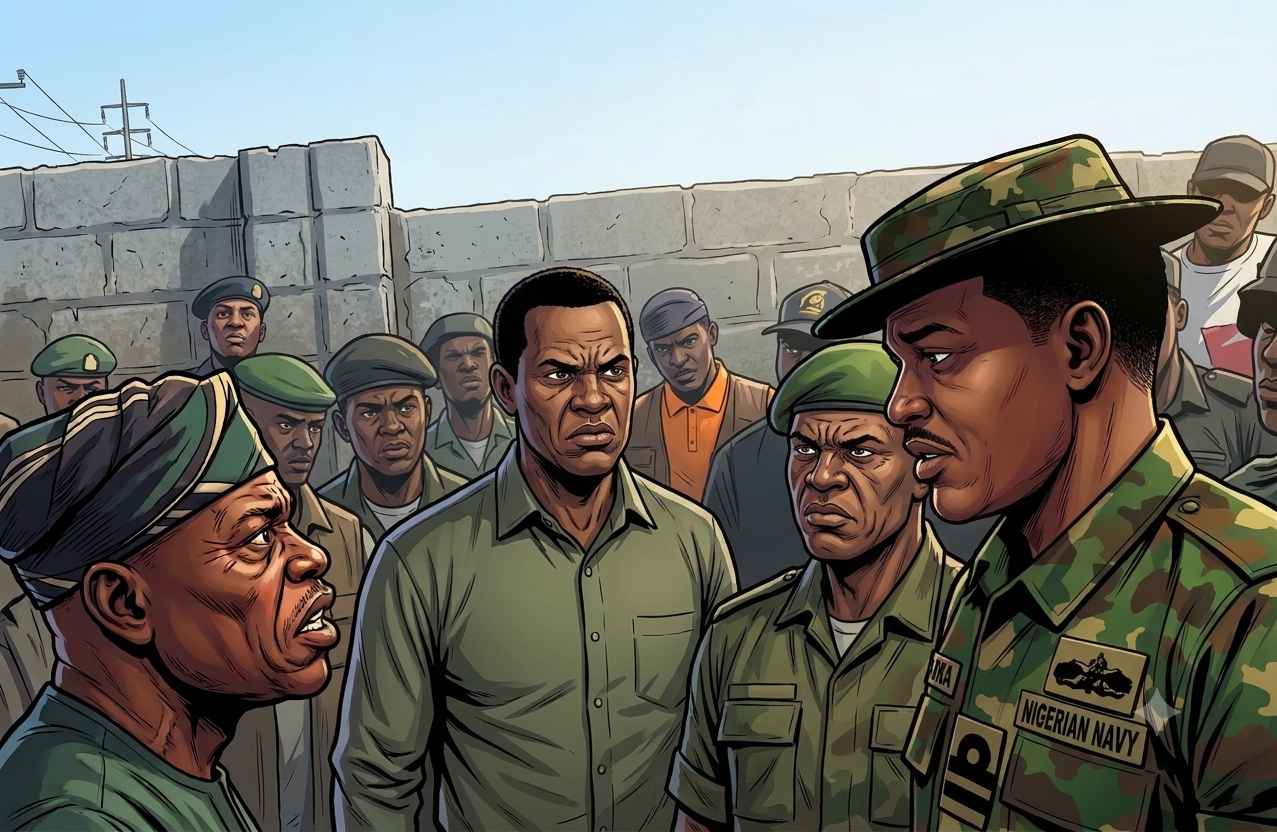
On November 11, 2025, Nyesom Wike arrived at Plot 1946 in the Gaduwa District of Abuja with a convoy. The purpose of the visit was to enforce a stop-work order on a property that Wike’s Federal Capital Territory Administration alleged lacked valid building approval. The property was allegedly linked to Vice Admiral Awwal Zubairu Gambo (rtd), a former Chief of Naval Staff, who had stationed military personnel at the site to protect it. The officer in charge of those personnel was Lieutenant A.M. Yerima of the Nigerian Navy.
What followed was captured on video and went viral with the kind of speed that only Nigerian social media can achieve for genuinely extraordinary content. In the seven-minute video confirmed by The Punch and TVC News, Ezenwo Nyesom Wike grew visibly agitated as Yerima calmly refused to comply with the minister’s directive to grant access to the property. Wike told the officer: “You are a very big fool. At the time I graduated, you were still in primary school. Shut up.” Yerima’s response became the most shared clip in Nigerian social media that week. The naval officer said, without raising his voice, without breaking composure, and with a clarity that made his response land harder than any shout could: “I am not a fool. I am an officer. I have integrity.”

The incident produced a cascade of institutional reactions. Former Chief of Army Staff Tukur Buratai demanded Nyesom Wike publicly apologize to President Tinubu, the Armed Forces, and Yerima, describing the “public disparagement of a uniformed officer of the Nigerian Armed Forces” as a potential threat to national security. Minister of Defence Mohammed Badaru ordered a probe. Minister of State for Defence Bello Matawalle assured the public that Yerima would face no disciplinary action. A report by This Day later alleged that in the days following the incident, unidentified men in two unmarked Hilux vans allegedly trailed Yerima’s movements, raising concerns about his safety, concerns that the military chose not to comment on.
There was a moment in the video that slipped past the noise of the main altercation but which was, arguably, more revealing than anything Nyesom Wike or Yerima said. One of the police officers in Wike’s convoy was overheard addressing the military personnel in Hausa, urging calm. According to SaharaReporters, the officer was heard saying: “The powerful are fighting, while you and I are the ones suffering and hungry.” There it is. The bodyguard of one of Nigeria’s most powerful ministers, in the middle of a confrontation about who owns an Abuja property, telling a soldier: we are both starving and this is not our war. The honesty of that moment was worth a hundred press conferences.
“Democracy is not just the right to vote. It is the right to have your vote matter and your government serve the people who cast it, not the people who funded the campaign.”
Widely attributed paraphrase of democratic theory, in common usage
Wike vs Fubara: Godfatherism in Nigeria Explained in One Prolonged Political Crisis
The story of Nyesom Wike and Siminalayi Fubara is the story of godfatherism in Nigeria condensed into a single, multi-year, institutionally damaging drama. It begins with the basics: Wike, having served his two terms as Rivers State governor, allegedly Fubara as his successor and backed him to win the 2023 governorship election. In Nigerian political culture, this transaction carries an expectation. The godfather gives you the throne. The godson governs as directed. Fubara apparently missed the briefing on part two. Within months of taking office, the relationship between the two men had collapsed under the weight of disagreements about state resources, commissioner appointments, and who actually runs Rivers State. The answer, from Wike’s perspective, was not debatable: Wike runs Rivers State. Wike would always run Rivers State. The governor is an implementation mechanism, not an independent governor.
What followed was one of the most destructive political disputes in recent Nigerian democratic history. Nyesom Wike controls a significant portion of the Rivers State House of Assembly. Those lawmakers, faithful to their godfather and not to the governor they were constitutionally obligated to work with, repeatedly attempted to impeach Fubara. The Rivers State House of Assembly complex was demolished during the crisis. Fubara, in response to a budget dispute, presented his budget before four lawmakers. The political dysfunction was so severe and so visible that President Tinubu declared a state of emergency in Rivers State in 2025, suspending democratic governance for six months. During those six months, an unelected administrator ran a state of 7 million people because two powerful politicians could not agree on who owned the mandate the people had exercised.
Nyesom Wike did not invent godfatherism in Nigeria. He perfected it. He does it loudly, publicly, and with a level of honesty about what he is doing that is, ironically, the most alarming thing about him. At least he is not pretending it is democracy.
Anuoluwa Soneye, NarrivonIn late 2025, a peace deal was brokered by President Tinubu. Fubara defected from PDP to APC. The terms of the deal, as described by Nyesom Wike himself, included a condition that Fubara would not seek a second term. In May 2026, Wike said publicly: “In the first place, he ought not to have collected the form, because agreement was reached that the impeachment should be dropped, while he should also not go about a second term. With collecting form first, he didn’t show sign of gentlemanship.”
Let us be very precise about what this statement means. Ezenwo Nyesom Wike, a federal minister, is publicly confirming that a sitting governor of a Nigerian state was required, as a condition of not being impeached by lawmakers loyal to Wike, to agree not to seek re-election. The right to seek re-election is a constitutional right of every sitting governor who has served one term. It is not a gift from a godfather. It is not a bargaining chip in peace negotiations. It is a democratic entitlement. And Wike is on camera, calmly, confidently, explaining that this entitlement was negotiated away as part of an “agreement.” He is not embarrassed by this. He describes Fubara’s decision to purchase the nomination form as a failure of “gentlemanship.” As though the problem with this situation is not that a sitting governor’s democratic rights were being traded in a deal brokered by his political superior, but that the governor had the poor manners to remind everyone that he had those rights.

Nyesom Wike’s FCT Ministry and the Question of Whose Land It Actually Is
As Minister of the Federal Capital Territory, Nyesom Wike has overseen the demolition of numerous structures in Abuja, described by his ministry as enforcement of building regulations and removal of illegal structures. The projects are visible and documented. Roads have been built. Interchanges have been commissioned. The physical transformation of parts of Abuja under his tenure is measurable. But the demolitions have produced a parallel conversation that the infrastructure projects cannot silence: about who is being demolished, about which buildings are “illegal” and which are not, and about the relationship between the minister’s political interests and the specific properties that end up receiving stop-work orders.
The Yerima confrontation was itself rooted in an allegation of illegal construction on land allegedly linked to a retired naval officer. Wike’s position was that the property lacked valid documentation. The military’s position was that its officer was acting on lawful orders. The question of who was right in that specific case has not been publicly resolved. But the broader pattern of the FCT’s enforcement activity, and the specific question of whether properties belonging to political allies of the minister face the same scrutiny as properties belonging to political opponents, has not been answered with documentary evidence that satisfied critics. As we noted in our examination of another minister with a complicated record on property and governance, the use of ministerial power to shape Abuja’s built environment is an authority that can be exercised with integrity or without it. The record of which has been more consistent in Wike’s FCT tenure is a matter of ongoing public debate.
Nyesom Wike Is Not the Problem. He Is the Symptom. The Disease Is Called Godfatherism in Nigeria.
Nyesom Wike did not arrive in Nigerian politics as a foreign body. He was produced by it. He is the logical outcome of a political system in which access to power is controlled not by elections but by godfathers, in which loyalty is valued more than competence, in which the person who controls nominations controls the state, and in which the formal institutions of democracy, the legislature, the courts, the constitution, are available as tools for whoever has the most resources and the least restraint. He is not unique. He is not exceptional. He is simply the current loudest example of a structure that has been running Nigeria since the return to democracy in 1999.
As we have examined in our piece on the psychology of corruption in Nigeria, the problem is not just the individual who behaves badly. It is the system that rewards bad behavior and punishes accountability. Fubara, whatever his own political calculations, tried at various points to assert that he was governor by right of election, not by permission of a godfather. The political system responded by deploying lawmakers to impeach him, withholding support, and eventually brokering a deal in which his constitutional right to seek re-election was traded for institutional survival. The man who supervised that process then described a sitting governor exercising his constitutional rights as lacking “gentlemanship.” And as we have documented in our analysis of the Electoral Act 2026, the legislative framework being built around the 2027 elections does nothing to address the structural conditions that make this kind of power brokering possible.
“The government you elect is the government you deserve.”
Alexis de Tocqueville, widely attributed, Democracy in America, 1835
What Nyesom Wike’s Record Demands of Nigerian Citizens
The Wike vs Fubara drama has produced genuine entertainment value for Nigerian social media. The Yerima video was extraordinary. The quotes have been quotable. The outrage has been episodic and genuine. But here is the thing about episodes: they end. The outrage fades. The next story comes. And Nyesom Wike remains Minister of the Federal Capital Territory, his political machinery in Rivers State successfully positioned his ally Kingsley Chinda as the APC governorship candidate for 2027, his other ally simultaneously secured the PDP ticket, and he sits in Abuja, overseeing the nation’s capital, building roads and demolishing buildings, and invoking agreements that trade away constitutional rights as though they are merely terms in a business contract.
This is what godfatherism in Nigeria looks like when it operates without consequence. A governor is told he cannot seek re-election. A naval officer is called a fool in public by the man he is stationed to oppose. A state’s legislative complex is demolished. A six-month state of emergency suspends democratic governance. And from the system that is supposed to protect democratic norms: a probe here, a commendation for Yerima there, a peace deal brokered by the president, and then business as usual.
The docility that allows this to continue is the enabler. As we have written in our Love Letter to the Nigerian People, the country cannot be fixed by the people who broke it. It can only be fixed by the citizens who decide that the entertainment value of watching it break is less important than the work of demanding it be repaired. That means knowing who Ezenwo Nyesom Wike is and what he has done. It means asking what the Rivers State voters who will go to the polls in 2027 actually want. It means demanding that the “agreements” negotiated between powerful men cannot override the constitutional rights of elected officials, because if they can, then elections are not choosing leaders. They are choosing which godfather’s preferred candidate gets to occupy the office.
At Narrivon, we document this because the record matters. The Yerima video matters. Wike’s “gentlemanship” quote matters. The demolished legislature matters. The six-month state of emergency matters. The dual-party candidate control for 2027 matters. Not because any single fact is definitive, but because together they build a picture of what Nigerian democracy currently is, and what it will remain, unless citizens decide that a country run on “agreements” is not a democracy at all. It is a franchise. And the franchise belongs to the godfather.
Frequently Asked Questions About Nyesom Wike and Nigerian Democracy
What happened between Nyesom Wike and naval officer Lieutenant Yerima?
On November 11, 2025, FCT Minister Nyesom Wike arrived at a disputed plot in Gaduwa District, Abuja, to enforce a stop-work order. Naval officer Lieutenant A.M. Yerima, acting on orders from his superiors, refused to grant access. In a video that went viral, Wike called Yerima “a very big fool” and told him “at the time I graduated, you were still in primary school.” Yerima replied calmly: “I am not a fool. I am an officer. I have integrity.” Former COAS Buratai demanded an apology. The Ministry of Defence ordered a probe. Reports later alleged Yerima was tracked by unmarked vehicles. Wike later claimed his words were misinterpreted.
What is the Wike vs Fubara political crisis about?
Nyesom Wike backed Siminalayi Fubara for governor in 2023. Within months, their relationship collapsed over control of state appointments and resources. Wike-aligned lawmakers attempted multiple impeachment proceedings. President Tinubu declared a state of emergency in Rivers State in 2025. A peace deal was brokered under which Fubara defected to APC and reportedly agreed not to seek a second term. In May 2026, Fubara purchased the APC nomination form but later withdrew. Wike’s ally Kingsley Chinda emerged as APC candidate; another Wike ally secured the PDP ticket simultaneously.
What did Nyesom Wike say about Fubara’s withdrawal from the APC governorship race?
Speaking while inspecting projects in Abuja in May 2026, Wike said: “I’m not surprised that the governor withdrew. In the first place, he ought not to have collected the form, because agreement was reached that the impeachment should be dropped, while he should also not go about a second term. With collecting form first, he didn’t show sign of gentlemanship.” Critics argued that describing a governor’s constitutional right to seek re-election as a negotiable “agreement” was incompatible with democratic governance.
What is godfatherism in Nigeria and how does Wike represent it?
Godfatherism in Nigeria refers to the practice of powerful political figures using their resources and networks to install candidates in elective positions, with the expectation of controlling those officials once elected. Wike’s relationship with Fubara has been widely cited as a textbook example: he backed Fubara’s governorship, then attempted to dictate the terms of his governance, used aligned lawmakers for impeachment threats, and brokered a deal that reportedly required Fubara to forgo his constitutional right to seek re-election in exchange for political survival.
Sources and Further Reading:
Wike-naval officer clash: Ex-Generals fume as FG orders probe (The Punch, November 13, 2025) •
Wike vs military officer: Video shows how brawl started (Legit.ng, November 13, 2025) •
Wike explains why he referred to Navy Lt Yerima as a fool (Politics Nigeria, November 14, 2025) •
Policeman attached to Wike: We are hungry, fighting for powerful people (SaharaReporters, November 13, 2025) •
Military keeps mum on alleged attempt on Lt Yerima’s life (This Day, November 17, 2025) •
Wike breaks silence on Fubara’s withdrawal from second-term ambition (Naija News, May 25, 2026) •
Fubara’s withdrawal from Rivers APC primary not surprising, says Wike (Leadership, May 2026) •
Which agreement is Wike always invoking against Fubara in this democratic world? (Opinion Nigeria, May 2026) •
How Wike forced Fubara out of APC primaries (City People, June 2026)