
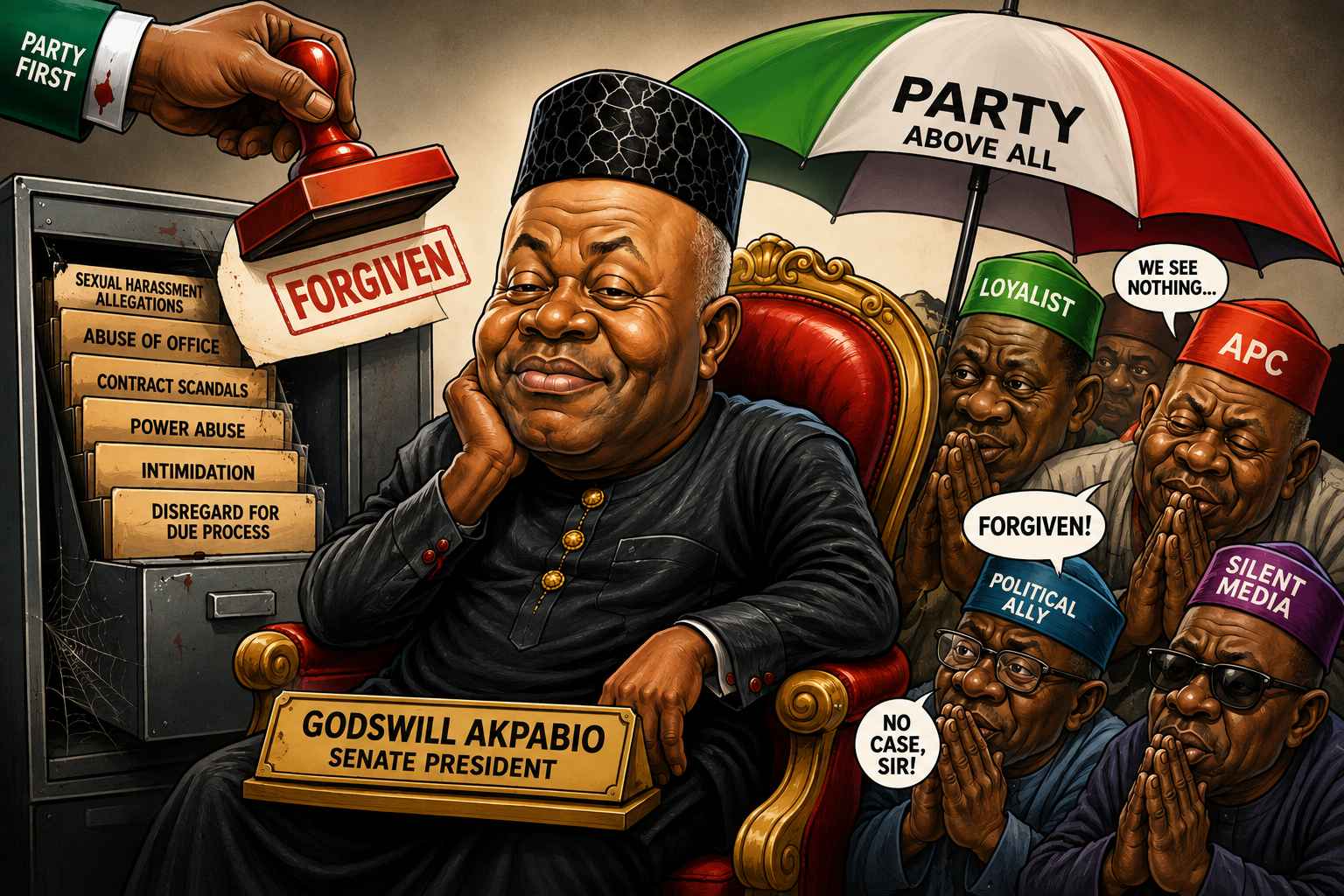
Godswill Akpabio Is Nigeria’s Senate President. Here Is Everything That Should Have Prevented That.
Chief Godswill Obot Akpabio GCON is the President of the Nigerian Senate, Nigeria’s third most powerful office. He has never been convicted of any crime. He has also, as the EFCC itself confirmed in August 2018, never been formally cleared of any crime. Between those two sentences sits N108 billion, a party defection, a probe that went quiet at a suspicious time, an NDDC chief who fainted mid-testimony, a switched-off microphone, a senator suspended for alleging his conduct, a court order the Senate defied, and the question Nigeria keeps not answering: why is this man here?
There is a question that Nigeria’s political architecture is not designed to answer. It is not a complicated question. It is, in fact, a very simple one. How does a man arrive at the third highest office in the land while carrying a portfolio of unresolved allegations so extensive that documenting them requires multiple sub-sections? The answer is not complicated either. He arrives there because the system was built to allow it. Because the institutions designed to produce consequences have been consistently redirected, delayed, or silenced at critical moments. Because Godswill Akpabio has benefited from every structural advantage that Nigerian political impunity provides: party affiliation, ministerial immunity, the institutional attention span of a goldfish, and the Nigerian public’s entirely understandable exhaustion with outrage that produces no consequence. As we have examined in our broader analysis of corruption in Nigerian governance, the problem is never one bad actor. It is a system that consistently produces the same bad outcomes regardless of which actor is playing the role. Senator Godswill Akpabio is not an anomaly. He is a product. He is what happens when a country repeatedly fails to complete what it starts.
Chief Godswill Akpabio GCON: Senate President, Former Governor, and the N108 Billion Question
Chief Godswill Obot Akpabio, GCON
Before he became the man who chairs Nigeria’s upper legislative chamber and ranks third in the constitutional order of succession, Godswill Akpabio governed Akwa Ibom State for eight years from 2007 to 2015. He was a PDP governor, a PDP senator, a PDP minority leader, a man who converted to APC in August 2018, a minister under Buhari, and ultimately the man who clinched the Senate Presidency in 2023 under Tinubu. He is, by any conventional measure, a Nigerian political success story. The question is what was cleared away to make the path smooth. In June 2015, the EFCC launched a probe into Akpabio’s 2007 to 2015 tenure in Akwa Ibom State, based on a petition by lawyer Leo Ekpenyong alleging the diversion of N108.1 billion. The petition alleged massive cash withdrawals from a Zenith Bank account designated for state government funds, totalling N22.1 billion in one year alone, alongside unjustified expenditures. By October 2015, the EFCC had detained Akpabio. Akpabio maintained he went voluntarily to respond to allegations and denied any wrongdoing. In September 2017, a second probe was launched regarding the alleged gifting of N1.4 billion to a bank during his governorship tenure. Then, on August 8, 2018, Akpabio defected from PDP to APC. The EFCC announced the very next day that the probe was “not over.” It then went quiet. No charges. No trial. No conviction. Also, in a development that added another twist, Leo Ekpenyong later appeared at a press conference saying the petitions were filed on behalf of clients whose allegations turned out to be politically motivated, and that the petitions had been withdrawn. Akpabio has consistently denied all wrongdoing. As the EFCC’s own spokesman confirmed to The Punch in 2018: the EFCC “does not close cases or give clearance to anybody.” That is the only official statement that describes the current status of the N108 billion matter.
Godswill Akpabio, APC and How Changing Parties Has Replaced Clearing Your Name in Nigeria
The most elegant feature of Godswill Akpabio’s political career is also the most revealing: the timing of his party defection relative to his EFCC probe is a textbook example of what investigative journalism outlet FIJ documented across multiple politicians in their report on “the miracle of defection.” The pattern is not unique to Akpabio. Former Senator Stella Oduah, under an N5 billion money laundering charge, joined the APC in July 2021. Her court case, which had been struggling to achieve attendance, went on extended pause. When she returned to PDP in April 2022, her trial resumed. Former Delta Governor Ifeanyi Okowa was arrested by the EFCC in November 2024 and defected to APC in April 2025. As we documented in our piece on Okowa, the EFCC felt it necessary to publicly assure Nigerians in October 2025 that the N1.3 trillion investigation was “still active,” the kind of assurance you only need to give when the silence has become conspicuous.
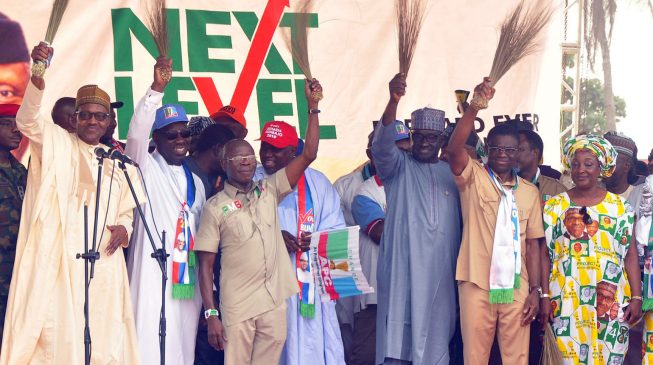
This pattern has a name. It was named, with remarkable candour, in January 2019 at an APC Presidential Campaign rally in Benin, Edo State, by Adams Oshiomhole, at the time the National Chairman of the APC and former Governor of Edo State. Standing before a crowd of supporters being urged to join the ruling party, Oshiomhole said: “Once you join the APC, all your sins are forgiven.” He said it like it was a selling point. Which, in practice, it is. The crowd cheered. Nigeria watched. The phrase has lived in Nigerian political memory ever since, not because it was a slip, but because it described something real. Not a policy. A pattern. And the pattern has consequences that extend well beyond the individual politicians who benefit from it. Every naira allegedly diverted and not recovered is a naira that did not build a road, pay a teacher, or stock a hospital. The “sins” being “forgiven” are not abstract moral failures. They have physical addresses. They are roads that were not paved, schools that were not built, and hospitals that run without drugs. The sinner goes free. The effect of the sin stays behind.
“The accomplice to the crime of corruption is frequently our own indifference.”
Bess Myerson, consumer advocate and public figure, widely attributed
Godswill Akpabio, the NDDC Billions and the Woman Who Allegedly Had to Slap the Minister
In 2019, Godswill Akpabio became Minister of Niger Delta Affairs under President Buhari, with oversight of the Niger Delta Development Commission. In 2020, he appointed Joy Nunieh as Interim Managing Director of the NDDC. He then removed her. She then went public. What she said was extraordinary, specific, and confirmed in multiple media appearances. In a live TVC News interview, Nunieh said that Akpabio had told her in a car: “If you don’t do what I say, the same pen with which I use to sign your letter, it will be the same pen which I will use to remove you.” She alleged he instructed her to inflate NDDC budgets. She alleged he asked her to take an oath. And she alleged that during an interaction at his residence, she had to physically defend herself from sexual advances by slapping him. She described the slap in detail and on camera. Akpabio denied all of her allegations in their entirety. He attributed her removal to regulatory reasons including her NYSC certificate status. An investigation was not launched into his conduct in any formal sense that ran to a public conclusion.
Then came the August 2020 joint Senate and House of Representatives public hearing into N81.5 billion in allegedly mismanaged NDDC funds. The hearing produced two moments that belong in any honest record of Nigerian political history. The first was the spectacular public health event during which Professor Kemebradikumo Pondei, the Acting MD of NDDC, fainted in his chair while being questioned by legislators about the missing billions. The video, which went viral globally, showed Pondei collapsing mid-session and being attended to by others in the room. The question he was answering at the time involved the whereabouts of very large sums of money. He recovered. The money did not. The second moment occurred when Akpabio himself addressed the committee. He produced a claim that, had the hearing been allowed to develop it, might have been one of the most consequential disclosures in Nigerian legislative history. He stated, publicly, on the record: “We have records to show that most of the contracts of the NDDC were given out to members of the National Assembly but you don’t know about it.” The response from the committee chair was: “It’s okay, off your mic.”
Off your mic. That sentence. A minister alleging that the very legislators investigating him had themselves benefited from the contracts they were investigating. And the response from the legislative committee investigating the matter was to switch the microphone off. This is what it looks like when the architecture of accountability encounters the architecture of mutual interest. Everything goes quiet. The investigation generates heat and headlines and exactly zero prosecution outcomes. And everyone involved goes back to their respective offices and waits for the next news cycle.
Godswill Akpabio told legislators that NDDC contracts went to members of the National Assembly. The mic was turned off. This is not a mystery. It is a documented live event. The only mystery is why nobody is still talking about it.
Anuoluwa Soneye, NarrivonGodswill Akpabio, Senator Natasha Akpoti-Uduaghan and the Suspension That a Court Called Unconstitutional
In early 2025, Senator Natasha Akpoti-Uduaghan, representing Kogi Central Senatorial District, went public with a sexual harassment allegation against Senate President Godswill Akpabio. In her words, he had allegedly told her: “Now that you are a senator, I’m going to create time for us to come spend quality moments here.” She made the allegation publicly, in detail, on camera. Akpabio denied all of it. What followed was a demonstration of institutional priorities so clear it almost did not need commentary. Instead of investigating the Senate President, the Senate investigated the senator who alleged his conduct. Natasha Akpoti-Uduaghan was suspended from the Senate for six months, during which her security detail was removed, her salary was cut off, she was barred from the National Assembly premises, and she was prohibited from identifying herself as a senator in any public setting.

Senator Natasha challenged her suspension in court. The Federal High Court ruled that the suspension was unconstitutional and ordered her reinstatement. When she attempted to return to the National Assembly to comply with the court order, the Senate defied the ruling and security personnel were reportedly directed not to allow her entry. A senator, reinstated by court order, physically barred from entering the legislature by security deployed by the legislature.The Nigerian Senate, presided over by Godswill Akpabio, defied a Federal High Court order relating to a senator who had accused the same Akpabio of misconduct. The circularity is perfect. The impunity is complete.
Godswill Akpabio Is the Product, Not the Problem: How the Nigerian System Produces These Outcomes
It would be easier, and considerably less accurate, to frame this as the story of one exceptional bad actor. It is not. Chief Godswill Akpabio navigates a system that has consistently rewarded exactly the kind of navigation he has demonstrated. Probes go quiet when political affiliations change. Accusers face institutional consequences while the accused face institutional protection. Court orders are defied when they threaten institutional power. The Electoral Act 2026, written by the legislature that Akpabio presides over, contains provisions that critics argue make the 2027 elections easier to manipulate. Godfatherism in Rivers State produced a six-month state of emergency. Yahaya Bello, facing 19 counts of money laundering, was cleared for a Senate seat. These are not coincidences. They are features of a political architecture that has consistently placed the interests of the political class above the interests of the people they govern.
Akpabio’s own public statement about the EFCC captures the tone of someone who has internalized his untouchability. When the new EFCC chairman appeared before the Senate for screening in 2023, Akpabio told him, in the chamber he presides over: “I don’t see how the EFCC will arrest a former governor and come through the rooftop as if they are taking Pablo Escobar.” He used his position as Senate President, during an EFCC chairman’s screening, to criticize the manner of EFCC operations. The person whose case the EFCC has not closed was screening the person who runs the EFCC. And then the screening continued. And then the chairman was confirmed. And then nothing happened.
“When plunder becomes a way of life for a group of men in a society, over the course of time they create for themselves a legal system that authorizes it and a moral code that glorifies it.”
Frederic Bastiat, The Law, 1850
The Akpabio Question Is the Nigeria Question: Will Citizens Demand Better?
This article has not convicted Godswill Akpabio of anything. No court has. That is the precise problem. He has not been convicted. He has also not been acquitted. No trial has run its course. No investigation has concluded with a verdict. What exists instead is a long trail of probes that stopped, allegations that were denied, a witness who fainted, a microphone that was switched off, a senator who was suspended for making an accusation, a court order that was defied, and a man who sits today in the third most powerful office in the Federal Republic of Nigeria, watching EFCC chairman screenings and offering institutional critique of the agency that has an unresolved case in his name.
The impunity that killed Pelumi Onifade and the impunity that allows an unresolved N108 billion probe to coexist with a Senate presidency are manifestations of the same system. A system that has decided, in practice if not in law, that accountability flows downward. The journalist with a camera is dead. The teacher at the market is frying akara. The soldier is underfed. And Godswill Akpabio is chairing the most powerful legislative body in the land and telling the anti-corruption chief not to come through rooftops. This is what the docility costs. Not just an unfair result for one politician. A country where the highest offices are most accessible to those who have the most practice surviving scrutiny, and the least accessible to those who have the most to offer the people.
The citizens who decide to change this will not change it in one election or one article or one hashtag. They will change it by creating and sustaining the kind of informed, organized, loud, persistent pressure that makes it politically costly to confirm a Senate president with an unresolved fraud probe, to defy a court order reinstating a suspended senator, to switch off a microphone when a minister alleges legislative misconduct on the record. At Narrivon, we write these things so that the record exists. So that “off your mic” is not the end of the sentence. So that six years from now, when someone asks what happened with the N108 billion probe, there is a clear and documented answer waiting. The system counts on forgetting. We are not forgetting.
Frequently Asked Questions About Godswill Akpabio and Nigeria’s Political Impunity
What is the EFCC’s N108 billion probe against Godswill Akpabio about?
In June 2015, the EFCC launched a probe into Akpabio’s 2007 to 2015 gubernatorial tenure in Akwa Ibom State, based on a petition by lawyer Leo Ekpenyong alleging the diversion of N108.1 billion from the state treasury. The petition alleged massive cash withdrawals from a designated Zenith Bank account. Akpabio was detained by the EFCC in October 2015 but maintained he went voluntarily. In September 2017, a second probe was initiated regarding N1.4 billion allegedly gifted to a bank. Akpabio defected to APC on August 8, 2018. The EFCC said on August 9, 2018 that the probe was “not over,” then went quiet. In April 2023, the EFCC invited Akpabio again for questioning before he became Senate President. As of this writing, no charges have been filed and no conviction has been secured. Akpabio denies all wrongdoing. The EFCC has confirmed it does not close cases or give clearance to anyone.
What did Joy Nunieh allege about Godswill Akpabio?
Dr Joy Nunieh, appointed as Interim MD of the NDDC by Akpabio in 2020 and later removed, alleged in a live TVC News interview that Akpabio told her in a car: “If you don’t do what I say, the same pen with which I use to sign your letter, it will be the same pen which I will use to remove you.” She alleged he instructed her to inflate NDDC budgets, asked her to take an oath, and that she was forced to physically slap him to defend herself from sexual assault at his residence. Akpabio denied all her allegations. No formal investigation of his conduct reached a public conclusion.
What happened with Senator Natasha Akpoti-Uduaghan’s sexual harassment allegation?
In early 2025, Senator Natasha Akpoti-Uduaghan publicly alleged that Senate President Godswill Akpabio had made an unwanted sexual advance, saying he told her he would “create time for us to come spend quality moments here.” Akpabio denied the allegation. The Senate suspended her for six months, removed her security detail, cut her salary, and barred her from the National Assembly. The Federal High Court ruled the suspension unconstitutional and ordered her reinstatement. When she attempted to return, she was reportedly denied entry by Senate security. The suspension case was adjourned with its outcome still pending.
What did Oshiomhole mean by “once you join APC, your sins are forgiven”?
At an APC Presidential Campaign rally in Benin, Edo State, in January 2019, Adams Oshiomhole, then the APC National Chairman, told members of the opposition: “Once you join the APC, all your sins are forgiven.” The comment has been widely cited in connection with the documented pattern of EFCC probes going quiet or losing momentum shortly after the relevant politicians defect to the APC. Multiple politicians including Godswill Akpabio, Stella Oduah, and Ifeanyi Okowa defected to APC during periods of active EFCC scrutiny, with varying degrees of subsequent probe activity reduction noted by investigative journalists.
Sources and Further Reading:
Miracle of defection: Politicians who joined APC and their EFCC probes went away (FIJ, April 2025) •
EFCC detains ex-Governor Akpabio over alleged N108.1 billion fraud (Premium Times, October 2015) •
EFCC arrests ex-Governor Akpabio over N108.1 billion fraud (The Nation, October 2015) •
We haven’t closed case against Akpabio, EFCC (The Punch, August 2018) •
EFCC asks Akpabio to turn himself in over corruption investigation (Premium Times, April 2023) •
I slapped Akpabio for sexually harassing me, Joy Nunieh (TVC News, 2020) •
Akpabio: How God saved me from EFCC embarrassment (Daily Trust, October 2023) •
Natasha Akpoti-Uduaghan suspension case (The Sun Nigeria, 2025) •
Once you join APC, your sins are forgiven, Oshiomhole (NaijaNews, January 2019) •
Godswill Akpabio (Wikipedia)
Leave a Reply