
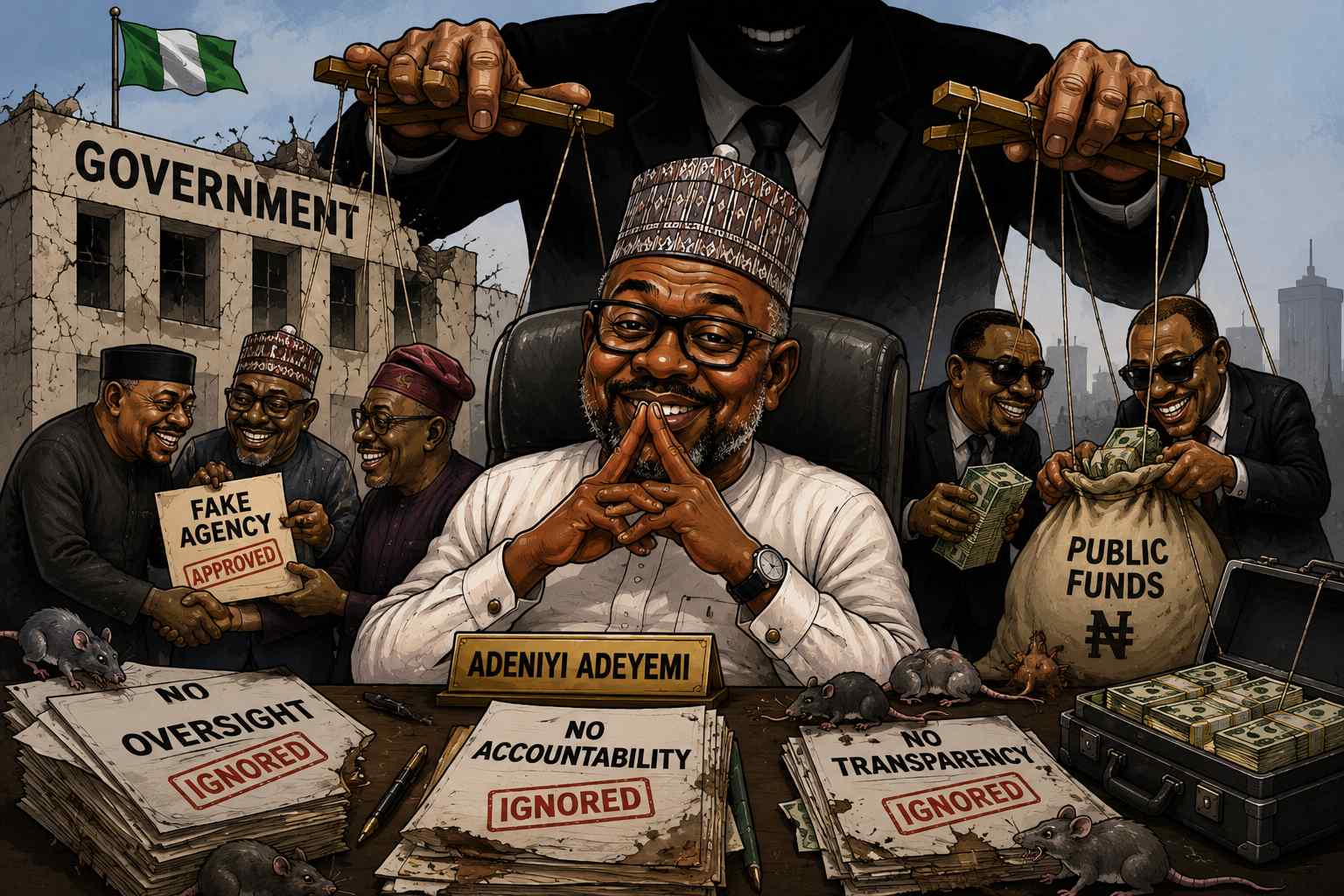
The Adeyemi-Gbajabiamila Controversy: A Fake Agency, N1.3 Billion and Nigeria’s Extraordinary Capacity for Institutional Blindness
A man set up a presidential agency that the Presidency says does not exist. The agency got N1.3 billion in the national budget. It got office space in the Federal Secretariat. It opened a Treasury Single Account and a domiciliary pound sterling account at the Central Bank of Nigeria. The man says the president’s Chief of Staff gave him an appointment letter. The Chief of Staff says he never communicated with the man. One of these statements cannot be true. Both men are still free. The suspect is the one calling for an investigation. And this is, by Nigerian standards, not even the strangest part of the story.
Let us begin with the sentence that contains the entire absurdity of this affair in one breathless clause. The Presidential Foreign Intervention Promotion Council (PFIPC), which the Presidency of the Federal Republic of Nigeria has officially described as a “fictitious” agency that “does not exist,” was allocated N1.302 billion in the 2026 Appropriation Act of the Federal Government of Nigeria, under the Presidency, with Budget Code 0111062001, with N802.98 million for personnel costs, N200 million for overhead, and N300 million for capital expenditure. The breakdown appeared on pages 50 and 51 of a 2,790-page budget document. A document that was prepared by the executive, submitted to the National Assembly, defended before legislative committees, scrutinised by lawmakers, passed by both chambers, and signed into law by President Bola Tinubu. At every one of those stages, the “non-existent” agency existed enough to collect its allocation and move on to the next line item. Nobody noticed. Or if they noticed, nobody said anything. And that institutional silence, that extraordinary collective failure of the Nigerian budget and appropriations process, is the actual story behind the Adeyemi-Gbajabiamila controversy. The man allegedly running the fake agency is the sideshow. The machinery that allowed him to run it is the main event.
Adeniyi Adeyemi, the PFIPC and the Chief of Staff Who Says He Never Knew Him
Prince Adeniyi Matthew Adeyemi
Adeniyi Adeyemi is at the centre of what may be the most audacious institutional infiltration in recent Nigerian history. He presented himself as the Director-General of the PFIPC, telling VeryDarkMan in a widely circulated video call: “I established that amount for the agency’s office out of passion for the country. I wanted to bring in foreign investors to Nigeria so that I can write my name in gold. I am just desperate to serve.” He says his late friend, Dolapo Babatunde Tanimola, paid the money to establish the agency. He says Tanimola died in a fire accident at a hotel in Utako, Abuja, before the case blew up publicly. He says Gbajabiamila gave him an appointment letter. He has documents. He says he is ready to hand them to security agencies. He says he is not a criminal. He also says he cannot say with certainty whether Gbajabiamila is involved or not, and he is calling on the president to set up an independent panel to find out. This is the position of the man charged with operating a fictitious agency: that the key witness is dead, the appointment came from the top, and the only way to find the truth is an independent investigation. He denies all criminal charges.
Hon. Femi Gbajabiamila
Femi Gbajabiamila is the man President Tinubu trusted most with the operational management of the presidency. As Chief of Staff, he is the gatekeeper of Aso Rock, the man through whom most presidential access flows, and Nigeria’s fourth most powerful political figure in terms of institutional proximity to the president. According to the Presidency’s account, Gbajabiamila alerted the DSS and the Nigeria Police Force in October 2025, after complaints that a purported agency was operating near the Nigerian Investment Promotion Commission. He told security agencies that forged appointment letters bearing his signature, reference numbers, and official seals were being used to legitimise the fictitious PFIPC. After Adeyemi went public on June 25, 2026, alleging that Gbajabiamila had received N400 million through a proxy and demanded 48 percent of the agency’s N27.4 billion take-off grant (approximately N12.5 billion), Gbajabiamila, through his lawyer Kemi Pinheiro, threatened a N10 billion defamation lawsuit against Adeyemi and denied ever communicating with him directly or through any intermediary. He denies all allegations against him without exception.

Adeniyi Adeyemi Asked Six Questions the Presidency Must Answer About Its Own Budget
The strongest thing Adeniyi Adeyemi has said in this entire controversy is not an allegation about any individual. It is a question. Six questions, in fact, which he posed publicly and which no government official has answered with any specificity. They deserve to be reproduced in full because they describe not a conspiracy theory but a process failure that requires a documented explanation.
“If the agency was fictitious, who prepared the budget estimates bearing its name?”
“Which ministry submitted them?”
“Which officials defended those estimates before the National Assembly?”
“Which committees scrutinised them?”
“Which lawmakers approved them?”
“Who inserted the allocation into the Appropriation Bill? And ultimately, who signed that budget into law?”
These are not rhetorical flourishes. They are process questions about the most documented and publicly available instrument of government: the national budget. The 2026 Appropriation Act is a public document. Its passage through committee hearings is recorded. The ministry and budget code under which the PFIPC appeared is listed (Code 0111062001, Expenditure Item 18, under the Presidency). Someone prepared those figures. Someone typed the agency name into a budget submission form. Someone signed off on that submission. Someone defended it at a committee hearing. Someone did not flag it as a non-existent agency because they were either unaware or unbothered. And the National Assembly, which the Presidency’s predecessor Godswill Akpabio once accused of contract-sharing, passed the budget with the allocation intact. Adeyemi also asked why the alleged fake agency managed to open a Treasury Single Account and a domiciliary pound sterling account at the Central Bank of Nigeria, noting that such accounts require institutional due diligence. “What the Chief of Staff is telling Nigerians is that the CBN Governor, his four deputies, 16 capable directors and over 5,300 staff members were clueless and failed to detect fraudulent documents before opening those accounts,” he said. He may be wrong about Gbajabiamila’s involvement. He is not wrong about those questions.
A fictitious agency ran from the Federal Secretariat, got a budget line, opened CBN accounts and operated for months before anyone noticed. The man accused of running it is asking how that was possible. The government, which is supposed to know, has charged him with eight counts and told Nigerians to await the judicial process. The questions are still there. The budget is still signed.
Anuoluwa Soneye, Narrivon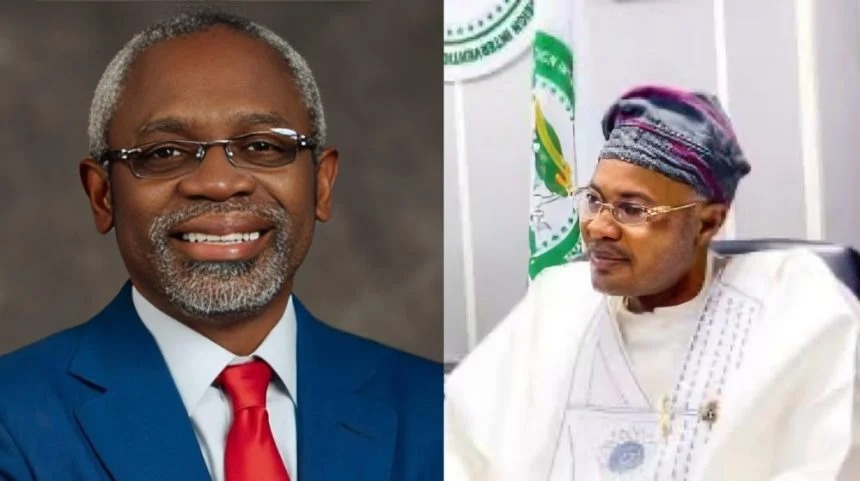
The PFIPC Controversy, the Fire Accident and the Report That Was Not Acted Upon for Nearly a Year
The detail that Adeniyi Adeyemi mentioned almost in passing in his VDM interview is worth dwelling on. His friend and alleged financier of the PFIPC’s establishment, Dolapo Babatunde Tanimola, died in a fire accident at a hotel in Utako, Abuja. PM News confirmed, citing an IGP Monitoring Unit report, that Tanimola’s death occurred before the petition was referred to the investigative unit, meaning this was not a witness who died after the case became public. This was a witness who died before the formal investigation started. That fact does not point to anything conclusively. What it does do is remove from the case the one person who could presumably have confirmed or denied the full account of how the PFIPC was established, funded, and whether anyone in power facilitated it.

The PM News investigation also revealed something that deserves its own paragraph of attention. The IGP Monitoring Unit, led by CP Akin Fakorede, investigated the PFIPC case after Gbajabiamila petitioned the then-IGP Kayode Egbetokun on October 17, 2025. The unit moved quickly, arrested Adeyemi on October 27, and submitted a nine-page interim report to the IGP’s office, dated November 13, 2025, recommending prosecution. The charge was filed on November 27, 2025. But the report then, according to PM News, “gathered dust for almost one year” before the matter became a public controversy. More significantly, the report noted that “the security operatives interrogating Adeyemi had to resist mounting pressures from influential personalities on the corridors of power who allegedly wanted the case file to be consigned to the trash bin.” Nobody has named these “influential personalities.” Nobody has faced any consequence for attempting to kill the investigation. The people pressing for the case to be dropped are as unidentified as the officials who approved the PFIPC’s budget allocation. This is what systemic corruption looks like in its most operational form. Not one bad actor making one bad decision. A network of unnamed, unaccountable actors at multiple levels, each doing just enough to keep the machinery moving in the desired direction.
The Adeyemi-Gbajabiamila Controversy and the Familiar Pattern of Charging the Small Fish
Let us be clear about what the Presidency has done so far. It has filed an eight-count criminal charge against Adeniyi Adeyemi and two accomplices. It has described him as an impostor, a forger, and a fraudster. It has told the public to await the judicial process. It has ordered the ICPC to investigate within 30 days how a fictitious agency ended up in the 2026 national budget. It has pointed, consistently and exclusively, at Adeyemi as the perpetrator of a one-man fraud. What it has not done is explain how the budget allocation happened. What it has not done is name the ministry official who submitted the PFIPC’s budget estimates. What it has not done is identify who defended those estimates before the National Assembly’s appropriations committee. What it has not done is explain the CBN account opening process and identify the specific official who approved the misleading documentation that Adeyemi allegedly used.
The Senate, when opposition parties demanded a legislative investigation into how the fake agency made it into the budget, declined to launch an immediate probe and said it would wait for the ICPC investigation ordered by the President. The Senate, which is the institution that passed the budget with the N1.3 billion allocation intact, has decided that investigating how it passed the budget is best left to the executive’s chosen anti-corruption agency. This is the same Senate whose president oversaw a microphone being switched off when inconvenient testimony was being delivered about NDDC contracts. The circularity is characteristic.
When Charles Aniagolu on Arise News asked the specific question that everyone wanted answered, how could a fake organisation secure offices in the Federal Secretariat, get its budget approved in the National Assembly, and open bank accounts, a government-aligned interviewee responded by invoking “the nature of sophisticated crimes across the world” and making a comparison to the 9/11 attacks in the United States. This is an interesting response. The 9/11 attacks were planned by a foreign terrorist network using significant resources over a long period. The PFIPC budget allocation appeared in Nigeria’s federal budget under the Presidency. These two situations share the quality of being crimes. They share almost nothing else. The comparison communicates, perhaps unintentionally, the precise thing it was trying to avoid: that the government does not have a clean answer to a very simple process question.

The PFIPC Controversy and What It Means If Adeyemi’s Version Is Even Partially True
Here is the uncomfortable question that this article cannot avoid but must frame carefully. Adeniyi Adeyemi alleges that he paid N400 million to secure his appointment and access through proxies. He alleges that an additional N200 million was demanded subsequently. He alleges that 48 percent of a N27.4 billion take-off grant was sought by someone above him. Gbajabiamila has denied all of this without exception, and no court has established any of it. But the question the allegations raise is structural, not personal. If the process of getting an agency established, getting office space in the Federal Secretariat, getting a budget allocation passed through the National Assembly, and getting CBN accounts opened requires money changing hands between private actors and officials, then the problem is not one man who faked documents. The problem is a system where institutional access has a price list.
As we have examined in our broader coverage of corruption in Nigerian governance, the pattern of Nigerian institutional fraud is not typically one man acting alone. The sophistication required to insert a budget line under the Presidency, secure Federal Secretariat office space, open CBN accounts, and operate alongside legitimate agencies for months without triggering institutional alarms is not the sophistication of a sole fraudster. It is the sophistication of a network. And when networks are involved in institutional fraud, the question of who was connected at each institutional node becomes the critical investigation. The police have charged Adeyemi and two accomplices. The budget was passed by two chambers of the National Assembly. The CBN accounts were opened with the involvement of the Office of the Accountant-General. The Federal Secretariat office was allocated by whoever manages Federal Secretariat occupancy. Each of those steps had institutional actors. None of them are in the dock. Only the man who allegedly set up the operation is charged.
“Corruption is not just the wrong of a single bad actor. It is the failure of every institution that allowed the bad actor to thrive, every oversight that was not exercised, and every question that was not asked.”
Anti-corruption advocacy principle, widely cited in governance literature
The Adeyemi-Gbajabiamila Controversy and the Nigerian Corruption Pattern That Always Ends the Same Way
Nigeria has been here before. Not in the specific details of a fake presidential agency. But in the general shape of a scandal that produces charges, investigations, public outrage, committee hearings, presidential directives, and then, at the end of a process long enough for public attention to have moved elsewhere, very little in the way of completed justice. The NDDC scandal of 2020 produced a man who fainted on camera rather than answer questions about N81.5 billion, a minister who alleged that lawmakers benefited from contracts, a microphone that was switched off, and, to date, no completed prosecution of any senior official. The EndSARS prosecutions that Nigerians have been waiting for since 2020 have not arrived. The N108 billion Akpabio probe has never concluded. The pattern is not that Nigeria is unable to investigate. It is that the investigation consistently stops short of reaching the people with the most institutional power.
The PFIPC controversy shows every sign of following the same trajectory. The man at the visible centre of it has been charged. The institutional actors at the invisible centre of it have not been named. The key witness is dead. The investigative report that was prepared promptly in November 2025 gathered dust for months while the budget that funded the fake agency was signed into law. And the government’s official response to the question of how this happened is: sophisticated crime. Wait for the court. Trust the process. The docility this relies upon is real and well-documented. The investigation this requires is not being conducted at the depth or the speed that the facts demand.
A “fictitious” agency had a national budget line, a Federal Secretariat office, and CBN accounts. The man running it says the top authorised him. The top says he forged everything. The witness who would know is dead. The investigative report was shelved while influential people allegedly pressed for it to disappear. Nigeria wants answers. The government is offering a court date.
Anuoluwa Soneye, NarrivonThe Adeyemi-Gbajabiamila Controversy Requires Citizens Who Demand Complete Answers
This article has not convicted anyone. Neither the courts, nor the evidence currently in the public domain, permit that. What it has done is trace the outline of an institutional failure so comprehensive that it cannot be explained by one man with forged documents and ambition. An agency appeared in a federal budget under the Presidency. It was not planted there by a ghost. Someone typed its name into a government form. Someone approved the submission. Someone defended the allocation before a committee of the National Assembly. Someone at the CBN opened accounts for it. Someone at the Federal Secretariat allocated it office space. Someone pressed for the police report to be shelved. These someones are currently unnamed and unindicted. Adeniyi Adeyemi is the only named defendant. Calling this a complete investigation would be like arresting the driver of a getaway car and calling the bank robbery solved.
The same Bayo Onanuga who told Nigerians he sees no hunger is the same Bayo Onanuga who issued the statement describing the PFIPC as “fictitious.” The same institutional impunity that protects powerful people from consequences for documented wrongdoing is the institutional impunity that allowed a fake agency to collect a national budget allocation while someone was allegedly pressing police officers to shelve their own report. These are not separate stories. They are the same story told in different chapters. And the chapter on the PFIPC is not finished.
At Narrivon, we believe that the Nigeria of our dreams is governed by institutions that cannot be infiltrated because their processes are transparent, their oversight is genuine, and the people operating them understand that public money is not a prize to be allocated to whoever has the right connection at the right ministry. That Nigeria requires citizens who do not accept “sophisticated crime” as an explanation for how a N1.3 billion budget line appears under the Presidency for an agency the Presidency says never existed. It requires citizens who read the budget. Who attend the committee hearings. Who ask the budget clerk how a code got inserted. Who demand that the six questions Adeniyi Adeyemi asked are answered not by him but by the officials who owe those answers as a function of their office. The Adeyemi-Gbajabiamila controversy will resolve in court eventually. The court will deal with what Adeyemi did. Someone still needs to answer for the system that let him do it.
Frequently Asked Questions About the Adeyemi-Gbajabiamila PFIPC Controversy
What is the PFIPC and why is it controversial?
The Presidential Foreign Intervention Promotion Council (PFIPC) is an agency that Adeniyi Adeyemi presented himself as Director-General of, which the Presidency of Nigeria has described as fictitious and non-existent. The controversy arose because despite the Presidency’s denial, the alleged fake agency was allocated N1.302 billion in the 2026 Appropriation Act under the Presidency (Code 0111062001), maintained office space at the Federal Secretariat Complex Phase III in Abuja, and opened a Treasury Single Account and a domiciliary pound sterling account at the Central Bank of Nigeria. Adeyemi was arrested on October 27, 2025 and faces eight criminal counts at the Federal High Court Abuja.
What does Adeniyi Adeyemi allege about Femi Gbajabiamila?
At a press conference on June 25, 2026, Adeyemi alleged that Femi Gbajabiamila received N400 million through a proxy in connection with appointments into the PFIPC, and that Gbajabiamila demanded 48 percent of the agency’s alleged N27.4 billion take-off grant (approximately N12.5 billion), which he says he refused to pay. He also said Gbajabiamila gave him an appointment letter for the agency, though he later clarified in a VDM interview that he had never met Gbajabiamila in person, only spoken through his late friend Dolapo Tanimola. He said he could not say with certainty whether Gbajabiamila is lying or telling the truth. Gbajabiamila has denied all allegations entirely and threatened a N10 billion defamation lawsuit.
What happened to the key witness Dolapo Tanimola?
Dolapo Babatunde Tanimola, described by Adeyemi as the friend who funded the establishment of the PFIPC, died in a fire accident at a hotel in Utako, Abuja. The PM News investigation, citing a police report by CP Akin Fakorede’s IGP Monitoring Unit dated November 13, 2025, confirmed that Tanimola’s death occurred before the petition was formally referred to the monitoring unit for investigation. Tanimola’s death has been noted as significant because, as the person alleged to have funded the agency’s establishment and acted as intermediary, his testimony would have been central to establishing the full facts of how the PFIPC was created and who authorised it.
How did a fake agency get into Nigeria’s national budget?
This is the central unanswered question of the PFIPC controversy. The Presidency has described the agency as fictitious and charged Adeyemi with forgery and impersonation. However, the N1.302 billion allocation appeared in the 2026 Appropriation Act under the Presidency with a specific budget code and breakdown. President Tinubu ordered the ICPC to investigate within 30 days how the allocation appeared in the budget. No explanation has yet been publicly provided for which ministry submitted the estimates, which officials defended them before the National Assembly’s appropriations committee, or which lawmakers approved them before the President signed the budget into law.
Sources and Further Reading:
PFIPC controversy deepens as FG files charges against Adeyemi (Channels TV, July 2, 2026) •
Fake council: Adeyemi fights back as police file 8-count charge (Vanguard, July 2, 2026) •
Why I established the PFIPC, fake agency DG explains (Tribune Online, July 2026) •
PFIPC scandal: I never met Gbajabiamila, fake agency DG (Tribune Online, July 2026) •
Alleged fake agency: How Fakorede’s report gathered dust for one year (PM News, July 11, 2026) •
Police to arraign alleged fake agency DG over forgery, impersonation (Nigeria Info FM, July 2026) •
PFIPC scandal: Adeyemi tackles Gbajabiamila (Osun Defender, June 2026) •
Why I created the alleged fake agency, Adeyemi speaks (Legit.ng, July 2026)