
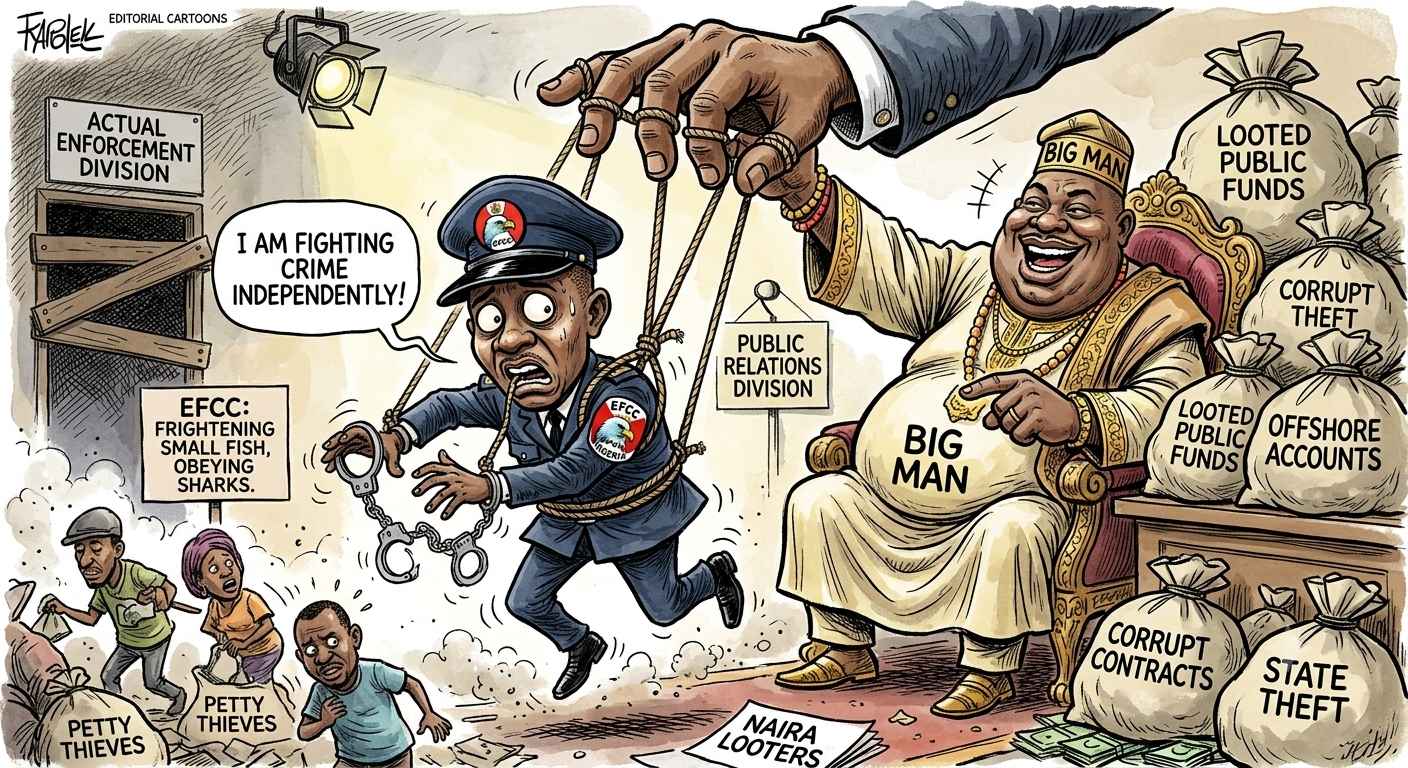
EFCC Freezes Osun State Accounts: Is This Fraud Prevention, or Is EFCC a Political Puppet?
Nine days before Osun State’s governorship election, the EFCC froze the state government’s statutory account. Osun is only the eighth Nigerian state to face this since Plateau State became the first in 2006, which means the tool itself is not new. What is new is the specific combination on display here: no court order at the point of freezing, a reversal within 48 hours, and an official presidential statement citing a court order that the EFCC’s own spokesman never claimed existed. Somewhere in that gap between the freeze and the reversal sits the real question this article is trying to answer: is EFCC a political puppet or a law enforcement agency?
There is a specific kind of Nigerian institutional theatre that unfolds so quickly, and with so many contradictory statements from so many powerful people, that by the time the dust settles, most citizens have simply moved on to the next news cycle without ever getting a straight answer. The EFCC freezes Osun state accounts saga of August 2026 is exactly this kind of theatre, except this particular episode is worth pausing on, because it happened nine days before an election, involved the President of the Federal Republic personally intervening, and produced a contradiction so specific it deserves to be read twice. This article does not pretend to have reached a courtroom verdict on what actually happened inside that account. What it can do, using only confirmed public statements from the EFCC, the Osun State Government, and the Presidency itself, is lay out the sequence of events and ask the obvious question nobody in power seems eager to answer directly.
Adeleke Targeted? The Timeline of How EFCC Froze Osun State Accounts
March 2026: The EFCC begins investigating the Osun State Government over the alleged fraudulent handling of approximately N11 billion in Ecology Funds, Intervention Funds, and Federation Account Allocation Committee (FAAC) allocations. Several state officials, including the Accountant-General, are questioned.
August 2, 2026: The EFCC says it begins observing what it describes as suspicious movement of funds from the government’s account.
August 5, 2026 (Wednesday): The EFCC sends a “Post No Debit” letter to First Bank, where the Osun government’s statutory account is domiciled, restricting the account. No court order is cited in this letter.
August 6, 2026 (Thursday): EFCC Director of Public Affairs Wilson Uwujaren appears on Arise Television and publicly defends the freeze as lawful, citing Section 34 of the EFCC Act and Section 7(6) of the Money Laundering Act 2022, which he says permit a 72-hour restriction without a prior court order.
Same day, later: A statement issued by the Presidency says it has learned the EFCC obtained a court order on August 5 to freeze the account, and directs that the account be unfrozen, with the Osun governor subsequently confirming contact from the federal government. This official version, citing a court order, directly contradicts the EFCC’s own public explanation from earlier the same day, which never mentioned a court order at all.
August 15, 2026: The Osun State governorship election proceeds, with incumbent Governor Ademola Adeleke of the Accord Party seeking re-election.
Plateau State, 2006, the first Nigerian state to have its government account frozen by the EFCC
Rivers State, 2008
Adamawa State, 2014
Benue State, 2018
Akwa Ibom State, 2018
Bauchi State, 2019
Kogi State, 2021
Osun State, 2026, the eighth state, and the first freeze this article can confirm was reversed within 48 hours amid a public contradiction over whether a court order actually existed
Read that timeline slowly, because the contradiction inside it is the entire story. On Thursday, the EFCC’s own spokesman told the nation, on live television, that no court order was needed and none had been sought, because the agency’s enabling laws permit a 72-hour administrative restriction. Later that same Thursday, an official statement from the Presidency claimed the EFCC had, in fact, obtained a court order two days earlier. Both statements cannot be simultaneously true. Either the EFCC’s spokesman misrepresented his own agency’s legal basis on national television, or the presidential statement was issued without the facts having been properly confirmed first. Neither explanation inspires confidence in the coordination between the executive and its flagship anti-graft body.
EFCC Freezes Osun State Accounts: Why the Timing Alone Deserves Scrutiny
Nigeria has 36 states and the Federal Capital Territory. In the entire recorded history of EFCC operations, no sitting state government’s statutory account has been restricted in this manner, this close to a governorship election, until Osun in August 2026. Wilson Uwujaren, defending the action, claimed the EFCC had taken a similar step in Edo State during that state’s own election period, though this claim has proven difficult to independently verify through published reporting, and this article treats it as an EFCC claim rather than a confirmed precedent. Governor Ademola Adeleke’s administration rejected the freeze outright, with the state’s Attorney General and Commissioner for Justice, Oluwole Jimi-Bada, SAN, directing the state to challenge the action at the Federal High Court in Osogbo, and arguing that while the EFCC has authority to investigate government accounts, it cannot freeze them without first securing a court order.
The Osun State Government went further, with the state’s Chief Press Secretary alleging that the EFCC had been conducting what he described as a witch-hunt investigation since March 2026, harassing officials weekly without producing incriminating evidence, and linking the action to political rivals of the current administration. This is a serious allegation made by a government official, and it remains an unproven political accusation rather than an established fact. What is not in dispute, because the EFCC confirmed it themselves, is the timing: the restriction landed nine days before Osun’s electorate went to the polls, in a state governed by a party outside the federal ruling coalition, during a period the state’s own government described as marked by heavy police presence, harassment, and arrests of opposition party members and supporters.
No state account has ever been frozen like this before. It happened to Osun nine days before an election. Is EFCC a political puppet or a law enforcement agency? The timing alone should make every Nigerian ask the question out loud.
Anuoluwa Soneye, NarrivonIs EFCC a Political Puppet? Isaac Fayose Says Nigerians Are Too Quiet to Ask
Prince Isaac Fayose
Isaac Fayose did not hold back. In a video posted to his verified Facebook page, Fayose said: “EFCC freezing Osun state government’s account is a joke taken too far. Nigerians are sitting down and watching these people bastardizing our democracy. They keep doing it because you are quiet. They keep doing it because they are sure that whatever they throw at you, you will grab it.” He then asked the question that turns this entire episode from a legal dispute into a comparative one: “How can you freeze a whole state government’s account, putting about four million people into nonsense? Why didn’t you freeze Ekiti state government’s account last month in June during their own governorship election? Why did you allow Ekiti to buy votes?”
This is where the story stops being purely about Osun and becomes about consistency, or its absence. On June 20, 2026, Ekiti State held its own off-cycle governorship election, and incumbent APC Governor Biodun Oyebanji was re-elected with nearly 85 percent of the vote. Dataphyte’s independent election monitoring analysis of 2,425 polling unit result sheets uploaded to INEC’s own Result Viewing portal flagged 452 sheets for numerical inconsistencies, with more than 100 containing visible alterations to recorded figures. The same analysis identified a discrepancy of over 71,000 registered voters between the figure INEC published before the election and the figure its own Returning Officer announced during the results declaration. Multiple voters in Aramoko Ekiti openly admitted, on camera, to receiving cash payments from political party agents in exchange for their votes, despite INEC Chairman Prof. Joash Amupitan having publicly directed security agencies, including the EFCC and ICPC, to arrest and prosecute vote buyers ahead of the poll. No comparable account freeze occurred in Ekiti before, during, or after that election.
EFCC Confirms Freezing Osun Govt’s Account, But What About the Bigger Fish Swimming Free?
Here is where the absurdity compounds. While Osun’s statutory account was frozen over an alleged N11 billion, and while the EFCC insisted it could not afford to look away because “Nigerians will ask where the EFCC was when those funds were being moved,” a considerably larger and more brazen scandal was unfolding elsewhere in government with no comparable urgency. As we documented in detail, a completely fictitious government agency, the Presidential Foreign Intervention Promotion Council, secured a N1.3 billion line in the actual national budget, office space in the Federal Secretariat, and functioning CBN accounts, operating for nearly a year before the EFCC or any other agency caught it. Nobody froze anyone’s account over that one within 72 hours of discovery. As we detailed in our broader breakdown of corruption in Nigeria, a Dataphyte review found that of 393 corruption cases against public officials reviewed over fourteen years, more than 60 percent remain unresolved, with elected officials facing an average trial timeline of 6 to 15 years. Was Yahaya Bello’s own account, connected to his 19-count, N80.2 billion fraud charge, ever restricted this swiftly, this publicly, or this close to a politically sensitive moment? Public record shows no comparable action.
A former governor now sits as Senate President with an unresolved N108 billion probe from over a decade ago that the EFCC itself has confirmed it never formally closed. Former National Human Rights Commission Chairman Chidi Odinkalu publicly stated the EFCC Chairman’s position had become “no longer tenable” following the Osun episode, referencing the agency’s earlier pledge to resign if it failed to secure Yahaya Bello’s prosecution, a pledge that has not been fulfilled. Social media users, reacting to the Osun reversal, drew a pointed comparison of their own, noting a pattern where the President appears to direct multiple ostensibly independent institutions, from the EFCC to the National Assembly to INEC, according to whatever outcome is politically convenient in the moment. Whether that broader characterisation is entirely fair is a matter for continued public scrutiny rather than settled fact, but the specific, confirmed contradiction between Tinubu’s court order claim and the EFCC’s own stated legal basis is not something this article invented. It happened in full public view, within the same 24 hours.
“Power tends to corrupt, and absolute power corrupts absolutely. Great men are almost always bad men, even when they exercise influence and not authority.”
Lord Acton, historian, widely cited
EFCC Freezes Osun Government Account, Adeleke Vows to Fight, and Nigerians Are Right to Watch Closely
This article has not concluded, and cannot conclude, whether the underlying N11 billion allegation against the Osun State Government has merit. That is precisely the kind of determination courts, not commentary, are built to make, and the Osun government has consistently pointed to the state’s multiple awards for budget and auditing transparency as evidence weighing against the EFCC’s account. What this article has established, using only confirmed statements from all sides, is that the process surrounding the freeze was chaotic, contradictory, and suspiciously timed, regardless of whether the underlying fraud allegation eventually proves true or false. A genuinely independent, consistently applied law enforcement process does not require the President to personally intervene within 48 hours to reverse an action his own anti-corruption agency had just publicly defended as lawful and unconditional.
Every time an episode like this unfolds and simply fades into the next news cycle without sustained public demand for consistency, the EFCC’s credibility, and by extension the credibility of every Nigerian institution meant to enforce law and restore public sanity, erodes a little further. As we explored in our examination of how corruption in Nigeria compromises ordinary citizens, this erosion of institutional trust does not stay contained within Abuja. It teaches every Nigerian watching that the rules are situational, applied with force against political opponents and applied with caution, or not at all, against political allies. At Narrivon, we believe the Nigeria of our dreams requires citizens who do right, think right, act right, and refuse to let episodes exactly like this one disappear quietly. It requires asking, loudly and specifically, why an account can be frozen in 72 hours in one state but a documented N394 billion in unresolved corruption cases elsewhere can sit in courts for over a decade. Isaac Fayose’s blunt question deserves a real answer, not a shrug: why does Ekiti get vote buying, and Osun gets a frozen account? The Nigeria worth demanding is one where the answer to that question is not simply “because we can.”
Frequently Asked Questions About the EFCC Osun Account Freeze
Why did the EFCC freeze Osun State’s government account?
The EFCC said it had been investigating the Osun State Government since March 2026 over the alleged fraudulent handling of approximately N11 billion in Ecology Funds, Intervention Funds, and Federation Account Allocation Committee (FAAC) allocations. On August 5, 2026, the commission sent a Post No Debit restriction letter to First Bank, the state’s bank, after observing what it described as suspicious fund transfers to multiple corporate entities beginning August 2, 2026, nine days before the state’s August 15 governorship election.
Did the EFCC need a court order to freeze Osun’s account?
The EFCC’s Director of Public Affairs, Wilson Uwujaren, said on Arise Television that the commission does not require a prior court order to impose a temporary restriction lasting up to 72 hours, citing Section 34 of the EFCC Act and Section 7(6) of the Money Laundering Act 2022. However, President Tinubu later issued a personal statement claiming the EFCC had obtained a court order on August 5, a claim that directly contradicted the EFCC’s own public explanation and had never been part of the agency’s stated position.
What did Isaac Fayose say about the EFCC freezing Osun’s account?
Isaac Fayose, a social commentator and younger brother of former Ekiti Governor Ayodele Fayose, called the freeze “a joke taken too far,” accusing the EFCC of bastardizing Nigerian democracy and acting selectively. He asked why the EFCC did not similarly freeze Ekiti State’s government account in June 2026 despite documented vote buying and electoral irregularities during that state’s governorship election, and urged Nigerians to stop being docile and demand accountability from institutions like the EFCC and INEC.
What happened during the Ekiti State governorship election in 2026?
Ekiti State held its governorship election on June 20, 2026, with incumbent APC Governor Biodun Oyebanji re-elected with nearly 85 percent of the vote. Independent election monitoring by Dataphyte identified 452 result sheets with numerical inconsistencies out of 2,425 analysed, more than 100 containing visible alterations, and a discrepancy of over 71,000 registered voters between INEC’s pre-election and post-election figures. Multiple voters were documented on camera admitting to receiving cash payments for their votes, despite INEC’s stated partnership with the EFCC to prosecute vote buyers.
Sources and Further Reading:
Tinubu speaks with Adeleke after ordering EFCC to unfreeze Osun’s account (Premium Times, August 2026) •
Onanuga: Tinubu spoke with Adeleke after ordering EFCC to unfreeze Osun accounts (TheCable) •
Osun account freeze: EFCC can restrict bank account for 72 hours without court order (Leadership) •
EFCC defends legal authority to freeze Osun’s account amid backlash (Premium Times) •
EFCC confirms freezing Osun govt’s account (Premium Times) •
Joke taken too far, Fayose reacts to EFCC freezing Osun Govt’s accounts (Daily Post, August 2026) •
Osun govt rejects EFCC’s N11bn looting claim (Legit.ng) •
Osun bank account: EFCC chairman’s position no longer tenable, should resign, Odinkalu (TheNiche) •
Ekiti governorship election 2026: Vote buying, altered result sheets, 71,000-voter discrepancy (Daily Trust) •
Ekiti Governorship Election 2026 analysis (Dataphyte Insight)