
ASP Nuhu Usman Shot a Bound Man Dead. Nigeria Has Seen This Before. That Is Exactly the Problem.
Oghenemine Ogidi, known as Mene Ogidi or OG Millan, was 28 years old, a musician, and on April 26, 2026, he had his hands tied behind his back and he was begging for his life. Then ASP Nuhu Usman shot him. On camera. In public. And if your first instinct is to say “this is terrible, let us call for justice and move on,” then you are part of the reason it keeps happening.
There is a video. That is the part that is different this time. Not the killing, because the killing is not new. What is different is that Nigerians watched it in real time, saw a man tied up and helpless, heard him beg, and then watched a uniformed officer in civilian clothes fire at him anyway. We have been here before. We have cried before. We have trended before. We have made hashtags before. And then, as Nigeria always does with its deepest wounds, we moved on. But this time, before we allow the hashtag to fade, we owe it to Oghenemine Ogidi and every family that has sat where his family now sits, to be honest about what this really is. Not a rogue officer. Not an isolated incident. A system. A culture. A studied pattern of impunity that has been allowed to grow because the people who benefit from it are the same people charged with ending it.
What Actually Happened in Effurun on April 26, 2026
Oghenemine Ogidi, known as Mene Ogidi or OG Millan
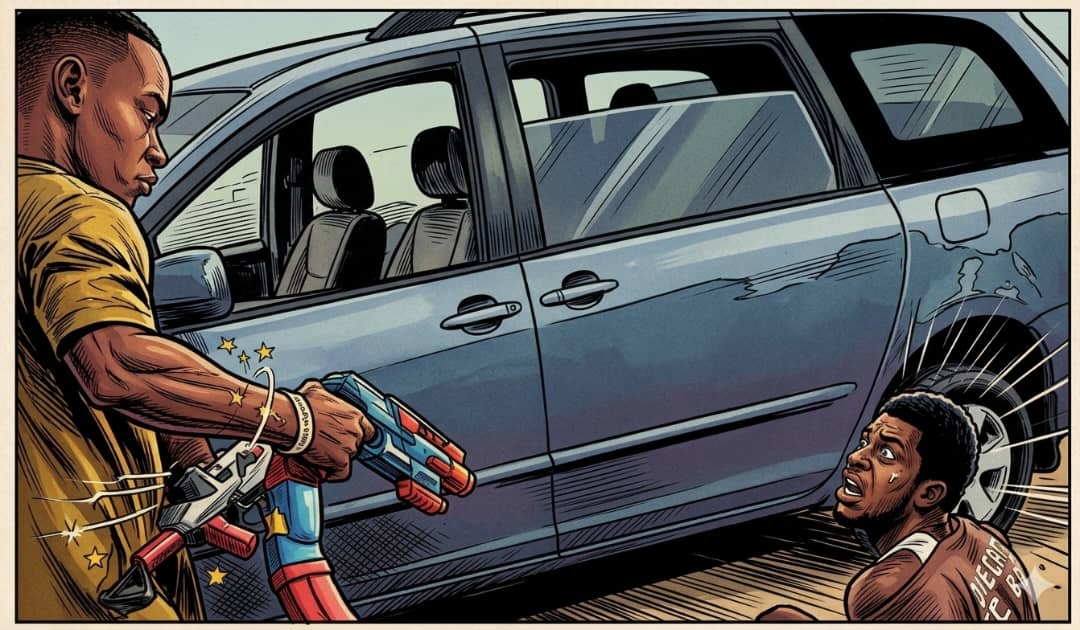
Oghenemine Ogidi was a 28-year-old musician and Delta State native, known by the stage name OG Millan. He was apprehended at the Benin Motor Park along the Warri-Sapele Expressway, reportedly by members of a transport union who claimed to have discovered a parcel he was attempting to send, allegedly containing a Beretta pistol and four rounds of ammunition. The police were called. He was handed over. He was tied up. He was begging for his life when ASP Nuhu Usman shot him. The entire sequence was recorded on video and distributed across Nigerian social media platforms, triggering national outrage. He was not threatening anyone when he was shot. He was restrained. He was pleading. He posed no threat.
ASP Nuhu Usman
ASP Nuhu Usman was the officer leading the team that responded to the tip-off about a suspect at the motor park. According to the Inspector-General of Police, Usman acted in clear violation of Force Order 237 and the Standard Operating Procedure of the Nigeria Police Force. The Delta State Police Command confirmed his arrest on April 28, 2026, two days after the killing. He was transferred to Force Headquarters in Abuja for disciplinary proceedings. Fresh allegations have since emerged from a woman who claims he assaulted and extorted her during a 2023 traffic stop, demanding N50,000 after threatening her with his firearm. Another victim confirmed on social media that she had an encounter with Usman’s team and described a pattern of harassment and extortion. This was not a first offence. It was a first offence that was caught on camera.
The Delta State Police spokesperson, SP Bright Edafe, said something during a Channels Television interview that deserves to be quoted exactly. He was asked why, given a clear instruction to bring in a suspect alive, Usman had shot him. His answer: “The instruction was very clear, go and bring a suspect. So one would wonder why a suspect who is not a threat to you, a suspect who is already tied to his back, a suspect who was begging for his life, you tried to shoot him the first time it did not work. One would wonder, except from a spiritual perspective.”
From a spiritual perspective. Let that sit. Nigeria’s Delta State Police spokesperson, asked to explain why an officer killed an unarmed, bound, begging man in broad daylight, told the country the answer might be supernatural. We are not making this up. It is on video. On Channels Television. That the spokesperson could say this without laughing, and that the country largely moved on without demanding a better answer, tells you everything about where we are.
“Impunity is not an accident. It is a policy. And every time a crime goes unpunished, someone in the system has decided that protecting the institution matters more than protecting the people it was built to serve.”
Adapted from Amnesty International, Nigeria Country Report 2025
The Killing of Mene Ogidi Is Not New. It Is a Tradition.
The average Nigerian does not hate the police because they watched too many crime dramas. They hate the police because they have met the police. If you are lucky, the encounter costs you money. If you are not lucky, it costs you time, your dignity, or a loved one. The killing of Mene Ogidi in the Effurun shooting is the most recent entry in a catalogue of police brutality in Nigeria that stretches back decades, and the most documented entries are still fresh enough to sting.
In February 2020, Amnesty International documented at least 82 cases of torture, ill-treatment, and extrajudicial execution by the Special Anti-Robbery Squad (SARS) between January 2017 and May 2020. Eighty-two documented cases. In three years. Those are not rumours. Those are names. Young men and women who were stopped for dreadlocks, for laptops, for driving nice cars, and who either never came home or came home changed. The pattern was so consistent, so documented, so broadly experienced by young Nigerians that in October 2020, something remarkable happened: an entire generation decided they had had enough and took to the streets.
The EndSARS protest of October 2020 was thirteen days of organized, passionate, documented civic action. Young Nigerians, leaderless, coordinated through social media, demanded five things: the immediate release of all detained protesters, independent oversight of the police, the definition of a fair modality for the prosecution of all dismissed SARS officers, psychological evaluation and retraining of disbanded SARS officers before redeployment, and the payment of compensation to all victims of police brutality. None of these five demands has been fully met. Not one. SARS was officially disbanded. Some of its officers were quietly redeployed. The culture moved on. Nuhu Usman, operating in Effurun, Delta State, in 2026, was operating in the exact same environment, with the exact same impunity, that EndSARS was organized to end.
And then came October 20, 2020. The night soldiers opened fire on unarmed protesters at the Lekki Toll Gate in Lagos. Electricity was cut. Cameras were covered. People died. Amnesty International confirmed at least 12 deaths. The Lagos State Government set up a judicial panel. The panel found military involvement. The government rejected the panel’s findings. No prosecution followed. The toll gates reopened. And somewhere in Delta State, ASP Nuhu Usman watched all of this and drew the only conclusion that the pattern logically supports: uniform protects.
EndSARS was not just a protest. It was a generation telling the state that the uniform had become a weapon. The state heard. Then it forgot. And then it killed Mene Ogidi.
Anuoluwa Soneye, NarrivonJustice Crack, Missing in Abuja: When Speaking Up Becomes Dangerous
Mark Chidiebere Justice, known as Justice Crack
Justice Crack is a Nigerian social media critic known for documenting alleged rights abuses, poor welfare conditions for frontline soldiers, and government accountability issues. In the days before his disappearance, he had posted videos questioning the Nigerian Army’s account of the killing of NYSC member Abdulsamad Jamiu in Abuja, whom the military described as a casualty of a stray bullet. Justice Crack publicly disputed this. On April 28, 2026, two days after Mene Ogidi was killed and while the national conversation about police brutality in Nigeria was at its loudest, Justice Crack left for a meeting in Abuja after receiving a mysterious phone call. He has not been seen since. His last tracked location was the NAOWA Shopping Complex in Asokoro, Abuja. His phones have been switched off. The Rule of Law and Accountability Advocacy Centre (RULAAC) has demanded that security agencies disclose his whereabouts. No agency has confirmed whether he is in custody.
In one of his final videos before going missing, Justice Crack said: “Abdulsamad’s death has scared the shit out of me because a lot have been positioned in Nigeria to kill anybody. We are just moving corpses.” He then disappeared. Draw your own conclusions. That is all the information we have. But the timing is impossible to ignore: the country’s most talked-about story is police killing a bound man on camera, a man who had been vocally calling out security agencies goes missing after receiving an unknown call, and the system produces silence. That silence is a communication.
“The disappearance of Justice Crack, coming just days after the Effurun shooting, sends a chilling message: speak up and something might happen to you too.”
RULAAC (Rule of Law and Accountability Advocacy Centre), statement, April 30, 2026
Why a Press Release, a Transfer, and a Trial Will Not Fix This
The Inspector-General of Police, IGP Olatunji Rilwan Disu, acted quickly after the Effurun shooting. He ordered the transfer of all involved officers. He recommended the immediate dismissal of ASP Nuhu Usman and the other officers. He said: “Let me be clear: this action was criminal, it was unprofessional, and it has no place in the Nigeria Police Force. No uniform is a license to kill.” He said justice for Mene Ogidi would be “swift, transparent, and absolute.”
Good. Now let us talk about why many Nigerians are not clapping.
Not because the IGP is insincere. But because we have heard this before. Nigeria has a documented history of consequential statements followed by inconsequential outcomes. The SARS officers who tortured and killed 82 documented victims between 2017 and 2020 were not prosecuted in any numbers that reflected the scale of what they did. The soldiers who shot EndSARS protesters at Lekki on October 20, 2020 have not been named, charged, or tried. The policeman who shot Kolade Johnson dead at a viewing centre in Lagos in March 2019 while watching a Champions League match was initially arrested, then the case went quiet. The pattern is not that Nigeria does not punish police brutality. The pattern is that Nigeria announces punishment, and then very quietly, very slowly, allows the announcement to become the punishment.
There is also the matter of what Nigerians have watched happen to people convicted of serious crimes in this country. When convicted persons receive sentence reductions through unofficial arrangements, when prisons become more comfortable than the average Nigerian’s home depending on who you are, when the journey from courtroom to consequence involves so many stops that the original sentence is unrecognizable by the time it is served, then the word “conviction” carries less weight than it should. The skepticism Nigerians feel is not irrational. It is evidence-based.
ASP Nuhu Usman got the courage to shoot a bound man in broad daylight because the system, across decades, told everyone wearing a uniform that consequences for this kind of action are manageable. The system built that courage. The system must now dismantle it, loudly, and in a way that is impossible to quietly walk back.
Anuoluwa Soneye, NarrivonThe Delta State Police spokesperson said the answer to why Usman did what he did might be spiritual. We disagree. The answer is structural. The structures that produced ASP Nuhu Usman are the same structures that paid him a meagre salary while expecting him to police a complex, dangerous environment with inadequate training and zero professional consequences for violence. The structures that produced him include a promotion system that rewards activity over integrity, a supervisory culture that turns a blind eye to petty extortion because everyone in the chain benefits from it, and a political environment in which senior police officials are deployed to protect the powerful rather than the vulnerable. Nigeria did not produce Nuhu Usman by accident. Nigeria produced him by design, and then expressed surprise when the design delivered exactly what it was built to deliver.
What This Has to Do with Governance, Looting, and the Cost of Public Impunity
The killing of Oghenemine Ogidi is a police story. But it is also a governance story. Because the culture of impunity that allowed ASP Nuhu Usman to fire at a begging man in front of witnesses does not live only in police stations. It lives in government ministries where allocations disappear before they become roads. It lives in the offices of officials who approve inflated contracts and collect a percentage. It lives in the boardrooms and backrooms where national resources are redirected into personal accounts. The uniform is a metaphor. The gun is a metaphor. What they represent, power exercised without consequence, exists in every arm of the Nigerian state.
This is why the rehabilitation of 744 ex-terrorists, celebrated with graduation ceremonies while communities bury their dead, is part of the same story. This is why a government that sends Boko Haram fighters to vocational training while families in the North-East wait for justice, is speaking the same language that ASP Usman was speaking on April 26 in Effurun. The language is: consequences are optional for those who hold power. And the listeners understand it perfectly.
A system that wants to be taken seriously cannot selectively apply consequences. It cannot dismiss a constable and celebrate a senator. It cannot imprison a blogger and rehabilitate a bomber. It cannot shoot Mene Ogidi with one hand and build platforms for his killer’s colleagues with the other. The people of Nigeria have watched this selective application of justice long enough to know what it means. It means the game is rigged. And a population that believes the game is rigged is a population that eventually stops playing by the rules.
“For evil to flourish, it only requires good men to do nothing.”
Edmund Burke, widely attributed
What Narrivon Is Here to Do, and What You Are Here to Do
The killing of Mene Ogidi, the disappearance of Justice Crack, the Lekki Toll Gate massacre that went without prosecution, the SARS officers who were disbanded but not tried, the pattern of dismissed cases and forgotten promises: these events have produced something very predictable in the average Nigerian. They have produced silence. Not the silence of peace, but the silence of people who have decided that speaking is dangerous, that demanding is futile, and that the only safe posture is the one that keeps you invisible.
That silence is the most dangerous thing in Nigeria right now. Not the police. Not the politicians. Not even the impunity. The silence. Because silence is consent. It is the message the system reads as permission. Every time an extrajudicial killing fades from the timeline without consequence, the system notes that the people are manageable. Every time a protest ends without a policy change, the government concludes that protests are manageable. Every time we bury a Mene Ogidi and move on to the next trending topic, we teach the system that Mene Ogidi was expendable.
He was not. He was 28. He was a musician. He was somebody’s son and somebody’s friend and somebody who had a name, OG Millan, that people knew. And the fact that a uniformed officer could shoot him dead, in front of witnesses, on camera, and the first official explanation was that the answer might be “spiritual,” and that some people nodded at this and kept scrolling, is the deepest emergency in this story.
At Narrivon, we exist to name the things that are designed to be forgotten. To put faces on the numbers and names in the press releases. To build a record that cannot be easily buried. We believe that accountability is not automatic. It is demanded. It is demanded by citizens who refuse to be quiet, who show up at the gates of institutions with documented facts, who vote with clarity rather than tribe, who teach their children that a uniform is not a license and that silence is not safety.
A better Nigeria is not a fantasy. It is a project. But every project requires workers who are present and awake and refusing to look away. The Effurun shooting happened in public. The justice for it must also happen in public. And the accountability that follows must extend beyond ASP Nuhu Usman and into every part of the system that told him he could get away with it.
You are reading this. That means you are one of those workers. Do not close the tab and forget. Remember Oghenemine. Remember OG Millan. Remember that his blood was not the first to wet the ground of this country’s indifference, and it will not be the last unless we decide, today, that the silence ends here.
The most dangerous thing in Nigeria is not a police officer with a gun. It is a citizen with a voice who has decided to keep quiet.
Anuoluwa Soneye, Narrivon
Sources and Further Reading:
Delta Police: Effurun officers will be tried for murder, Bright Edafe interview (Channels TV, April 29, 2026) •
Social media erupts over killing of handcuffed suspect (Peoples Gazette, April 2026) •
Effurun shooting: IGP confirms sacking and prosecution of ASP Usman (Daily Post, April 29, 2026) •
Police officer arrested for killing Delta suspect (TheCable, April 2026) •
Fresh allegations of extortion and abuse trail ASP Usman (The Eagle, May 2026) •
Delta PPRO tags Mene Ogidi death a suspected murder (News Central TV, May 2026) •
Ogidi body awaiting autopsy, not missing, police say (The Punch, May 2026) •
Justice Crack goes missing in Abuja after criticising Nigerian Army (SaharaReporters, April 29, 2026) •
RULAAC warns over enforced disappearance of Justice Crack (SaharaReporters, April 30, 2026) •
Nigeria: Pattern of unlawful killings by SARS must end (Amnesty International, 2020) •
2020 Lekki Tollgate Shootings (Wikipedia)