
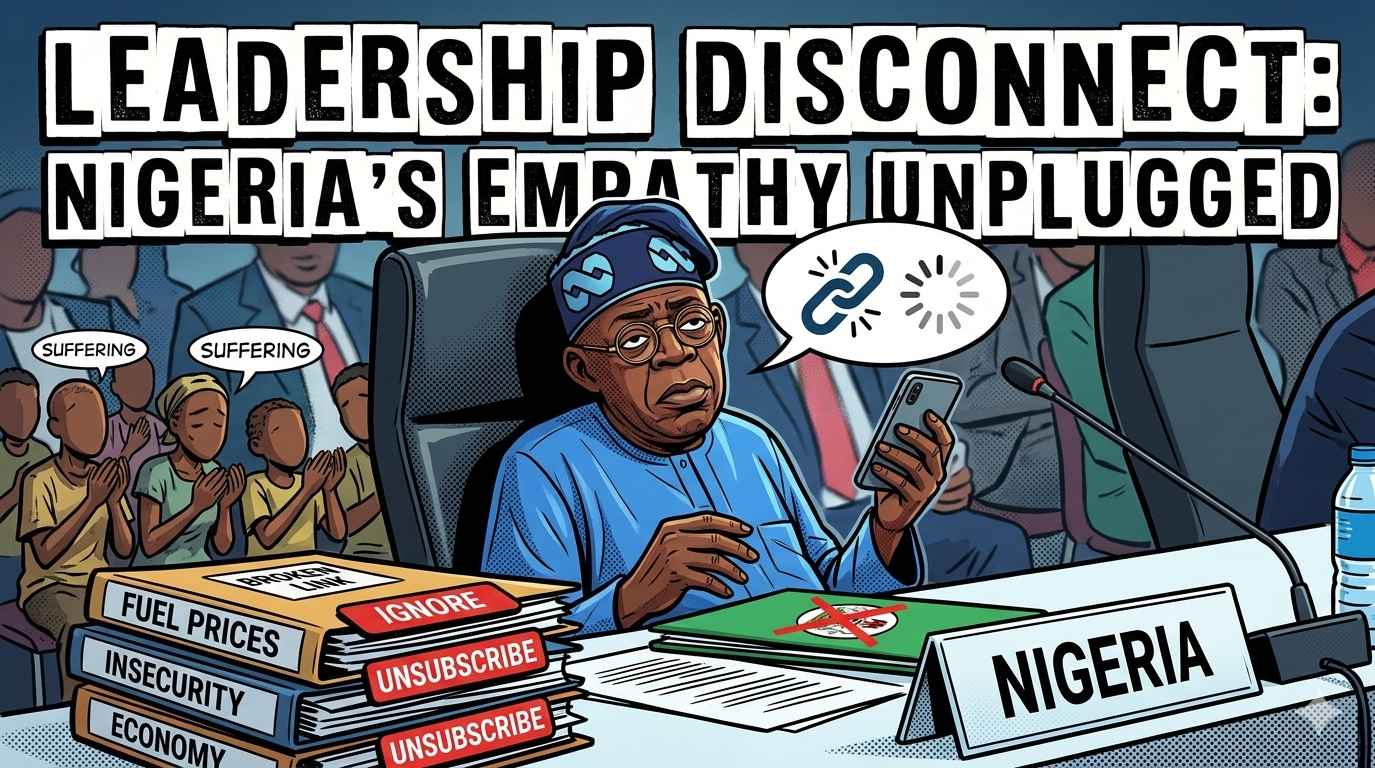
President Tinubu on Insecurity: The Government Is “Sleepless at Night” While Nigerians Are Dying in the Day
On May 27, 2026, after Eid-el-Kabir prayers in Lagos, reporters asked President Tinubu about insecurity. Children from Oyo State were still in captivity. A teacher had been beheaded. His response was a theology lesson. His spokesman, that same day, was pursuing VeryDarkMan on X. Leadership is not a sermon. It is a presence. And presence has been absent.
There is a particular kind of Nigerian governance theatre that has been perfected over decades. A tragedy happens. People die. Communities mourn. And the president speaks. On Wednesday, May 27, 2026, after performing Eid-el-Kabir prayers at Dodan Barracks in Lagos, reporters caught President Tinubu on insecurity. Children were still missing in Oyo State. A teacher had been beheaded days before. This was Children’s Day. The president was asked directly. And his response, confirmed word for word by Channels Television, The Punch, and Daily Trust, was this: “On the issue of insecurity, nowhere in the holy teaching that you should engage in banditry. Nowhere that you should kill another human being. The sacrifice we are talking about, even in the beginning of life, where we take this from, a child was replaced with animal, and that is what the value of life is all about.” You read that correctly. On Children’s Day. With children in captivity. With a beheaded teacher’s family still in mourning. Nigeria’s president, asked about insecurity, gave the bandits a Quran lesson. Not a deployment order. Not a rescue update. Not even the name of the beheaded teacher. A theological argument. As though the primary problem is that bandits have not yet read the correct scripture. As though the families in Oyo State were waiting to hear that their children are in the hands of people who were unaware that the holy books disapprove of their actions. This is not a failure of resources. It is a failure of empathy. And empathy, unlike funding and policy, is a choice.
President Tinubu on Terrorism: From “Sleepless at Night” to a Quran Lesson for Bandits
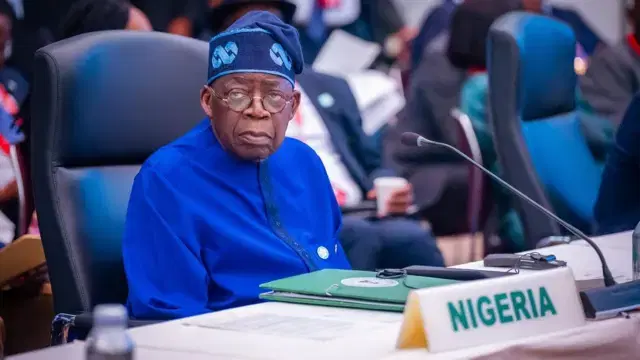
President Bola Ahmed Tinubu, GCFR
President Tinubu on insecurity has been nothing if not consistent. In February 2026, at the Second National Economic Council Conference, he said insecurity keeps Nigeria’s leadership “sleepless at night.” He said “we will overcome this unacceptable terrorism and banditry. It’s not part of our culture. It’s foreign to us.” Three months later, with the Oyo State kidnapping and teacher beheading fresh in national memory, and with Children’s Day being observed while Oyo children remained in captivity, reporters found the president again at Dodan Barracks in Lagos on May 27, 2026. They asked about insecurity. What Channels Television recorded and the State House confirmed was this: “On the issue of insecurity, nowhere in the teachings does it say you should engage in banditry or kill another human being. The sacrifice we speak of, even from the beginning of life, where we take these lessons, teaches us that a child was replaced with an animal. That is the value placed on human life.” The statement was issued, as always, by Bayo Onanuga. The missing children of Oyo State were not mentioned by name. The beheaded teacher, Michael Oyedokun, was not mentioned by name. What the president had, for Nigeria’s insecurity crisis on Children’s Day, was a theological rebuttal aimed at people who already know what the holy books say and have decided, with their fully loaded weapons and their growing convoy networks, that they disagree.
Nigeria’s president was asked about kidnapped children and a beheaded teacher. He responded with a religious argument that banditry is not in the holy books. The bandits, one assumes, are grateful for the clarification.
Anuoluwa Soneye, NarrivonLet us be precise about what this response is and what it is not. It is not wrong. No holy book does endorse banditry. The Quran reference to a child being replaced by an animal, the story of Prophet Ibrahim and his son Ismail, is a genuine theological teaching about the value of human life. Tinubu on insecurity was not speaking nonsense. He was speaking theology. And that, in the context of the question being asked, on the day it was asked, by reporters standing in front of a president whose country was in the middle of a mass kidnapping crisis, is precisely the problem. A leader of a country where hundreds of children are abducted each month, where teachers are being beheaded at work, where security forces are described by the Chief of Defence Staff as lacking resources while simultaneously graduating 744 ex-terrorists with certificates, does not need more theology. He needs more operational answers. The families of the Oyo victims are not waiting for a theological argument. They are waiting for their children.
There is a vast and measurable distance between the sleeplessness that produces a press statement and the sleeplessness that produces a changed security outcome. Tinubu on insecurity is, to his credit, at least consistently verbal. He declared a national security emergency in November 2025. He ordered more police recruitment. The scale of the challenge, as we have documented extensively in our coverage of insecurity in Nigeria, requires more than verbal commitment. It requires the kind of sustained, personal, visible engagement that communicates to both the security forces and the bereaved public that the president understands what is being lost. A theology lesson for bandits is not that engagement. The bandits are already theologically aware of their position. What they are responding to is not a gap in knowledge. It is an absence of consequence.
How the Government Has Shown Up for Victims: An Audit
The clearest measure of empathy in leadership is not the press release. It is the physical location of the leader when the people are in pain. As Narrivon documented in detail, when President Tinubu visited to express condolences after the Palm Sunday massacre in Angwan Rukuba, Jos, he met grieving community members at the airport. Not at the site of the massacre. Not in the village where people buried their dead. At the airport. The community that lost 51 people in a single night of terror received a condolence visit at the city’s transport hub and a press release. This is not a protocol detail. It is a communication. It tells the community: your grief is significant enough for a flight but not significant enough for presence.
Governor Caleb Mutfwang of Plateau State, the man directly responsible for the communities being attacked, addressed survivors of the Angwan Rukuba massacre from inside an armored APC vehicle. He did not step out. He spoke through the window of a heavily fortified vehicle to people who had just buried their children. The optics of a man in bullet-proof armor addressing unarmed civilians about their dead is the perfect visual metaphor for the empathy deficit that runs through every tier of Nigerian governance: protected power addressing unprotected grief from a safe distance, calling it a condolence visit.
And then there is the rehabilitation chapter. In April 2026, 744 former terrorists graduated from the Operation Safe Corridor rehabilitation programme in Gombe, with speeches, certificates, and state resources. The Chief of Defence Staff had compared these same former insurgents to the biblical prodigal son. The families of the people those insurgents killed received, across the same period, press releases and condolence visits at airports. The asymmetry is not subtle. It communicates clearly where the government places its emotional investment. President Tinubu on terrorism says it is “foreign” to Nigeria’s culture. The treatment of its victims suggests it is foreign to the government’s attention.
The Spokesman Who Found His Voice to Go After VDM While Oyo Teachers Were Missing
Bayo Onanuga
Bayo Onanuga is the man who issued President Tinubu’s statement on insecurity in February 2026, the one about sleepless nights. He is the president’s primary voice on information and strategy. In May 2026, an X user shared an AI-generated audio clip allegedly linked to social media activist VeryDarkMan (Martins Vincent Otse), in which a voice mimicking the president made inflammatory statements. Without verifying whether the audio was authentic, Onanuga posted on X calling for VDM to be prosecuted, describing the alleged circulation of the audio as “an abuse of social media platforms.” The speed was remarkable. The certainty was remarkable. What was also remarkable, and what VDM pointed out in a video that then went further viral, was that Bayo Onanuga had said nothing comparable about the abduction of teachers and students in Oyo State. VDM said: “Now you can talk. Bandits went into a school in Oyo State, they carried three teachers, one man, two women, they carried students. One of the teachers was beheaded. Bayo Onanuga, where is your comment on that? As I speak to you today, it is Children’s Day. Those children are still in an unknown location.” As of the time of this writing, that specific question remains publicly unanswered.
Nigerians online, who had watched all of this in real time, said what needed to be said. One widely quoted comment read: “Bayo is a disgrace unapologetically. Has he released any statement on insecurity?” Another: “He never speaks on insecurity. He is only after what people say about the president’s failure. Then you will see him jump out.” This is the clearest available evidence of where the administration’s emotional priorities lie. Not in the children who are missing. Not in the teacher who was beheaded. In the critic who was being vocal about both. The docility of Nigerians on insecurity is disturbing enough. When the people paid to communicate on behalf of the government demonstrate the same selective engagement, the message it sends is complete.

The First Lady, the “Blessing,” and the Memory of “There Is God O”
Senator Oluremi Tinubu is not just Nigeria’s First Lady. She holds, concurrently, the position of Assistant Pastor at the Haven of Glory Church in Lagos. She is a woman of faith, and that faith is a public part of her identity. In December 2025, when the United States military launched airstrikes against ISIS-linked targets in Sokoto State, Senator Remi Tinubu described the American military intervention in Nigerian soil as “a blessing.” She did not, in the same period, make equivalent public statements about the families of the Nigerians being killed by the groups that American airstrikes were targeting. The US government found it necessary and technically possible to strike terrorist targets on Nigerian soil. The Nigerian government’s first lady found the US intervention a cause for gratitude. The families of the dead found it yet another reminder that security for their communities requires foreign intervention.
Compare this to April 2014. The Chibok girls had just been taken. Boko Haram had abducted 276 schoolgirls and the world was demanding to know what Nigeria’s leadership would do. The then-First Lady, Patience Jonathan, wife of President Goodluck Jonathan, visited with parents of the Chibok girls at a public event. And in a moment that was genuine, unscripted, and deeply human, she began to cry. The “there is God o” video went viral because what Nigerians saw was grief they recognized. It was messy. It was not a managed communications moment. Patience Jonathan was visibly, publicly, uncontrollably sad about children who were not hers. The moment was mocked at the time. It was memed extensively. But in retrospect, it captured something that is increasingly rare in Nigerian political culture: the sight of a powerful person who actually felt something.

There is also the question of the church. Senator Remi Tinubu is an Assistant Pastor. Nigeria is a deeply Christian and Muslim country. As we have examined in our piece on the influence of religion and culture on Nigerians, the church has enormous capacity to mobilize sentiment, action, and accountability demands in this country. When the church at the highest levels of Nigerian power does not loudly name the crisis of abductions and killings in Nigeria as a spiritual and moral emergency requiring political accountability, it communicates to the congregation, which is the entire country, that the situation is within acceptable parameters. That silence, from people of faith in positions of power, is itself a response. And it is one the bereaved families of Oyo State and Benue State and Plateau State and Borno State have been receiving for years.
The Man Who Canvasses for Bandits and Is Still Invited to Rooms of Power
Sheikh Ahmad Abubakar Mahmoud Gumi
Sheikh Gumi has spent the better part of the last five years positioning himself as the moral voice for people who are doing the killing. His advocacy has ranged from calling bandits “our brothers” to arguing that amnesty is the only workable solution to Nigeria’s insecurity. On May 25, 2026, at a press conference in Kaduna, he called on the federal government to consider granting amnesty to bandits, arguing that since the kinetic (military) approach had not worked for 17 years, it was time to change strategy. He also disclosed, in a March 2026 interview with DRTV, that the Nigerian government knows the terrorists by name and by location, and that when he goes to interact with bandits, he is accompanied by security agents. This revelation, treated with relative calm, is one of the most significant statements made about insecurity in Nigeria in recent years. If the government knows who they are and where they are, the question of why they are still there requires an answer that “insufficient resources” does not adequately provide. Gumi has denied supporting terrorism. Defence Minister Christopher Musa warned in January 2026 that “a friend of a thief is a thief.” The Tinubu administration had nevertheless invited Gumi for engagement in 2024. He remains a prominent, amplified voice in Nigeria’s security discourse. The families of his “brothers'” victims remain a less amplified one.
Alex Otti, the School Children, and the Moment That Went Viral for the Right Reason
On May 29, 2026, a day before this article was written, a video went viral across Nigerian social media. It was not a video of insecurity. It was a video of its opposite: a leader who showed up and showed that he was paying attention. Governor Alex Otti of Abia State arrived at a school for an official visit and found the children lined up outside. They had been waiting for hours. Teachers had organized a welcome that required the pupils to stand in the sun, not learning, not in their classrooms, but outside waiting for a governor. What Governor Otti said to those teachers was recorded and went viral immediately. He told them: “I know you wanted the children to come out and greet me, and I appreciate it. But you can’t keep them outside from morning till this time. It means they didn’t learn anything today.”
A governor noticed that children had not learned anything today. He said so out loud. He corrected it. That is what empathy in leadership looks like. It is not a press release. It is noticing.
Anuoluwa Soneye, NarrivonThe reaction online was immediate and revealing. Nigerians, who had just spent weeks watching politicians respond to teacher beheadings and student abductions with airport condolences and armored APC speeches, looked at Alex Otti telling teachers not to keep children outside and felt something. Not because it was a grand gesture. Because it was a small one that revealed a large character. As we have documented in detail in our coverage of governance in Abia State under Otti, this is not an isolated moment. It is consistent. It is a governor who personally conducts road project inspections. Who paid N40 billion in salary arrears. Who declined a chieftaincy title mid-tenure. Who told his political appointees they would only receive salaries after workers were paid. Empathy is not a campaign strategy for Alex Otti. It is a governance philosophy. And it costs nothing to adopt it and everything to demonstrate it consistently.

“People will forget what you said, people will forget what you did, but people will never forget how you made them feel.”
Maya Angelou, widely attributed
The Country Will Not Be Fixed By Sleepless Speeches. It Will Be Fixed By Leaders Who Feel It.
President Tinubu on insecurity said the right words in February 2026. He was sleepless. He was determined. He was going to win. Three months later, his spokesman was pursuing a social media critic while a teacher’s family in Oyo was identifying a beheaded body. Three months later, the president was still meeting insecurity victims at airports. Three months later, a cleric who advocates for bandit amnesty was still holding press conferences and being invited into rooms of power. And three months later, 744 former terrorists were home with their certificates and their families while the families of their victims were still writing petitions and holding press conferences of their own.
The argument of this article is simple. President Tinubu on terrorism is articulate. His government is administratively functional at a basic level. What it has not consistently demonstrated is empathy, the specific quality of feeling the weight of other people’s pain and allowing that weight to shape your decisions, your presence, your priorities, and your language. Empathy is what makes a leader step out of the armored vehicle. Empathy is what makes a spokesman respond to a teacher’s beheading with the same speed as he responds to a social media post. Empathy is what made Patience Jonathan cry in public in 2014. Empathy is what made Alex Otti ask why children were standing outside in the sun for him.
The questions about government complicity in insecurity are serious and documented. But even without going there, the simpler question remains: does the leadership feel it? And if it does, when will that feeling produce something the families of Oyo State can hold, something more than a statement, more than a promise, more than a press release about sleepless nights that ends with a commendation for the governor of Katsina and no mention at all of the beheaded teacher’s name?
His name was Michael Oyedokun. He was a mathematics teacher. He went to work.
At Narrivon, we believe that the Nigeria we deserve is governed by people who know that name. People who say it at press conferences before they say anything else. People who would never keep children standing in the sun to welcome them. People who feel the difference between a condolence at an airport and a presence at a grave. That Nigeria is possible. We have seen it in Abia State. We have seen what it looks like when the head is correct and the heart is present. We need more of it. And as citizens, the most important thing we can do is refuse to accept less. Name the names. Show up. Hold the line. And do not stop until the people governing this country understand that the sleeplessness they describe must eventually wake them up to action that matches the weight of the grief they claim to carry.
“The purpose of human life is to serve, and to show compassion and the will to help others.”
Albert Schweitzer, physician and Nobel Laureate
Frequently Asked Questions
What has President Tinubu said about insecurity in Nigeria?
At the Second National Economic Council Conference on February 9, 2026, President Tinubu said insecurity keeps leadership “sleepless at night.” He stated: “That, I promise you, is what has kept all of us sleepless at night, but I assure you we will win with determination and resilience. We will overcome this unacceptable terrorism and banditry. It’s not part of our culture. It’s foreign to us.” The statement was issued by his spokesman Bayo Onanuga.
What happened with Bayo Onanuga and VeryDarkMan in May 2026?
In May 2026, presidential spokesman Bayo Onanuga publicly called for the arrest and prosecution of social media activist VeryDarkMan (Martins Vincent Otse) over an AI-generated audio allegedly linked to him. VDM blasted Onanuga in a video, asking: “Bandits went into a school in Oyo State, they carried three teachers. One of the teachers was beheaded. Bayo Onanuga, where is your comment on that?” Nigerians widely criticized Onanuga for his silence on the Oyo kidnapping but fast public action against a social media critic.
What did Alex Otti do at the school that went viral?
On May 29, 2026, Governor Alex Otti of Abia State went viral after questioning teachers who had kept school children lined up outside for hours just to welcome him. He told the teachers: “I know you wanted the children to come out and greet me, and I appreciate it. But you can’t keep them outside from morning till this time. It means they didn’t learn anything today.” The moment was widely praised as a demonstration of genuine empathy in Nigerian governance.
Who is Sheikh Ahmad Gumi and why is he controversial in Nigeria?
Sheikh Ahmad Gumi is a Kaduna-based Islamic cleric advocating for dialogue and amnesty with bandits since 2021. In March 2026, he disclosed that the Nigerian government knows the names and locations of terrorists. In May 2026, he called for bandit amnesty. Defence Minister Christopher Musa warned in January 2026 that “a friend of a thief is a thief.” Gumi denies supporting terrorism and maintains his advocacy is for peace through dialogue.
Sources and Further Reading:
Tinubu at Eid: On the issue of insecurity, nowhere in the teachings (Channels TV, May 27, 2026) •
No religious teaching supports banditry, killings, Tinubu (The Punch, May 27, 2026) •
Tinubu on insecurity at Eid-el-Kabir (Daily Trust, May 27, 2026) •
President Tinubu: We’ll overcome terrorism, banditry (State House Nigeria, February 9, 2026) •
Insecurity keeps us sleepless, Tinubu vows (Vanguard, February 9, 2026) •
VeryDarkMan fires at Tinubu aide Bayo Onanuga (Daily Post, May 27, 2026) •
VDM blasts Bayo Onanuga, mentions Oyo kidnapping (Gistlover, May 27, 2026) •
Nigerians react as Onanuga calls for VDM arrest (African Examiner, May 28, 2026) •
Sheikh Gumi urges FG to grant amnesty to bandits (Naija News, May 25, 2026) •
Govt knows terrorists’ names and locations, Gumi discloses (Vanguard, March 2026) •
Alex Otti praised after stopping pupils from waiting to welcome him (Gistlover, May 29, 2026) •
Bandits behead abducted Oyo teacher Michael Oyedokun (The Punch, May 2026) •
Patience Jonathan “There is God o” Chibok girls moment (YouTube)