
Kano’s N1.5 Billion Mass Wedding: 1,500 Couples, One 17-Year-Old Bride, and a Region Still Waiting for Actual Governance
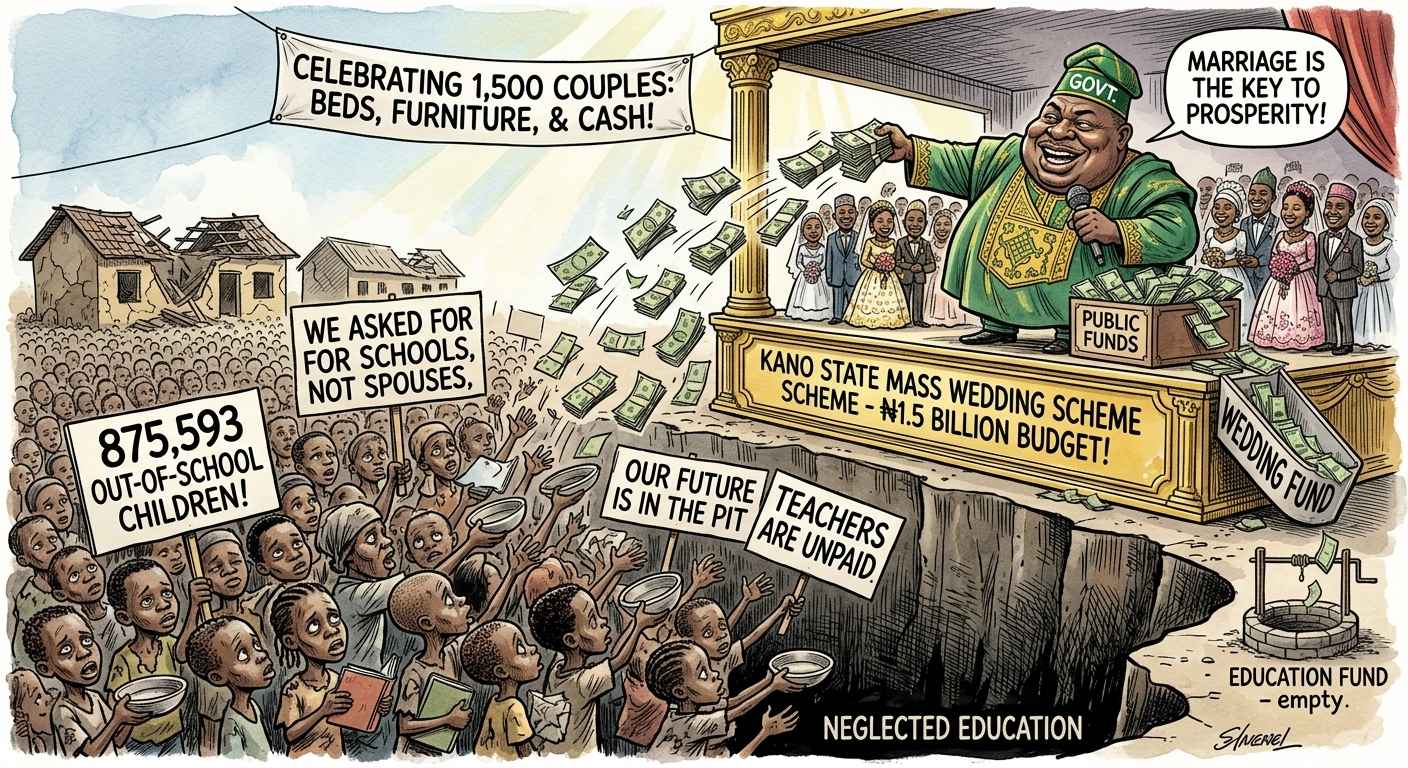
Over the weekend of August 7 and 8, 2026, Kano State married off 1,500 couples in a single, state-sponsored ceremony that cost the government N1.5 billion. It was framed as social welfare. It generated global headlines and warm human interest coverage. It also produced a groom who told a national television camera, with visible pride, that his new bride is 17 years old. Meanwhile, 875,593 children in the same state remain out of school. This article asks the question the wedding photographs conveniently avoid: is this governance, or is this a spectacle wearing governance’s clothes?
There is something almost admirable about the sheer scale of the Kano mass wedding. Organising 1,500 couples across two days, coordinating the Emir’s Palace mosque, medical screenings, dowry payments, and household item distribution, is a genuine logistical achievement. Governor Abba Kabir Yusuf’s administration, working through the Kano State Hisbah Board and its Commander-General, Sheikh Aminu Ibrahim Daurawa, pulled it off without visible chaos, and for many of the participants, the day was described as a source of real hope. That part of the story deserves acknowledgment before this article turns critical. But mass marriage in Nigeria, dressed up as social welfare, deserves the same scrutiny this publication applies to every other government spending decision, and when you place a N1.5 billion wedding budget next to Kano’s actual, documented crises, the arithmetic stops looking like compassion and starts looking like a government choosing the easiest photograph over the hardest problem.
Kano Mass Wedding 2026: The Numbers, the Governor, and the Groom Who Lost Everything
Alhaji Abba Kabir Yusuf
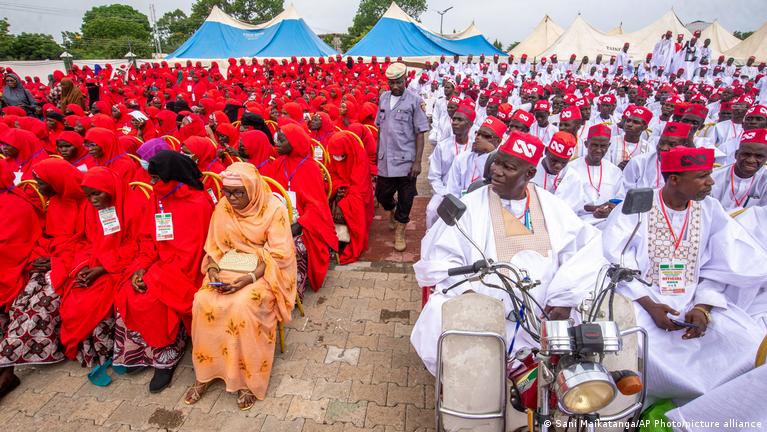
On the weekend of August 7 and 8, 2026, Governor Abba Kabir Yusuf presided over the second major mass wedding of his administration, following a similar exercise of roughly 1,800 couples in 2023. This edition brought together 1,500 couples from all 44 local government areas of the state, comprising widows, widowers, divorcees, orphans, spinsters, and bachelors screened through a medical process that included HIV, hepatitis, and genotype compatibility testing. Each bride reportedly received N100,000 as dowry and a further N100,000 in capital support, alongside household items including beds, mattresses, foodstuffs, and cooking utensils. The Emir of Kano, Muhammadu Sanusi II, represented the bride at the central ceremony, while Governor Yusuf represented the first groom, a symbolic gesture rooted in Islamic marriage tradition. Yusuf described the programme as designed “not only to assist women who might otherwise struggle to afford marriage, but also to strengthen families and promote social stability in the state.”
The most widely reported individual story from the ceremony belonged to Haruna Bashir, a groom who lost his first wife, Fatima Abubakar, and their six children in an attack on their home in Dorayi Chiranchi Quarters, Kano, earlier in 2026. According to Daurawa, Bashir had withdrawn from social interaction following the tragedy, and the mass wedding marked his gradual return to normal life. This is a genuinely moving individual story, and it is worth stating plainly that this article does not dispute the human value the programme provided to participants like Bashir. What this article disputes is whether a N1.5 billion government wedding budget is the correct governance instrument for addressing the underlying crises that make marriage financially unreachable for so many Kano residents in the first place, especially when those same underlying crises, insecurity chief among them, are what claimed Bashir’s first family.
Mass Wedding in Nigeria Versus the Out-of-School Children Crisis Sitting Next Door
Here is where the celebration photographs need to sit beside a spreadsheet. Kano State’s own Ministry of Education, in a rigorous 2026 state-wide survey conducted with UNICEF and international development partners, recorded 875,593 out-of-school children in the state, representing 13.34 percent of the state’s 6.56 million school-age children. UNICEF’s own regional data separately put Kano’s Almajiri and out-of-school adolescent girl population at over 305,006, the highest concentration in the entire North-West geopolitical zone. Kano, Katsina, and Jigawa together account for 16 percent of Nigeria’s entire national out-of-school children population, in a country that already carries one of the highest such populations on earth. The commissioner overseeing the survey noted the state’s own reduction efforts were “encouraging,” representing an 11.5 percent decrease from the 989,234 figure recorded in 2023. Progress, but from a catastrophic baseline, in the same state that just spent N1.5 billion marrying people off in a weekend.
As we have documented extensively in our coverage of insecurity in Nigeria, northern communities including parts of Kano State have faced repeated bandit attacks, the very category of violence that claimed Haruna Bashir’s first family. The Almajiri system, which channels hundreds of thousands of children out of formal classrooms and into itinerant Quranic schooling without structured welfare oversight, remains the single largest driver of the region’s out-of-school crisis, according to UNICEF and multiple education ministry officials. Poverty, insecurity, and a broken education pipeline are not separate northern Nigerian problems existing in parallel to the mass wedding. They are the precise conditions the mass wedding programme claims to be responding to, and none of them are addressed by N100,000 in dowry money and a set of cooking pots.
Government spending on the August 2026 mass wedding: approximately N1.5 billion for 1,500 couples
Out-of-school children recorded in Kano’s own 2026 state survey: 875,593
Almajiri and out-of-school adolescent girls in Kano, per UNICEF regional data: over 305,006, the highest in the North-West
Kano’s stunting rate among children, per the 2024 National Demographic and Health Survey: 51.9 percent
A state government spent N1.5 billion marrying off 1,500 people in a weekend while 875,593 of its children sit outside a classroom. This is not compassion. This is a photograph standing in for a policy.
Anuoluwa Soneye, NarrivonMass Wedding in Nigeria and the Underage Bride Question Nobody in Power Wanted to Answer
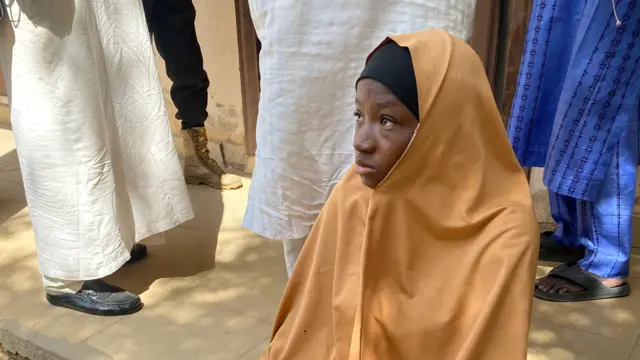
This is the part of the story that turned a heartwarming news cycle into a genuine national controversy. During the televised proceedings, a groom, identified in reporting simply by his statement, told a camera: “This is my first marriage, and I’m not a married widower. I married 17 years old. I’m very happy today. I married 17 years old.” He said it twice, apparently unaware of, or unconcerned by, the legal and ethical weight of the sentence he had just delivered on national television. The ICIR confirmed the exchange and the subsequent social media reaction, with one widely shared comment reading: “Someone just confessed to marrying a minor on national TV.” Separately, Vanguard confirmed a civil society commentator specifically raised concern over reports of a 17-year-old bride, questioning what life skills and opportunities would realistically be available to someone entering marriage at that age, and CAPPA’s media officer, Robert Egbe, publicly questioned whether N1.5 billion could have produced greater impact through direct economic empowerment rather than a wedding budget.
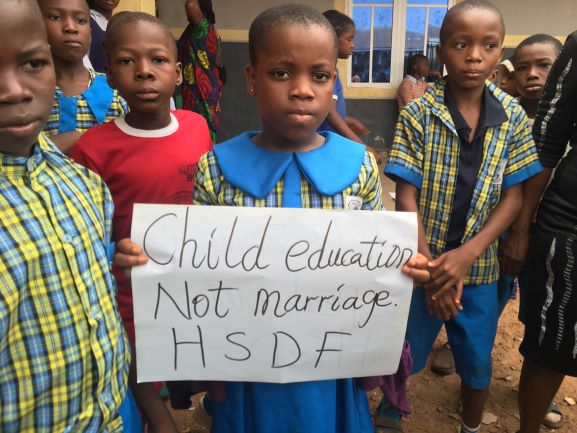
Nigeria’s own laws on this are not ambiguous at the federal level, even where state-level enforcement and cultural practice diverge sharply. The Child Rights Act sets the minimum marriage age at 18. Yet child marriage in Nigeria remains disproportionately concentrated in the north, where, according to the international campaign group Girls Not Brides, 30 percent of girls nationally are married before age 18, and 12 percent before their 15th birthday, with the practice most common among poor, rural households where religious and cultural norms are cited as justification. This is not a hypothetical northern problem discussed in the abstract. It surfaced, confirmed, on camera, at a ceremony the state government itself organised, funded, and publicly celebrated. When Governor Yusuf urged the newlyweds to “conduct their marital affairs in accordance with the teachings of the Holy Quran and the Sunnah of Prophet Muhammad,” the sentiment sits uncomfortably beside a documented, on-record admission of a marriage involving a minor, occurring under the direct sponsorship of the very government issuing that guidance.
Mass Marriage in Nigeria and the Overpopulation Question a Wedding Budget Cannot Answer
The mass wedding tradition in Kano, popularised during former Governor Rabiu Musa Kwankwaso’s administration and sustained continuously since 2012 across more than 4,000 marriages, carries explicit religious and cultural justification. Officials have consistently framed it as a response to rising divorce rates and children born outside marriage, arguing that facilitating marriage reduces what one Kano resident described to Sahara Reporters as “the temptation to engage in immoral acts.” This framing, whatever its sincerity, sidesteps a harder demographic question entirely. Kano’s population already exceeds 15 million, in a state carrying some of Nigeria’s highest poverty and child malnutrition figures, and a policy explicitly engineered to accelerate marriage formation and, by direct extension, birth rates, in a region already struggling to educate, feed, and protect the children it has, deserves scrutiny beyond its religious packaging. As we have examined in our broader analysis of religion’s influence on Nigerian society, framing a policy choice as primarily religious or cultural does not exempt it from the basic governance question of whether it serves the material welfare of the population it claims to protect.
There is also the uncomfortable structural pattern this programme reinforces. A society that channels its billions into ceremony rather than classrooms, clinics, and security infrastructure is a society that keeps its population dependent on the next ceremony rather than equipped to build independent, transformative futures for itself. Science, technology, and higher education, the disciplines that actually lift regions out of generational poverty, receive no comparable billion-naira weekend headline in Kano’s public spending calendar. As we explored in our examination of Nigeria’s broader anti-intellectual drift, a governance culture that consistently prioritises visible, celebratory spectacle over the quieter, harder work of institution building produces citizens equipped to celebrate rather than citizens equipped to build.
“You cannot build a nation on the ashes of its children’s education and call it progress simply because the ashes were photographed at a beautiful ceremony.”
Common framing in Nigerian education advocacy circles
Kano Mass Wedding Shows What Governance by Spectacle Costs a Region That Cannot Afford It
None of this article’s argument requires villainising the 1,500 couples who found genuine relief and dignity in Kano’s mass wedding programme, or the officials who organised it with apparent sincerity. The argument is structural, not personal. A government facing 875,593 out-of-school children, a documented insecurity crisis violent enough to have claimed a groom’s entire first family, and child malnutrition stunting rates above 50 percent, chose to spend N1.5 billion on a single weekend of ceremony rather than on any of those measurable, documented, decades-long crises. As Robert Egbe of CAPPA put it, that sum divided across 1,500 couples comes to roughly N1 million per couple, money that could have funded scholarships, vocational training centres, or maternal healthcare infrastructure with a far longer transformative reach than a bed frame and a bag of rice.
As we have argued in our broader examination of empathy in Nigerian leadership, the test of good governance is never whether an intervention photographs well. It is whether it addresses root causes with the seriousness those causes demand. A government that can find N1.5 billion for a wedding weekend but has spent years failing to close a 875,593-child education gap has not demonstrated compassion. It has demonstrated a preference for the applause line over the audit line. At Narrivon, we believe the Nigeria of our dreams requires citizens who do right, think right, act right, and speak up, not only against corruption in Abuja, but against every regional government that mistakes spectacle for substance. Ask the harder question the wedding photographs were designed to make you forget: what would N1.5 billion have done for the 875,593 children still waiting for a desk, a teacher, and a future that does not depend on the next government ceremony?
Frequently Asked Questions About the Kano Mass Wedding
How much did the Kano mass wedding cost and how many couples were married?
Kano State’s government-sponsored mass wedding, held on August 7 and 8, 2026, cost approximately N1.5 billion (roughly $1 million) and involved 1,500 couples from all 44 local government areas of the state. Each bride reportedly received N100,000 in dowry and N100,000 in business capital, alongside household items including beds, mattresses, foodstuffs, and cooking utensils. The programme was organised by the Kano State Hisbah Board under Governor Abba Kabir Yusuf’s administration.
Was there a case of underage marriage at the Kano mass wedding?
Yes, confirmed by multiple outlets including The ICIR and Vanguard. During televised proceedings, a groom stated on camera: “I married 17 years old. I’m very happy today. I married 17 years old.” This statement, made publicly at a government-sponsored event, generated significant social media and civil society criticism regarding child marriage and Nigeria’s Child Rights Act, which sets the minimum marriage age at 18.
How many children are out of school in Kano State?
Kano State’s own Ministry of Education, in a rigorous 2026 state-wide survey conducted with UNICEF and international partners, recorded 875,593 out-of-school children, representing 13.34 percent of the state’s 6.56 million school-age children. Separately, UNICEF data put Kano’s Almajiri and out-of-school adolescent girl population above 305,006, the highest concentration in Nigeria’s North-West geopolitical zone.
Has Kano State organised mass weddings before?
Yes. The tradition dates back to former Governor Rabiu Musa Kwankwaso’s administration and has been sustained by successive Kano governments since 2012, with the Hisbah Board reporting it has facilitated over 4,000 marriages through similar programmes. Governor Abba Kabir Yusuf’s administration held a similar mass wedding of approximately 1,800 couples in 2023 before the 2026 edition of 1,500 couples.
Sources and Further Reading:
Widower who lost wife and 6 children remarries in Nigerian mass wedding (Associated Press, August 2026) •
Kano invests N1.5bn on mass weddings of 1,500 families (Punch, August 2026) •
Kano govt marries off 17-year-old in mass wedding (The ICIR, August 2026) •
More knocks on Kano mass wedding: Same compassion should go to schools, hospitals (Vanguard, August 2026) •
Kano records 875,593 out-of-school children, new survey reveals (Kano Focus, August 2026) •
Kano, Katsina, Jigawa have 16 percent of Nigeria’s out-of-school children (UNICEF via AllAfrica) •
Nigeria marries 1,500 couples in mass wedding (Deutsche Welle) •
Nigeria’s mass wedding and how telling lovers from fraudsters is proving tricky (The Star)