
Nigeria’s Extreme Poverty Crisis, in Full: A Country-by-Country Reckoning, and What China Did Differently
The World Bank’s March 2026 Global Poverty Update puts the number of people living in extreme poverty worldwide at approximately 847 million. Nigeria and the Democratic Republic of Congo together account for nearly a quarter of that population while holding just 5 percent of the world’s people. In the same window of history, China took its own extreme poverty rate from 88 percent in 1981 to functionally zero, lifting roughly 800 million people out of destitution. Both stories happened on the same planet, within living memory, under governments that made choices. This is the full data picture, and the choices that explain the gap.
Poverty statistics have a way of numbing the mind precisely because of their scale. Hundreds of millions is not a number most people can genuinely picture, so it slides past as an abstraction rather than landing as the emergency it describes. This article resists that numbness by doing two things at once: laying out, with precision, exactly where Nigeria sits in the global ranking of extreme poverty by country, and placing that position directly beside the one country that has, within the same historical timeframe, demonstrated that mass extreme poverty is not a permanent condition but a policy outcome. China did not escape poverty through luck, geography, or resource windfalls it uniquely possessed. It escaped through a specific, sustained, institutionally coherent set of choices. Nigeria’s continued position near the top of the world’s poverty rankings is, this article argues, also the result of specific, sustained, institutionally coherent choices, just choices pointed in the opposite direction.
People Living in Extreme Poverty by Country: The Full Picture
Extreme poverty, by the World Bank’s current international standard, means surviving on less than $2.15 per day in 2017 purchasing power parity terms, later research increasingly referencing an updated $3.00-a-day line to reflect the true minimum cost of basic nutrition. The World Bank’s March 2026 Global Poverty Update confirms that 847 million people worldwide remain below this threshold, with Sub-Saharan Africa now accounting for approximately 67 percent of the world’s extreme poor despite holding only about 15 to 16 percent of the global population. This concentration has worsened over time precisely because poverty has fallen faster almost everywhere else. Within this picture, two countries stand out starkly: the Democratic Republic of Congo, with an extreme poverty rate of 85.3 percent, the highest of any nation on earth, and Nigeria.
| Rank | Country | Extreme Poverty Rate |
|---|---|---|
| 1 | Democratic Republic of Congo | 85.3% |
| 2 | Mozambique | ~74% |
| 3 | Burundi | 64.9% |
| 4 | Zambia | ~62% |
| 5 | Central African Republic | 68.8% |
| 6 | Madagascar | 70.7% |
| 7 | Niger | ~52% |
| 8 | Kenya | ~38% |
| 9 | Burkina Faso | ~47% |
| 10 | Nigeria | 41.8% |
Nigeria’s position on this specific list, at rank 10 by percentage rate, understates the true scale of its crisis, because Nigeria’s enormous population converts a comparatively lower percentage into one of the largest absolute populations of poor people on the planet. Statista’s 2026 analysis found that 12 percent of the entire world’s extreme poor population lives in Nigeria alone, a single country holding roughly one in eight of the world’s poorest people. The World Bank’s most recent household survey identified approximately 93.3 million Nigerians living below $3 a day as of 2022, a number so large it exceeds the entire population of most countries on earth combined.

Multidimensional Poverty in Nigeria: 133 Million Deprived of More Than Money
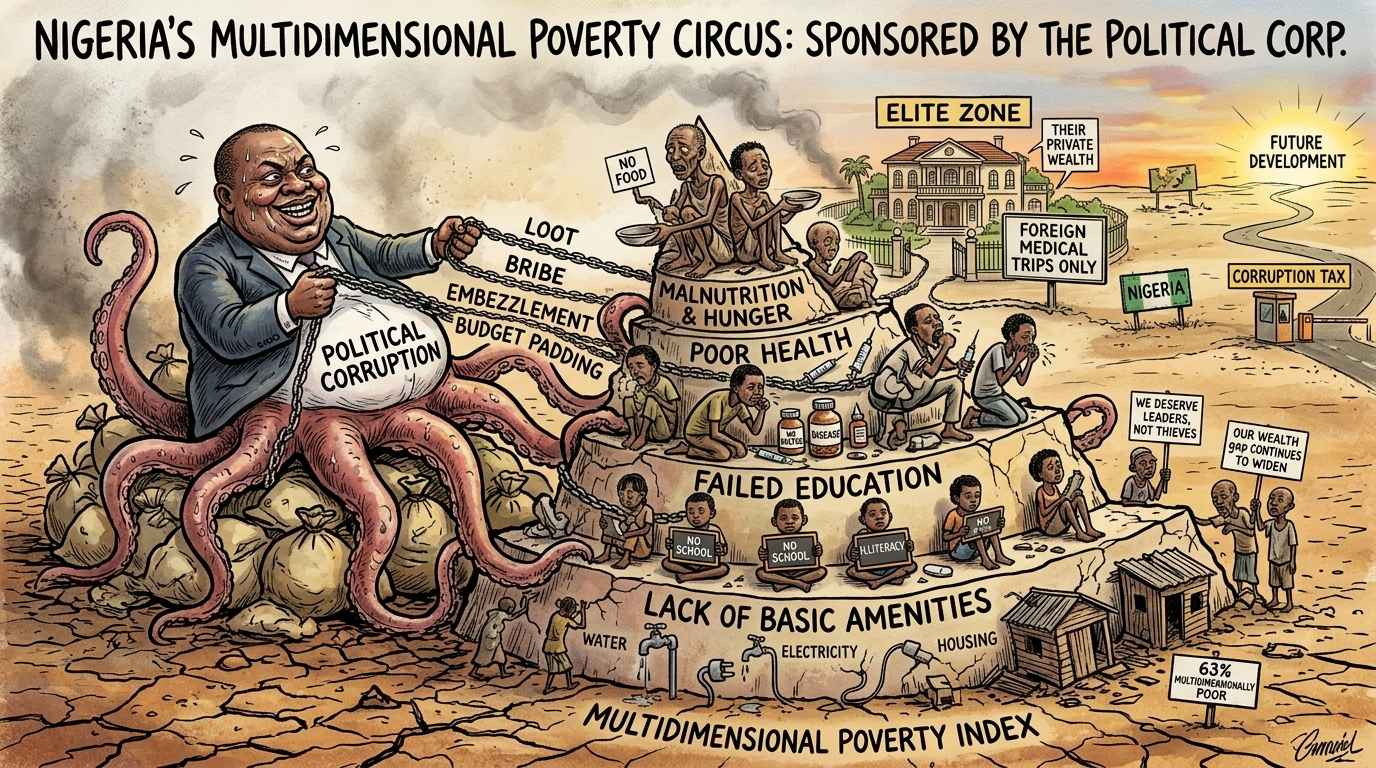
Monetary poverty lines alone can understate the depth of Nigeria’s crisis, because they measure only income, not whether a person actually has access to healthcare, clean cooking fuel, sanitation, or education. Nigeria’s own National Bureau of Statistics, in its landmark 2022 Multidimensional Poverty Index survey, found that 63 percent of Nigerians, approximately 133 million people, are multidimensionally poor, meaning they are deprived across health, education, living standards, and economic shock resilience simultaneously. The survey found that 65 percent of Nigeria’s poor, roughly 86 million people, live in the North, against 35 percent, nearly 47 million, in the South, with the incidence of multidimensional poverty ranging from a low of 27 percent in Ondo State to a staggering 91 percent in Sokoto State. Over half of all Nigerians still cook with dung, wood, or charcoal rather than clean energy, a marker of deprivation that a country of Nigeria’s oil wealth should never have allowed to persist at this scale.
133 million Nigerians, 63 percent of the population, are multidimensionally poor per the NBS 2022 MPI survey
93.3 million Nigerians live below $3 a day per the World Bank’s most recent household survey (2022)
12 percent of the entire world’s extreme poor population resides in Nigeria alone
91 percent of Sokoto State’s population is multidimensionally poor, against 27 percent in Ondo State
The World Bank projects Nigeria’s poverty rate will increase by 3.6 percentage points between 2022 and 2027, the only trajectory of increase among resource-rich Sub-Saharan African economies
The World Bank’s Africa Pulse report delivers the most damning forward-looking verdict: poverty in Nigeria and the Democratic Republic of Congo, both classified as “resource-rich but fragile” economies, is projected to increase by 3.6 percentage points between 2022 and 2027, making them the only country group in Sub-Saharan Africa moving in the wrong direction while their non-resource-rich neighbours reduce poverty faster. This detail deserves to be read twice. Nigeria is not poor despite having oil. Nigeria’s specific category of resource-rich fragility is precisely why its poverty trajectory is worsening while resource-poor countries improve. Wealth beneath the ground has not translated into wealth above it, and the World Bank’s own projections say that gap is widening, not closing.
China’s Poverty Reduction: 800 Million People, One Sustained National Project
Set against Nigeria’s trajectory, China’s poverty story is not simply impressive. It is the single largest reduction of human deprivation ever recorded. The World Bank’s own 2022 joint report with China’s Ministry of Finance confirmed that over the 40 years between 1978 and 2020, the number of Chinese people living below the $1.90-a-day international poverty line fell by close to 800 million, with China alone accounting for nearly 75 percent of the entire world’s poverty reduction across that same period. In 1981, China’s extreme poverty rate stood at 88 percent, among the highest ever recorded for a country of its size. By 2020, that figure had fallen to functionally zero. In 2021, the Chinese government formally declared “complete victory” against absolute poverty, achieving the United Nations’ 2030 Sustainable Development Goal target for ending extreme poverty a full decade ahead of schedule.
| Year | Extreme Poverty Rate | Approx. People in Extreme Poverty |
|---|---|---|
| 1981 | 88% | ~880 million |
| 1990 | ~66% | ~750 million |
| 2000 | ~40% | ~500 million |
| 2010 | ~11% | ~150 million |
| 2020 | ~0% | Functionally zero |
The mechanics behind this collapse are well documented and instructive. Analysis from the ASEAN+3 Macroeconomic Research Office identifies two central drivers: a broad-based economic transformation beginning with Deng Xiaoping’s 1978 market-oriented reforms, which created new income opportunities at scale, and a deliberately targeted state poverty alleviation strategy specifically engineered to reach areas mired in poverty due to geography and structural disadvantage. Rural poverty fell from 97.5 percent in 1978 to nearly zero by 2020. Crucially, this was not simply market forces left to their own devices. It combined sustained agricultural productivity reform in the first decade with deliberate industrial policy thereafter, backed by a state apparatus with the institutional capacity and continuity to execute multi-decade plans without being derailed by the kind of political discontinuity that characterises many developing economies.

Deng Xiaoping did not personally lift 800 million people out of poverty. A sustained, institutionally coherent state project did, executed across four decades without being captured by the kind of elite extraction that has defined so many other developing economies over the same period.
Anuoluwa Soneye, NarrivonCorruption in Nigeria and the Politics of a Country Left Behind
The comparison is not simply that China grew its economy and Nigeria did not. Nigeria has, at various points, posted respectable GDP growth figures. The comparison is that China’s growth was captured, at scale, by state-directed poverty reduction infrastructure, while Nigeria’s growth and resource wealth have been repeatedly diverted through the specific mechanisms this publication has documented extensively. As we detailed in our breakdown of corruption’s true cost in Nigeria, a Dataphyte review found that of 393 corruption cases against Nigerian public officials reviewed between 2013 and 2026, more than 60 percent remain unresolved, with N3.61 trillion, over a billion dollars, and further sums in euros linked to those unresolved allegations. That is not abstract money. Using the illustrative infrastructure comparisons in our earlier reporting, a single unresolved diversion of N109.5 billion could have funded between 91 and 137 kilometres of asphalt road, or over 700 fully equipped primary health centres. Multiply that arithmetic across hundreds of similarly unresolved cases spanning decades, and the scale of foregone poverty reduction capacity becomes almost impossible to overstate.
As we documented in our analysis of Nigeria’s 2026 budget, N8.05 billion was earmarked for church and mosque construction projects embedded inside government agencies with no religious mandate, while N22.15 billion went to palace renovations across the country, all in a budget carrying a N31.45 trillion fiscal deficit representing 46 percent of total spending. As we examined in our broader look at the caliber of leadership occupying Nigeria’s highest offices, a political system that repeatedly elevates individuals carrying serious, unresolved allegations of fund diversion is not structurally positioned to execute the kind of sustained, multi-decade, corruption-resistant poverty strategy that defined China’s transformation. China’s poverty reduction required political continuity and institutional discipline sustained across generations of leadership. Nigeria’s institutions have instead repeatedly demonstrated the opposite: discontinuity, capture, and a documented pattern where the very agencies meant to safeguard public funds for development purposes cannot account for where those funds went.
China needed forty years of one coherent state project to move 800 million people out of poverty. Nigeria has spent a comparable stretch of time producing 393 corruption cases, more than 60 percent of them still unresolved. The difference between those two sentences is the entire story.
Anuoluwa Soneye, NarrivonHow Failed Security Institutions Compound Nigeria’s Extreme Poverty Crisis
Corruption alone does not explain the full picture. As we have documented extensively in our coverage of insecurity in Nigeria, the country’s fragmented landscape of armed non-state groups, by one account cited in our reporting on the kidnapping economy, numbering as many as 86 distinct groups during the Buhari era, has displaced farming communities, disrupted agricultural productivity, and driven the exact category of instability the World Bank explicitly cites as a driver of Sub-Saharan Africa’s concentrated poverty. The World Bank’s own poverty analysis specifically identifies ongoing conflict in high-population economies, alongside infrastructure deficits with electricity access below 50 percent in many affected countries, as structural drivers of Sub-Saharan Africa’s disproportionate share of global extreme poverty. A farmer displaced by banditry in Zamfara or Katsina is not merely a security statistic. He is a household permanently removed from the productive economy, converting what was once agricultural output into another entry in the multidimensional poverty count.
China, by contrast, executed its poverty reduction during a period of sustained internal stability, allowing multi-decade infrastructure and agricultural policy to compound without the kind of repeated, violent disruption that characterises much of rural Nigeria today. This is not a claim that China’s path is directly replicable in every particular, given the profound differences in political system, scale of governance, and historical starting point. It is a claim that stability, institutional continuity, and freedom from extractive corruption are not incidental features of successful poverty reduction. They are, based on the comparative evidence, close to prerequisites for it.
Extreme Poverty in Nigeria Is Not Inevitable. China’s Story Proves the Alternative Exists.
It would be intellectually dishonest to present China’s poverty reduction as a simple template Nigeria could adopt overnight, given the vast differences in political system, population distribution, and historical circumstance between the two countries. But the comparative data assembled here is not offered as a policy manual. It is offered as a rebuttal to the quiet fatalism that treats Nigeria’s position among the world’s most extreme-poverty-burdened nations as some kind of natural, unavoidable condition tied to geography or culture. It is neither. China proved, within living memory, that a country starting from an extreme poverty rate of 88 percent could reach functional zero within four decades through sustained, corruption-resistant, institutionally coherent state action. Nigeria, over a comparable stretch, has instead produced a documented pattern of unresolved diversion, budget lines for palaces and unrelated religious projects, and a security landscape fragmented across dozens of armed groups that continue displacing the very rural populations whose agricultural productivity poverty reduction depends on.
At Narrivon, we believe the Nigeria of our dreams requires citizens who do right, think right, act right, and refuse to accept extreme poverty as a fixed feature of national identity rather than the direct, traceable output of specific institutional choices. The 133 million Nigerians living in multidimensional poverty and the 93.3 million living below $3 a day are not the result of insufficient resources. Nigeria has oil, gas, arable land, and a working-age population larger than most nations on earth. What it has lacked is the institutional discipline to convert those resources into the kind of sustained, protected, corruption-resistant development pipeline that China built and defended for forty consecutive years. Demanding that discipline, relentlessly, from every level of government, is not an abstract political preference. Based on the comparative record laid out here, it is the single most direct lever available for moving Nigeria off the list this article opened with.
Frequently Asked Questions About Extreme Poverty in Nigeria and China’s Comparison
How many people live in extreme poverty in Nigeria?
According to the World Bank’s most recent household survey, approximately 93.3 million Nigerians live below $3 a day as of 2022. Nigeria’s own National Bureau of Statistics found in its 2022 Multidimensional Poverty Index that 133 million Nigerians, 63 percent of the population, are multidimensionally poor, meaning deprived across health, education, living standards and economic resilience. Nigeria accounts for approximately 12 percent of the world’s entire extreme poor population, according to 2026 Statista analysis of World Bank data.
How did China lift 800 million people out of extreme poverty?
According to a 2022 joint World Bank and Chinese Ministry of Finance report, China’s extreme poverty rate fell from 88 percent in 1981 to functionally zero by 2020, with the number of people below the $1.90-a-day poverty line falling by close to 800 million, representing nearly 75 percent of the entire world’s poverty reduction over that period. This was achieved through Deng Xiaoping’s 1978 market-oriented economic reforms combined with a deliberately targeted state poverty alleviation strategy directed at geographically disadvantaged regions, sustained consistently across four decades.
Which country has the highest extreme poverty rate in the world?
The Democratic Republic of Congo has the highest extreme poverty rate globally at 85.3 percent, according to the World Bank’s March 2026 Global Poverty Update. Nigeria ranks among the top ten countries by extreme poverty rate at 41.8 percent, but due to its large population, Nigeria and the DRC together account for nearly 24 percent of the world’s entire extreme poor population despite representing only about 5 percent of the global population.
Why is Nigeria’s poverty rate expected to increase while other African countries improve?
The World Bank’s Africa Pulse report projects that poverty in Nigeria and the Democratic Republic of Congo, both classified as resource-rich but fragile economies, will increase by 3.6 percentage points between 2022 and 2027, making them the only country group in Sub-Saharan Africa moving in the wrong direction. This has been linked to documented patterns of corruption, unresolved fund diversion, and insecurity from armed non-state groups that displace agricultural communities and disrupt productivity, factors that non-resource-rich, more stable countries in the region have managed to avoid to a greater degree.
Sources and Further Reading:
Poverty Rate by Country 2026, World Bank March 2026 Global Poverty Update (Statistics of the World) •
Share of global poverty in Africa by country 2026 (Statista) •
Poorest Countries in the World 2026 (Union Citizenship) •
More Nigerians expected to fall into poverty by 2027, World Bank Africa Pulse Report •
Nigeria launches its most extensive national measure of multidimensional poverty (National Bureau of Statistics, 2022) •
Lifting 800 Million People Out of Poverty, World Bank and China Ministry of Finance joint report (World Bank, April 2022) •
An Exemplary Journey in Eradicating Poverty (ASEAN+3 Macroeconomic Research Office) •
Nigeria Multidimensional Poverty Index 2025 Country Profile (UNDP)