
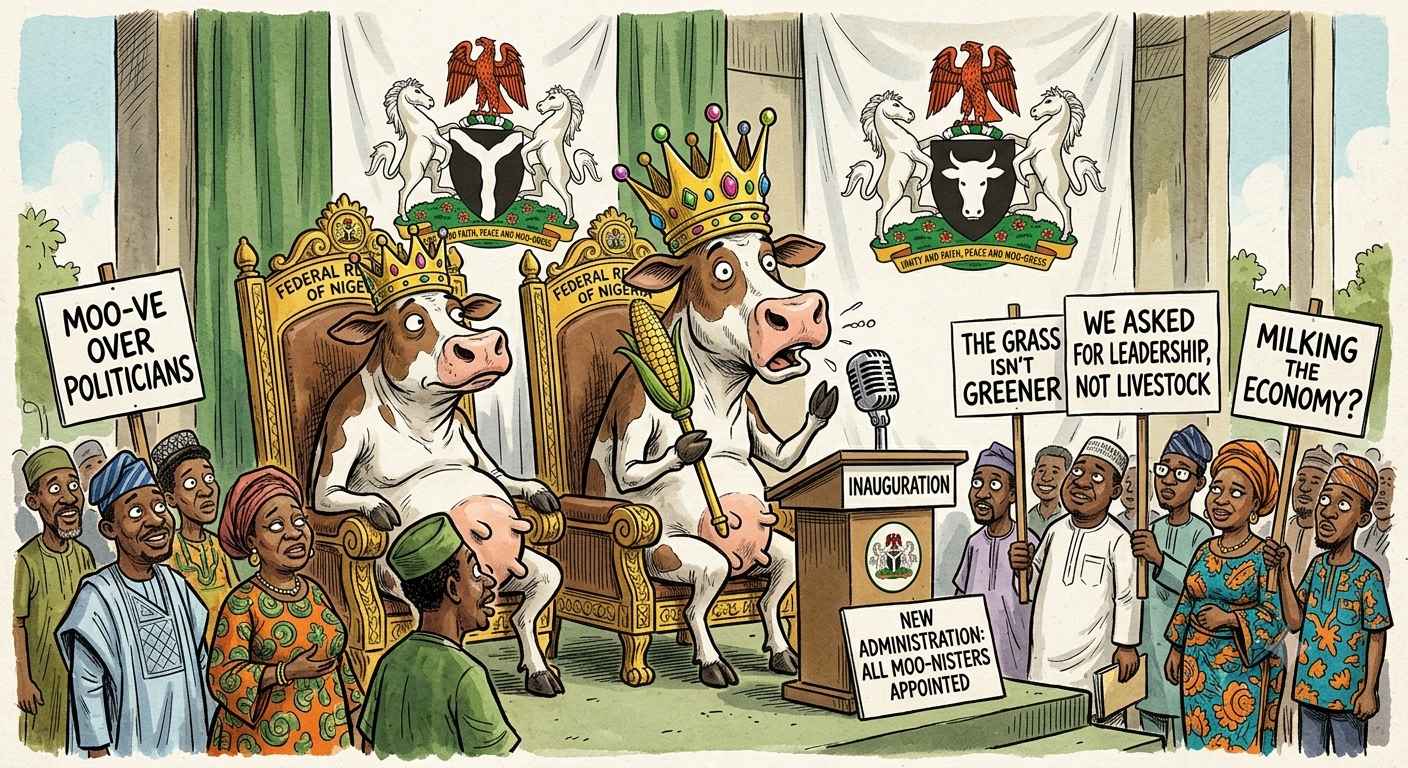
Open Grazing in Nigeria: The Day Cows Became More Politically Untouchable Than People
A motorist stopped his car in traffic to film a herd of cattle crossing an Abuja expressway. The herdsman approached him with a specific instruction: film me if you like, but do not film my cows. Months later, when asked directly what his administration was doing about the same cattle on the same roads, FCT Minister Nyesom Wike gave an answer that somehow made the herdsman’s instruction look almost reasonable by comparison. “I won’t talk about cows. It’s a matter of national security.”
There is a particular kind of Nigerian absurdity that does not announce itself with violence or scandal. It simply sits in plain sight, on a major highway, chewing grass, while millions of people navigate around it and quietly agree not to ask the obvious question out loud. Open grazing in Nigeria has reached exactly this point in 2026. Cattle walk past the World Trade Centre in Abuja. Cattle cross the road to Nnamdi Azikiwe International Airport. Cattle graze within sight of Aso Rock, the seat of the presidency itself. And when a journalist finally asked the man responsible for administering the Federal Capital Territory what, precisely, was being done about it, he declined to answer, citing national security, and asked everyone present to simply leave the matter there. This article does not intend to leave it there.
Cattle Grazing on Nigeria Highways: The Confrontation That Went Viral for the Wrong Reasons
In May 2026, a video began circulating that captured, almost too perfectly, the strange power dynamic at the centre of open grazing in Nigeria. A motorist stuck in traffic on a busy Abuja expressway pulled out his phone to record a large herd of cattle crossing the road, disrupting the flow of vehicles. A herdsman approached him, visibly irritated, and delivered a sentence that deserves to be studied in a Nigerian civics class: “You can film me but you cannot film my cows.” The herdsman went further, insisting nothing could be done to stop the crossing because the government had failed to secure grazing areas from bandit attacks in the first place, a claim that, whatever one makes of the confrontation itself, points to a genuine and largely unaddressed rural security collapse.
A separate, equally telling exchange, reported by Daily Trust, captured a different motorist shouting at a herder whose cattle had occupied part of an Abuja road. The herder, entirely unbothered, responded with a question of his own: “Is your car a human being?” It is worth sitting with the philosophical confidence required to ask that question in the middle of a national capital’s traffic jam. Cattle grazing in Nigeria highways has become so normalised that the animals, in this exchange, were treated as having at least equal standing to the vehicle attempting to pass them.

Open Grazing in Nigeria Reaches the Nation’s Front Door
If a herd crossing a highway on the outskirts of town feels like a rural problem creeping into urban space, the image of cattle grazing directly in front of Abuja’s World Trade Centre removes any ambiguity about how far open grazing in Nigeria has travelled. A widely circulated video showed exactly this scene, with the person filming offering a single, weary commentary that needed no elaboration: “This is a shame. This is a shame to Nigeria.” According to reporting from The Sun, cattle have been documented grazing very close to Aso Rock Villa itself, near the Three Arms Zone, the symbolic and literal centre of Nigerian federal power. One Abuja-based journalist quoted in that report offered a theory worth taking seriously rather than dismissing as gossip: that many of the cattle seen roaming the capital are reportedly owned by senior military officers, prominent businessmen, and traditional rulers, which he suggested explains why herders feel entirely at liberty to graze wherever they choose, confident that no consequence will follow.
Whether that specific ownership claim is fully verifiable or not, and this article treats it as a widely circulated allegation rather than an established fact, the practical outcome is not in dispute. Cattle grazing in Nigeria highways, including the highways of its own capital, has continued for years, across multiple administrations, despite formal bans. Malam Muhammad Musa Bello, a previous FCT Minister, restated a ban on cattle grazing in the Federal Capital City as far back as 2016. The ban did not need restating in 2016 if it had actually been enforced the first time. A decade later, it is being discussed again, on television, by a different minister, with a different, more theatrical answer.
Cattle Grazing Security Issue in Nigeria: Wike’s Apology and the U-Turn That Followed
Ezenwo Nyesom Wike, CON, GSSRS
The sequence of events here is genuinely worth laying out in full, because the contrast tells its own story. During his monthly media briefing in June 2026, Nyesom Wike accepted personal responsibility for the continued presence of cattle roaming Abuja’s streets, telling residents directly: “I apologise that up till now there are cows still roaming the streets of Abuja; I take responsibility.” At that time, he explained that the Federal Government, through the newly created Ministry of Livestock Development, had been engaging Miyetti Allah and other stakeholders, and that removing the animals required a cautious approach because rushing the matter could inflame ethnic and religious tensions.
Then, roughly two months later, in early August 2026, during a media chat with journalists in Abuja, Wike was asked again what steps the FCT Administration was taking to address ongoing resident complaints, this time specifically about cattle along the route to Nnamdi Azikiwe International Airport. This time, Wike responded: “I won’t talk about cows. It’s a matter of national security. I have said it severally.” He added that the National Security Adviser and the Department of State Services would handle the matter, and stated: “It’s not like we don’t have the capacity but we have to be very careful.” The same minister who had personally apologised and taken responsibility for the cattle problem in June was, by August, declining to take questions on the identical issue, reclassifying it as a national security matter above his own administrative jurisdiction.
In June, the minister took responsibility for cows on the road. In August, the same cows became a national security matter he would not discuss. Somewhere between those two months, the cattle apparently got a promotion.
Anuoluwa Soneye, NarrivonThe reaction was swift and, in places, genuinely funny in the way only Nigerian political commentary can be about a genuinely serious subject. Former Ekiti State Deputy Governor Isaac Fayose posted publicly that “Wike fears cows more than human beings,” adding that a government afraid of cattle while quick to disrespect ordinary citizens would be remembered unkindly. The comparison Fayose was implicitly drawing is not unfair. As we have documented extensively, this is the same minister who called a uniformed naval officer a fool during a land dispute in Gaduwa District, demanding documents and declaring that no one, regardless of rank, is above the law. That confrontation drew condemnation from former Chief of Army Staff Tukur Buratai, who described Wike’s conduct as itself a threat to national security. The same minister who confidently confronted an armed naval officer over a construction site apparently finds a herd of cattle a bridge too far to even discuss on record.
Why the Cattle Grazing Security Issue in Nigeria Deserves More Than a Closed Door
It would be intellectually lazy to simply mock the phrase “national security” and move on, because there is a genuine, documented layer of truth underneath it. Rural banditry has displaced traditional grazing routes across Nigeria’s Middle Belt and North, pushing herders and their cattle into unfamiliar, often urban, corridors in search of safety and grass. Herder-farmer clashes over destroyed farmland have produced real casualties across multiple states for over a decade, and allegations connecting some armed groups operating under the herding identity to broader insecurity are neither new nor without some documented basis, even though responsible reporting requires that these remain allegations rather than blanket conclusions about an entire ethnic or occupational group. As we have documented extensively in our coverage of Nigeria’s broader insecurity crisis, the collapse of rural safety has consequences that ripple outward in ways that are genuinely difficult to police cleanly.
What “national security” does not explain is why this framing only surfaces when a minister is asked a direct, uncomfortable question on camera, and conveniently disappears when the same minister is confidently issuing demolition orders, confronting military officers, or announcing infrastructure projects. National security, as a concept, should produce a coordinated policy response, involving named agencies, timelines, and public updates. What it has produced instead, repeatedly, across successive administrations dating back at least to 2016, is silence dressed up as caution. As we have observed in our coverage of other governance failures, “national security” and “ongoing investigation” have become two of the most reliable phrases in the Nigerian official vocabulary for indefinitely postponing an answer nobody in power actually wants to give.
“The first responsibility of a leader is to define reality. The last is to say thank you. In between, the leader is a servant.”
Max De Pree, leadership author, widely cited
Open Grazing in Nigeria Needs a Policy, Not a National Security Excuse
This article is not an argument against herders, against cattle, or against the legitimate livelihood that pastoralism represents for millions of Nigerians. It is an argument against the specific pattern where open grazing in Nigeria is treated as simultaneously too small a problem to fix and too sensitive a problem to discuss. Both cannot be true at once. If cattle on Abuja’s highways genuinely constitute a national security matter, Nigerians deserve a coordinated, named, time-bound response from the National Security Adviser’s office, not a single sentence at a media chat followed by silence. If the matter is administratively solvable through proper ranching policy, controlled grazing reserves, and the Ministry of Livestock Development’s stated engagement with Miyetti Allah, then Nigerians deserve to see that engagement produce visible, measurable progress rather than the same cattle appearing on the same roads a decade after the same bans were first announced.
At Narrivon, we believe the Nigeria of our dreams is built by citizens who think right, act right, and refuse to accept “let’s leave it there” as an acceptable final answer to a question this basic. A country that can confidently confront a naval officer over a land dispute but cannot confidently address cattle on its own capital’s roads has not run out of capacity. It has run out of will, or perhaps run into an inconvenient set of interests it would rather not name publicly. Either explanation deserves to be pursued, loudly and persistently, rather than politely dropped because a minister asked everyone present to leave it there. The cows are still on the road. The question should still be on the table.
Frequently Asked Questions About Open Grazing in Nigeria and the National Security Debate
What did FCT Minister Nyesom Wike say about cows and national security?
In early August 2026, during a media chat with journalists in Abuja, Wike was asked what the FCT Administration was doing about cattle grazing along major roads, including the route to Nnamdi Azikiwe International Airport. He responded: “I won’t talk about cows. It’s a matter of national security. I have said it severally.” He added that the National Security Adviser and the DSS would handle the matter, stating the government had capacity to act but needed to be careful.
Did Wike ever apologise for cattle roaming Abuja’s streets?
Yes. During his monthly media briefing in June 2026, roughly two months before his national security comment, Wike publicly apologised and took responsibility, saying: “I apologise that up till now there are cows still roaming the streets of Abuja; I take responsibility.” He explained at the time that the Federal Government’s Ministry of Livestock Development had been engaging Miyetti Allah and other stakeholders on the issue.
What happened in the viral video of a herdsman confronting a driver filming cattle?
In May 2026, a video went viral showing a motorist in Abuja filming a herd of cattle crossing a busy expressway and disrupting traffic. A herdsman approached the driver and told him: “You can film me but you cannot film my cows.” The herdsman insisted nothing could be done to stop the cattle crossings because the government had failed to secure rural grazing areas from bandit attacks.
Why does cattle grazing on Nigerian highways continue despite official bans?
Multiple FCT administrations have restated bans on open grazing in Abuja dating back to at least 2016, yet cattle continue to be documented on major highways, including near the World Trade Centre and close to Aso Rock Villa. Contributing factors reported include rural banditry displacing traditional grazing routes, inconsistent enforcement, and allegations, not conclusively verified, that some cattle in urban areas are owned by influential individuals who face little consequence for the practice.
Sources and Further Reading:
Cattle grazing is a national security issue, not my responsibility, Wike (Politics Nigeria, August 4, 2026) •
Wike afraid of cows, Isaac Fayose reacts (Daily Post, August 5, 2026) •
You can film me, not my cows, Abuja herdsman confronts driver (Naija Punch News, May 2026) •
Cows in Abuja: security story not only an urban nuisance (Daily Trust, May 2026) •
Kings of the highways: Abuja, Lagos motorists recount cattle experiences (The Sun Nigeria, June 2026) •
Video: Herd of cattle walk along Nigerian highway despite ban on open grazing (Premium Times) •
Miyetti Allah, farmers, residents speak as Lagos awaits anti open grazing law (Tribune Online)