
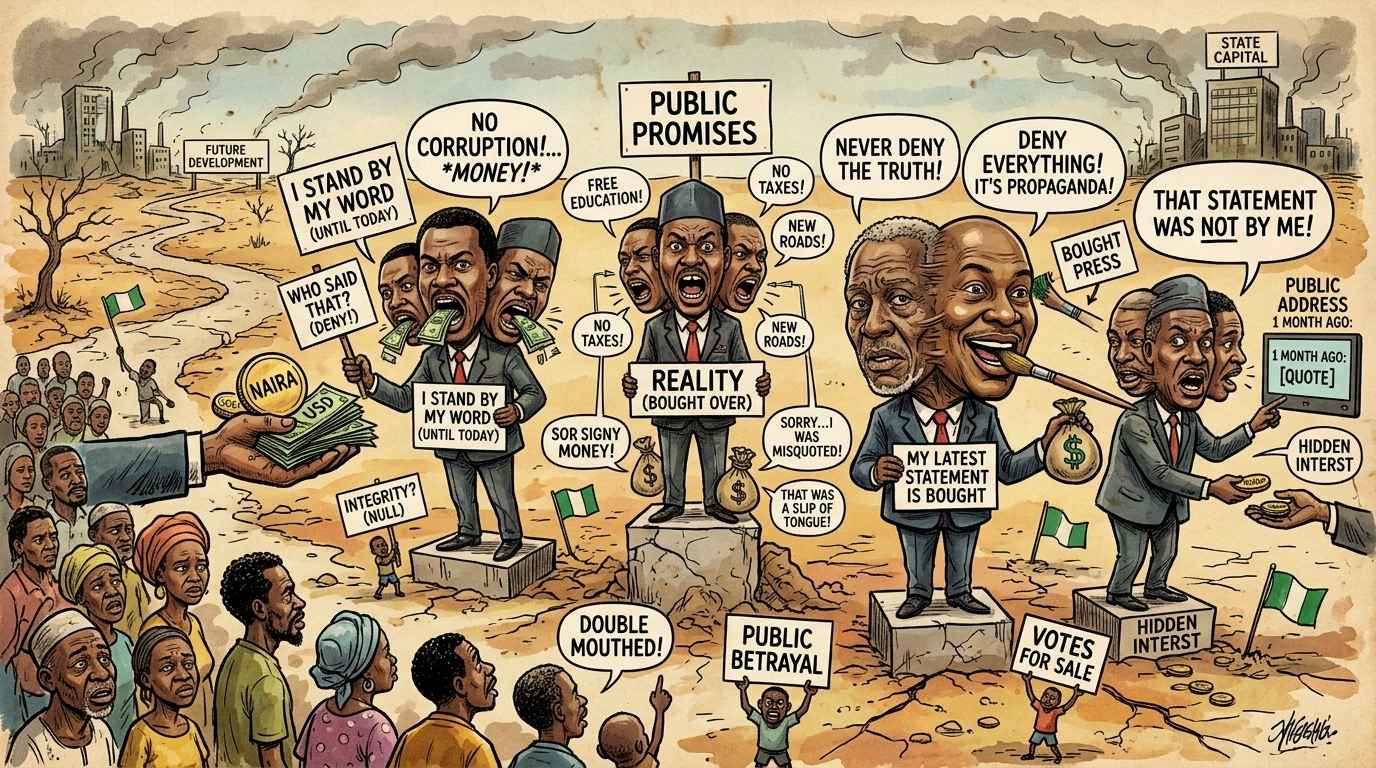
What Is the Price of Truth in Nigeria? Political U-Turns and a Value System for Sale
Yesterday’s fiercest critics are today’s loudest defenders, and the rest of us are left holding one question: what was the offer that weighed more than a reputation? The answer may say less about one president and more about what Nigerians now value.
Every country has people who change their minds. Growing up means doing it. What makes the price of truth in Nigeria such a live question is the speed, the volume and the total lack of explanation. A man spends years describing a politician in terms too harsh to print, then one day he is on television defending that same politician with equal passion, and we are expected to nod along. Nobody asks what changed. The comment section has already moved on to the next outrage. This article asks the question out loud, looks at what a few well-known figures have actually said on the record, and then argues that the political U-turns in Nigeria are a symptom of something much older than any one administration.
The Price of Truth in Nigeria: Reno Omokri’s Journey From Critic to Defender
Reno Omokri
A former aide to ex-President Goodluck Jonathan, Omokri was among the most prolific online critics of Bola Tinubu during the 2022 and 2023 election cycle. He has since become one of the president’s most visible defenders.

Peoples Gazette reported that around 2022 Omokri called Tinubu a “known drug lord” in a tweet and said that “a forfeiture is an admission of guilt.” On November 30, 2025, after his ambassadorial nomination, the same report quotes him saying: “The President has taught me the meaning of forgiveness and has helped me better understand what patriotism entails,” and calling Tinubu “the right man, at the right time, for the right job.”
In fairness, Omokri has given his own account. He says he withdrew the earlier claims publicly after the Supreme Court affirmed the election on October 26, 2023, apologised to Tinubu in person on October 1, 2024, and in his words: “I did say some negative things about the president between 2022 and 2023.” He has also said, in the same reporting, that the president “is not, has never been, and will never be a drug lord.” We repeat the original remark only because it is on the public record, it has been retracted by the man who made it, and we do not offer it as fact. We have explored this pivot before in our piece on how Reno Omokri and Daniel Bwala auction integrity.
Political U-Turns in Nigeria: Daniel Bwala and the “Opposition’s Job” Defence
Daniel Bwala
Bwala left the APC in 2022 over its Muslim-Muslim ticket and joined the PDP, where he became a high-profile opposition voice. He now speaks for the administration he once questioned.

As the Gazette reported in February 2025, Bwala once posted on X that Tinubu “will struggle with moral legitimacy (because he rigged the election) for 240 days of his presidency,” and on Arise TV he called him a “president-select” rather than a “president-elect.” Asked about it after his appointment, he said: “I criticised Tinubu’s election and administration in the past because I was in the opposition. The opposition’s work is to criticise the sitting government and hold them accountable.” And then: “My views changed after I met the president, and he saw a need to appoint me.” On his old remarks he said: “They are not relevant.”
It is a candid answer, and it deserves credit for being candid. It also quietly admits something uncomfortable: the criticism was a job description and the praise is one too. If your words follow your position, they stop being evidence of what you believe.
Kenneth Okonkwo, Peter Obi and Changing Political Positions in Nigeria
Kenneth Okonkwo
Okonkwo is still a sharp critic of President Tinubu, so his case differs from the two above. His U-turn concerns an ally. He campaigned for Peter Obi in 2023 and now attacks him.

On Channels Television on May 14, 2026, Okonkwo said of Obi and Kwankwaso: “Let me say they are political conmen.” In June he told a Symfoni TV audience, as Pulse reported, that “anybody voting any vote whatsoever for Peter Obi, you’re voting for Tinubu.” In September he explained: “The person you’re seeing now is completely different from the person I campaigned for,” adding, “if he’s going to fall into a pit, I do not have any contract to fall into the pit with him.” Those are his words, as reported by Parrot Nigeria, and he is entitled to them. A politician who changes his view of a former candidate is doing what politicians do. The wider pattern is what makes us pause, because the same year gave us Abubakar Atiku Abubakar, the son of the ADC aspirant, who joined the APC in January 2026 to help “actualise the second term bid of President Bola Ahmed Tinubu.” Femi Fani-Kayode has also said he retracted his own harsh remarks about Tinubu years ago.
Adetoun and the Price of Truth in Nigeria: Where Does “Never” Go?
Then there is Adetoun Onajobi, the activist and Instagram creator known as @justadetoun. In an earlier video, as it was quoted to us, she said: “So, I did a video and said Jagaban is a scam… According to my opinion, this man is a scam, his name is a scam, his education is a scam, his income is a scam. Nigeria itself is a scam.” She added that people claimed she had been paid: “Ah, they have given justadetoun 100 million, she has been bought.” Her answer was firm: “I will never endorse Tinubu, I am saying it loud and clear… He is my father, my husband worked for him closely… but I will never support his political ambition.” Daily Trust confirmed in 2022 that she calls Tinubu “father” figuratively and is not his biological child.
The online crowd now says she has pivoted, and the comments are as creative as ever: “how many corn you don harvest,” “are you corn-fused,” “she has ten tongues.” We need to be careful here. We could not find a dated, published statement of hers backing Tinubu or the APC, and in a separate episode an Instagram blogger claimed a leaked video showed her backing the APC, which she denied, calling the video fake and writing that she had “not and will never betray the love nor the trust,” as Kemi Filani News reported. So we leave her case as a question for her to answer in her own words. What her old video does is set a clear marker: she said “never,” on camera, and a public “never” is a promise to the audience.
A public “never” is a promise to the people who believed you. When it is broken, the debt is owed to the audience that believed you.
Anuoluwa Soneye, NarrivonThe Price of Truth in Nigeria: What Exactly Was the Deal?
Supporters of the president often call him a master strategist, and a cynic would say the evidence is right there: critics keep arriving at his door. A fair reader should resist that story as well, because it is a guess. We have no evidence of any improper offer to anyone named here, and each of them has given an explanation, whether forgiveness, the logic of opposition or a changed assessment of a candidate. People are allowed to change their minds, and some do for honourable reasons.
Yet the lingering question remains, and it is a fair one: what exactly was it that these people weighed against their reputations, and why did the scale tip? An appointment, a nomination, safety, access, friendship, a sincere change of heart? We do not know, and the public is rarely told. When people who sold us outrage yesterday sell us comfort today with no account of the exchange, the trust damage lands on everyone who ever believed a voice online. That is the real cost of this season, because the price of truth in Nigeria falls whenever citizens learn that nothing said in public can be taken at face value. Truth then gets discounted across the board.
“They are not relevant.”
Daniel Bwala, on his earlier criticisms of Tinubu, as reported by Peoples Gazette, February 2025
Nigeria’s Value System and the Worship of Money
Here is the point that matters more than any single name when we ask about the price of truth in Nigeria. The political U-turns in Nigeria reflect the value system of the country itself, far more than any one president’s strategy. Over many years, the ideal in Nigerian life has drifted toward money, and the drift shows up everywhere you look. It is in everyday conversation, where the first question about a stranger is what he does and how much he makes. It is in the music, where wealth is the plot. It is in the podcasts and relationship talk, where the measure of a partner is how much he can provide. It is in the social media space, where people will say or do almost anything to gain followers.
Seen from there, a public figure who trades a stance for a reward has simply followed the lesson the society has been teaching: money and self-gain first, integrity and self-esteem later, if at all. We said as much in our pieces on the entitlement mentality in Nigeria, the psychology of corruption and the influence of religion and culture on Nigerians. When we cheer a “hustle” without asking how it was done, we are rehearsing the same lesson. The outcry that greets politicians who flip is real, but it would carry more weight if it started with our own choices.
None of this is unique to Nigeria. Every society has people who can be bought. What is distinctive here is how popular the attitude has become, and how quickly the shame around it has faded. We also showed in how Nigerian politicians weaponize hunger that a hungry people are easy to price, which is why our value problem and our poverty problem feed each other.
The Price of Truth in Nigeria Is Heavy, So Rest Well
Asking these questions week after week is draining, and many Nigerians are stressed, short on sleep and carrying more worry than one head should hold. Pause for a few minutes. Put on headphones, press play, close your eyes and let these calming sounds slow your breathing. A rested mind keeps its values better than a tired one. If your stress feels heavy or lasts for weeks, please speak with a doctor or a trusted person as well.
Guarding Nigeria’s Shared Values: The Price of Truth in Nigeria Starts With Us
Two lessons stand out. First, shared ideologies need guarding. A value that nobody defends dies quietly, and truth-telling is one of those values. Second, social values decide what a country looks like. A nation runs on the aggregate of what each citizen believes and rewards, so the Nigeria we get is the sum of our daily choices: who we follow, who we applaud, whom we excuse because he is funny, and what we are willing to sell. If we reward flexible loyalties, we will keep producing them. If we reward consistent people, even when they are less rich, we will start producing those instead.
Becoming better citizens, people who do right, think right, act right, speak up and actively participate, and who have the guts to demand for more, is a step toward the Nigeria of our dreams. That begins with a simple habit: save the old video, remember the old “never,” and ask the new question politely and loudly. The price of truth in Nigeria is whatever we agree to pay for it, so let us stop selling it cheap. We covered similar ground in our letters on hopelessness and power and on how docility is costing us everything, and the message is the same: the power to change the price is in our hands.
Frequently Asked Questions About the Price of Truth in Nigeria
Is it wrong for politicians to change their positions?
No. People can learn, mature and revise their views. The concern is a pattern of sudden reversals with no explanation, especially after an appointment, nomination or other benefit, because it makes the public doubt that anything said in public can be trusted.
What did Reno Omokri and Daniel Bwala say about their change of stance?
Omokri says he withdrew his earlier claims after the 2023 Supreme Court ruling and apologised to President Tinubu in October 2024. Bwala said he criticised Tinubu because he was in the opposition, which he described as the opposition’s job, and that his views changed after he met the president.
Has Kenneth Okonkwo switched to supporting President Tinubu?
No. Okonkwo remains a critic of the president and a chieftain of the ADC. His reversal concerns Peter Obi, whom he campaigned for in 2023 and now criticises.
How does Nigeria’s value system affect politics?
When wealth and self-interest rank above integrity in everyday life, public figures and citizens alike are more likely to trade principles for gain. Politics then reflects the society that produces it, which is why change depends on citizens as much as on leaders.
Sources and Further Reading:
Omokri, who called Tinubu ‘drug lord’, praises him for ambassadorial nomination (Peoples Gazette, November 2025) •
‘I have long apologised to Tinubu’, Omokri says (allAfrica, February 2026) •
Why Sowore can’t rely on my past remark, Reno Omokri (allAfrica, January 2026) •
I criticised Tinubu as opposition party member, says Bwala (Peoples Gazette, February 2025) •
‘Political conmen’, Kenneth Okonkwo fires at Obi, Kwankwaso (Channels TV, May 2026) •
‘A vote for Obi is a vote for Tinubu’, Kenneth Okonkwo (Pulse Nigeria, June 2026) •
Peter Obi I campaigned for is different from who he is now, Okonkwo (Parrot Nigeria, September 2026) •
Atiku’s son endorses Tinubu for 2027 (allAfrica, January 2026) •
Fani-Kayode to Sowore: Reno Omokri and I retracted harsh criticism of Tinubu (allAfrica, February 2026) •
Fact check on Adetoun Onajobi’s viral video (Daily Trust, August 2022) •
Activist Adetoun Onajobi makes U-turn, tenders apology (Kemi Filani News)