A Love Letter to the Nigerian People: You Are Not as Hopeless as They Need You to Be
They have sold you despair in installments, and you have been paying faithfully. But here is the thing about hopelessness: it only works if you believe it. And you, dear Nigeria, are a lot smarter than they are counting on.
Dear Nigerian People,
We need to have an honest conversation. Not the polite kind that begins with “may God bless Nigeria” and ends with a collective sigh before everyone returns to their business. The kind of conversation where we sit down, look each other in the eye, acknowledge the mess we are sitting in, and then, crucially, talk about how we helped the mess get so comfortable. This is that conversation. And because we are doing it with love, we are going to be mercilessly honest. Consider this both a letter and a mirror. The mirror is going to sting a little.
Let us begin where the story really begins. Not with the politicians, not with fuel subsidy, not with David Umahi, whose record as Nigeria’s Minister of Works reads like a masterclass in holding an entire country’s infrastructure hostage with one hand while pointing fingers with the other. We will get to all of them. Let us begin with the one ingredient without which none of their tricks would work: your hopelessness. Because your hopelessness, dear Nigeria, is not a natural disaster. It is a manufactured product. It has a supply chain, a distribution network, and a very satisfied customer base in Abuja.
Hopelessness Is Not Your Destiny. It Is Their Strategy.
Think about what happens when a population genuinely believes nothing can change. The protests stop. The noise dies down. The pressure evaporates. The politicians can steal at leisure, appoint whoever they want to whatever they want, give a title to whoever flatters them most today, and the worst thing that happens is some tweets and a trending hashtag that fades in 72 hours. Hopelessness, properly administered, is cheaper than any bribe and more durable than any election rigging. It is the political class’s most efficient technology.
“The most potent weapon in the hands of the oppressor is the mind of the oppressed.”
Steve Biko, I Write What I Like, 1978
This is why you will notice that every time there is genuine civic momentum in Nigeria, a very particular set of responses is deployed. First, they mock it. Then, they co-opt it. Then, they dilute it with palliatives and promises. When five-star general Biko described the mind as the oppressor’s most potent weapon, he was describing exactly what happens in this country every election cycle: a political class that has become extraordinarily skilled at making you believe that the cage you are in is the natural order of things, and that anyone who rattles the bars is either naive, foreign-funded, or simply does not understand how Nigeria works.
Here is how Nigeria actually works. Corruption in Nigerian governance does not persist because Nigerians are uniquely corrupt people. It persists because the cost of corruption is consistently lower than its benefit, and the cost is kept low by a citizenry that has been successfully convinced that demanding accountability is futile. The moment enough Nigerians stop believing it is futile, the cost of corruption increases dramatically. Politicians know this. This is why they invest so heavily in manufacturing futility. Every time a whistleblower is victimized without consequence, every time an election result is brazenly altered and the courts shrug, every time a minister is accused of unspeakable theft and simply transferred to another ministry, the message is identical: your resistance changes nothing. That message is not incidental. It is the policy.
Your hopelessness is their most reliable infrastructure. It does not need maintenance, does not require budget allocation, and never goes on strike. They just have to keep feeding it, and you keep cooperating.
Anuoluwa Soneye, NarrivonWhat Happens When Citizens Actually Show Up
Here is the part of the story that tends to get lost in the collective gloom: accountability works. Citizen pressure works. It is not a myth invented by optimists. It is a documented, repeatable phenomenon that Nigeria has itself demonstrated, when it has chosen to try.
The #EndSARS movement of October 2020 demonstrated in thirteen extraordinary days what organized, leaderless, digitally-coordinated citizen pressure could achieve. SARS, a unit that had terrorized young Nigerians for decades with unofficial impunity, was officially disbanded within days of the protest reaching critical mass. The government moved with a speed it has never replicated for any positive policy initiative before or since. Why? Because enough people showed up. Because the cost of inaction suddenly exceeded the cost of action. Because, briefly, the citizens were organized enough to matter.
Now consider what happened after. The same unit, rebranded and reassembled under different acronyms, resumed operations. The Lekki Toll Gate massacre of October 20, 2020, in which the state’s willingness to deploy lethal force against its own citizens was laid bare for the world to see, resulted in zero prosecutions. The panel set up to investigate found the military culpable. The government rejected the findings. The journalists who documented it faced harassment. And the movement, deprived of sustained organizational structure and overwhelmed by the sheer weight of state response, gradually lost its momentum.
The lesson the political class drew from EndSARS: do not reform, outlast. The lesson they hoped you would draw: it is not worth it. The lesson you should actually draw: it worked until it stopped. The question is not whether citizen pressure is effective. The question is whether you are willing to sustain it long enough to overcome the state’s superior capacity to wait you out. And that capacity for sustained action is precisely what hopelessness destroys.
“Never doubt that a small group of thoughtful, committed citizens can change the world; indeed, it is the only thing that ever has.”
Margaret Mead, cultural anthropologist
Meanwhile, the evidence accumulates at every level of government. When public figures like Reno Omokri and Daniel Bwala perform spectacular ideological U-turns from sharp critics to enthusiastic government defenders in exchange for appointments, the silence from civil society is deafening. When the psychology of corruption in Nigeria has been studied, documented, and written about extensively, and the response of those who read it is a tired nod before changing the channel, something has gone badly wrong with the citizenry’s relationship to its own future. Accountability is not just about the big federal scandals. It is about the local government chairman who has not held a public meeting in three years. The state lawmaker who has never sponsored a bill. The school principal who pockets the PTA funds. The police DPO who runs his division like a franchise. All of them are relying on the same thing: your assumption that it is someone else’s problem.
We Need to Talk About What You Are Actually Paying Attention To
This is the part of the letter where we must be especially honest, because this is where the finger points directly at you, at us, and at a peculiar national talent for generating maximum emotional energy around things that have absolutely no bearing on whether the country improves.
In 2025, Nigeria collectively lost its mind — multiple times — over things that would not have registered as news in a country with a functioning attention economy.
#Chivido2025 — Davido and Chioma’s Miami Wedding
The wedding of David Adeleke, better known as Davido (singer, philanthropist, scion of the Adeleke family of Osun State), and Chioma Rowland trended for weeks. Not just the wedding itself. Chioma’s hairstyle. The asoebi. The guest list. The cake. The hairstyle inspired enough recreations to constitute a small cultural movement. Meanwhile, in the same calendar year, several state governments quietly diverted constituency development funds, INEC began planning for state elections under conditions that critics described as structurally compromised, and the Nigerian naira continued its ambitious project of racing to the bottom. But the hair, though. The hair was spectacular.
#JP2025 — Priscilla Ojo and Juma Jux’s Wedding
Priscilla Ojo, daughter of Nollywood actress Iyabo Ojo, married Tanzanian singer Juma Jux in a multi-country, multi-cultural celebration that generated an entire separate discourse about asoebi coordination, cross-cultural fashion diplomacy, and whether the 15-foot white cake was structurally sound. Nigerians engaged with the details of this wedding with the forensic precision of a KPMG audit team. In the same period, security forces were engaged in active conflict across at least three geopolitical zones, and the number of internally displaced Nigerians had crossed figures that should constitute a national emergency. But the aso-ebi, though. The aso-ebi was truly something.
The BBL Debate, 2024-2025 (Ongoing)
The Brazilian Butt Lift, a cosmetic surgery procedure, generated more sustained analytical energy on Nigerian social media over a 12-month period than any single piece of economic policy from the Tinubu administration. Nigerians debated the ethics, the aesthetics, the motivations, the societal implications, and the health risks of BBL with the kind of rigorous, multi-perspectival analysis that would be enormously useful if applied to, say, the Finance Act amendments or the restructuring of the federal allocation formula. It was not so applied. The buttocks conversation continued.
Labubu Dolls — Status Symbol and Spiritual Concern (2025)
When Labubu dolls, a collectible toy by artist Kasing Lung, became a global trend, Nigerian social media split into two factions: those who wanted them as status accessories, and those who were spiritually alarmed by their appearance. The debate consumed weeks of timeline real estate. Just to be clear about what was happening in the background during those weeks: fuel prices remained at historic highs, the doctor-to-patient ratio in Nigeria was approximately 1:8,000 against a WHO recommendation that should be making health ministry officials lose sleep, and politicians were actively deploying rice distributions and branded Danwake bags to purchase votes for the 2027 election. But the dolls were either cute or demonic, and Nigeria needed to decide.
None of these things are wrong to enjoy. Weddings are beautiful. Celebrity culture is human. The problem is the proportion. The issue is not that Nigerians are passionate about entertainment. The issue is that this same passion, applied to governance, to accountability, to civic engagement, would be transformative. Consider: a fraction of the energy that went into debating Chioma’s hairstyle, applied instead to demanding that your local government publish its quarterly accounts, would make ward-level corruption significantly more expensive to sustain. A fraction of the forensic intensity applied to BBL analysis, applied instead to tracking the implementation of constituency projects, would make legislators think twice before diverting funds. The capacity is demonstrably there. The application is the problem.
“An educated, informed populace is the only sure guarantor of liberty. An entertained, distracted one is the greatest tool of tyranny.”
Thomas Jefferson, paraphrased and widely attributed
On Worshipping the Things That Are Killing You
Let us talk about two things that Nigerians consider sacred and that are, in practice, the most effective tools the political class uses to keep you divided and manageable.
The first is money. Not the earning of it, which is admirable and necessary. The worship of it. The specific Nigerian phenomenon in which a person’s worth, credibility, and moral authority are almost entirely determined by the volume of cash they can spray at a party. We have explored in detail how politicians weaponize this tendency, how a bag of rice can purchase loyalty that no governance record could earn. But the money worship runs deeper than the transactional. It infects the entire value system. A billionaire businessman with no documented civic contribution commands more national respect than a community organizer who has spent fifteen years building functional public infrastructure from the ground up. A celebrity with a massive Instagram following and a track record of spraying at parties gets appointed as a political coordinator ahead of qualified, committed community advocates. And the nation watches and nods, because in Nigeria, money is its own endorsement, and the display of it is its own argument.
The second sacred object is tribe. The specific, resolute, frequently irrational loyalty to ethnic identity over demonstrated competence. It is the mechanism by which a man who has been comprehensively documented as a governance failure retains his base, because to abandon him would feel like abandoning the tribe itself. It is the logic that says: he has not delivered infrastructure, security, or economic growth in four years, but he is our son, and our sons must be protected. This is not love of community. It is the political class’s most durable insurance policy, paid for with your future.
The day you value what a politician has done for you more than what tribe he belongs to, is the day Nigerian elections become dangerous for bad politicians. Right now, they are perfectly safe.
Anuoluwa Soneye, NarrivonThese two loyalties, to money and to tribe, are not accidents of Nigerian culture. They are carefully cultivated dependencies. A citizen who evaluates politicians on tribe rather than performance is a citizen who can never hold a politician accountable, because accountability requires the ability to withdraw support when performance fails. A citizen whose respect is purchased by displays of wealth is a citizen whose opposition can always be bought. Together, these two tendencies make the Nigerian voter the most manageable electorate in the world, not because they are foolish, but because the system has invested heavily in making these particular loyalties feel like wisdom.
On Leaving the Country That Needs You Most
We understand. We genuinely do. When the hospitals have no equipment, when ASUU strikes mean your child loses academic years to political theater, when the dollar-to-naira rate makes planning for the future feel like a game of chance, when a 1:8,000 doctor-to-patient ratio means that getting sick is itself a gamble, leaving is not irrational. It is a completely reasonable response to an unreasonable situation.
But here is the arithmetic that rarely gets spoken aloud. Every skilled, educated, civically engaged Nigerian who leaves takes with them exactly the kind of human capital that systemic change requires. Every doctor who leaves is a doctor who is not in a position to advocate for better hospital funding. Every engineer who leaves is an engineer who is not present to build civic institutions from the ground up. Every journalist who leaves is a journalist not covering local government corruption in Enugu or Delta or Gombe. The political class has not missed this arithmetic. In fact, the governance failures that drive emigration are, structurally, also serving as a brain drain mechanism that removes precisely the people most capable of demanding change.
This is not a guilt trip. It is a strategic observation. The thing Nigerians are searching for abroad, functional infrastructure, accountable governance, personal safety, economic predictability, human dignity, is not a cultural artifact of Canada or the UK. It was built. By citizens. Over time. Often badly, always imperfectly, but consistently. The UK did not arrive at its current state of relative governance because its citizens gave up and moved to a better country. It arrived there through centuries of civic pressure, institutional reform, and the slow, unglamorous work of building accountability into every level of public life. The Nigeria you dream of in Toronto or London is not a fantasy. It is a project. And projects require workers who are present.
“There is no easy walk to freedom anywhere, and many of us will have to pass through the valley of the shadow of death again and again before we reach the mountaintop of our desires.”
Nelson Mandela, 1953
How Close Is It, Actually?
Let us do something unusual in Nigerian civic discourse: let us be specific. Not inspirational-poster specific. Actually, mathematically, operationally specific about what a different Nigeria would require.
Nigeria has 774 local governments. Each local government has a chairman, a council, and a quarterly allocation from the federation account. In most of these 774 local governments, there is no functional system for citizens to track what that allocation is, what it was spent on, or whether the projects promised actually exist. This is not a constitutional impossibility. It is an accountability gap that a few hundred organized, consistently present citizens per local government could close. That is not millions of people performing heroic acts. That is relatively small groups of consistently engaged people attending public meetings, filing Freedom of Information requests, photographing project sites, and making noise when the noise is warranted.
The country does not need everyone to become a political activist. It needs enough people at every level of governance to make corruption inconvenient. The federal scandals get the headlines, but the rot is local. The ward councilor who diverts school furniture money. The primary school headteacher who pockets capitation grants. The local government staff who inflates stationery procurement. These are the building blocks of the culture that produces the Umahis and the Wikes and the ministerial thieves, and they persist precisely because there is no consistent local pressure on them. The psychology of corruption in Nigeria is not mysterious: it is the rational behavior of people who have correctly calculated that the cost of being caught is manageable, and the reward of not being caught is significant. Change that calculation at the local level, and you change the entire system incrementally, from the bottom up.
Build a culture where integrity costs less than corruption. Where the local businessman who overprices government contracts loses customers and social standing. Where the political appointee who cannot account for their brief faces consistent, organized community pressure rather than a single week of outrage followed by silence. Where the school principal who steals knows that parents will show up, loudly, repeatedly, and with documentation. This is not a revolution. It is civic maintenance. It is what functional societies do as a baseline. Nigeria has outsourced civic maintenance to God, to outrage cycles, and to the occasional viral hashtag, and then been surprised that nothing gets maintained.
“It does not matter how slowly you go as long as you do not stop.”
Confucius
Here is the specific ask. Not the vague “be the change you want to see” variety. The specific kind. Know who your local government chairman is. Know when the next council meeting is. Know what your state’s education budget is and whether the schools in your community reflect it. Know the name of your House of Assembly member and whether they have sponsored any legislation in the last two years. Ask one awkward question at one public function this month. Share one piece of verified information about governance in your community this week. Build one friendship with one other person who is paying attention to the same things you are. None of these actions is heroic. All of them, multiplied across millions of citizens, are transformative.
On Hope as an Act of Resistance
This is where we arrive at the part of the letter that the political class would prefer you not read. Because here is the truth they have worked very hard to bury under decades of manufactured despair, elite capture, and strategic distraction: the Nigeria you want is genuinely close. Not close in the way that politicians mean it when they say “it will get better,” which is a promise with no delivery date and no collateral. Close in the specific, structural, practical sense that the gap between the country you have and the country you deserve is bridged primarily by one thing: enough people deciding simultaneously that it is worth bridging.
This is not naive. This is the mechanism by which every society that has moved from dysfunction toward functionality has moved. Not by waiting for perfect leadership to arrive from nowhere. Not by emigrating en masse and hoping the country somehow improves without its citizens. Not by drowning the national discourse in celebrity hairstyles and BBL debates while the people who have stolen the future count their money in Dubai. But by the slow, unglamorous, frequently frustrating work of civic presence. By demanding accountability from every level of government, not just the federal one. By building a culture in which integrity is genuinely rewarded and its absence genuinely costly. By pointing at the bad eggs loudly, consistently, and without apology until “mob action” in defense of public standards is as Nigerian as Jollof rice at a party.
Narrivon exists because we believe that the conversation matters. That telling the truth about what happens when integrity is for sale, about what lawlessness looks like when culture is allowed to override law, about how poverty is systematically weaponized to purchase votes, matters. Not because the truth automatically changes anything. But because the truth, widely circulated and unflinchingly faced, is the prerequisite for every change that has ever happened anywhere.
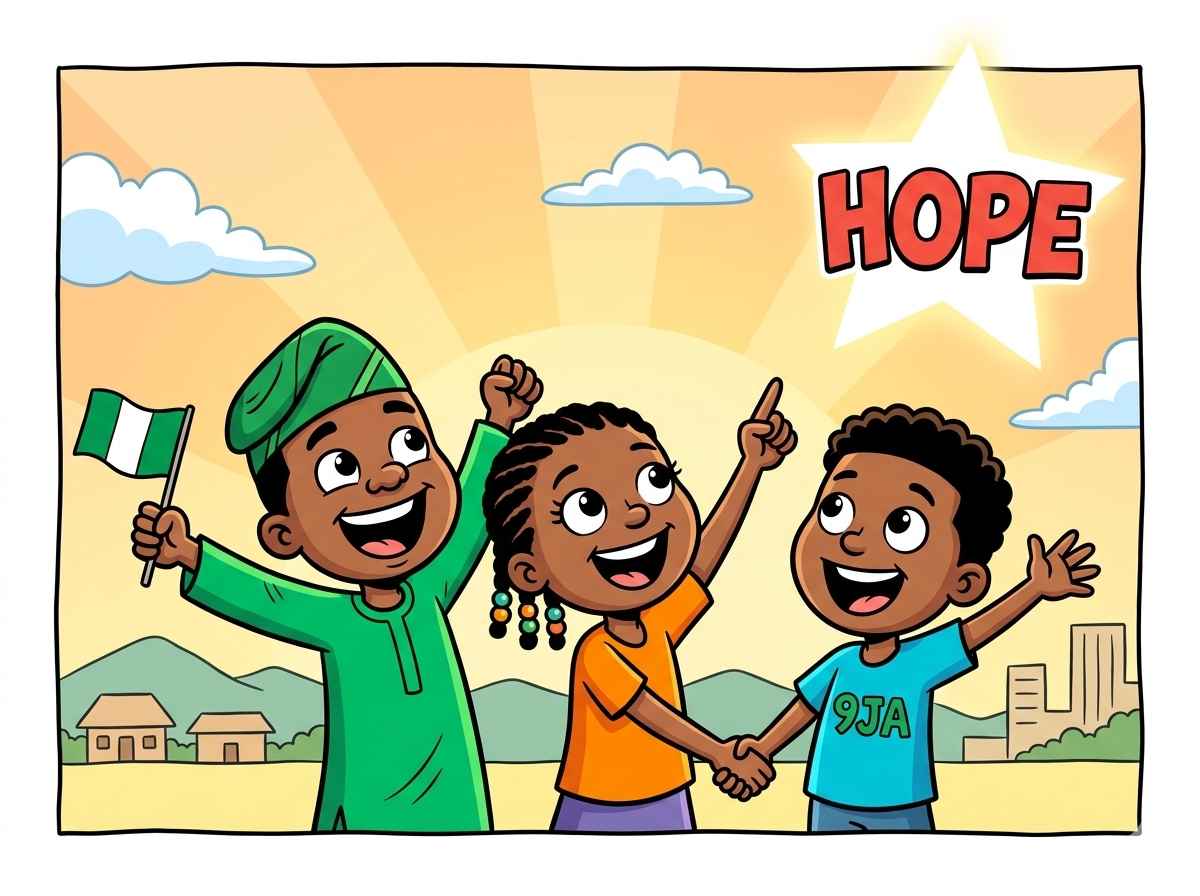
You are not hopeless. You have been told you are hopeless because hopelessness is a very convenient condition in those who are being governed. The moment you stop being hopeless, you become expensive to ignore. The moment enough of you stop being hopeless at the same time, you become impossible to ignore. That moment is not a distant dream. It is a decision. It is, in fact, the only decision that has ever mattered.
“Hope is a discipline.”
Mariame Kaba, activist and organizer
Practice it. Not as a feeling. As a daily act of choosing to pay attention, to show up, to hold people to account, and to refuse the comfortable sedation of a country that has decided your despair is the price of its own comfort. The Nigeria you deserve is not on the other side of some miraculous event. It is on the other side of enough of you deciding, today, that you are going to stop cooperating with the version of you they have been selling you.
We are watching. We are writing. And we are not going anywhere.
With more love than the circumstances would suggest is warranted,
and with exactly as much hope as the situation demands,
Narrivon
Telling Nigeria’s truth, one uncomfortable letter at a time.
Sources and Further Reading:
Japa Syndrome: A mass exodus of Nigerians (Global Visions, December 2024) •
Japa Syndrome threatening Nigeria’s workforce (Leadership, January 2025) •
Intangible wealth and the Japa syndrome (The Punch) •
Biggest social media moments that dominated Nigeria in 2025 (Pulse Nigeria) •
2025 in review: Social media moments that kept Nigeria scrolling (Leadership) •
How Nigerian politicians weaponize hunger to win elections (Narrivon) •
Corruption in Nigerian governance (Narrivon) •
The psychology of corruption in Nigeria (Narrivon)