
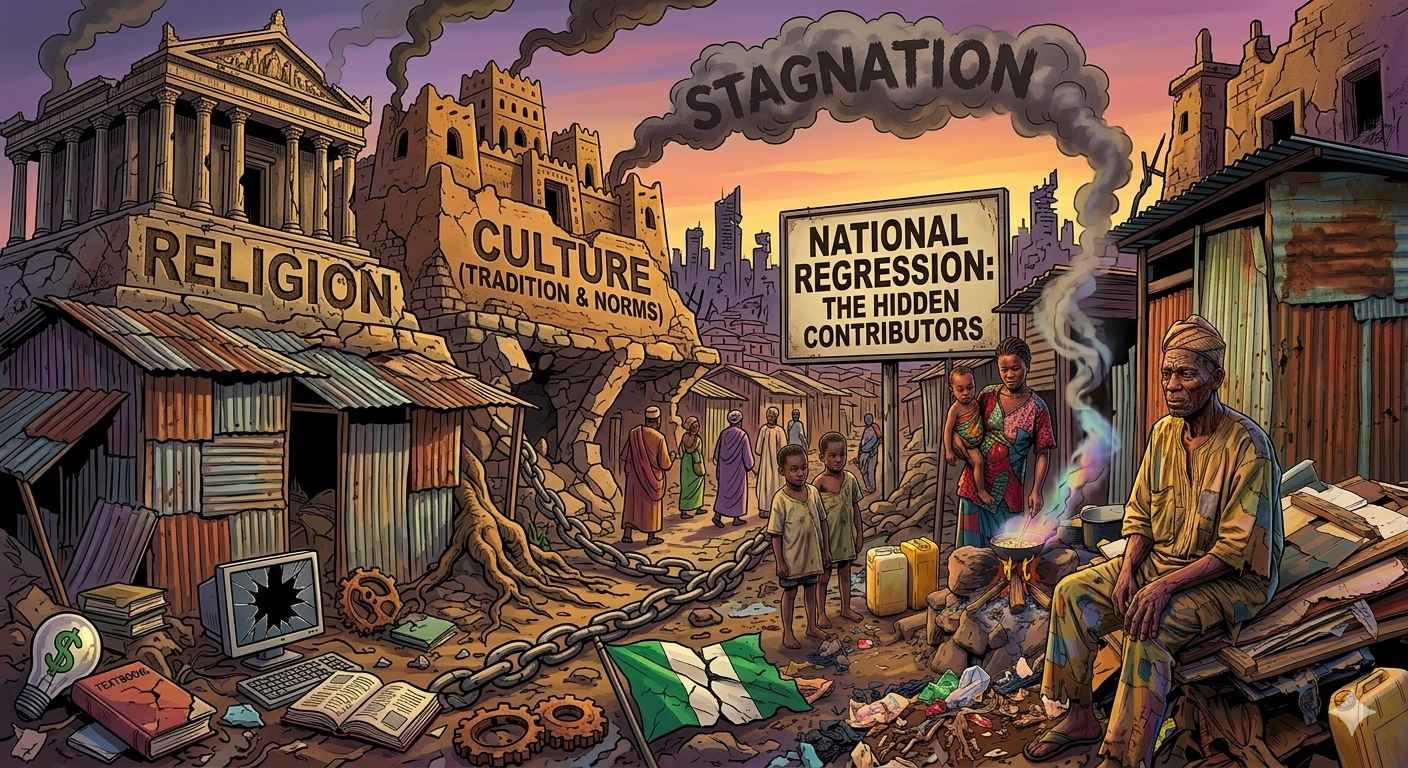
God, Culture and the Art of Standing Still: The Influence of Religion and Culture on Nigerians
How religion and tradition have become Nigeria’s most effective tools of mass sedation, and why Nigerians keep reaching for the bottle.
There is a peculiar genius in keeping a people enchanted while their house burns. You need not be a dictator. You need not deploy tanks. You only need to convince 220 million people that the fire is a test from God, that their suffering is a seed planted for harvest, and that the man on the pulpit, dripping in Italian fabric and stepping off a private jet, is proof that the harvest is coming. Welcome to Nigeria, where corruption in Nigeria wears a cross, wraps itself in Ankara, and receives a standing ovation every Sunday.
This is not a piece about hatred for faith. It is a piece about what happens when faith is captured, commodified, and aimed like a loaded weapon at the very people it claims to liberate. It is about how cultural tradition, that rich, living body of ancestral wisdom, has been calcified into a rigidity that punishes women, terrorizes the young, excuses poverty, and immunizes the powerful from accountability. It is, at its core, about corruption in Nigeria and the fact that Nigeria’s most powerful corruption is not the money stolen from the treasury. It is the theft of the Nigerian mind.
Blessed Are the Rich: The Prosperity Gospel Industrial Complex
In most countries, a pastor is a spiritual guide. In Nigeria, a pastor is a brand, a lifestyle influencer and, if the congregation is sufficiently surrendered, a near-infallible oracle. The prosperity gospel, that distinctly American export which mutated spectacularly on Nigerian soil, has produced some of the most theologically creative fundraising in human history. Its core premise is elegant in its simplicity: God wants you rich. If you are not rich, you are spiritually deficient. Give to your man of God, and God will give back. The poor are poor because their faith is weak. The pastor is rich because his faith and, conveniently, your seed money, is strong.
“Religion is what keeps the poor from murdering the rich.”
Napoleon Bonaparte, widely attributed
Napoleon never visited Nigeria, but had he done so today, he might have updated his observation: in Nigeria, religion keeps the poor from even questioning the rich, especially when the rich man is behind the pulpit.
Pastor Biodun Fatoyinbo
COZA is one of Nigeria’s most aesthetically polished megachurches, famous for concert-quality worship productions, a congregation loaded with politicians and celebrities, and teachings that place financial prosperity at the center of spiritual identity. In January 2025, Fatoyinbo delivered a sermon that crystallized the prosperity gospel’s fundamental logic with bracing directness: “The devil fears prayers, but he’s not afraid of you if you don’t have money.” In the same sermon, he added: “The devil wants people to stay behind and just be making noise even though Jesus became poor for our sake that through the grace of God we might become rich.” Fatoyinbo has also declared that “You will never hear a genuine COZA member say ‘I dey hustle.'”, implying that poverty is evidence of spiritual non-membership.
Let that settle. In a country where approximately 95 million people, 42% of the population, live in poverty according to UNFPA, a pastor with a Porsche in his driveway is telling the congregation that the devil has no interest in the poor because the poor are already beneath him. The theological creativity here is staggering. The poor are not being oppressed by a rotten system. They are simply losing a spiritual competition. Fix your faith. Give your offering. Buy your way into divine relevance.
In a particularly extraordinary moment, later flagged by the Christ Apostolic Church, Fatoyinbo used the late revered Apostle Ayo Babalola as a cautionary tale, suggesting the legendary miracle worker’s legacy was diminished because he “had no money.” In Fatoyinbo’s own words: “He was anointed. Oh! He was praying one day and a python crossed his leg and dried up… Anointed man, heavy-duty grace. But no money. So, all the grace just went like that.” Nigeria’s founding evangelists, men who built the church through fasting, prayer, and deprivation, are now posthumously rebranded as cautionary tales of financial failure. The audacity is almost admirable.
The Prayer-for-Power Pipeline
But the exploitation does not stop at wallets. Nigeria’s prosperity pastors have built something more dangerous: a pipeline between the pulpit and political power. In this arrangement, spiritual authority is leveraged to launder political legitimacy, and politicians gain the endorsement of congregations too large and too devoted to ignore.
No recent case illustrates the influence of religion on Nigerian politics more vividly, or more brazenly, than the revelations of Pastor David Ibiyeomie, founder and General Overseer of Salvation Ministries in Port Harcourt, one of Nigeria’s most widely watched televangelist figures. In March 2026, during a church service streamed online and titled “Enjoying the Help of God Through Prophets,” Ibiyeomie delivered what amounted to a live confession of political manipulation dressed as testimony.
Pastor David Ibiyeomie
Ibiyeomie commands a massive congregation and a significant broadcast audience across Nigeria. In March 2026, a viral video from one of his services showed him claiming to have spiritually intervened in the political career of Nyesom Wike, the controversial former Rivers State Governor and current Federal Capital Territory (FCT) Minister under President Bola Tinubu. According to Ibiyeomie: “Wike came; he had lost in the High Court and in the Appeal Court, and a judgment had already been passed in the Supreme Court against him, not to be governor. I called him while I was in Israel, he was shaking but I told him not to fear.”
He went further. Ibiyeomie claimed that he personally made a financial covenant with God on Wike’s behalf, without Wike’s knowledge, and that divine intervention subsequently altered the election result. In his words: “The day they were to change the result and give it to one person called Lawal, something happened, on the spot, the High Commission stepped into INEC. They couldn’t change the result. That’s how he became Governor the second time.”
Read that again. A pastor is publicly claiming, from his pulpit, to his congregation, that he prayed to override a court ruling, and that divine intervention stopped election officials from changing a result. He also claimed to have done the same thing for Rotimi Amaechi’s governorship and Peter Odili’s tenure. In one sermon, he essentially catalogued a prayer-powered political dynasty. The congregation, apparently, applauded.
“Suggesting divine influence over judicial decisions or electoral processes could undermine public confidence in Nigeria’s democratic institutions.”
Analysis from The Trumpet NG, following Ibiyeomie’s viral sermon, March 2026
Wike, it should be noted, is himself no stranger to controversy. As FCT Minister, he has become famous for demolitions of homes and businesses, brutal political feuds, and working against his own party’s presidential candidate in the 2023 election. That the man Ibiyeomie prayed into power has spent years tormenting the citizens of Abuja with demolition orders is perhaps the most vivid illustration of what happens when pastors cosign politicians without accountability. When your spiritual father prays a strongman into office, you cannot then wonder why the strongman behaves like one.
The Holy Police: When the Church Calls the Cops
The weaponization of state institutions by Nigeria’s religious elite reached a grotesque peak in 2019 when Busola Dakolo, celebrity photographer and wife of gospel musician Timi Dakolo, publicly accused Pastor Biodun Fatoyinbo of raping her twice as a teenager. What happened next was a masterclass in how wealth, power, and religiosity combine to produce impunity in Nigeria.
Rather than face the allegation head-on, Fatoyinbo filed a counter-petition accusing Busola and her husband of defamation. The Nigerian Police, the same institution that had consistently failed to investigate Fatoyinbo, swiftly summoned the Dakolos to Abuja on charges of “falsehood, mischief and threat to life.” The investigation into the rape allegation was simultaneously allowed to stall into irrelevance.
The most chilling moment came when Busola described what happened outside her Lagos home: armed men in an unmarked vehicle blocked her gate, one holding a gun, another holding a letter, demanding she sign a document recanting her claims against Fatoyinbo. The men identified themselves as being from the Inspector General of Police’s office. The letter, Busola said, contained allegations not against Fatoyinbo but against herself and her husband.
Amnesty International Nigeria called the intimidation “a disturbing pattern” and noted it was not the first time police had been used to silence rape accusers at the instance of powerful connected men. Nigeria’s then-First Lady Aisha Buhari publicly warned the Inspector General to back down.
As DP Advocates later observed: “Like a typical Nigerian rich man accused of some crime, Pastor Fatoyinbo turned the police against the accuser. As typical of the Nigerian police, the police ignored the rape allegations and went after the woman and her husband for defamation.” The case was eventually declared inconclusive because Fatoyinbo declined to honor police invitation, and the police apparently decided this was fine. You cannot make this up.
The Culture of Sacred Immunity
Busola Dakolo herself pinpointed the cultural rot at the center of all of this. “Our culture doesn’t allow speaking of these sorts of things against anointed men of God,” she said. “They’d rather hide it, and the party that is being victimised tends to live with that self-blame.”
This is the operating system of Nigerian religious life. The pastor is anointed. The anointed cannot be questioned. To question the anointed is to question God. And to question God is to forfeit your blessing. It is a closed loop, hermetically sealed against accountability, custom-built to protect spiritual entrepreneurs from the consequences of earthly behavior.
The late TB Joshua, founder of the Synagogue Church of All Nations (SCOAN), once ranked by Forbes as Nigeria’s third-richest pastor, received heads of state from across Africa, made prophecies that swayed elections, and built what tourism officials called Nigeria’s biggest religious tourist attraction. A BBC investigation published in 2024, three years after his death, revealed systematic abuse of followers over more than 15 years, including faked miracles, coerced “confessions,” and sexual misconduct. While alive, Joshua was untouchable. The church is a sanctuary. Accountability is blasphemy.
“The prosperity gospel tells people that God rewards faith with financial blessings. It is tailor-made to exploit the desperate. It is a product, not a theology.”
Kate Bowler, Professor of American Religious History, Duke Divinity School, author of Blessed: A History of the American Prosperity Gospel
Prayer as a Substitute for Revolution
Perhaps the most consequential function of Nigerian religion is the one nobody talks about: its role as a sedative. A population sufficiently convinced that God controls all outcomes, that good governance will come when God wills it, that corrupt leaders are tolerated until God removes them, that your job is to pray and fast and “declare blessings,” is a population that will not riot, will not organize, will not hold anyone accountable.
This is not an accident. It is a feature, not a bug. Across Nigerian social media, any discussion of political activism is immediately met with: “Let us pray for Nigeria.” After the 2023 elections, widely criticized as massively rigged, the dominant response from many churches was not civic outrage but a call to fast and “trust God’s plan.” When Pastor Ibiyeomie openly claimed he prayed elections into specific outcomes, what he was really demonstrating was that the political class has successfully outsourced civic pacification to the clergy.
“In Nigeria, the church has become a surrogate state, providing the social services, emotional reassurance, and communal identity that government has failed to deliver. But in doing so, it has also absorbed the energy that would otherwise fuel political accountability.”
J.D.Y. Peel, Christianity, Islam, and Orisa Religion: Three Traditions in Comparison and Interaction, University of California Press
The 2023 elections saw millions of Nigerians vote, protest result manipulation, and ultimately accept it. Not because they did not care, but because the theological infrastructure told them to. Their suffering is a test. Their leaders are allowed by God. Change will come in God’s time. Meanwhile, the leaders are buying properties abroad and the petrol queues stretch into tomorrow.
Born and Buried by Culture: How Tradition Constructs the Trap
If religion is Nigeria’s opium, culture is the addiction it was born into. Long before prosperity gospel arrived with its American accent and private jets, Nigeria was already in the grip of traditions that, in their refusal to evolve, interrogate, or make room for the individual, function as generators of poverty, gender violence, and social rigidity. The tragedy is not that Nigeria has culture. All societies do. The tragedy is that Nigeria has mistaken the fossil record for a living organism.
The Demographics of Doom: Having Children as a National Sport
Nigeria’s fertility rate in 2024 was 5.01 children per woman, one of the highest in the world, up sharply from 4.48 in 2023. UNFPA data shows the rate is even higher among the poorest and least educated households, reaching 6.7 children per woman in the lowest income bracket. Nigeria’s population, currently around 220 million, is projected to reach 400 million by 2050.
The relationship between these two facts, high fertility and deep poverty, is not coincidental. A peer-reviewed 2024 study in the International Journal of Research and Innovation in Social Science found “a clear positive relationship between high fertility rates and poverty levels” in Nigeria, with causality primarily running from fertility to poverty. The researchers noted: “The absence of social safety nets and support programs in Nigeria contributes to larger family sizes, resulting in inadequate healthcare, limited educational opportunities, and restricted economic prospects.”
In plain English: people are having children they cannot feed, clothe, or educate, and those children are growing up to have children they cannot feed, clothe, or educate. The cycle does not rotate; it descends. Each generation is born slightly deeper into the hole than the last.
The Cultural Logic
Children in traditional Nigerian culture are wealth, labor, social capital, insurance against old age. In an agricultural economy with no pension system, more children meant more hands and more security. In a 21st-century urban economy where a child’s education costs real money and jobs are scarce, the same logic produces poverty. Culture has not caught up with arithmetic.
And yet the cultural programming is relentless. A woman who chooses not to have children is not simply making a personal decision. She is, according to her community, betraying God, her husband, her lineage, and her own femininity. A 2025 feature from Global Voices on childfree Nigerian women found that women who opt out of motherhood face social ostracism so intense it requires community-building simply to survive it. Motherhood, as one commentator observed, “is intertwined with ideas of maturity, morality, and even patriotic duty.” To not reproduce is not just unconventional. It is, in many communities, a moral failure.
Meanwhile, the men who father these children and abandon them, either physically or financially, face no equivalent cultural condemnation. The man who has six children by three different women is not a negligent father; he is a virile testament to male vigor. That those children will grow up hungry, undereducated, and desperate is a problem for the women, for society, for God. Not for him.
The Woman Question: Accessories, Accessories, Accessories
Nigeria ranks 168th out of 191 countries on the United Nations Gender Inequality Index. That is not a statistic. That is a verdict. Let’s unpack what it costs.
The foundational premise of gender in Nigerian culture is that women are instruments of male purpose. They are daughters until they become wives, wives until they become mothers, and mothers until they become grandmothers. Their social value is almost entirely contingent on their relationship to a man and their production of children for that man. A UK-based study of Nigerian women’s experiences of sexual violence found that socialization is so deep that women themselves have internalized the ideology: “If not that I came to the UK, my dear, I must tell you the truth, we are brought up like that, the man has the final say, he is the head of the house.”
In professional life, this translates to openly acknowledged gender bias: job candidates described as “outstanding” are passed over because “a man has to be appointed.” Leadership positions are “always occupied by men.” And yet women who manage to thrive economically, the market women of Lagos’s Balogun Market who run multi-million-naira operations, must still maintain the public fiction of male household authority. As The Guardian Nigeria observed: women control real financial power while everyone pretends otherwise. “Rather like being asked to carry half the load whilst pretending you’re only holding a handbag.”
The situation in Northern Nigeria is, if anything, more stark. Approximately 43% of Nigerian girls are married before age 18, and 17% before age 15. The north has a maternal mortality rate of 21 deaths per 1,000 pregnancies. Widows in parts of Southern Nigeria are still subjected to rituals including drinking the water used to bathe their dead husbands, sleeping on bare floors, and being denied inheritance. The bride price system legally transacts women as commodities. These are not relics. They are alive and well.
The Complexity Nobody Wants to Discuss: When Women Choose the Cage
Here is where the analysis must resist the temptation of simple heroism narratives. The gender crisis in Nigeria is not a clean story of oppressor and oppressed. It is a far messier, more uncomfortable story about two groups of people who have been so thoroughly shaped by a broken system that neither can see the other as fully human.
On one side: the “baby girl” culture. A significant strand of Nigerian femininity has commodified female helplessness, not as a defeat but as a strategy. The “baby girl” does not pay for anything, does not carry anything, does not stress about anything. Her job is to be beautiful and to receive. Men who fail to provide are “broke” and unworthy of respect. Her labor-free existence is framed as female empowerment, as “knowing your worth.” It is, of course, nothing of the sort. It is the architecture of patriarchy presented as a lifestyle brand. By accepting the logic that men should fund everything simply by virtue of being men, these women do not challenge gender inequality. They enshrine it. They make it glamorous. They sell it on TikTok.
On the other side: a category of Nigerian men who respond to this with maximalist entitlement, men who use the financial expectation as justification for ownership, control, and violence. The logic is merciless: I pay, therefore I own. I provide, therefore I command. You depend on me, therefore you have no voice.
The Nigerian gender war on social media is not really about men versus women. It is about two groups of people who have been taught to see each other as utility, and are now furious that the utility is not performing as advertised.
Anuoluwa Soneye, NarrivonThe social media discourse, the Twitter/X wars, the TikTok content, the podcast debates, is the sound of this collision in real time. Nigerian men and women do not consistently fight about politics or governance. They fight about who owes whom what in a transactional relationship model that neither party chose but both parties perpetuate. The women who enjoy “baby girl treatment” and the men who weaponize financial provision are both, in different ways, children of the same broken cultural script. The tragedy is that while they argue, the politicians steal, the roads decay, and the pastors buy jets.
The real cost is not the online drama. It is what happens off-screen: the domestic violence normalized as discipline, the marital rape legitimized as wifely duty, the career woman told she is “intimidating,” the man crushed under the weight of being the sole provider for eight people on a salary designed for two. These are not separate issues. They are the same issue: a society that has not yet decided to see men and women as full human beings with equal dignity and equal responsibility.
A Nation of Elders: The Culture of Sacred Seniority and Its Body Count
Nigeria runs on hierarchy. Age is authority. Seniority is wisdom. The young cannot correct the old. The junior cannot challenge the senior. The child cannot question the parent, even when the parent is wrong, even when the parent is drunk, even when the parent is about to drive everyone off a cliff. This is called “respect.” In practice, it is a system perfectly engineered to insulate incompetence and perpetuate failure across generations.
In the family, this means children who are beaten into submission are later expected to become autonomous adults, as if the capacity for independent thought, once systematically destroyed, simply returns on a schedule. In the office, it means junior employees watch seniors make catastrophic decisions they are not permitted to challenge. In the church, it means congregations cannot question pastors. In the nation, it means young people, who constitute 70% of Nigeria’s population, are governed by a gerontocracy that consistently governs them as afterthoughts.
The dress you wear, the car you drive, the laptop in your bag: all of these became evidence of criminality in the hands of SARS, Nigeria’s disbanded Special Anti-Robbery Squad. Young people were profiled, detained, and tortured for dreadlocks, for owning iPhones, for driving nice cars. The cultural logic behind this state violence is the same logic behind the family dinner table: if you are young and have something, you must have gotten it wrong. Wealth in young hands is suspicious. Ambition in the young is presumption. The old are wise because they are old. The young are criminals because they are young.
“Amnesty International documented 82 cases of torture, ill-treatment, and extrajudicial execution by SARS between January 2017 and May 2020. SARS officers regularly detained young male Nigerians illegally and extorted money from their relatives.”
Harvard Human Rights Journal, #EndSARS Analysis, November 2020
The #EndSARS movement of October 2020 was the most articulate the Nigerian generation Z had ever been about its dispossession. For thirteen extraordinary days, young Nigerians, leaderless, organized entirely through social media, funded collectively, documented ruthlessly, occupied the streets of every major city and demanded to be treated as citizens. The hashtag accumulated over 28 million tweets. The international community watched. Davido, Burna Boy, Cardi B, and John Boyega amplified the call.
The government’s response: on October 20, 2020, Nigerian soldiers opened fire on unarmed protesters at the Lekki Toll Gate in Lagos. At least 12 people died, according to Amnesty International. Security cameras had been removed. Electricity was cut. The Lagos State Government set up a panel of inquiry; its leaked report found the military culpable. The government rejected the report. No one was prosecuted. The soldiers went home. The toll gates reopened. Business as usual.
What is most revealing is not the massacre itself, as state violence against protesters is not unique to Nigeria. It is what happened after. The churches called for prayer. The elders called for calm. The culture of deference reasserted itself. And Nigerians, conditioned for centuries to absorb punishment in silence and present the wound as a lesson from God, largely absorbed it. There were protests on the 20th of subsequent months, but the organized mass movement never fully reconstituted. The fire went out. The government had correctly calculated that it would.
Public Space as Personal Dump
There is a detail so mundane it seems trivial until you realize it is actually the whole argument in miniature: Nigerians litter. Aggressively, defiantly, creatively. Lagos highways are decorated with sachets, bottles, wrappers, food waste, and plastic bags in quantities that would make a landfill self-conscious. The Lagos Lagoon and the waterways that thread through Nigeria’s cities are among the most polluted in Africa. Public infrastructure, buses, market stalls, government buildings, is treated with the kind of contemptuous indifference reserved for things that belong to someone else. Because that, of course, is exactly the operating assumption: public things belong to the government, the government is the enemy, and the enemy’s property is fair game.
This is not incivility for its own sake. It is the logical expression of civic alienation. When the state has never been experienced as a benevolent custodian, when the police are a racket, the roads are permanent construction sites, the hospitals are tombs, and the politicians are thieves, the concept of “the commons” loses all meaning. Why care for something that has never cared for you?
But this logic, however understandable, is circular. The same alienation that drives people to litter is the alienation that drives them to pray rather than organize. It is the alienation that makes them watch a pastor claim he prays elections into existence and nod approvingly rather than ask what that means for democracy. A people who have given up on their public institutions have given up on themselves, and no amount of prayer, no number of church services, no quantity of anointing oil will substitute for the hard, organized, unglamorous work of demanding accountability from the people who have stolen 64 years of nationhood and are still counting.
Nigeria’s deepest corruption is not in Abuja. It is in the bargain that millions of its citizens have struck with powerlessness, the agreement, renewed every Sunday, that suffering is holy, that silence is virtue, and that the man on the throne, earthly or divine, knows best.
Anuoluwa Soneye, NarrivonThe Diagnosis, the Bill, and Who Pays
Nigeria is not a failed state. It is a captured one. Captured by a clergy that has monetized desperation. Captured by a tradition that calcifies hierarchy and calls it culture. Captured by a political class that has made an art of staying in power by keeping the people busy with God, with gender wars, and with the daily survival that leaves no bandwidth for accountability.
The antidote is not Western secularism. It is not a rejection of Yoruba or Igbo or Hausa identity. It is not the abandonment of faith. It is the much harder, much less photogenic work of insisting that nothing, not anointing, not age, not gender, not tradition, grants anyone exemption from accountability. It is the work of building a civic culture in which the road belongs to everyone and must therefore be kept clean. In which a young person with a laptop is a worker, not a suspect. In which a woman’s value is not contingent on her reproductive output or her relationship to a man. In which a pastor who prays elections into existence must answer for what he is actually saying about the sanctity of democratic institutions.
It is, in the words of the philosopher Frantz Fanon, who understood colonial psychological capture better than most, the work of decolonizing the mind. Not from a foreign power this time. From ourselves.
“Each generation must discover its mission, fulfill it or betray it.”
Frantz Fanon, The Wretched of the Earth, 1961
Nigeria’s mission is sitting right there, unattended, while the congregation sings, the elders deliberate, the women compete for who is the best baby girl, and the men decide whose job it is to fix the country. Spoiler: it is everyone’s job. It has always been everyone’s job. The only question is whether the next generation will discover this before the house finishes burning, or whether they will, as their parents did before them, bow their heads, close their eyes, and call it prayer.
Frequently Asked Questions
How does religion influence Nigerian society?
Religion in Nigeria functions as both a spiritual institution and a political tool. Prosperity gospel preachers have commodified faith to extract wealth from congregants, while the culture of pastoral infallibility has made churches immune to accountability. Religion also acts as a civic sedative, encouraging Nigerians to pray rather than organize politically against corruption and bad governance.
What is the prosperity gospel and how does it affect Nigeria?
The prosperity gospel is a theological movement teaching that God rewards faith with financial blessings. In Nigeria, it has mutated into a system where pastors equate poverty with spiritual failure, extract tithes under the guise of divine seed-sowing, and use wealth as a marker of God’s favor. This deeply harms a population where over 95 million people live in poverty.
How does Nigerian culture contribute to poverty?
Nigerian cultural traditions that valorize large families, despite changed economic realities, directly fuel the poverty cycle. With a fertility rate of 5.01 children per woman in 2024, and the highest rates concentrated among the poorest households, the absence of family planning culture means generations are born into poverty without the resources needed to escape it.
How does Nigerian culture affect women?
Nigerian culture largely treats women as instruments of male purpose. Women are defined by their roles as wives and mothers, face discrimination in professional settings, and are subjected to harmful traditions including child marriage, widowhood rites, and bride price transactions. Nigeria ranks 168th out of 191 countries on the UN Gender Inequality Index.
What was the EndSARS protest in Nigeria?
EndSARS was a mass youth protest movement in October 2020 against police brutality in Nigeria, specifically targeting the Special Anti-Robbery Squad (SARS). Young Nigerians organized leaderlessly through social media to protest routine profiling and torture. On October 20, 2020, soldiers opened fire on unarmed protesters at the Lekki Toll Gate in Lagos, killing at least 12 people according to Amnesty International.
Sources and Further Reading:
Fatoyinbo devil/poverty sermon (Linda Ikeji Blog, January 2025) •
Ibiyeomie-Wike prayer claims (Premium Times, March 2026) •
Busola Dakolo police intimidation (Vanguard, August 2019) •
EndSARS (Wikipedia) •
EndSARS (Harvard Human Rights Journal) •
Nigeria Poverty and Fertility (UNFPA) •
Fertility-Poverty Nexus Study (IJRISS, 2024) •
Women in Nigeria (Wikipedia) •
Cultural Beliefs and Violence Against Nigerian Women (PMC)
Leave a Reply