
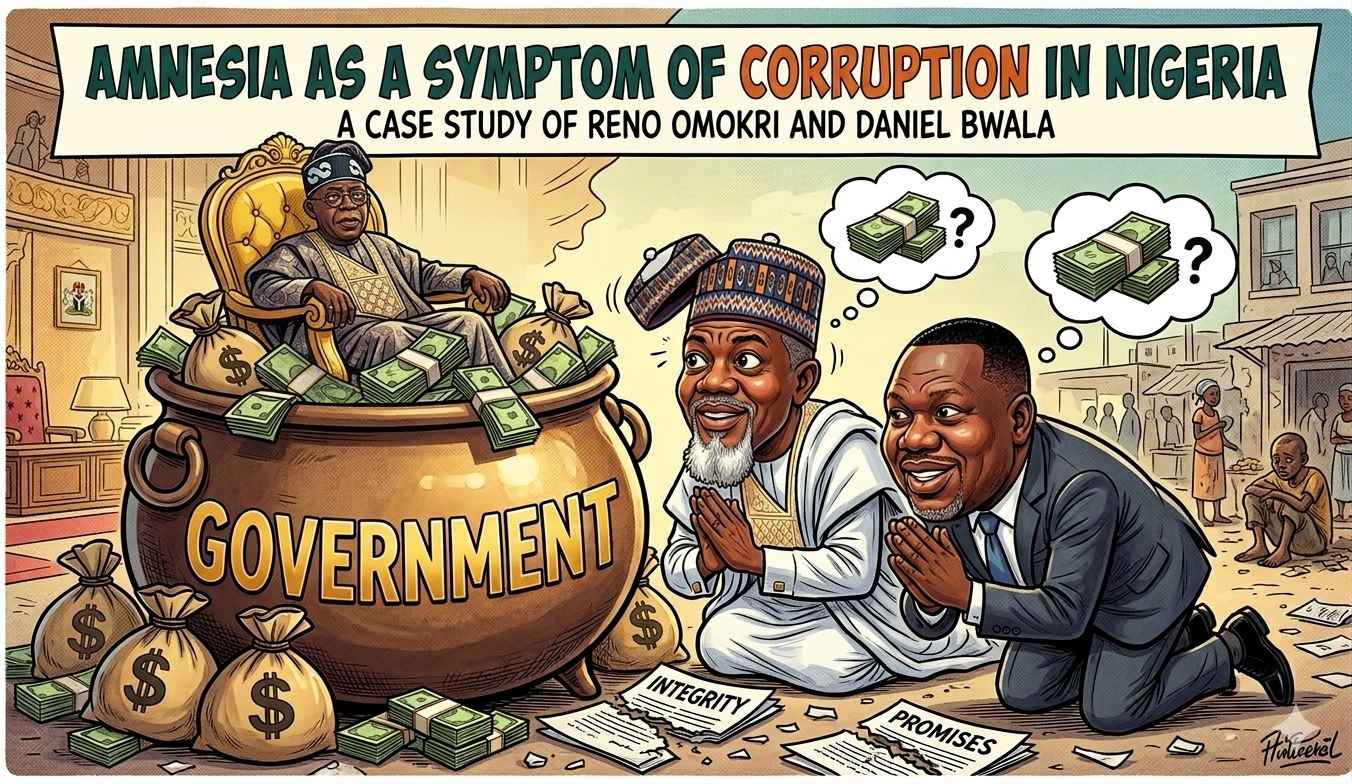
Amnesia as a Symptom of Corruption in Nigeria: A Case Study of Reno Omokri and Daniel Bwala
One called the president a drug lord and flew to Chicago to prove it. The other called him corrupt, unfit, and a creator of militia, then went on Al Jazeera and denied ever saying it. Both now serve the man they once eviscerated. Nigeria, ladies and gentlemen, has entered the stomach infrastructure era of political performance art.
There is a medical condition called selective amnesia, in which a person conveniently forgets only the memories that are inconvenient. Doctors consider it rare. In Nigerian politics, it is a job requirement. Every election cycle, this republic produces a fresh crop of principled voices, men and women who speak truth to power with such conviction, such eloquence, such passionate outrage that you could almost believe they mean it. And then someone in Aso Rock makes a phone call, a position is offered, an appointment is dangled, and suddenly the outrage dissolves like sugar in warm eba. The receipts remain. The conscience does not. Welcome, one more time, to the republic of the eternally convertible, where the price of a man’s convictions is just a portfolio away.
This is the story of two men. Their names are Daniel Bwala and Reno Omokri. Their story is not unusual in Nigerian politics. It is Nigerian politics, compressed into two faces, two sets of viral clips, two spectacular reversals, and one common denominator: a government so skilled at buying silence that it turned its most ferocious critics into its most enthusiastic defenders. If you want to understand the depth of corruption in Nigeria, you do not need to read a financial audit. You only need to watch what happens to people who once demanded accountability the moment power offers them a seat at the table.
The Daniel Bwala Files: When Your Past Self Shows Up to Testify Against You
Daniel Bwala
Bwala is a Nigerian lawyer who first rose to prominence as a vocal member of the APC before dramatically defecting to PDP in August 2022, where he became one of Atiku Abubakar’s most prominent spokesmen during the 2023 elections. During this period, he produced a documented archive of blistering criticism of Bola Tinubu, calling him corrupt, unfit to lead, and a creator of political militia. After Tinubu won, Bwala defected back to the APC and was rewarded with a presidential appointment in August 2023. He is now the face of the government he once described as unelectable.
The thing about Daniel Bwala is that he was not careless with his words. He was deliberate, forensic, and emphatic. He did not whisper these things in private. He said them loudly, on camera, with the confidence of a man who had done his research. That is what made the Al Jazeera interview of March 6, 2026 so extraordinary. It was not just a bad interview. It was a collision between a man and himself. And the version of Daniel Bwala that showed up to testify against Daniel Bwala was carrying receipts.
“If you give President Tinubu 30 years in office, he will achieve nothing.” Bwala also accused Tinubu of running a corrupt administration, creating political militia, and involvement with bullion vans. He argued that the APC had done too much damage to Nigeria to be allowed to continue in power.
Now (March 2026, as Presidential Spokesman on Al Jazeera)“I want to put it on record, on my own honour, that is not what I said.” Mehdi Hassan then played the video of him saying exactly that. The studio audience laughed. Social media never stopped.
Let us dwell here. On live television, before a global audience at Conway Hall in London, Mehdi Hassan confronted Bwala with his own documented statements about Tinubu: corruption, bullion vans, political militia, democratic decline. Bwala denied them. Hassan played the video evidence. Bwala then accused Hassan of practicing “opposition research-style journalism,” as though the radical act of confronting a spokesman with his own words is a violation of journalistic ethics rather than literally the most basic function of journalism.
His defence, delivered with the unshaken confidence of a man who has decided that the problem with his credibility crisis is the audience, was this: “It is all politics. Half of Donald Trump’s cabinet is made up of people who once spoke against him.” Yes, Daniel. Half of Donald Trump’s cabinet also did not go on international television and deny, under questioning, that they ever said the things they demonstrably said on camera. There is a difference between changing your mind and lying about ever having had a mind at all.
“The interview made a spectacle of Nigeria, not just because of the reach of the programme globally, but also the format in which there was a global audience in the room itself. It was a sad commentary on Nigeria’s political culture in which there are no beliefs, no policies, no ideology, just crass opportunism and the battle for political power. Turn-coatism is ‘it’.”
Kingsley Moghalu, former Deputy Governor, Central Bank of Nigeria, and Presidential Candidate, on X, March 2026
Bwala’s aftermath was perhaps even more impressive than the interview itself. He issued a statement saying Al Jazeera had never told him they planned to challenge his past. He argued, with a straight face, that had he known he would be asked about his own recorded public statements, he would have prepared a response. What, precisely, would that preparation have looked like? Would he have pre-emptively memorized alternative historical timelines? Would he have filed an injunction against his own video archive? The mind boggles.
He then described Mehdi Hassan as “arguably the best debater on the planet” while simultaneously accusing him of fake news. The cognitive gymnastics required to hold both positions simultaneously would impress an Olympic committee. As TheCable’s columnist concluded: “Bwala is more of a foe than a friend to the Tinubu administration.” Which raises the obvious question: if this is what Nigeria’s government considers a credible spokesman, what does that say about the government?
Daniel Bwala did not just fail an interview. He showed up to a gunfight armed with a philosophy of denial, and discovered, too late, that his own receipts were loaded.
Anuoluwa Soneye, NarrivonReno Omokri: The Man Who Flew to Chicago, Came Back Empty, and Still Got a Visa
Bemigho Reno Omokri
Reno Omokri is one of Nigeria’s most recognizable social media personalities, a former presidential aide under Goodluck Jonathan who became a prolific commentator, pastor, and bestselling author. Between 2022 and 2023, he was arguably Tinubu’s most aggressive critic in the digital public space, producing a relentless stream of videos, posts, and media appearances accusing Tinubu of drug lordship, corruption, and unfitness for office. He also publicly swore, on camera, that he would never accept a position from Tinubu. He is now Nigeria’s ambassador-designate to Mexico.
If Daniel Bwala’s conversion was a betrayal of principle, Reno Omokri’s was a betrayal of principle performed entirely in public with documentary evidence submitted at every stage. Bwala at least had the dignity of attempting, however unsuccessfully, to deny his past. Omokri has produced something more theatrical: a documented arc of conviction, renunciation, prostration, and reappointment that should be taught in political science departments as a case study in stomach infrastructure.
Let us begin at the beginning. In December 2022, during an interview on ARISE TV, Omokri stated the following, verbatim: “Drug lord is not an unprintable name. Bola Tinubu is a known drug lord. I’ve got documents to back it up. I spent my money, went to Chicago, went to court, and got certified true copies.”
This was not a casual remark. This was a man announcing that he had personally funded an investigation, traveled internationally, accessed court records, and arrived at a documented conclusion. He did not say he suspected. He did not say he had heard. He said he knew, and he had the paperwork. He also, around the same time, told interviewers: “Tinubu is a known drug lord who belongs in jail, not Aso Rock.” For additional flourish, he suggested that if anyone could get close enough to Tinubu to collect a hair or urine sample, the matter would be settled in a laboratory.
The Podcast Moment
In a 2023 appearance on the Mic On podcast, Omokri was asked directly whether he would accept a position from Tinubu if offered. His answer: “It cannot happen. Some people can do that. It’s not in my DNA. I can’t do it. It’s never going to happen. It’s never going to happen.” He repeated “never” twice for emphasis. He then prostrated before Tinubu in October 2024 and accepted an ambassadorship in 2026.
Now fast-forward to January 2026. Omokri issued a formal statement in which he said: “President Bola Ahmed Tinubu is not, has never been, and will never be a drug lord. He is a person of good character, high moral standing… I make these statements freely and of my own volition, knowing them to be true, and I am fully prepared to testify to the above under oath in court.”
To testify. Under oath. In court. About the same man he was once prepared to testify against with certified Chicago court documents. The same man he said belonged in jail, not Aso Rock, is now a person of “high moral standing.” The receipts he personally flew to Chicago to collect have apparently been shredded. The certified true copies, prepared at his own expense, with great conviction, have apparently been certified false.
When pushed for an explanation, Omokri offered this: he had been misled by media publications, particularly SaharaReporters, into believing Tinubu was a drug lord. He also flew into Nigeria on October 1, 2024 and, in his own words, prostrated flat on the ground before the president to apologize in person. Shortly thereafter, he was nominated as ambassador. Shortly after that, he thanked Tinubu for being “a most Christlike individual.”
Let us also note, for the record, that when human rights lawyer Dele Farotimi heard about the Mexico posting, his immediate reaction was not congratulations but a safety advisory: “You sent Omokri to Mexico after he had been busy running his mouth about drug cartels. He had better make sure he has a lot of bulletproof cars and vests in that place.” Which is, when you think about it, a very specific problem to have created for yourself.
The man who went to Chicago to prove Tinubu was a drug lord now represents Nigeria in Mexico. The irony is not subtle. Nigeria is not even trying anymore.
Anuoluwa Soneye, NarrivonThe Craftsman: How Bola Tinubu Turned His Critics Into His Cabinet
It would be unfair to discuss Bwala and Omokri without discussing the architect of their conversions, because this is not just a story of two weak men. It is a story of one very skilled one. President Bola Ahmed Tinubu did not stumble into having his most vicious critics become his most enthusiastic defenders. This is strategy. This is deliberate. This is Nigerian politics operating at its most sophisticated and most corrosive.
Tinubu’s political genius, if we are to call it that, is a specific form of co-option. Where other Nigerian leaders have silenced critics with lawsuits, arrests, or threats, Tinubu prefers employment. He is less a strongman than a magnificent recruiter. Why threaten the man who calls you a drug lord when you can make him your ambassador? Why imprison the man who says you will achieve nothing in thirty years when you can make him your spokesman? The critic is neutralized, the narrative is complicated, and the message to everyone watching is crystal clear: in this republic, the price of your principles is negotiable. Name your number.
This is the politics of stomach infrastructure elevated to a federal art form. Stomach infrastructure, for the uninitiated, is the Nigerian political concept of buying loyalty, votes, and silence with immediate material comfort. It is the reason politicians hand out bags of rice before elections. It is the reason agbadas arrive at polling units with cash. But Tinubu has industrialized the concept. He does not buy ordinary Nigerians with bags of rice. He buys opinion leaders with ambassadorial postings. The currency scales with the target. The principle is identical.
“The most insidious form of corruption is not the theft of money. It is the corruption of voice. When the people who should be speaking truth to power are instead on its payroll, the entire architecture of democratic accountability collapses.”
Transparency International, Global Corruption Report Framework
And what of the Nigerian people in all this? TheCable noted acutely that Tinubu boasts of controlling 30 of Nigeria’s 36 governors, with more allegedly set to follow. This is presented as political strength. It is actually a symptom of total institutional capture. When your political opposition can be bought with appointments, there is no opposition. There is only a waiting room for the next batch of critics who have not yet named their price.
Lt. Yerima, Nyesom Wike, and the Four Words That Broke the Internet
In November 2025, something unusual happened. A public servant in Nigeria said no.
The scene: a disputed parcel of land in Abuja. The characters: FCT Minister Nyesom Wike, known for his volcanic temper, his demolition orders, and his talent for political survival through alignment with whoever is currently in power; and Lieutenant A.M. Yerima of the Nigerian Navy, stationed to secure property that reportedly belonged to a former chief of naval staff. Wike arrived, the confrontation escalated, and the minister reportedly called the officer a fool. Yerima’s response, delivered with the calm of a man who has apparently never encountered the concept of stomach infrastructure, was: “Sir, I am an officer. I have integrity.”
Four words. They enraged the minister further, because, as one observer on X noted: “The officer was indirectly telling Wike that he does not have integrity. So that was why Wike was so angry.” The video went viral in seconds. The phrase became merchandise, printed on T-shirts with Wike and Yerima’s faces. It became a meme, a rally cry, and, briefly, a cultural monument to the radical idea that a public servant could refuse to be humiliated by a political powerful man and survive.
The less funny part: unconfirmed reports emerged that Yerima was subsequently trailed by two unmarked Hilux vans days after the confrontation. The man who said “I have integrity” to a powerful minister may have been followed home as a reward for his honesty. In a functioning democracy, the minister would face accountability. In Nigeria, the honest man buys pepper spray.
The Wike-Yerima episode is the companion piece to the Bwala-Omokri story. One story is about the price of selling your convictions. The other is about the price of keeping them. In both cases, the power dynamic is identical: the Nigerian state rewards compliance and punishes integrity. The only difference is the scale. Bwala and Omokri surrendered their convictions for offices and salaries. Yerima refused to surrender his dignity for safety. Nigeria noticed. Nigeria cheered. And then Nigeria moved on, because what else is there to do when the system has been this way your entire life?
You Are Not a Pawn. You Are Not Even on the Board.
There is a comforting lie that circulates in Nigerian political commentary, the idea that the people are pawns in the game of their rulers. A pawn, at least, is on the board. A pawn moves. A pawn matters to the outcome of the game. The Nigerian citizen is not a pawn. The Nigerian citizen is the table the board sits on, invisible, structural, and entirely taken for granted. The game is played by, for, and between the players. The 220 million Nigerians who cannot afford three meals a day are not part of the negotiation. They are the justification for the negotiation’s existence. “We are in government to serve the people.” The people are not at the table. They are the table.
This is the terminal diagnosis of the Bwala-Omokri episode. It is not about two men who changed their minds. It is about a political culture so thoroughly insulated from consequence that the people who are supposed to hold it accountable have decided the easiest path is to join it. And why not? The EFCC does not investigate appointees with the same enthusiasm it investigates critics. The DSS does not trail spokesmen with the same energy it trails activists. Omoyele Sowore is in court for calling Tinubu a criminal. Reno Omokri called Tinubu a drug lord, prostrated before him, and received an ambassadorship. These outcomes are not accidents. They are instructions.
“When citizens can no longer trust that political language means anything, they stop engaging with politics altogether. That is not apathy. That is rational response to a system that has proven itself unresponsive to their participation.”
Larry Diamond, Senior Fellow, Hoover Institution; author of The Spirit of Democracy
The instruction is this: in Nigeria, the government does not fear you if you speak. It does not fear you if you protest. It does not fear you if you publish. It fears you only if you refuse to be purchased. And even then, it has learned to wait. Most people, given enough time and enough hunger, eventually name a price.
The exceptions to this rule are rare and beautiful and usually in danger. They look like Yerima standing unmoved while a minister calls him a fool, calm enough to say “I have integrity” in a country where integrity is treated as a character flaw. They look like the wives of five missing engineers in black T-shirts outside a ministry. They look like the journalists who continue to publish despite receiving messages that read “I can see you.”
They are the evidence that the soul of Nigeria is not yet fully for sale, only that the bid is very, very high, and the government has very deep pockets. The question, the only question that matters for the country’s future, is whether the next generation of Nigerians will decide that their convictions are not, in fact, priced at an ambassadorial posting. That there is something the government cannot offer that is worth more than anything the government can give. That Reno Omokri flying to Chicago, obtaining those court documents, and then prostrating flat on the ground before the man he called a criminal is not just embarrassing for him. It is embarrassing for all of us. And that embarrassment is, perhaps, the beginning of something.
Or perhaps Nigeria will keep producing Bwalas. Only one way to find out.
Frequently Asked Questions
What did Reno Omokri say about Tinubu before his ambassadorial appointment?
Reno Omokri publicly called Tinubu a “known drug lord” on ARISE TV in 2022-2023, claiming he personally traveled to Chicago, visited courts, and obtained certified documents to support the claim. He also swore publicly that he would never work for Tinubu. After Tinubu was elected, Omokri reversed course, prostrated before the president in October 2024, and was appointed Nigeria’s ambassador to Mexico in 2026.
What happened at Daniel Bwala’s Al Jazeera interview with Mehdi Hassan?
In March 2026, Bwala appeared on Al Jazeera’s Head to Head where Mehdi Hassan confronted him with his own documented statements calling Tinubu corrupt, unfit to lead, and a militia creator. Bwala denied making the statements. Hassan played video recordings of Bwala making them. The moment was widely described as one of the most embarrassing episodes in recent Nigerian political history.
What is stomach infrastructure in Nigerian politics?
Stomach infrastructure is a Nigerian political term for buying votes, loyalty, and silence with food, money, or patronage, appealing to basic survival needs. Under President Tinubu, it has evolved to include silencing political critics with government appointments, ambassadorships, and political offices.
What happened between Wike and Lieutenant Yerima?
In November 2025, FCT Minister Nyesom Wike confronted Naval Lieutenant A.M. Yerima over a disputed land in Abuja and reportedly called him a fool. Yerima responded calmly: “Sir, I am an officer. I have integrity.” The phrase became a viral cultural moment. Unconfirmed reports later emerged that Yerima was trailed by unmarked vehicles after the incident.
Sources and Further Reading:
Bwala at Al Jazeera: How to Disown One’s Past Politics (Vanguard, March 2026) •
Bwala Defends Al Jazeera Interview, Accuses Anchor of Fake News (The Punch, 2026) •
Daniel Bwala and the Burden of Political Amnesia (TheCable, March 2026) •
Al Jazeera Never Said They Would Challenge My Past, Bwala (Guardian Nigeria, 2026) •
Diaspora Group Writes Mexico, Calls for Omokri’s Rejection as Ambassador (SaharaReporters, March 2026) •
Omokri: Yes, I Called Tinubu Drug Baron, But I Publicly Withdrew It (The Source, January 2026) •
Omokri Says Tinubu Has Never Been a Drug Lord, Apologises (ARISE News, 2026) •
Reno Omokri Reacts as Tinubu Posts Him to Mexico as Ambassador (Legit.ng, 2026) •
Ensure Reno Omokri Has Bulletproof Cars in Mexico, Farotimi (Daily Post, March 2026) •
What Naval Officer Yerima Said That Angered Wike (Gistreel, November 2025) •
Ohanaeze Youths: Confirming Omokri Validates His Drug Lord Allegation Against Tinubu (SaharaReporters, December 2025)

Leave a Reply