
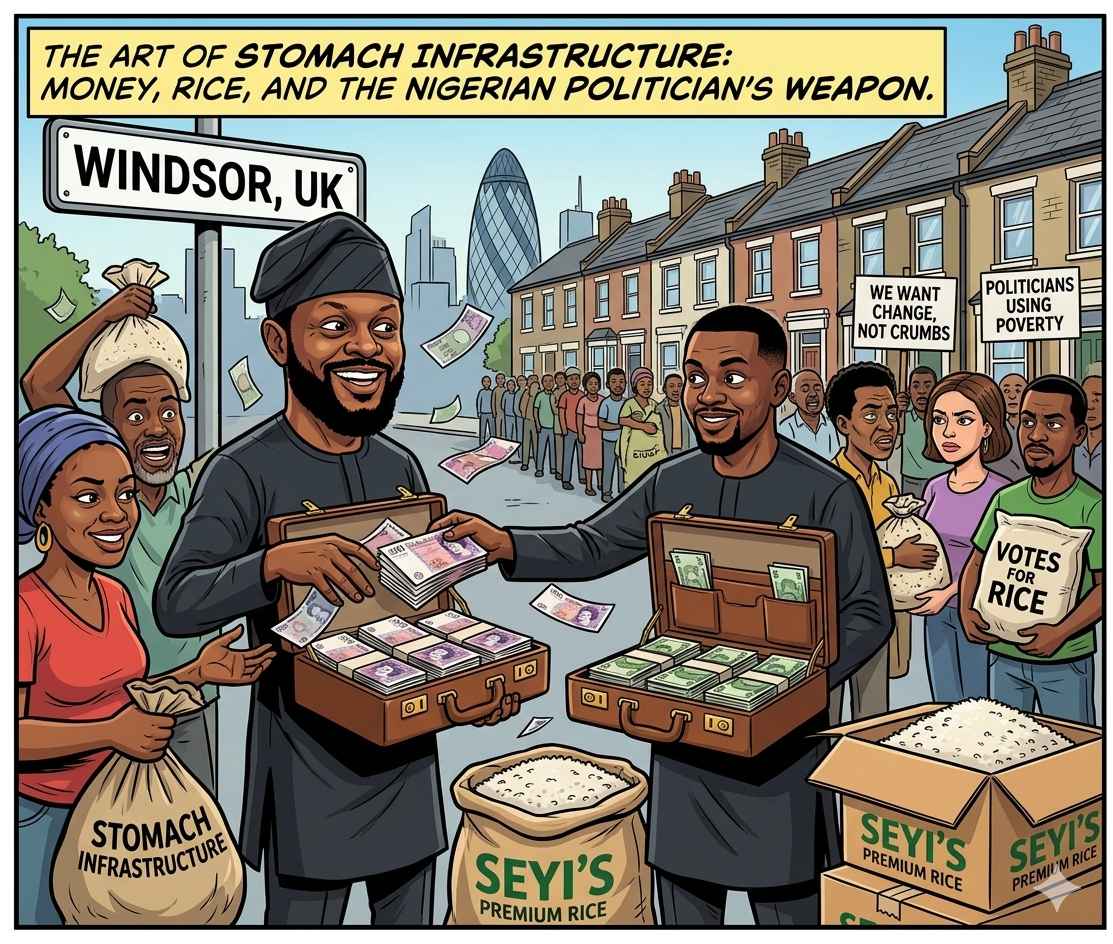
Politics in Nigeria and the Fertility of Poverty: How Nigerian Politicians Weaponize Hunger to Win Elections
Rice in traffic. Danwake in branded bags. Pounds in Windsor. Sewing machines in Owerri. The City Boy Movement. If you are wondering why the government will never solve poverty in Nigeria, the answer is simple: poverty is not a problem they are trying to fix. Poverty is the product they are selling.
Here is a thought experiment. Imagine you are a Nigerian politician with a re-election bid coming up. Your citizens are desperately poor. Inflation has gutted their purchasing power. A bag of rice that cost N15,000 three years ago now costs N85,000. Their daily reality is, by any civilized standard, a national emergency. Now ask yourself: do you want to solve this problem before the election, or do you want them still hungry when the campaign season begins? If you solve it, they vote on policies. They ask questions. They demand accountability. If you keep them hungry, a bag of rice becomes a campaign speech. A sachet of Danwake becomes loyalty. A N500 note in their hand becomes a receipt for their vote. The math of Nigerian politics has never been complicated. It has only been deeply, deliberately cruel.
Why the Government Will Never Solve Poverty in Nigeria
Let us be very clear about something that most Nigerian political commentary dances around: poverty in Nigeria is not an accident of bad governance. It is a feature of deliberate governance. There is a specific, functional relationship between a politician’s power and the depth of his constituency’s hunger. The poorer the people, the more grateful they are for crumbs. The more grateful they are for crumbs, the cheaper each vote becomes. The cheaper each vote becomes, the less a politician has to actually deliver in governance. And so the cycle turns, endlessly and profitably, for everyone except the Nigerian people.
“The most dangerous creation of any society is the man who has nothing to lose.”
James Baldwin, The Fire Next Time, 1963
Baldwin was warning about what happens when the excluded become desperate. Nigerian politicians read the same text and heard the opposite lesson: the man who has just enough to survive but not enough to thrive is the perfect voter. Give him a bag of rice in March. Give him N1,000 in April. Show up at his door with a branded food package bearing your face, and you have purchased not just his vote but his gratitude, his loyalty, and his silence for another four years. The infrastructure of governance — roads, hospitals, schools, security — would actually undermine this relationship. A man with a stable income, healthcare, and security does not scramble for Danwake in a branded bag. He asks harder questions. He is a liability.
This is why the government will never solve poverty in Nigeria. Not because they do not know how. Not because the resources do not exist in one of Africa’s largest oil economies. Because solving poverty would be electoral suicide for a political class whose entire machinery runs on manufactured desperation.
Rice in Traffic, Bibles for Birthdays, and a Movement Built for 2027
Seyi Tinubu
Seyi Babajide Tinubu, born in Lagos, is the son of Nigeria’s President Bola Ahmed Tinubu. A serial entrepreneur, he runs Loatsad Promomedia, a marketing and communications firm, and co-founded the Noella Foundation, a charitable organization. His most politically significant venture is the City Boy Movement, a nationwide political mobilization machine operating in all 774 local governments across Nigeria, widely understood to be the infrastructure for his father’s 2027 re-election campaign. In 2025, he distributed 1 million Bibles for his birthday, drawing widespread mockery for the gesture’s symbolism in a country where what people actually needed was electricity, food, and security. His social media persona alternates between philanthropy and politics, often blurring both until they are indistinguishable.
The City Boy Movement was founded around 2022 as a youth empowerment and political mobilization platform supporting Tinubu’s presidential ambition. It now operates as a fully structured national political machine with state coordinators, local government chapters, and ward canvassers. Its stated mission is “Empowering the Youths.” Its actual mission, as anyone watching can plainly see, is manufacturing enough goodwill through palliative distribution to deliver a second presidential term for Bola Tinubu in 2027.
Here is the highlight reel. In March 2026, viral footage showed City Boy Movement members distributing 25kg bags of rice to motorists and pedestrians stuck in traffic, prompting Dr. Kenon, a social commentator, to describe the scenes as “dehumanising and disgracing” to the Nigerian people. Prior to this, Seyi distributed street food during Ramadan across northern states, packaged in branded bags carrying his and his father’s photographs. Northern Nigerians were not flattered. “This is an insult, Allah!” one narrator said in a viral video, condemning the gesture and questioning whether the distribution of Danwake was a serious response to the hunger his father’s policies created.
Then came the Owerri event. Thousands of residents reportedly scrambled for sewing machines and deep freezers distributed during a City Boy Movement empowerment program in Owerri, Imo State, while Seyi Tinubu, Obi Cubana, and Cubana Chief Priest enthusiastically sang the president’s 2023 campaign song, “On Your Mandate We Shall Stand.” At some point, you have to admire the audacity. The country is drowning in poverty and the response is a sing-along.
And then the UK visit happened. During President Tinubu’s state visit to the United Kingdom in March 2026, videos circulated of scenes near Windsor, with Seyi Tinubu distributing money to Nigerians who had gathered to celebrate the visit. The spectacle of the president’s son handing out cash on the streets of England while millions of Nigerians at home cannot afford a plate of food summarizes the entire character of Nigeria’s political class in one image: comfortable enough abroad to be generous, untouched enough at home to be indifferent.
If your father had actually governed well, you would not need to buy people with rice, Danwake, and sewing machines to remember his name. Good governance is its own campaign poster.
Adapted from Nollywood actor Austine Emmanuel, March 2026Actor Austine Emmanuel said it directly in a now-viral video: “People following you now will not follow you if money was not involved. It’s all fake love. If President Tinubu did well, you don’t need to buy people with money before they support you.” He added the devastating line: “Obi Cubana and Cubana Chief Priest are just deceiving you.”
The Socialites Who Traded Their Credibility for Coordinator Certificates
The City Boy Movement’s masterstroke has been its deployment of celebrity social capital as a political currency. Rather than hiring conventional political operatives, Seyi Tinubu has assembled a roster of some of Nigeria’s most recognizable socialites and entertainers, people with millions of Instagram followers and the kind of cultural credibility that no amount of party money can simply buy. The calculation is elegant: if Obi Cubana says it’s fine, the youth will hear him before they hear any politician. The only problem is that it says everything about what Nigerian celebrity culture actually rewards, and nothing flattering.
Obinna Iyiegbu, known as Obi Cubana
Obi Cubana built his reputation on a rags-to-riches story that captivated Nigeria, culminating in the viral spectacle of his mother’s burial in 2021, where hundreds of millions were reportedly sprayed on the casket. On February 3, 2026, Seyi Tinubu personally visited his home to hand him his appointment certificate as South-East Zonal Coordinator of the City Boy Movement, a move analysts described as Tinubu’s strategic attempt to break Peter Obi’s grip on the Igbo vote ahead of 2027. Cubana defended his acceptance, saying: “The South East can never be sidelined anymore because we are now fully involved.” Political analyst Donald Okwuosa was less charitable, describing the City Boys as “social media showboys” who “don’t even accept poor people within their circle.” One each to cast, he reminded everyone. Celebrity endorsements do not multiply votes.
Pascal Okechukwu, known as Cubana Chief Priest
Cubana Chief Priest was formally appointed Imo State Director of the City Boy Movement on February 7, 2026. The man who built a personal brand on nightlife, flamboyance, and “spraying” has now transferred those same skills to political mobilization, traveling to London with the president’s entourage during the UK state visit and singing “On Your Mandate We Shall Stand” in Owerri. He publicly declared he would work against Peter Obi in the South-East in 2027. Notably, he once declared he “never joins any movement where there is no personal or communal gain,” which at least makes his motivations clear.
Seyi Agboola, known as Seyi Law
Seyi Law, one of Nigeria’s most recognizable stand-up comedians, announced his appointment as Ondo State Coordinator of RTIFN, another pro-Tinubu political support group, declaring: “Tinubu till 2031.” He has publicly defended the Tinubu administration’s security record, drawing fierce pushback from critics who argue that fewer bombs does not equal safety when armed bandits still control highways. Alongside Reno Omokri, he has become one of the most visible celebrity defenders of the administration. Comedian Koboko, responding to the death of a woman’s husband at the hands of bandits, stated that those defending the government were doing so “because the insecurity had not affected them personally.”
Yul Edochie
Yul Edochie revealed on Instagram that he had been named Deputy South-East Coordinator of RTIFN, declaring: “2027 is for Tinubu or nothing.” Edochie, already controversial from his public announcement of a second marriage, now doubles as a political mobilizer. His appointment certificate arrived just as Nigerian families were calculating whether they could afford three meals a day. “2027 is for Tinubu or nothing” is quite the political slogan when the alternative to Tinubu, for many Nigerians, is also nothing.
Other notable names in the star-studded lineup include: Bolanle Ninalowo (Nollywood actor, RTIFN Atlanta Coordinator), Zack Orji (veteran Nollywood actor, Deputy Director-General, Strategy and Communication, RTIFN), and Chinedu Ikedieze, known as Aki, who was photographed with Seyi Tinubu in the president’s son’s Instagram story, sporting a City Boy Movement cap. The political machinery has apparently swept through Nollywood like a talent scout at a casting call.
“The ruling class has the schools and press under its thumb. This enables it to sway the emotions of the masses.”
Albert Einstein, Why Socialism?, Monthly Review, 1949
Reno Omokri, and the Career Politicians Masquerading as Concerned Citizens
Bemigho Reno Omokri
Reno Omokri’s political journey has been documented extensively in these pages. The man who called Tinubu a “known drug lord” on national television, flew to Chicago to obtain court documents, and swore publicly he would never work for Tinubu now serves as Nigeria’s ambassador to Mexico. In May 2025, he formally endorsed Tinubu for a second term, urging “all Nigerians” to join him. He has since written articles urging both the North and South-West to vote massively for Tinubu in 2027, arguing that “the colour of the cat does not really matter as long as it catches mice.” For a man who once conducted personal research into the president’s alleged criminal history, the conversion has been thorough. Omokri has become the government’s most enthusiastic apologist, defending Seyi Tinubu’s place on international trips, praising Tinubu’s economic record, and framing the administration’s performance as not just acceptable but remarkable. An ambassadorial appointment, it turns out, is a very effective memory eraser.
What is most instructive about Omokri’s journey is not the reversal itself, as that is standard Nigerian political fare. It is what it reveals about the architecture of value in Nigerian public life. In Nigeria, opinion, conviction, and stated principle are not assets that appreciate over time. They are inventory. They have a market price. And the market, in 2024 and 2025, was paying top dollar for critics willing to convert. The transaction is clear-eyed and mutual: you give the government your platform, your credibility, and your silence on the things you previously screamed. The government gives you a title, a salary, and the protection of official immunity. Everyone smiles. Everyone moves on. And somewhere in the background, the Nigerian people, who were supposed to benefit from the accountability that critics like Omokri once promised, are left holding an empty receipt.
When Your President’s Ethnicity Is More Important Than Your Child’s Future
Here is the most uncomfortable truth in Nigerian politics, the one that everyone knows but few say plainly: a significant portion of Tinubu’s most loyal support base does not support him because of what he has done. They support him because of what he is. Yoruba. And in a country where ethnicity is the primary political operating system, being the right tribe is worth more than any policy achievement or governance record.
The tribal calculus works like this. A Yoruba Tinubu supporter watching rice being thrown into Lagos traffic does not feel insulted. He feels represented. He is not calculating the policy implications of distributing palliatives instead of building functional social infrastructure. He is experiencing the emotional satisfaction of watching “his own” occupy the highest office in the land. And for that satisfaction, he will vote again. He will argue on Twitter. He will defend the government’s record with a ferocity that no RTIFN appointee can match, because for him, it is personal in a way that no amount of critical analysis can easily dislodge.
The tragedy is not that tribal loyalty exists. It is that it has been so effectively weaponized that it functions as a vote-buying mechanism that costs absolutely nothing. You do not have to distribute rice to the Yoruba voter who loves Tinubu for being Yoruba. You do not have to give him a sewing machine or a branded bag of Danwake. His loyalty is pre-purchased by the accident of shared ethnicity. And the system exploits this perfectly, supplementing tribal loyalty with physical palliatives where ethnicity alone is not sufficient, and standing back to watch the coalition assemble itself.
“A people that elect corrupt politicians, imposters, thieves, and traitors are not victims, but accomplices.”
George Orwell, widely attributed
This is not a comfortable observation. It implicates not just the government but the governed. The person who takes the rice and votes for the man who kept them poor enough to need the rice is not a victim in the simple sense. They are a participant. They are, perhaps, a rational actor making the most sensible choice available in a system rigged against them. But the collective result of millions of rational short-term choices is an irrational long-term outcome: a country that will be distributing Danwake in branded bags at the 2031 elections as surely as it is distributing rice in traffic today.
When Money Is the Only Credential That Matters in Nigeria
Let us talk about Obi Cubana for a moment, not as a villain but as a symptom. Here is a man who became one of the most celebrated Nigerians of the last decade. His burial of his mother in 2021 trended for weeks, with social media genuinely awed by the spectacle of money being sprayed in quantities that would have funded a small hospital. He was praised, admired, and held up as a model of what a “hustler” could achieve. His conversion to City Boy Movement coordinator in 2026 was met with outrage from critics but also with significant support from admirers who argued that he was “being strategic.”
Notice what is entirely absent from both responses: the question of whether Obi Cubana has ever contributed anything to Nigerian civic life that does not involve the display of wealth. His cultural standing is built entirely on money — the having of it, the flaunting of it, the spraying of it. His appointment as South-East political coordinator is built on the same foundation. He was chosen not for his ideas, not for his governance track record, not for any demonstrated commitment to public good, but because he is rich, visible, and people like watching him. In a country with a functioning value system, this would be insufficient. In Nigeria, it is a qualification.
This is the deep structural problem that the City Boy Movement exposes but does not create. Nigeria has, over decades, constructed a social hierarchy in which the display of money is the primary path to respect, credibility, and influence. A man who can spray N50 million at a party commands more cultural authority than a professor, more moral credibility than a human rights lawyer, and more political capital than a community organizer who has spent ten years building civic infrastructure from scratch. This is not unique to Nigeria, but it is uniquely acute here, where the absence of meritocratic institutions has left conspicuous consumption as the only generally legible signal of worth.
Nigeria has not just normalized corruption. It has monetized integrity. The people who sell their convictions get ambassadorships. The people who keep theirs get poverty. The market has spoken.
Anuoluwa Soneye, NarrivonThe Conclusion: What a Sane Nigeria Would Actually Look Like
The poverty fertility cycle of Nigerian politics will not end with elections. It will not end with opposition parties, who, when they come to power, have historically demonstrated the same strategic fondness for keeping their constituencies just desperate enough to be grateful. It will not end with celebrity endorsements, celebrity condemnations, or celebrity neutrality. It will end only when a critical mass of Nigerian citizens decides, individually and collectively, that their vote cannot be purchased with a bag of rice, that their loyalty cannot be rented with a coordinator certificate, and that being the same tribe as the president is not a substitute for being governed competently.
“The measure of a country’s greatness is its ability to retain compassion in times of crisis.”
Thurgood Marshall, US Supreme Court Justice
That requires a radical reorientation of the Nigerian citizen’s relationship to politics. Not just demanding better candidates, but demanding a different kind of politics entirely. One in which Obi Cubana’s coordinator certificate generates not admiration or outrage but boredom, because celebrity endorsements have been rendered irrelevant by a citizenry that evaluates candidates on policy records and governance outcomes. One in which a politician who distributes rice in traffic is not praised for being “grassroots” but laughed out of public life for offering a palliative where a solution was owed. One in which being Yoruba, Igbo, or Hausa does not automatically translate into a vote, and where the people who were born poor are allowed to stay angry about it long enough to demand structural change rather than accepting seasonal handouts as evidence of care.
The City Boy Movement is not the problem. It is the evidence of the problem: a political class that has correctly identified that Nigerians are so hungry, so exhausted, and so ideologically confused that the management of poverty is a more effective electoral strategy than the elimination of poverty. Until Nigerians collectively decide that they are not content to be managed, this is the government they will keep getting. Rice in traffic. Danwake in branded bags. Pounds in Windsor. “On Your Mandate We Shall Stand.” Over and over, until someone decides to stand for something else.
“Until the lion learns to write, every story will glorify the hunter.”
African proverb
Nigeria needs more lions. And fewer men willing to hand out the hunter’s branded rice.
Frequently Asked Questions
What is the City Boy Movement in Nigeria?
The City Boy Movement is a pro-Tinubu youth political mobilization group founded around 2022 and championed by Seyi Tinubu, son of President Bola Tinubu. It operates across all 774 local governments in Nigeria with appointments including Obi Cubana as South-East Zonal Coordinator, Cubana Chief Priest as Imo State Director, Yul Edochie and Seyi Law as regional coordinators. Critics describe it as an organized vote-buying and loyalty-purchasing operation ahead of the 2027 presidential election.
What is stomach infrastructure in Nigerian politics?
Stomach infrastructure is a Nigerian political term for buying voter loyalty through food, cash, and basic essentials rather than delivering real governance. The term captures the idea that Nigerian voters are kept poor enough that their immediate survival needs, rather than civic values, determine their political choices.
Why would a government not want to solve poverty in Nigeria?
A government that solves poverty eliminates its most powerful electoral tool. When citizens are economically empowered, a bag of rice no longer buys their vote. Nigerian political structures have found it more strategically advantageous to remain the emergency provider of what should be a citizen’s basic right, creating a permanent cycle of dependency that keeps politicians in power and the people in poverty.
Sources and Further Reading:
City Boy Movement rice distribution backlash (247 Ureports, March 2026) •
City Boys Movement: Tinubu harvests socialites (Daily Post, February 2026) •
Tinubu poaches Obi Cubana for South-East (The Africa Report, February 2026) •
City Boys: Chiefpriest and 6 other celebs working with Tinubu (Legit.ng) •
Actor Austine Emmanuel tells Seyi Tinubu: If your father did well… (BDnews, March 2026) •
Northerners slam Seyi Tinubu over Ramadan food distribution (SaharaReporters, March 2025) •
Why North and South-West should vote for Tinubu in 2027, Reno Omokri (Tribune, 2025) •
Reno Omokri endorses Tinubu for 2027 (Vanguard, May 2025) •
City Boys vs Village Boys: Inside Tinubu and Obi’s fight for young voters (Substack, March 2026)