
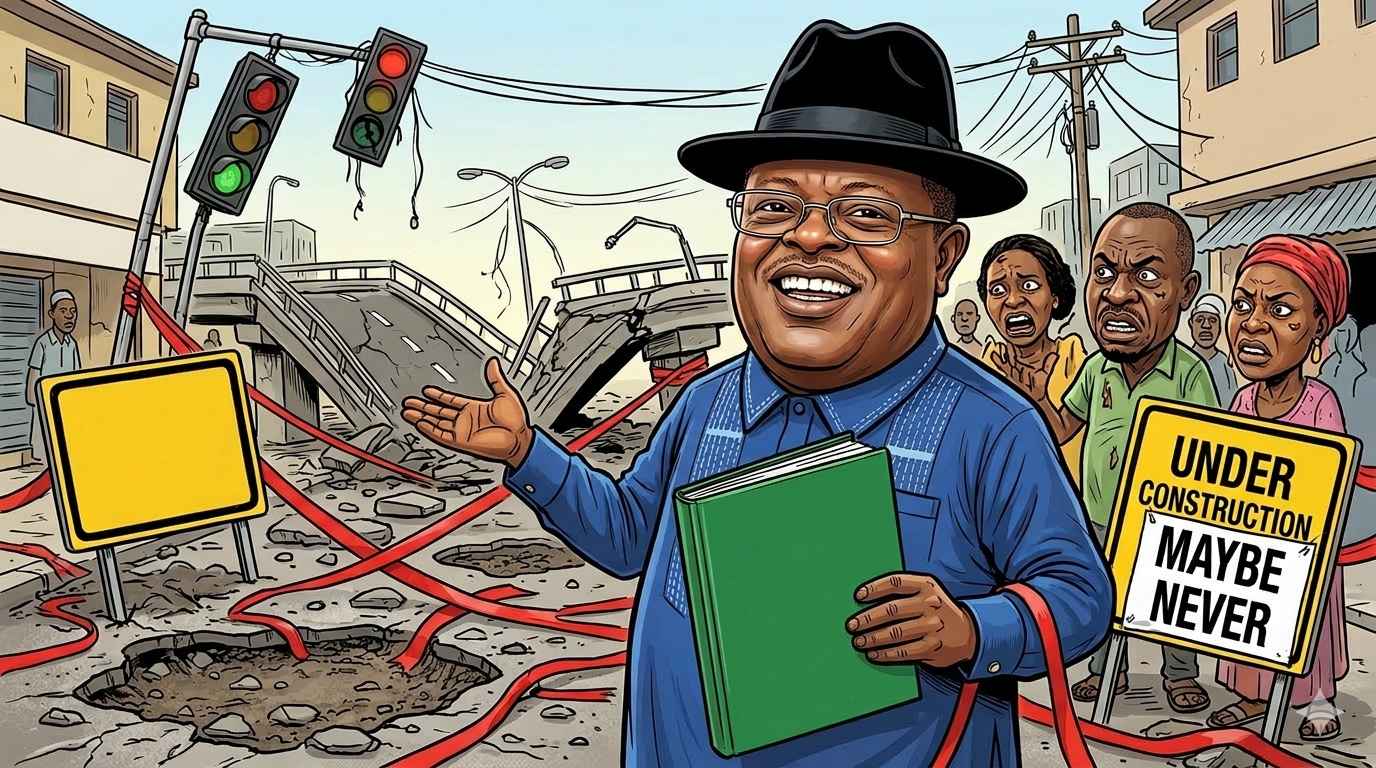
The Minister of Works: David Umahi and the Practical Guide to Things Not Working in Nigeria
Missing engineers. Demolished investments. A N3.6 billion treasury scandal. Death threats to journalists. And a presidency so quiet you could hear the impunity echoing. David Umahi is not an aberration. He is the architecture.
If you wanted to design a perfect specimen of Nigerian governance failure, you could not do better than Senator Engineer David Nweze Umahi, current Minister of Works of the Federal Republic of Nigeria. The man is a walking, talking, press-conference-holding monument to impunity in the Nigerian government. He is the kind of public servant who threatens journalists for investigating him, demolishes diaspora investments while soldiers watch, and publicly introduces himself to rooms of people with the words “I am a dangerous man.” He is, without irony, the minister in charge of making things work. And in that role, he has constructed the most comprehensive case study ever assembled for why nothing in Nigeria does.
Let this sit with you for a moment. In a cabinet that serves a president who campaigned on “Renewed Hope,” the man responsible for roads, bridges, and physical infrastructure has accumulated allegations that include: the disappearance and presumed killing of five engineers who refused to bend to his will; the demolition of a quarter-billion-dollar diaspora investment in alleged violation of a court order; N3.6 billion transferred from state treasury to his own private company; sexual harassment allegations from a businesswoman he allegedly owed money for nine years; job racketeering at his ministry; and a habit of threatening anyone who reports any of the above. The presidency’s official response to all of this? Silence. Profound, presidential, policy-grade silence.
“Impunity is the impossibility, de jure or de facto, of bringing the perpetrators of violations to account. Without accountability, there is no deterrence. Without deterrence, the violations become a system.”
United Nations Human Rights Committee, General Comment No. 31
Welcome to Nigeria, where that impossibility has been dressed in a three-piece suit, given a ministerial portfolio, and assigned a convoy.
Senator Engineer David Nweze Umahi, CON
Born July 25, 1964, in Umunaga, Uburu, Ebonyi State, Umahi holds a BSc in Civil Engineering from Enugu State University of Science and Technology. He co-founded Norman Engineering in 1990, then built Brass Engineering and Construction Nigeria Limited into a major construction firm before entering politics in 2011. He served 12 years as deputy governor and governor of Ebonyi State before being appointed Minister of Works by President Bola Tinubu in August 2023. His Wikipedia entry reads like a political thriller with the final chapters still being written in courtrooms.
The NELAN Five: When Engineers Become Inconvenient
On the morning of November 3, 2021, five engineers employed by NELAN Consulting Engineers drove into Abakaliki, the capital of Ebonyi State, for a meeting linked to a road project they were supervising. The project was the Abakaliki Ring Road, funded by the African Development Bank (AfDB), and the engineers were there because their job required them to be. They were professionals doing professional work. They were also, it would emerge, men who had said no to a governor.
They never came back.
The five men were: Engr. Nelson Onyemeh, lead partner and supervising engineer; Engr. Stanley Nwazulum, 33 years old and the youngest of the group; Engr. Samuel Aneke, who had left his pregnant wife in Adamawa State three days earlier; Engr. Ernest Edeani; and Engr. Ikechukwu Ejiofor. Five men with families, professions, and the misfortune of integrity.
“He told me Umahi was putting a lot of pressure on him to step aside and allow other engineers to supervise the project while Nelan would later sign the completion documents. He said he would never do such a thing because it would violate the contract and compromise his professional integrity. I told him, Nelson, be careful. But he told me, Nothing is going to happen to me. Those were the last words he said before he left.”
The background is this: according to the families and their legal representatives, the engineers had an ongoing dispute with then-Governor Umahi over the management of the AfDB-funded project. Umahi allegedly wanted NELAN to step aside so he could directly control the project, inserting a contractor of his own choosing while NELAN simply signed off on the work. The engineers refused, citing two critical facts: doing so would violate the terms of the AfDB contract, and it would expose them to being professionally blacklisted by the African Development Bank. Their integrity had a cost. The cost, it appears, was their lives.
“He opened up that Umahi told him that he was stubborn and he should take a back seat. He was being compelled to sign a certificate of satisfactory completion for a job supervised by another contractor, and he said he was not going to do it because he did not want to be blacklisted by the AfDB and because it was illegal. My husband traveled to Abakaliki and never came back again.”
What followed in the weeks after the disappearance is one of the most extraordinary episodes in recent Nigerian political history. On November 30, 2021, then-Governor Umahi stood up during a Christian Association of Nigeria (CAN) meeting and announced, publicly, that the five engineers were dead and buried in the bush. The police had not said this. The DSS had not said this. No investigation had produced this conclusion. But the governor announced it to the world. When Patricia Onyemeh, who saw the announcement online, messaged Umahi directly asking if her husband was alive or dead, she said he replied that he did not know the true situation and was still investigating. He had just told CAN the men were dead in the bush. He then told the dead man’s wife he was still investigating.
Years later, police in Ebonyi presented skeletal remains to the families as those of the engineers. The families commissioned independent DNA testing. The DNA tests came back negative. The remains did not belong to the engineers. The case had stalled. No prosecution had followed. No one had been held responsible.
In March 2026, more than four years after the disappearance, the wives, mothers, and families of the five engineers marched in black T-shirts to the Federal Ministry of Works in Abuja, the very ministry now headed by the man who was governor when their husbands vanished. They shut the gate. They displayed placards. They wept in public because the only language left to them, after four years of silence from every institution, was grief performed in the open air.
“My son is the youngest among the engineers. He was just 33. He used to be responsible for my hospital bills. Since 2021, I have not seen him; I do not know where he is. Please, I need justice for my son. I need the government to tell me where my son is.”
“I am the wife of Engineer Samuel Chibike Aneke who went to work. He left me in Adamawa State on October 30, 2021, for Ebonyi State. At the time, I was two months and two weeks pregnant. Since then, I have not seen him and I have not even seen his body. Please, I am asking for justice.”
Umahi’s response, delivered through his media office, was to blame the communal conflict between the Effium and Ezza-Effium communities, claiming the engineers were victims of a broader war that swept the area. He said he had visited the scene personally and supervised efforts. He said arrests had been made. He said the matter was before a court.
What he did not say was why, if the matter is before a court after four years, no one has been sentenced. What he did not say was why independent DNA tests proved the remains presented to the families were not those of the engineers. And what he absolutely did not say was why an engineer is now the Minister of Works, overseeing the very profession to which the five missing men belonged, while their families still do not know where they are.
A governor who announced five men were dead, then told their wives he was still investigating, is now the Minister of Works. The road to impunity in Nigeria is paved with unanswered questions.
Anuoluwa Soneye, NarrivonN3.6 Billion: When the Governor’s Pocket Was the State Budget
On January 29, 2021, the Peoples Gazette published a bombshell investigation, backed by actual bank records, showing that throughout his tenure as deputy governor and governor of Ebonyi State, David Umahi had transferred more than N3.6 billion in government money to his own private company, Brass Engineering and Construction Nigeria Limited. The payments had started in 2011, when he became deputy governor, and continued through his time as governor, in direct violation of the Code of Conduct for public officials which prohibits operating private businesses while in office.
This was not speculation. It was not rumor. It was bank records. The Gazette had the account numbers, the transaction dates, and the amounts. It was as documented an allegation as Nigerian investigative journalism has ever produced.
Umahi’s response was a masterpiece of Nigerian elite behavior under scrutiny. He did not dispute the figures. He did not provide alternative documentation. He did not welcome an investigation. What he did was reach for his phone. In a recorded call obtained by the Gazette, an aide calling on Umahi’s behalf told the newspaper’s reporters: “This thing can cost people’s lives, this particular thing you did can cost people’s lives, and I know what I’m saying. I’m close to you. I can see you.” He then demanded a retraction and demanded the paper pay N1 billion as “atonement.” The Peoples Gazette website was subsequently blocked in Nigeria.
The Committee to Protect Journalists (CPJ) documented the incident, noting that the Gazette’s reporter had been told “he knows about my movement,” a phrase that, in Nigeria, is not a casual comment. CPJ’s Africa program coordinator Angela Quintal stated: “Authorities in Nigeria should ensure Peoples Gazette is able to work unhindered by online disruptions or fear of retaliation. Journalists in Nigeria are too often faced by deliberate obstructions to their work and intimidation tactics by politicians.”
The Self-Branding of a Public Servant
There is a particular kind of Nigerian political figure who, having realized that accountability will never reach him, stops pretending otherwise. David Umahi has entered this phase with theatrical commitment. In multiple videos circulating online, and in at least one documented meeting with investors and journalists, Umahi has introduced himself with the words “I am a dangerous man.” Not as a warning reluctantly issued. Not as a metaphor. As a boast. As a brand. As the opening line of a public servant’s self-presentation.
In March 2026, journalist O’Law Egwu documented this directly after Umahi sent him a threatening WhatsApp message following the recording of a meeting in which Umahi had made statements damaging to a diaspora investor. Egwu published a public statement saying: “If anything happens to me, please look no further. Engr. David Nweze Umahi, the Minister of Works, who has declared himself ‘a dangerous man,’ should be held responsible.” He sent copies to the US Embassy, the British High Commission, Amnesty International, and the Committee to Protect Journalists.
Think about what it means for a journalist, in a democracy, to need to write those words. Think about what it says about the state of impunity in the Nigerian government that this is a reasonable precaution. And then think about the fact that, as of this writing, Umahi remains in his position, his convoy intact, his ministerial portfolio unquestioned.
“Power tends to corrupt, and absolute power corrupts absolutely. Great men are almost always bad men, even when they exercise influence and not authority.”
Lord Acton, Letter to Bishop Mandell Creighton, 1887
Lord Acton was talking about popes and kings. He would have recognized Umahi immediately. In Nigerian political culture, the localization of power, the compression of an entire state’s decision-making into one man’s hands, is not an accident. It is a feature. Governors in Nigeria are practically monarchs within their states: controlling contracts, security forces, judicial appointments, and the informal rules of what happens to people who say no. Umahi governed Ebonyi State for eight years. Eight years of absolute local power. And when you have had that much power for that long, the behavioral patterns it produces do not disappear when the title changes. You take the kingdom with you. You just move it to Abuja.
Tracy Ohiri, Stella Okengwu, and the Price of Speaking Truth to Power
One of the most consistent features of David Umahi’s political career is the pattern of women who stand up to him, make serious public allegations, and then find themselves under extraordinary pressure, legal, social, and otherwise, to recant.
Tracynither Nicholas Ohiri
In 2025, Ohiri went public with allegations that Umahi owed her approximately N200 million for promotional materials she had supplied for his 2014 governorship campaign. She alleged that when she began demanding payment, Umahi made sexual advances, which she rejected, and that the refusals caused him to stop responding to her calls entirely. She had waited nine years. In one of her videos, she told Umahi directly: “Your wife knows that I am not lying. Your children know that I am not lying. I know you have the power; you have the money, you have everything. Your government is in power to lock me up. But one thing I want to tell you is that I am ready to die for this.” She protested publicly, displaying placards warning Nigerians that the DSS might be deployed against her. Then, weeks later, Ohiri released a new video apologizing and walking back her claims, saying the matter had been “misunderstood.” The videos she had posted across TikTok, Instagram, and Facebook for years, gone. A woman who had said she was “ready to die for this” had apparently reconsidered. No explanation was offered for what changed. Only the silence of deletion.
Engr. Stella Ifeoma Okengwu
Okengwu’s confrontation with Umahi is arguably the most consequential, because it directly implicates Nigeria’s ability to attract foreign investment. Winhomes had invested what it claims was $250 million (approximately N375 billion) in developing 17.03 hectares of land in Okun-Ajah, Etiosa LGA, Lagos State, as a residential estate. In February 2025, Okengwu held a World Press Conference in Houston, Texas, presenting an “Address to the President: An Indictment of Minister Engr. David Umahi,” alleging that Umahi had ordered soldiers to demolish the property for the Lagos-Calabar Coastal Highway project, despite the company having all necessary documentation and a court injunction against demolition. According to Winhomes, ministry officials demanded a $150,000 bribe to redirect the road away from their property, which was refused. Okengwu stated publicly: “We have invested over N250 million in that estate and pay our taxes in full. What the Minister is doing is not just illegal, it is criminal.” The case remains in the Federal High Court in Lagos.
In Nigeria, it costs a woman everything to say what she knows. It costs the powerful nothing to deny it. That arithmetic is not an accident. It is a governance strategy.
Anuoluwa Soneye, NarrivonHow a Civil Servant Builds a Hotel Empire
One of the more colourful subplots of the Umahi story is the extraordinary financial success of the Umahi family during his years in public office. Umahi’s son, Prince Osborn Nweze Umahi, is described in Nigerian media as a billionaire businessman, reportedly worth over $200 million, with a hotel chain, Osborn La-Palm Royal Resort, spanning Abuja, Port Harcourt, Abakaliki, and Lagos. He took over management of his father’s company, Brass Engineering and Construction, at 22, while the senior Umahi was governor. The Daily Times described him as “one of the few young Nigerians” under 30 with a net worth exceeding $200 million.
The EFCC Thread
In August 2016, the EFCC arrested Umahi’s brother Austin Umahi and two others over a N400 million slush fund linked to the 2015 PDP Presidential Campaign. The money had been moved into accounts of Brass Engineering and Osborn La-Palm Royal Resort. The arrests did not produce prosecutions that altered the family’s trajectory.
The senior Umahi founded Osborn La-Palm Royal Resort himself. The company began operations in 1998. It now operates as a luxury chain valued in the hundreds of millions of dollars, with its marquee property in Port Harcourt described as a 300-bed, $300 million, 5-star complex. The Umahi family also owns Brass Engineering and Construction, which, per the Peoples Gazette’s bank-record investigation, received N3.6 billion from Ebonyi State coffers between 2011 and 2019 while Umahi was in government.
The family’s uncle, Prince Arthur Eze, is one of Nigeria’s most prominent oil billionaires, which provides one plausible explanation. But the question that hangs over the Umahi empire is the one that corruption in Nigeria always produces: how does a civil servant who entered office earning a governor’s salary exit with assets worth hundreds of millions of dollars? Nigeria’s civil service does not pay in compound interest. The only industry that reliably generates that kind of return while a man is simultaneously running a state is the state itself.
Aso Rock’s Most Valuable Silence
Here is what makes David Umahi not a story about one man, but a story about a system. In May 2025, Umahi and his top officials refused to appear before the House of Representatives Committee on Public Petitions investigating allegations of widespread job racketeering at his ministry, where federal jobs were allegedly being sold to desperate Nigerians for as much as N2.5 million per placement. No official explanation was provided for the absence. A committee member described it as “administrative rascality.” The hearing was adjourned. There was no consequence.
Five engineers have been missing for over four years. A diaspora investor alleges the illegal demolition of a $250 million property with soldiers as enforcers. A businesswoman alleges nine years of unpaid debt and sexual harassment. A journalist has publicly stated that if he dies, the minister should be held responsible. The Committee to Protect Journalists has documented threats against reporters.
And from Aso Rock: nothing. No investigation ordered. No suspension. No statement. No probe. No ministerial accountability hearing. Nothing. Not even the performance of concern.
“The most potent weapon of the oppressor is the mind of the oppressed.” But the second most potent weapon is the silence of those who could intervene and choose not to.
Adapted from Steve Biko, South African anti-apartheid activist
This silence is not passivity. It is policy. In Nigerian governance, the toleration of a minister’s excesses is how the executive communicates to that minister: you are protected, therefore you owe us loyalty. It is the foundational currency of the Nigerian political economy. Umahi defected from PDP to APC in 2020, was appointed minister in 2023, and now sits in a cabinet where the president has apparently decided that the cloud of allegations surrounding his Minister of Works is someone else’s problem. The someone else, apparently, is the Nigerian people.
The families of Nelson Onyemeh, Stanley Nwazulum, Samuel Aneke, Ernest Edeani, and Ikechukwu Ejiofor are the Nigerian people. They marched to the Ministry of Works in black T-shirts. They submitted petitions to the Senate President. They wrote to the Speaker of the House. And the Ministry’s Director of Human Resources told them, with bureaucratic serenity, that “the matter remains before a court of law.” In other words: we are handling this, stop asking, go home.
David Umahi Is Not the Exception. He Is the Exhibit.
There is a version of this story where David Umahi is a villain and the Nigerian government is an otherwise functioning institution that simply has not gotten around to him yet. That version is fiction. The truth is that Umahi exists because the system that produced him, rewards him, and protects him is not broken. It is working exactly as it was designed to work, for the people it was designed to serve.
The system produces men who transfer billions from state coffers to their private companies and then threaten to kill the journalists who document it. It produces men who intimidate women into silence, demolish diaspora investments with soldiers, and announce the deaths of men they allegedly had killed before the police have concluded their investigation. It produces men who stand in rooms full of people and say “I am a dangerous man,” because they have learned, correctly, that in Nigeria, being a dangerous man is not a liability. It is a credential.
“In any country, what separates a functioning democracy from a kleptocracy is not the presence of laws but the presence of consequences. Nigeria has the laws. It is the consequences that are missing.”
Transparency International, Corruption Perceptions Index, Country Report Framework
A New Nigeria is not a Nigeria that simply replaces David Umahi with a better version of the same thing. It is a Nigeria that decides, fundamentally and irrevocably, that no one is above the question. Not the governor. Not the minister. Not the man in the convoy. Not the man who says “I am dangerous.” Especially not him.
It is a Nigeria that looks at five families in black T-shirts, standing in the rain outside a ministry, holding photographs of men who went to work and never came back, and decides that this is not acceptable. That the next time a minister fails to appear before a House committee, the consequence is not an adjourned hearing but a suspended portfolio. That the next time bank records show N3.6 billion flowing from a state treasury to a governor’s private company, the consequence is not a lawsuit against the journalist but a trial for the governor.
Nigeria has the laws for all of this. What it does not have, yet, is the political will to apply them equally. That is the only infrastructure project that matters. And no minister of works is going to build it for you. You will have to build it yourself.
The road to a New Nigeria runs straight through every silence that powerful men have counted on. The question is whether this generation will finally decide to make some noise.
Anuoluwa Soneye, NarrivonFrequently Asked Questions
Who is David Umahi?
David Nweze Umahi is Nigeria’s current Minister of Works, appointed by President Bola Tinubu in August 2023. He previously served as Governor of Ebonyi State from 2015 to 2023 and Deputy Governor from 2011 to 2015. He is a civil engineer by training and the founder of Brass Engineering and Construction Nigeria Limited.
What happened to the NELAN engineers in Ebonyi State under Umahi?
Five engineers from NELAN Consulting, Nelson Onyemeh, Ernest Edeani, Ikechukwu Ejiofor, Samuel Aneke and Stanley Nwazulum, disappeared on November 3, 2021, after travelling to Abakaliki following a dispute with then-Governor Umahi over the African Development Bank-funded Abakaliki Ring Road project. The engineers had refused to sign off on work they did not supervise. More than four years later, no one has been prosecuted and independent DNA tests rejected remains presented to the families as those of the engineers.
What is the Winhomes and David Umahi controversy?
Engr. Stella Ifeoma Okengwu, CEO of Winhomes Global Services Limited, alleges that Minister Umahi ordered the illegal demolition of a $250 million diaspora-funded real estate development in Okun Ajah, Lagos, for the Lagos-Calabar Coastal Highway project, in violation of court orders. Winhomes also alleges ministry officials demanded a $150,000 bribe to redirect the road away from their property.
What did Peoples Gazette expose about David Umahi?
In January 2021, Peoples Gazette published bank records showing Umahi had transferred over N3.6 billion in Ebonyi State government funds to his private company, Brass Engineering, during his time as deputy governor and governor. His office responded by threatening reporters and having the newspaper’s website blocked.
Has the Nigerian government acted on allegations against David Umahi?
Despite a growing record of serious allegations, the Tinubu presidency has issued no official statement, ordered no investigation, and taken no disciplinary action against Umahi. He also refused to appear before a House of Representatives committee probing job racketeering at his ministry. Critics describe the institutional silence as evidence of systematic impunity in the Nigerian government.
Sources and Further Reading:
Wife alleges cover-up in NELAN engineers disappearance (SaharaReporters, March 2026) •
Protest at Works Ministry over NELAN engineers (SaharaReporters, March 2026) •
Umahi speaks on five missing engineers (Premium Times, 2026) •
N3.6 billion treasury scandal (Peoples Gazette, January 2021) •
Umahi threatens Peoples Gazette reporters (Peoples Gazette, 2021) •
Committee to Protect Journalists on Peoples Gazette blocking (CPJ, February 2021) •
Tracy Ohiri N200 million allegation (SaharaReporters, March 2025) •
Ohiri recants allegations (Advocate NG, March 2026) •
Winhomes diaspora investment demolition (Legit.ng, February 2025) •
Winhomes CEO fires back at Umahi (Tribune Online, June 2025) •
Journalist holds Umahi responsible for safety (SaharaReporters, March 2026) •
Umahi shuns House committee probe (SaharaReporters, May 2025) •
David Umahi (Wikipedia)
Leave a Reply