
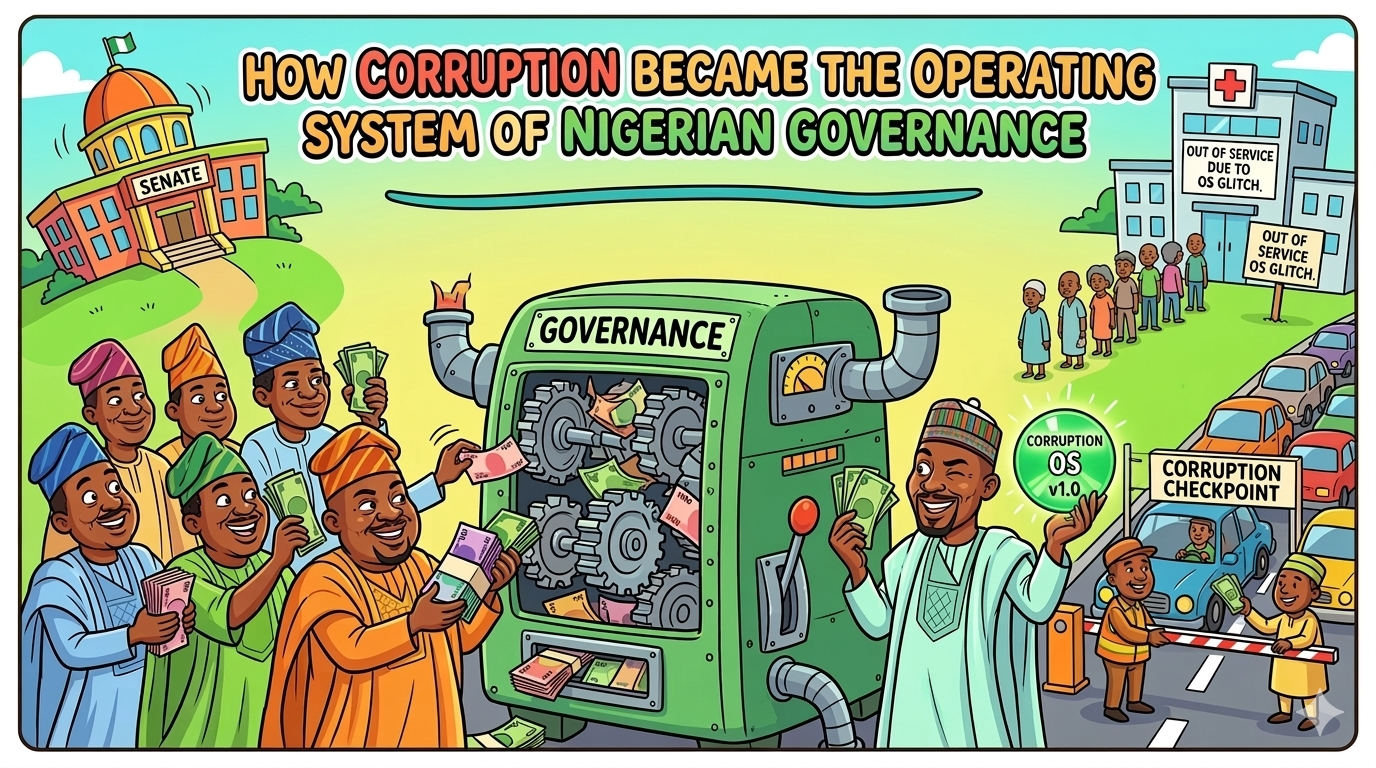
Nigeria: A Country Where Scandal Has Become Routine
Nigeria has developed a curious national rhythm. A corruption scandal breaks on Monday. Nigerians argue about it until Wednesday. By Friday the country has moved on to the next outrage. By Sunday the original scandal has disappeared into the graveyard of forgotten headlines.
The result is a strange political environment where corruption rarely shocks anyone anymore. It simply confirms what citizens already expect.
Nigeria did not wake up one morning and suddenly become corrupt. Corruption has been built slowly, brick by brick, office by office, budget by budget. Over time it evolved from occasional misconduct into a system that quietly shapes Nigerian governance itself.
Transparency International’s Corruption Perceptions Index has repeatedly ranked Nigeria among countries struggling with public sector corruption. In the 2025 index Nigeria scored 26 out of 100, placing it among nations facing persistent governance challenges and weak institutional accountability.
Numbers like these are often quoted in reports and forgotten. Behind those statistics lies a far more dangerous reality. Corruption in Nigeria no longer behaves like a crime. It behaves like an institution.
Public office has become less about service and more about access. Access to contracts. Access to influence. Access to the public treasury.
Power tends to corrupt, and absolute power corrupts absolutely.
Nigeria has turned that observation into a working political model.
Governance in Nigeria: A System Designed to Resist Accountability
Nigeria operates under a federal democratic system with executive, legislative, and judicial branches. On paper the architecture looks balanced. Power should be shared. Oversight should exist. Public institutions should check each other.
Reality tells a different story.
The executive branch holds enormous influence over national resources. Federal ministries control billions of naira in public spending through procurement systems that remain opaque to most citizens.
Budget announcements receive media attention each year. Budget implementation receives far less scrutiny.
Oversight institutions exist. Their effectiveness often fluctuates depending on political will.
These agencies have recorded notable successes but clearly with a country with that magnitide of corruption, the rot has crept it’s way into those institutions and they are now more or less political fronts.
Many high profile corruption cases stretch across years of litigation. When accountability moves slowly impunity grows quickly.
Citizens notice the pattern.
Officials accused of financial misconduct frequently remain influential political actors. Some continue to win elections. Some return to public office after convictions are overturned or sentences reduced.
The message this sends is subtle yet powerful. Corruption does not necessarily end a political career. In some cases it merely pauses it.
The Billion Dollar Question: Where Does the Money Go?
Nigeria stands as Africa’s largest economy and one of the continent’s major oil producers. Millions of Nigerians still live with unreliable electricity, deteriorating infrastructure, and underfunded public institutions.
The contradiction raises an uncomfortable question.
If Nigeria generates enormous national revenue why does development often feel absent.
Corruption plays a significant role.
One widely discussed example involves Diezani Alison Madueke, Nigeria’s former Minister of Petroleum Resources from 2010 to 2015.
Alison Madueke oversaw the country’s oil sector during a period when billions of dollars flowed through petroleum revenues. Multiple international investigations later examined allegations that enormous sums were diverted through complex financial networks.
Authorities in several jurisdictions announced asset seizures linked to investigations surrounding funds allegedly connected to the former minister. These assets reportedly included luxury properties and financial holdings.
Cases like this illustrate a central problem within Nigeria’s governance structure.
When enormous resources move through weak oversight systems corruption rarely appears as isolated misconduct. It evolves into organized extraction.
The money that disappears from public systems rarely vanishes quietly. It leaves visible footprints.
Unfinished highways. Abandoned schools. Hospitals struggling to operate.
Development becomes theoretical while wealth becomes concentrated.
Pension Funds and the Betrayal of the Vulnerable
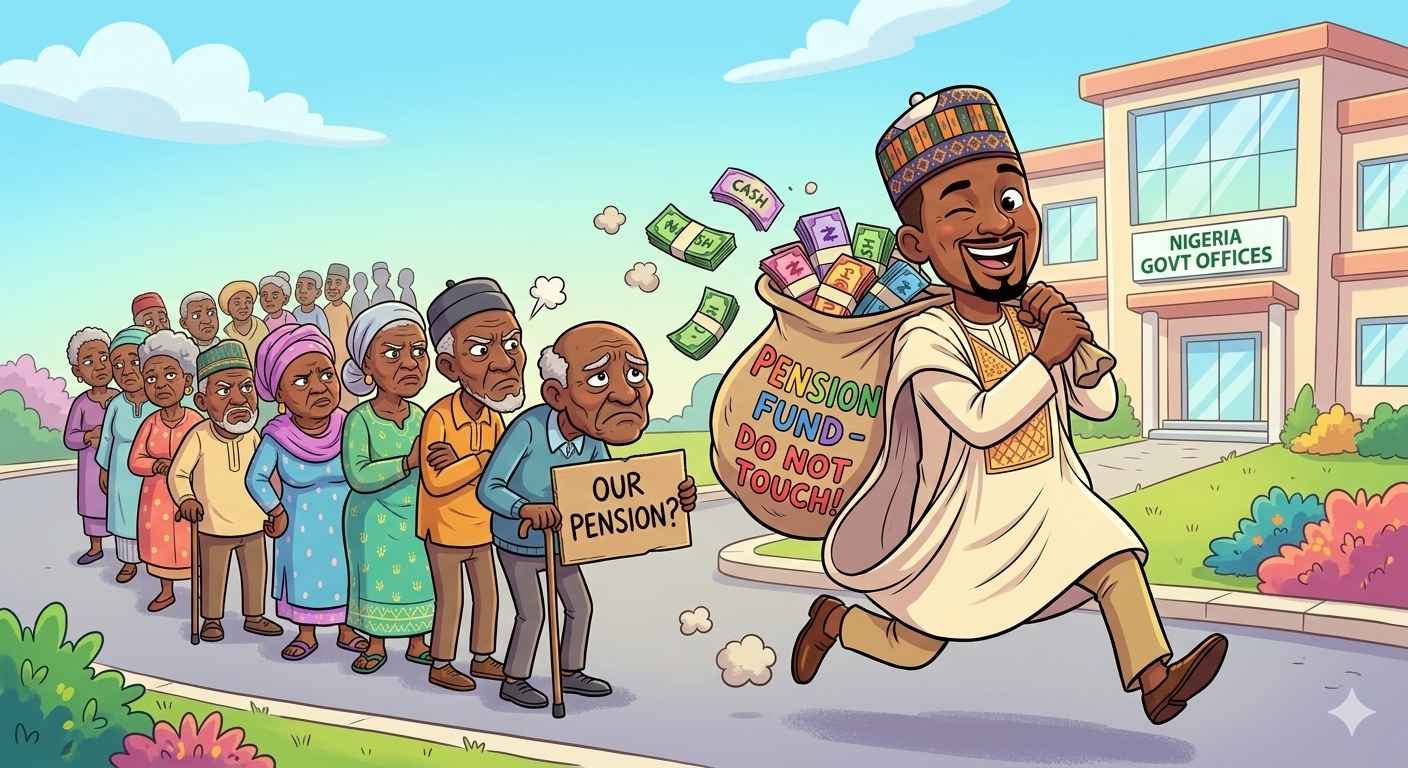
Few corruption scandals illustrate the human cost of governance failure in Nigeria more clearly than the Abdulrasheed Maina pension fraud case.
Abdulrasheed Maina once headed the Pension Reform Task Team, an office responsible for addressing fraud within Nigeria’s pension system.
Investigations later revealed allegations that billions of naira intended for retired public servants were misappropriated.
The real victims were not politicians. The victims were retired civil servants who spent decades working in public service.
Many discovered that pensions meant to sustain their retirement had vanished.
Corruption does not merely steal money.
A nation that allows pension theft sends a devastating message to its citizens. It tells workers that even retirement can become negotiable.
Impunity: When Public Office Stops Fearing Consequences
Corruption alone does not fully explain Nigeria’s governance crisis.
The more dangerous phenomenon involves impunity.
Corruption involves illegal gain. Impunity involves the belief that consequences will never arrive.
When public officials stop fearing accountability the behavior of governance changes.
Resignation becomes rare. Apologies become optional. Investigations stretch into prolonged conversations rather than decisive action.
Nigeria’s situation contains deeper structural complexities. Many citizens vote. Many don’t. However, economic hardship, systemic weaknesses, and political patronage networks often shape outcomes long before ballots are counted.
Poverty and Political Control as a tool in Nigerian Governance
Nigeria’s political economy contains another uncomfortable reality. Poverty can become politically useful.
Millions of citizens struggle to secure basic needs. Political patronage becomes extremely effective under these conditions.
Election seasons often produce distributions of food, cash, or temporary assistance programs commonly described as palliatives.
These gestures provide immediate relief. Structural issues such as education access, infrastructure investment, and economic diversification often remain unresolved.
When Nigerian Governance Starts Looking Like Theatre
Nigeria’s political environment sometimes resembles theatre more than governance.
Press conferences replace explanations. Political allies defend the indefensible on television. Opponents weaponize allegations for political advantage.
Ordinary citizens watch from the audience while the work of governing stalls.
Nigeria’s challenge sits exactly in that space. The system has normalized watching.
Watching scandals unfold. Watching investigations stall. Watching the same figures rotate through positions of power.
Where This Conversation Leads
The deeper question does not concern whether corruption exists in Nigeria. Evidence has answered that question repeatedly.
The real question involves why the system continues to reproduce it.
Why institutions fail to prevent it. Why political careers survive it. Why citizens sometimes tolerate it. Why accountability remains rare.
Answering these questions requires examining the cultural and social forces that sustain Nigeria’s political system.
It requires confronting uncomfortable truths about power, loyalty, silence, and public responsibility.
That is where the discussion becomes far more interesting.
How Impunity Became the System
Nigeria runs on a strange contradiction. The country holds elections. It has a constitution. It has anti-corruption agencies. It has courts. The structures exist on paper.
Reality tells a different story.
Public power in Nigeria often operates with minimal fear of consequences. Officials treat public office like a private estate. Citizens watch the drama unfold daily. Most expect nothing to change.
This culture did not appear overnight. It grew slowly through repeated examples of power exercised without accountability.
The Architecture of Corruption in Nigeria
Several international reports support this assessment.
According to Transparency International, Nigeria is the 142nd least corrupt country out of 180
The ranking placed Nigeria among the lower tier of countries globally.
The Afrobarometer survey in 2023 revealed troubling findings. Many Nigerians believe corruption increased in recent years. A significant percentage believe government anti-corruption efforts remain ineffective. Public trust in political leaders remains extremely low.
These statistics confirm what citizens already know from experience.
The problem does not lie only in individuals. The problem lies in the structure that protects them.
Officials control the institutions that should investigate them. Political influence often affects investigations. Legal cases move slowly through the courts.
Consequences rarely follow.
This system encourages repetition.
Case Study 1: David Umahi and the Power Culture in Nigerian Politics
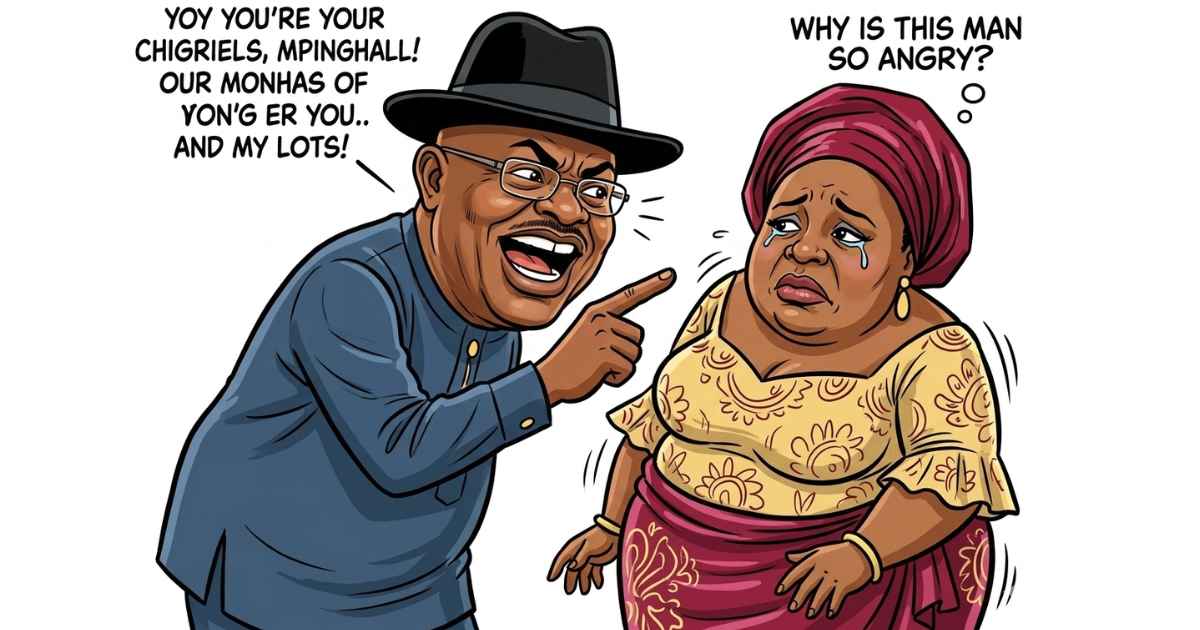
David Nwaeze Umahi provides an example of how political power operates in Nigeria.
Umahi served as governor of Ebonyi State between 2015 and 2023. He later became Nigeria’s Minister of Works under President Bola Tinubu.
Several controversies followed his political career.
In 2022 the Federal High Court in Abuja ruled that Umahi’s defection from one political party to another violated constitutional provisions regarding electoral mandates. The court ordered him to vacate his seat as governor.
Umahi rejected the ruling, pulled he stings of the appeal court and remained in office after appeals and political maneuvering.
The episode raised important questions.
Another controversy emerged in 2026 involving allegations that Umahi refused to pay a Nigerian woman a money he owed her simply because she denied him access to intimacy.
Cases like this rarely receive clear public resolution. Investigations appear slow or inconclusive. Public attention moves on.
Officials remain in office.
The pattern continues.
Case Study 2: Eugene Chita and the Intimidation of Citizens

Eugene Chita Epelle, chairman of the Ahoada West Local Government Area (LGA) in, faced serious public criticism after an incident involving a female citizen who had raised concerns about poor development in her local government area.
According to reports circulated across Nigerian media and social platforms, the situation escalated when Chita allegedly confronted the woman physically in her own residence.
Almost first of its kind- The alleged assault shocked many observers.
Public officials hold constitutional authority. Citizens hold the right to criticize them. Democracy cannot function when criticism leads to intimidation.
The incident reflected a broader pattern in Nigerian politics. Politicians often treat public criticism as personal disrespect rather than democratic accountability.
Many Nigerians fear speaking openly about political leaders.
Fear protects the system.
The Palliatives Economy
Another factor sustains political dominance in Nigeria.
Poverty.
Economic hardship places citizens in a vulnerable position. Politicians understand this dynamic very well.
Nigeria has one of the highest poverty rates globally. According to the World Bank millions of Nigerians live below the national poverty line.
Economic hardship changes political behavior.
Citizens struggling to feed their families rarely have the luxury of sustained political activism.
Politicians exploit this reality through what Nigerians call palliatives.
Palliatives often include food packages, small cash distributions, temporary welfare assistance, and election-period handouts.
These programs appear as relief measures. In practice they often function as political control mechanisms.
Citizens depend on politicians for temporary survival support. Politicians depend on that dependence for loyalty.
The cycle continues.
Illiteracy and Political Control
Education plays a crucial role in democratic accountability.
Large populations with limited access to education face barriers in political participation.
Nigeria still struggles with literacy gaps. UNESCO estimates millions of Nigerian children remain outside the formal education system.
Education helps citizens analyze government policies. Education helps voters question authority. Education helps people recognize manipulation.
Limited education weakens these capabilities.
Political actors benefit from this environment.
Citizens without access to reliable information often rely on political messaging rather than independent evaluation.
Political narratives dominate public understanding.
Reality becomes secondary.
The Cult of Political Worship
Nigeria faces another cultural problem within its political system.
Hero worship.
Many politicians maintain large networks of loyal supporters who defend them regardless of their actions.
These supporters dominate political discussions both offline and online.
Criticism of a politician often triggers emotional responses from supporters.
Political loyalty becomes personal loyalty.
This environment weakens democratic accountability. Public officials receive praise for routine duties while serious misconduct receives defensive justification.
Citizens begin to see politics through personality rather than performance.
Democracy cannot function effectively under those conditions.
Why Institutions Struggle to Hold Power Accountable
Nigeria established several institutions designed to combat corruption.
These agencies have prosecuted multiple corruption cases over the years.
Challenges remain significant.
Political influence sometimes affects investigations. Funding limitations affect operational capacity. Court processes often move slowly.
Powerful officials make their stolen wealth speak for them, prolonging legal battles for years.
Many cases fade from public attention long before reaching final judgment.
Public frustration grows.
When Corruption Becomes Normal
Repeated exposure to corruption produces a dangerous psychological effect.
Normalization.
Citizens begin to assume corruption forms part of Nigerian governance.
Conversations about corruption shift from outrage to resignation.
People often say things like:
These statements reveal deep public exhaustion.
Political cynicism spreads across society.
Democracy weakens when citizens stop expecting accountability and even fantasizing about being in the shoes of their oppressors.
Nigeria’s political climate reflects a worrying imbalance between these two conditions.
Government power often appears stronger than public oversight.
The Silent Majority
Nigeria contains millions of intelligent citizens who recognize systemic problems within the political structure.
Many remain silent.
Silence often emerges from fatigue. Years of watching scandals produce little accountability discourage civic participation.
Silence also emerges from fear.
Political influence reaches many areas of society. Citizens sometimes worry that speaking publicly could invite retaliation.
The result becomes widespread indifference.
Indifference protects corruption.
Where Narrivon Enters the Conversation
Narrivon enters this national conversation with a specific purpose.
Power survives best in darkness. Accountability requires visibility.
Nigeria does not suffer from lack of talent. The country contains brilliant scholars, journalists, activists, and thinkers.
Nigeria suffers from a system that discourages consistent scrutiny of power.
Narrivon aims to contribute to that scrutiny.
The platform will document events, analyze power structures, and encourage open civic discussion.
Citizens deserve accurate information about the people who govern them.
Transparency strengthens democracy.
The Hard Truth Nigerians Must Confront
Many citizens believe meaningful reform cannot occur. Decades of scandals with limited consequences created deep skepticism.
This skepticism sometimes leads to silence.
Silence helps the system survive.
Another uncomfortable truth exists as well. Some Nigerians benefit from the corruption they criticize. Political patronage networks provide jobs, contracts, and influence to loyal supporters.
This dynamic creates a society where people criticize corruption publicly while participating privately.
Real reform requires more than new politicians.
Reform requires a cultural shift among citizens.
Citizens must demand accountability consistently. Citizens must reject political worship. Citizens must stop defending leaders who misuse public power.
Nigeria also needs structural reforms that strengthen institutions and protect whistleblowers.
Democracy cannot function without pressure from the people.
Nigeria must repair its democratic roof.
Narrivon exists to help start that repair.
Involve me!